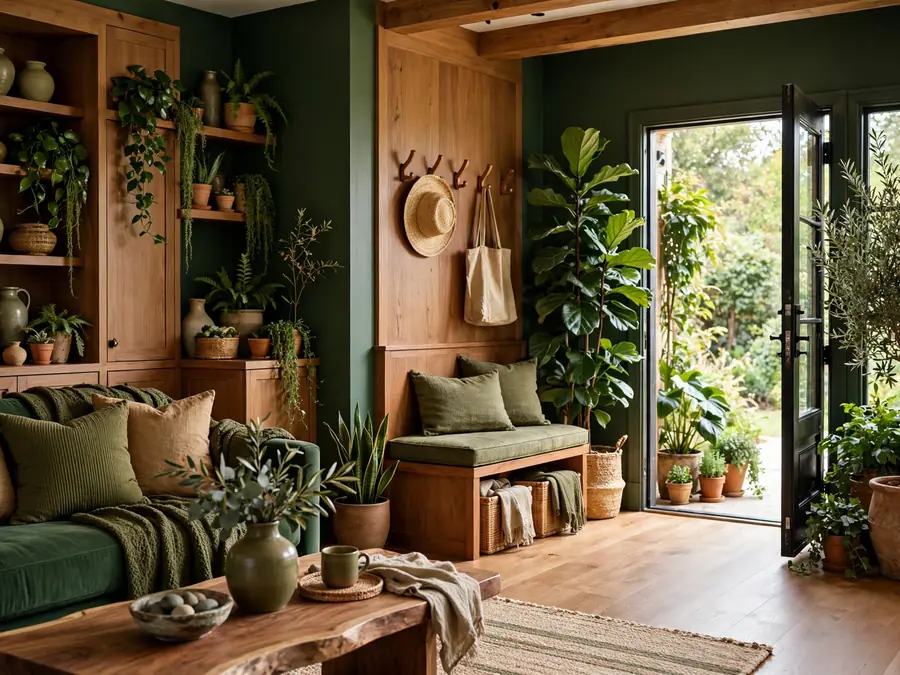
Most attempts at a woodland home fall apart room by room. The living room gets a deep green sofa and feels moody and right, then the hallway stays bright white, the bedroom turns beige, and the bathroom belongs to a different house entirely. Each room is fine alone, but walking through the home feels like flipping channels, and the forest mood you wanted never survives the doorway.
The fix is to stop decorating rooms and start building one system. The homes that get this right repeat a small set of colours, materials and textures in every space, changing only the volume, so a true forest home feels like one walk through the same woods from front door to pillow.
Below are 28 ideas for carrying that system through your whole home: the shared palette, the material thread, the transitions between rooms, and the light and scent that tie them together. Most need nothing more than paint, fabric and pieces you already own, simply repeated on purpose.
The Forest Home Formula That Keeps Separate Rooms Looking Like One Woodland
- Grow from the floor up: anchor every room in the same wood tone and a soft stone-coloured base, so the ground plane reads as one continuous forest floor.
- Hold one green family: pick a single range of deep forest greens and let it lead in one room, then whisper in the next, instead of introducing a new green each time.
- Plan for muddy boots and real life: choose washable fabrics, sealed wood and wipeable stone in the busy rooms, because a system that cannot survive daily life will not survive the season.
- Build in one removable layer: keep throws, cushion covers and scent as the swappable layer, so the mood can deepen in autumn or lighten in spring without repainting a thing.
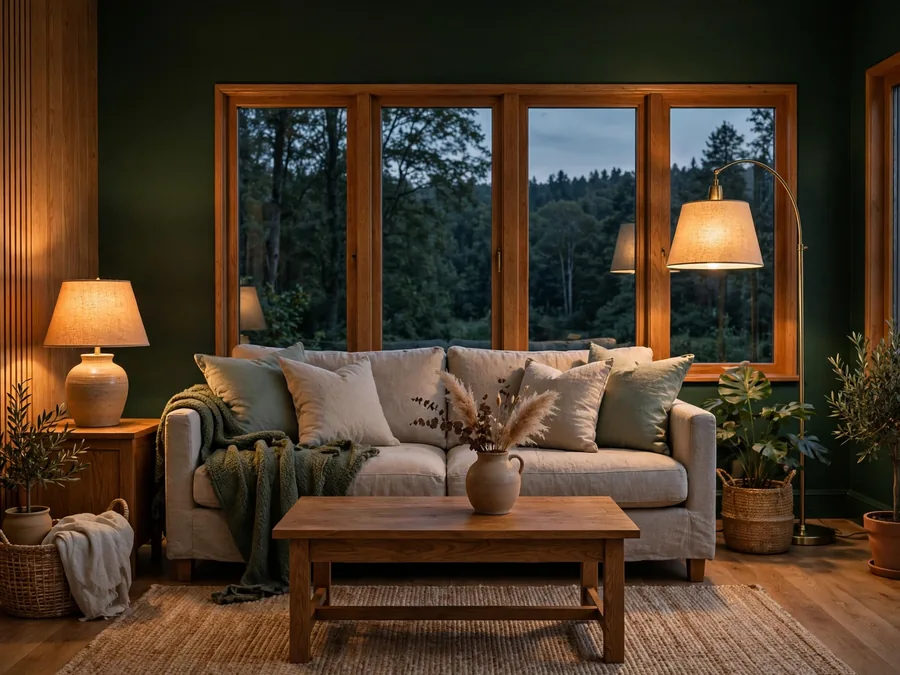
Put together, that looks like a warm oak floor running through the hall, deep forest-green cushions on a stone-grey sofa, a natural linen throw over the arm, and the same oak and green reappearing, smaller, on the bed at the far end of the house.
| Idea | Best For | Key Material |
|---|---|---|
| 1. One Palette, Every Room | Whole-home colour flow | Paint and fabric |
| 2. A Signature Wood Tone | Linking mixed furniture | Warm oak |
| 3. Threshold Cues at Every Doorway | Disconnected rooms | Wood and seagrass |
| 4. The Entry as Trailhead | First impressions | Solid acacia |
| 5. The Hallway as a Forest Path | Long, plain corridors | Wool runner |
| 6. Sleep Rooms at Half Volume | Calmer bedrooms | Washed linen |
| 7. One Scent Family, Door to Bath | A signature house smell | Cedarwood |
| 8. Stone, the Quiet Third Material | Cool contrast | Slate and stoneware |
| 9. Linen as the House Fabric | Softening every room | Natural linen |
| 10. A Canopy Cue on Two Ceilings | Flat, boxy rooms | Wood slats |
| 11. Floors That Flow | Open-plan zoning | Wood and jute |
| 12. A River-Stone Boot Tray | Muddy back doors | River stones |
| 13. Sheer-First Windows Everywhere | Dappled light | Linen sheers |
| 14. One Motif, Once Per Room | Theme without clutter | Printed cotton |
| 15. The Three-Texture Ladder | Rooms that feel flat | Bark, linen, wool |
| 16. The Living Room at Full Volume | The main gathering room | Deep green fabric |
| 17. Evening Light at Lamp Height | Harsh overhead glare | Warm 2700K bulbs |
| 18. One Finds Shelf | Collected natural objects | Glass and pine |
| 19. A Wood Bridge Between Zones | Dividing open plans | Low oak bookcase |
| 20. Bathrooms Echo in Wood and Stone | Tying in the bathroom | Teak-look wood |
| 21. The Motif at Playful Scale | Guest and kids’ rooms | Printed cushions |
| 22. The 60-30-10 Split | Balancing proportions | Whole palette |
| 23. Deepest Colour, Smallest Room | A depth gradient | Forest-green paint |
| 24. One Hardware Finish, Repeated | Small linking details | Matte black metal |
| 25. Art in the Same Frame Wood | Walls that wander off-theme | Oak frames |
| 26. Frame the View You Have | Ordinary windows | Clear glass |
| 27. A Swap Basket in Every Room | Seasonal changes | Woven baskets |
| 28. The Monthly Reset | Keeping the system alive | Fifteen minutes |
1. One Palette, Every Room
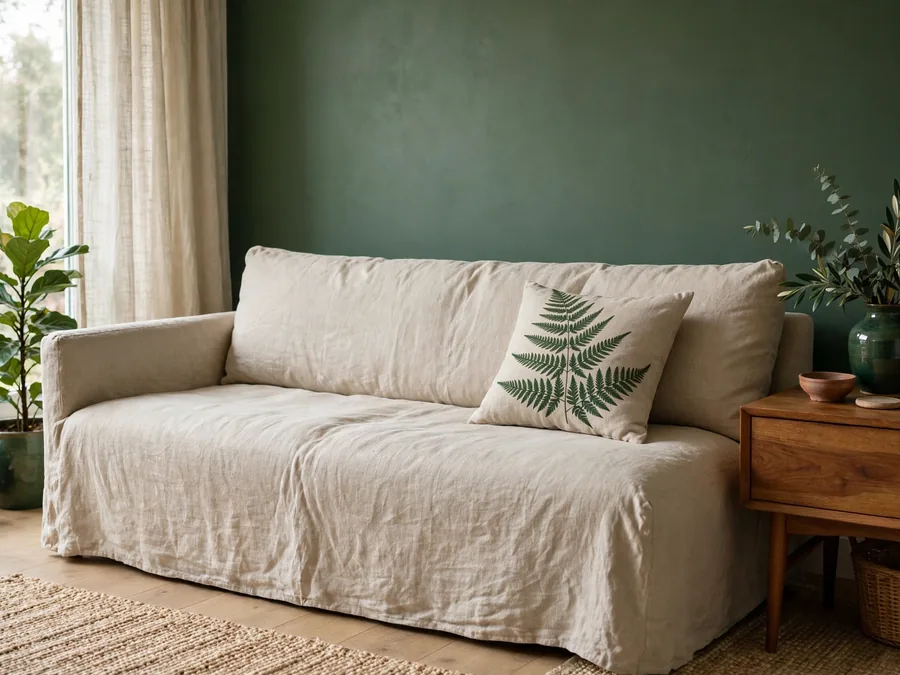
Choose three core colours and refuse to decorate outside them: a deep forest green, a warm bark brown and a soft stone cream. Then repeat all three in every room, changing only the proportions. The living room might carry green on the sofa and cream on the walls, while the bedroom flips it, cream bedding with one green cushion, and the hall runs brown wood against cream paint. The trade-off is discipline: a bargain cushion in the wrong colour stays in the shop, however pretty it is.
Color note: Keep the green in one family, blue-leaning and deep, everywhere it appears; mixing yellowy sage in one room and emerald in another is what makes a house feel mismatched.
2. A Signature Wood Tone
Pick one wood finish, warm mid-oak for example, and make it the thread that stitches the rooms together. Not matching sets: the picture frames in the hall, the stool in the bathroom, the shelf in the kitchen and the side table by the sofa all sit within a shade or two of each other, so the eye reads one material story. The honest cost: pieces in clashing orange pine or grey-washed finishes have to be stained, painted or moved on.
Texture note: Within the one tone, vary the surface freely, smooth sanded oak beside rougher brushed grain, so rooms feel layered rather than showroom-matched.
3. Threshold Cues at Every Doorway
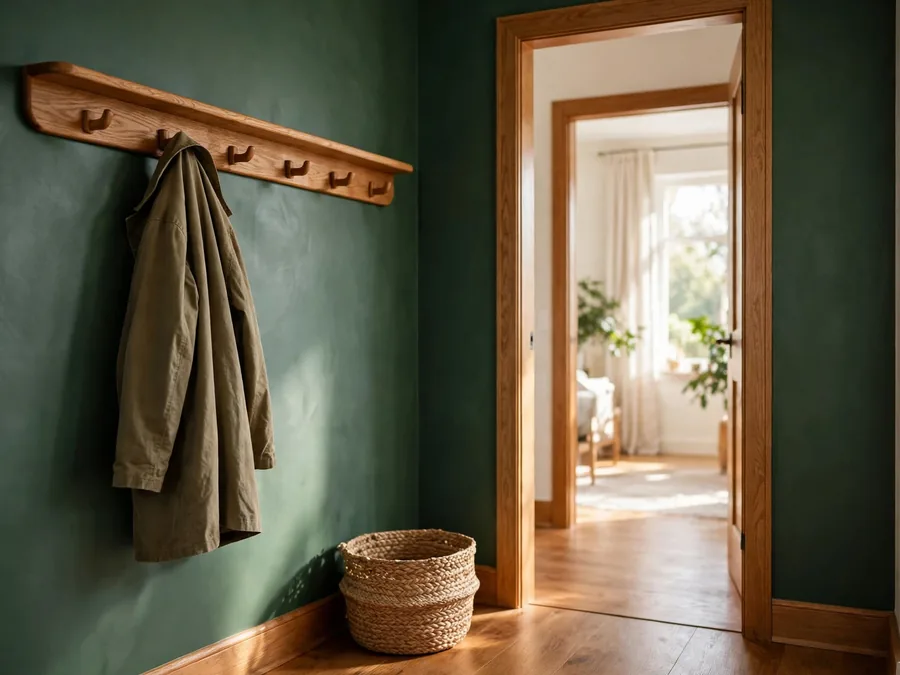
Rooms disconnect at their doorways, so give every threshold the same small signal. Hang an identical oak hook rail, around 24 inches wide, just inside each bedroom and bathroom door, and set the same woven seagrass basket, roughly 14 inches across, beneath it. Passing from hall to room to room, the repeated pair tells you the woodland continues here. It earns its keep too, holding dressing gowns, dog leads and stray towels. If your household is rough on baskets, expect to replace one every couple of years.
Space note: Mount rails at 66 inches high with the basket on the floor beneath, keeping the cue in the same sightline at every door so the repetition actually registers.
4. The Entry as Trailhead
Every walk starts somewhere, and in this house it starts at the front door. Set a solid acacia storage bench from IKEA at $149.99 against the entry wall: 47 inches of warm wood that seats two people putting on shoes and swallows clutter underneath. Above it, one large framed print of tall pines, about 28 by 40 inches, and beside it a tall stoneware pot holding bare branches. Keep to the house palette and the message lands in seconds. Solid acacia is heavy, so build it where it will live.
Budget note: The bench is the one splurge here; the print can be a downloaded woodland photograph in a thrifted oak frame, and the branches cost a walk.
5. The Hallway as a Forest Path
Halls are usually ignored, yet you pass through them more than any room. Run a wool runner in moss green and stone, 2.5 feet wide, down the centre of the floor, and mount a shallow oak picture ledge at eye height along one wall. Rest three or four unframed nature prints and postcards along the ledge, leaning, so they can rotate with the seasons. The trade-off: a runner on the busiest path in the house needs a weekly shake outside and shows pet hair honestly.
Get the look:
- Main piece: moss-and-stone wool runner
- Supporting piece: shallow oak picture ledge
- Texture or material: matte, unframed art paper
- Finishing touch: one small stoneware dish for keys at the far end
6. Sleep Rooms at Half Volume
Bedrooms should tell the same story at a lower volume, because deep saturated colour everywhere can feel heavy where you sleep. Keep the house palette but reverse the ratios: stone-cream bedding and walls, bark-brown wood, and the forest green reduced to one cushion, a folded throw at the foot of the bed and perhaps the inside of a lampshade. It is the same thinking that makes greenery bedroom ideas feel restful rather than themed: nature present, but quiet. If you share the room, agree the shade together, because green reads darker at night than on the sample card.
The formula: cream base layers + one green textile pair + warm wood at the bedside.
7. One Scent Family, Door to Bath
Choose a single scent family, cedar and pine, and repeat it gently rather than mixing fragrances room by room. One cedar candle on the living room sideboard, cedar blocks on the wardrobe shelf, and the same pine hand soap at both sinks is enough; scent should arrive like shade, noticed only when it is gone. Never place a source in every room, because constant fragrance flattens into background noise within a week. Anyone with asthma in the house should test one candle first before the family commits.
Fit check: Stand in the doorway of each room and breathe; if you can name the scent instantly, it is too strong; move the source farther from the door.
8. Stone, the Quiet Third Material
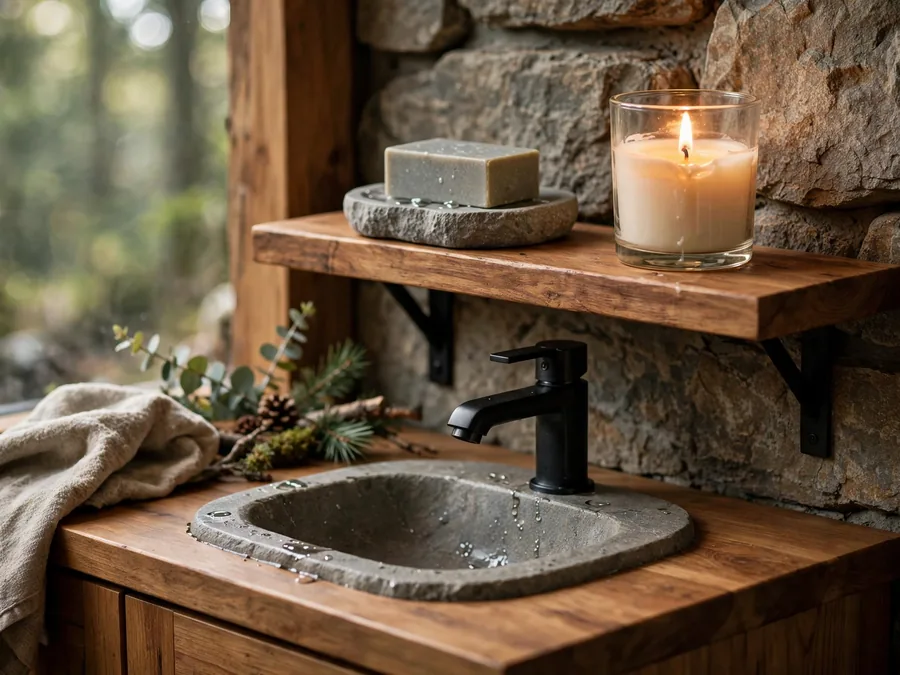
Wood and green alone can turn soft and samey, so give the house a third material: stone. It needs only small, repeated appearances: a slate soap dish by each sink, stoneware mugs on the kitchen shelf, a heavy stone-look planter by the door, slate coasters on the coffee table. Cool and matte, stone is the riverbed under the trees, and it stops the scheme feeling like a garden centre. Real stone is heavy, so keep pieces small enough to lift with one hand.
Style note: Choose honed, matte finishes over polished shine; gloss reads glamorous, while a dull surface reads geological, which is the mood you are after.
9. Linen as the House Fabric
Designate one fabric as the house standard and let it turn up everywhere: natural, unbleached linen. Curtains in the living room, cushion covers on the bed, a runner across the sideboard, napkins at the table. The same slubbed texture at different scales quietly argues that these rooms belong together. The honest downside is the crumple itself: if you cannot make peace with relaxed wrinkles, choose a linen-cotton blend for the public rooms and keep pure linen for bedding.
Seasonal swap: In winter, layer a bark-brown wool throw over the linen in each main room; in spring, strip back to linen alone and the whole house breathes again.
10. A Canopy Cue on Two Ceilings
Forests are defined from above, so borrow the canopy once or twice at ceiling level. In the largest room, fix three or four oak beams, or lighter wood-slat panels, across the ceiling; then echo it, smaller, in one more room, a slatted porch ceiling or a wood-tone pendant in the hall. Two mentions make a system; five would make a theme park. Faux beams collect dust on their top edges, so budget a long duster and ten minutes a month.
Why it works:
- It gives tall, plain rooms the sheltered feeling of standing under branches
- Repeating it in a second room links the two biggest spaces in the house
- Wood overhead warms lamplight bounced down in the evening
11. Floors That Flow
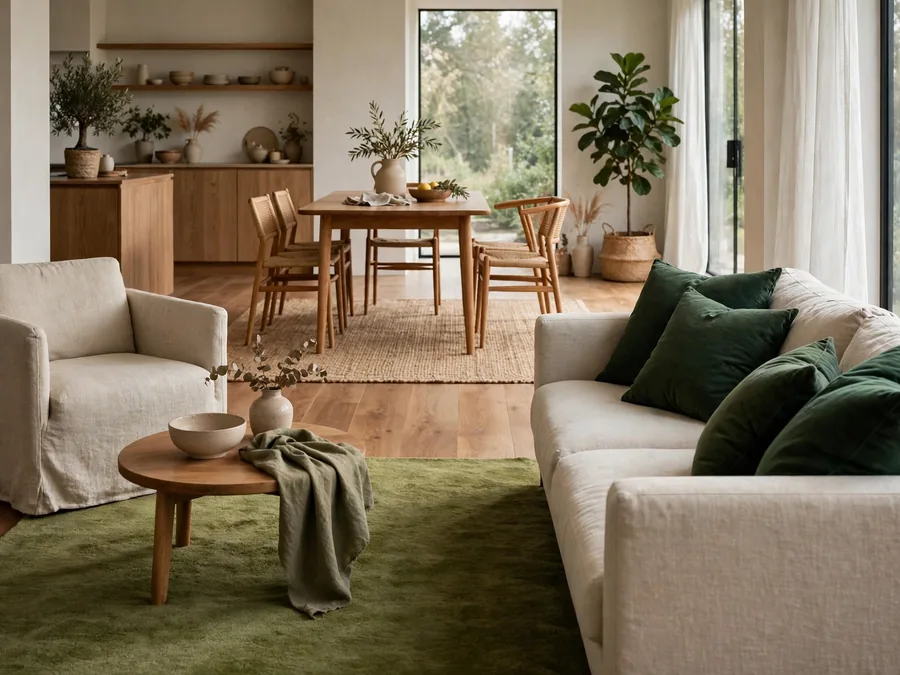
In an open-plan home or a flat with one long sightline, treat the floor as a single forest path. Keep one wood tone running continuously, then zone it with flat-weave rugs in the palette: a moss-green rug, about 5 by 8 feet, under the seating, a stone-coloured jute rug under the dining table, their edges aligned so the eye travels cleanly. Mismatched flooring that changes at every doorway chops the home into episodes. Rugs over hard floors will creep, so fit non-slip underlay beneath both, especially on the route to the kitchen.
Easy swap: Trade the green rug to the bedroom and bring the cream one downstairs; the zones feel new while every piece stays inside the palette.
12. A River-Stone Boot Tray
Put the forest floor to work at the back door. Fill a shallow galvanised or wooden tray, roughly 30 by 14 inches, with a single layer of smooth river stones and stand wet boots and shoes on it. Water drains between the stones instead of pooling, the tray reads as a small piece of riverbed, and the ritual of stepping onto stone at the door marks the crossing from outdoors to in. Tip it out and rinse the stones every few weeks, because trapped grit and leaf litter sour quickly in a warm hallway.
Best for: Country homes, dog owners and any back door that opens straight onto a garden path.
13. Sheer-First Windows Everywhere
Forest light is filtered light, so dress every main window the same way: a natural linen sheer first, hanging close to the glass, with the heavier curtain, house green or bark brown, drawn over it at night. By day the sheer breaks sun into the soft, shifting brightness you get under leaves, and repeating it in living room, dining room and main bedroom makes every window feel like an opening in the same canopy. Bathroom sheers need a denser weave, or neighbours get the full woodland show.
Color note: Keep sheers warm white or natural flax in every room; a cool blue-white sheer in one room will glare against the warmer rooms either side of it.
14. One Motif, Once Per Room
Choose a single woodland motif, a fern frond, say, or a pinecone, and allow it exactly one appearance per room: printed on a cushion in the living room, etched on a glass in the kitchen, woven into the hall runner’s border, stamped on the guest towel. The repetition builds the story, while the strict limit keeps it elegant. A second fern in the same room tips the effect from woodland into gift shop, so retire pieces rather than adding rivals.
Texture note: Let the motif change material as it travels, print, weave, etch, emboss, so it feels discovered in each room instead of ordered as a matching set.
| Palette Thread | Where It Leads | Where It Whispers | Best Finish |
|---|---|---|---|
| Deep forest green | Living room sofa or chairs | One cushion per bedroom | Matte, blue-leaning |
| Warm oak | Floors, bench, main shelves | Frames, hooks, stool tops | Natural oil, low sheen |
| Stone cream and grey | Walls and largest textiles | Dishes, planters, trays | Honed, never polished |
| Natural linen | Curtains and bedding | Napkins, runners, covers | Unbleached, softly creased |
| Matte black metal | Pendant and lamp bases | Hooks, handles, hinges | Flat black, no shine |
15. The Three-Texture Ladder
Give every room the same three-step climb of textures and it will feel finished even with plain furniture. Step one, something rough: a bark-textured planter, a raw-edge wood board, a chunky woven basket. Step two, something smooth: the linen cushion, the cotton throw, the glazed stoneware. Step three, something soft: a wool cushion or sheepskin over a chair back. Work the ladder on one surface per room and the rooms rhyme without matching. Collect the three textures over a season of markets rather than buying them at once.
Get the look:
- Main piece: rough woven basket or bark planter
- Supporting piece: smooth linen cushion cover
- Texture or material: matte stoneware with visible grain
- Finishing touch: sheepskin or wool layer
16. The Living Room at Full Volume
Every system needs a place where it plays loudest, and here that is the living room. Let the deep green take the largest surface, the sofa or both armchairs, and stack the full thread around it: oak shelving, stone-grey rug, linen curtains, the motif on one cushion, lamps warming it after dark. Treating the forest living room as the canopy at full strength gives the quieter rooms something to echo, and guests read the whole story from one seat. Keep the ceiling and one wall stone cream, or the depth turns to gloom.
Space note: In a room under about 150 square feet, put green on the chairs, not the sofa, and keep the larger piece stone-coloured.
17. Evening Light at Lamp Height
After dark, switch the ceiling lights off throughout the house and let lamps do the work at seated height. A table lamp on the sideboard, a floor lamp behind the reading chair, a small lamp on the hall console, each fitted with a warm 2700K bulb, creates pools of light and shadow that feel like the last sun through trees. Keeping every lamp in the same matte black or oak finish links the rooms after dark just as the wood tone links them by day. Smart bulbs make the ritual one tap, but standard warm bulbs and three plug-in timers cost far less.
The formula: one lamp per room + warm 2700K bulbs + shades in natural linen.
18. One Finds Shelf
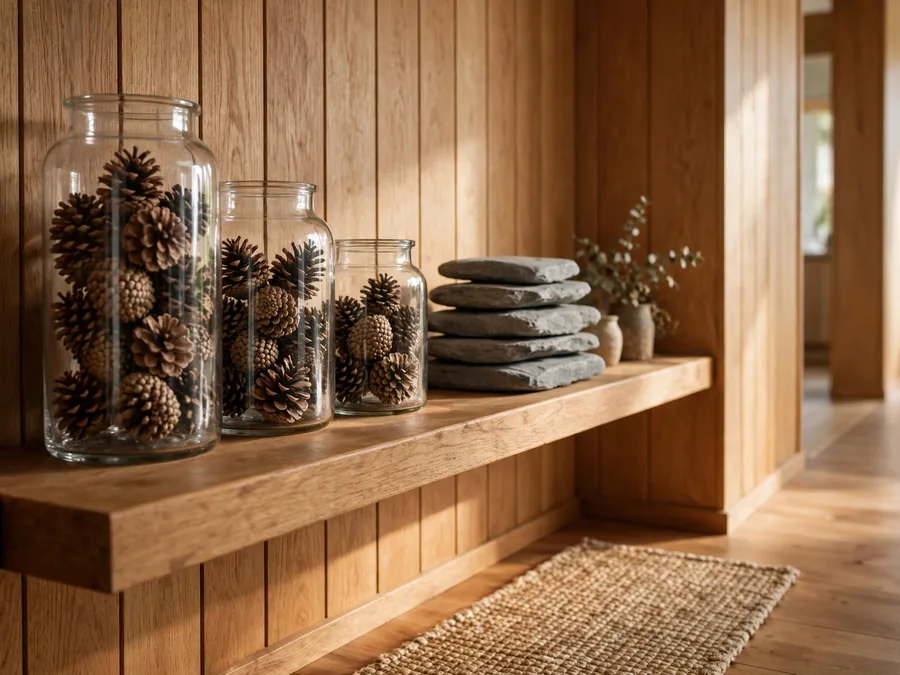
Designate one shelf, in the hall or on the bookcase, as the collection point for natural finds: jars of pinecones and acorns, flat stones, one piece of driftwood, a feather in a bottle. One shelf keeps collecting dignified; finds scattered on every surface become clutter within a month. Children take to the rule quickly when the shelf is theirs to curate. Wash outdoor finds, and freeze cones for a day so no insects move in with them.
Why it works:
- It gives every walk a souvenir without spreading objects through the house
- Glass and stone keep the display inside the palette and materials thread
- A single shelf is a five-minute dust, not a whole afternoon
19. A Wood Bridge Between Zones
Open-plan rooms need a hinge, not a wall. Stand a low oak bookcase, about 30 inches high and 5 feet long, between the seating zone and the dining zone, its back finished so both sides look intentional. Style the top with the house thread, a stoneware bowl, a small stack of nature books, the motif plant pot, and the two areas stay connected while gaining definition. Because it is furniture, not structure, it can move when life rearranges. Check the sightline from the sofa before committing: the top of the case should sit below eye level when seated.
Best for: Open-plan living-dining rooms and studio flats that need zones without losing light.
20. Bathrooms Echo in Wood and Stone
Bathrooms break themes because they are built from hard, shiny materials, so answer with the house thread in miniature. A teak-look wood stool, about 18 inches high, beside the bath, a slate tray holding the soap, a rolled stack of stone-cream towels and the same pine hand soap as the kitchen sink. Nothing matches the bathroom suite, yet everything matches the house. Wood in steam needs air: lift the stool to dry weekly and oil it twice a year.
Fit check: Leave at least 6 inches between the stool and the bath side, enough to step out safely onto a mat without kicking wood in the dark.
21. The Motif at Playful Scale
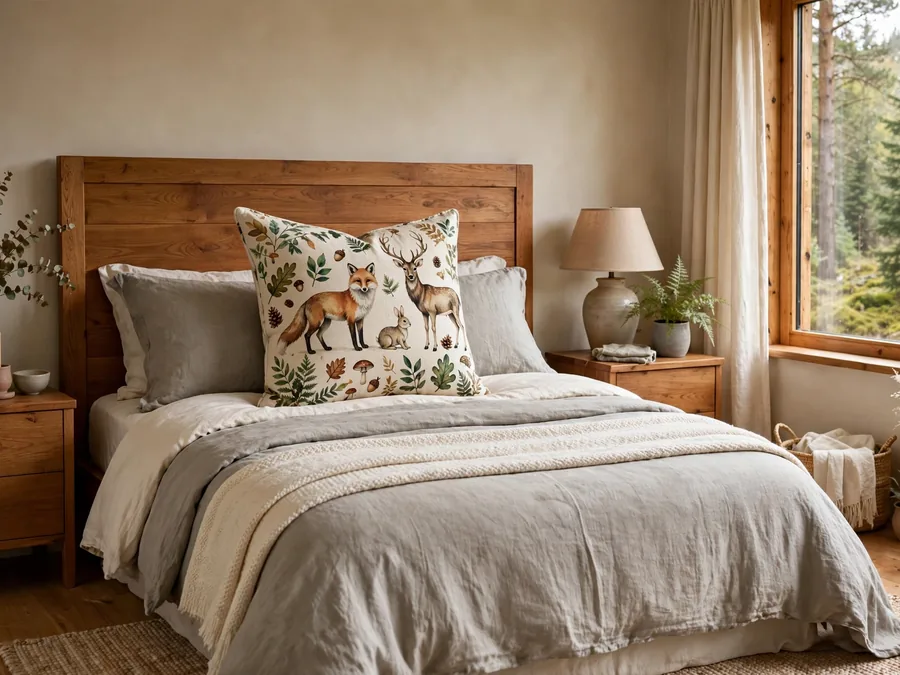
Guest rooms and children’s rooms can carry the story with a lighter hand. Keep their base in the house palette, cream walls, oak furniture, stone-grey rug, then let the chosen motif appear once, at a bigger, friendlier scale: a large woodland animal cushion on the guest bed, a framed print of mushrooms above the desk, a fox-face cushion on the reading chair. Visitors get it instantly, and the room redecorates in an afternoon when tastes change. Avoid covering walls in novelty prints you will tire of before the paste dries.
Style note: One oversized motif reads as wit; five small ones read as a nursery catalogue, so spend the room’s single allowance on the biggest version you can find.
22. The 60-30-10 Split
When a room feels off but you cannot say why, check its proportions against the house ratio: roughly 60 percent stone cream and pale neutrals, 30 percent warm wood tones, 10 percent deep forest green. Apply it room by room, counting walls and the biggest furniture first. A bedroom might hit it with cream walls and bedding, an oak bed and dresser, and green only in the cushion and throw. A hall may lean woodier; the split is a compass, not a contract. It fails only when green creeps past a third and rooms turn swampy.
Budget note: Rebalancing usually costs nothing, since it means moving existing pieces between rooms until each one sits inside its ratio.
23. Deepest Colour, Smallest Room
Let colour depth fall as rooms grow: a gradient across the whole home. Paint the smallest room, the downstairs cloakroom or a tiny study, in the deepest version of your forest green, walls and ceiling alike, so stepping in feels like stepping into dense shade. Medium rooms take the green on furniture only, and the largest rooms stay mostly cream with green accents. The gradient gives the house a rhythm of clearings and thickets. Test the deep shade on one full wall first; north-facing small rooms can swallow light entirely.
Easy swap: If paint feels permanent, get the same depth from a full-height green linen curtain across the small room’s window wall, hung in an afternoon.
24. One Hardware Finish, Repeated
The smallest thread in the house may be the strongest: choose one metal finish, matte black, and repeat it on every hook, handle, hinge and lamp base you control. It costs little, changes no room’s layout, and quietly links a thrifted oak dresser to a new shelf because both wear the same black handles. Resist mixing in brass in one room and chrome in another; mixed metals are a different, busier story. Screws and fittings on old furniture sometimes fight back, so change pieces gradually as they come loose or get painted.
Seasonal swap: Hardware stays fixed all year, which is the point; let scent and textiles do the seasonal moving instead.
25. Art in the Same Frame Wood
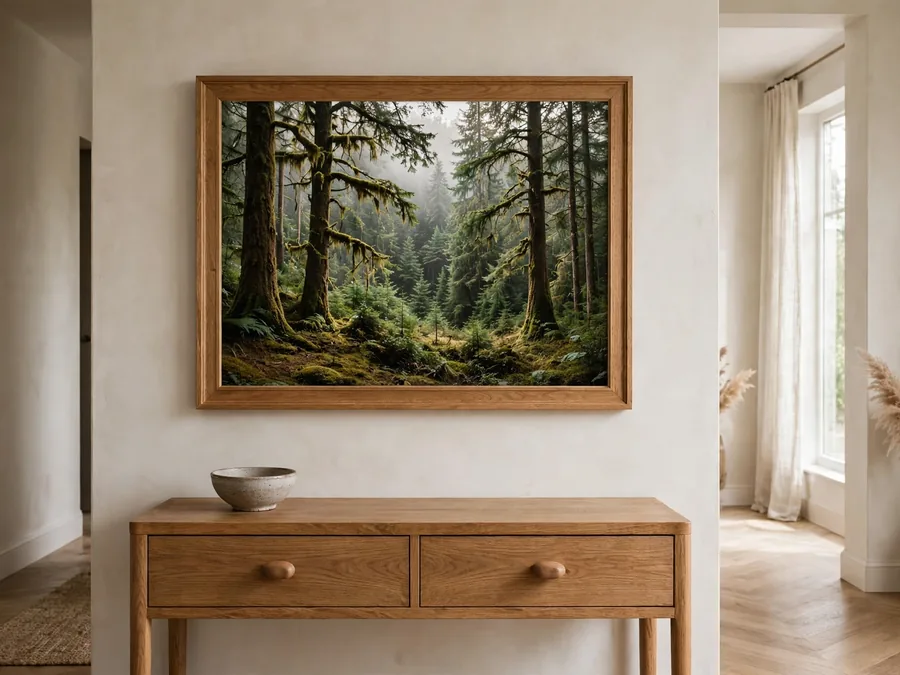
Art is where whole-home schemes quietly fall apart, every frame a different finish and era. Reframe, gradually, into one wood: the same warm oak as your signature tone, in a simple flat profile. Then hang one substantial landscape or forest photograph or print, around 24 by 36 inches, in each main room, with smaller pieces grouped under the same rule. The subjects can differ, misty pines here, a river bend there, while the frames carry the thread. Good frames are not cheap, so do one room per season and buy during framing sales.
Color note: Favour prints in muted greens, greys and browns; one lurid sunset photograph will shout over every quiet room around it.
26. Frame the View You Have
The cheapest forest in the house is the one outside the window. Keep sills clear except for one low stoneware pot, pull sheers wide by day, and turn the main seat to face the greenest view, even if that is one tree and a hedge. Where the view is a wall or a street, hang the largest framed forest print opposite the window so the eye still lands on trees. A small rearrangement, but it changes how woodland the room feels at breakfast.
Texture note: A bare wooden sill and one matte pot keep the window feeling like a picture frame; glossy plastic pots break the spell at the point of focus.
| Season | The Layer to Swap | The Care Task |
|---|---|---|
| Spring | Wool throws away, linen alone | Wash sheers, shake runners outside |
| Summer | Fresh fern or leaf stems on the finds shelf | Rinse boot-tray stones, dust beam tops |
| Autumn | Bark-brown throws return, cedar candle lit | Oil the entry bench and bathroom stool |
| Winter | Extra wool layer at beds and reading chairs | Check lamp timers, replace tired cushion covers |
27. A Swap Basket in Every Room
Systems survive seasons when changing them is easy. Give each main room one lidded woven basket, roughly 16 inches wide, that stores its off-season layer: wool throws in summer, light cushion covers in winter, the spare candle in spring. When the season turns, the swap takes ten minutes per room and the base scheme never moves. This is what keeps nature-inspired home decor feeling intentional in March as well as October. Label the baskets underneath, because by next year nobody remembers which covers live where.
Get the look:
- Main piece: lidded woven seagrass basket
- Supporting piece: the room’s folded off-season throws
- Texture or material: natural fibre against warm wood
- Finishing touch: a handwritten label tied inside the lid
28. The Monthly Reset
A system is only as good as its upkeep, so give it a small ritual. Once a month, walk the house with a basket and return every stray object to its room, straighten the finds shelf, check the palette in each space and swap back anything that wandered off-thread, a bright cushion that crept in, a chrome lamp that does not belong. Fifteen minutes is enough once it becomes habit, and the walk itself is pleasant, a slow patrol of your own woods. Skip a month and nothing collapses; skip four and the channels start flipping again.
The formula: one basket + one slow walk + every stray back inside the thread.
Keeping the Whole Forest Alive
None of this asks for a renovation. A forest home is built from repetition with restraint: one palette, one wood, one motif, one scent, carried from the front door to the quietest bedroom and adjusted only in volume. Rooms will drift as life happens, purchases arrive and seasons turn, but a system gives you something to drift back to, which a collection of separately decorated rooms never can.
Your one next step: stand in your front doorway this evening and look as far through the house as you can, then name the one colour or material that breaks the thread in that view, and fix just that one thing this week.