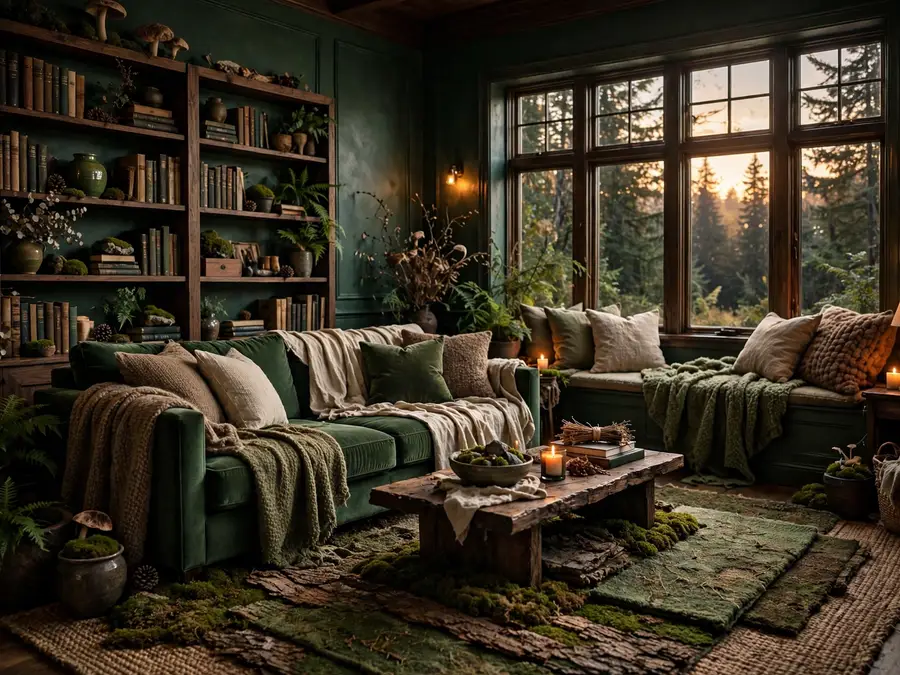
Deep green living rooms look rich in photos and gloomy in real life. The paint goes on darker than the swatch promised, the sofa swallows what little light the room gets, and by evening the whole space feels like a cave you sit in rather than a retreat you sink into. Most failed versions make the same mistake: they take the colour and skip the layers that keep it warm.
The rooms that work treat green as a backdrop, not the whole story. Every deep-green surface is answered by something warm or rough or soft — walnut against velvet, stone against wool, amber light against shadow. That push and pull is what turns a plain sitting room into a forest living room: moody, yes, but always welcoming.
Below are 25 ideas that build that balance piece by piece, from the sofa out to the scent in the air. Most start with basics you probably already own — a wooden table, a spare throw, a lamp that can move — and none of them needs a renovation. Pick the two or three that fit your room and layer from there.
The Forest Living Room Formula That Keeps Deep Greens Looking Warm, Not Gloomy
- Anchor in one deep piece: give the room a single dark-green hero — a sofa, a painted bookcase, a pair of curtains — and let everything else orbit it instead of competing with it.
- Answer green with wood and stone: for every green surface, add a natural material in a warm tone, such as walnut, oak, leather, slate or travertine, so the palette reads forest floor rather than paint chart.
- Plan for evening first: this palette lives after dark, so check bulbs, lamp heights and candle spots before buying anything, because a moody room with cold white light just looks dim.
- Keep one layer swappable: throws, cushion covers and mantel greens should lift off in minutes, so the room can lighten in spring without repainting a thing.
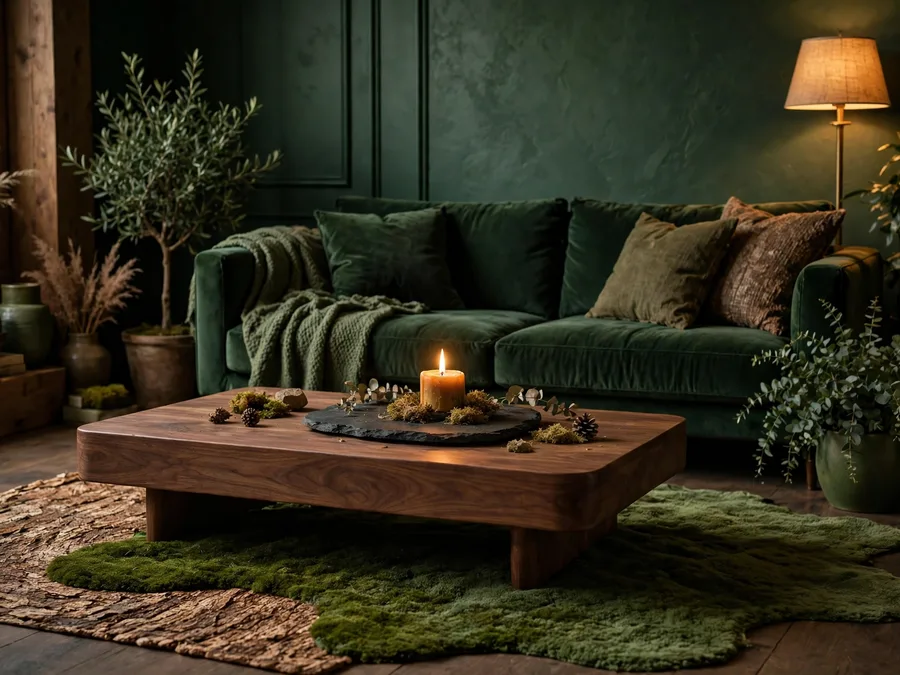
Put together, that looks like this: a forest-green velvet sofa on a moss-and-bark wool rug, a walnut coffee table with a slate tray at its centre, cream linen cushions against the green, and two amber-glass lamps glowing at either end.
| Idea | Best For | Key Material |
|---|---|---|
| 1. Forest-Green Velvet Sofa as the Anchor | Committing to the mood | Cotton velvet |
| 2. Layered Rug Stack in Moss and Bark Tones | Cold or hard floors | Wool over jute |
| 3. Stone Fireplace Framed With Raw Wood | A fireplace focal wall | Stone and oak |
| 4. Leather and Wool — the Warm Counterweights | Balancing all that green | Cognac leather |
| 5. Reading Corner Under a Branch-Style Floor Lamp | One quiet seat | Linen shade |
| 6. Media Wall in Matte Charcoal-Green | TV rooms | Matte paint, pine |
| 7. The Throw Layer: Deep Green Over Natural Linen | Instant sofa warmth | Plush and linen |
| 8. Mushroom and Fern Motifs in Small Doses | A hint of woodland whimsy | Printed linen |
| 9. Bookshelves Painted Into the Green | Book-filled walls | Painted pine |
| 10. Faux Fur and Sheepskin Over Hard Edges | Softening benches and arms | Faux fur |
| 11. Window Seat Piled With Forest Tones | Bay windows | Wool cushions |
| 12. Jute and Wool Underfoot Paths | Walkways and entries | Jute runner |
| 13. Low Walnut Coffee Table With a Stone Tray | The centre of the room | Walnut and slate |
| 14. Candle Clusters at Three Heights | Evening glow | Beeswax, glass |
| 15. Deep-Green Ceiling for a True Cocoon | Low or plain ceilings | Matte paint |
| 16. Woven Baskets as Firewood and Blanket Stores | Beautiful clutter control | Seagrass, willow |
| 17. A Green Wingback Chair as Second Anchor | Fireside seating | Wool-blend upholstery |
| 18. Sheer Linen Panels Over Blackout Depth | Layered window light | Linen, blackout cloth |
| 19. Antler and Horn Accents, Used Sparingly | One sculptural moment | Shed antler, resin |
| 20. The Forest-Floor Coffee Table Vignette | A styled tabletop | Moss, pinecones |
| 21. Dim-to-Warm Bulbs and Amber Glass | Fixing cold light | Amber glass |
| 22. Seasonal Greens Swapped on the Mantel Shelf | A look that evolves | Faux branches |
| 23. Hide-the-Tech Cabinet in Reclaimed Pine | Hiding boxes and cables | Reclaimed pine |
| 24. Oversized Botanical Art in Thin Oak Frames | A big blank wall | Paper, oak |
| 25. A Scent Layer of Cedar and Pine | The finishing sense | Cedarwood, soy wax |
1. Forest-Green Velvet Sofa as the Anchor
Start where the eye lands first: a three-seat sofa in deep forest-green cotton velvet, around 84 inches wide, set on low walnut legs. Velvet matters here — its pile catches lamplight and shifts from near-black in shadow to rich green where light hits, which is exactly the depth this palette needs. Keep the cushions on the sofa itself plain, and let two 20-inch cream linen cushions at each end do the softening.
The honest trade-off: velvet shows every crumb and pet hair, and dark velvet shows dust, so this is a weekly vacuum commitment, not a fit-and-forget fabric.
The formula: forest-green velvet sofa + cream linen cushions + walnut legs and side tables to warm the base.
2. Layered Rug Stack in Moss and Bark Tones
Layer the floor like a forest floor. Lay a natural jute rug first, a foot wider than your seating group, then centre a wool rug over it — moss green or bark brown, 5 by 8 feet, under the coffee table. The jute border frames the wool and stops the green reading flat.
It is the cheapest test of the whole nature-inspired home decor direction before paint, though two rugs mean more dust to beat out.
Get the look:
- Main piece: moss-green wool rug, 5 by 8 feet
- Supporting piece: natural jute rug one size larger beneath
- Texture or material: flat jute against low wool pile
- Finishing touch: front sofa legs on the wool, not the jute
3. Stone Fireplace Framed With Raw Wood
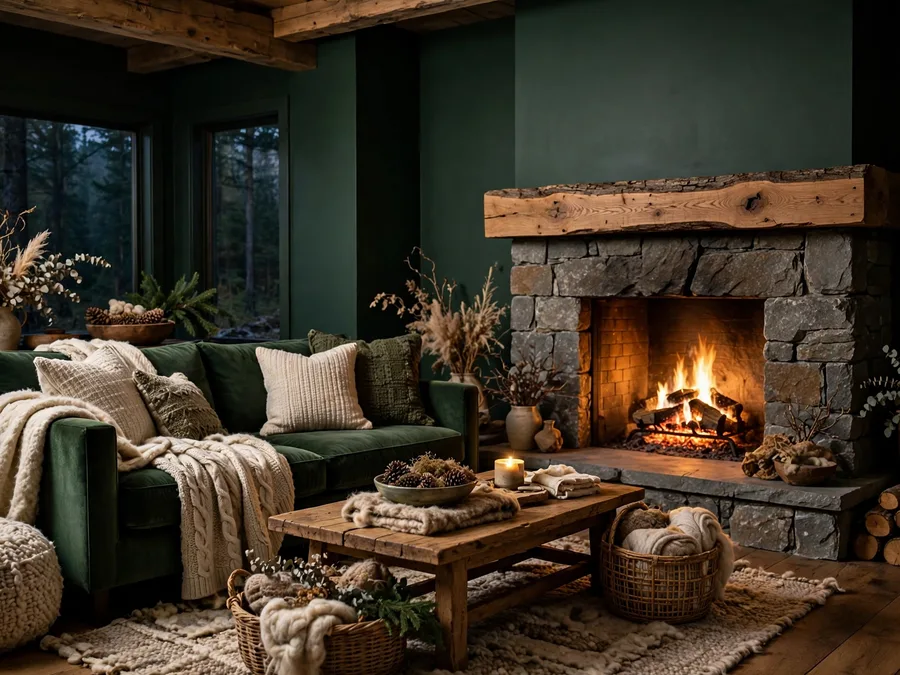
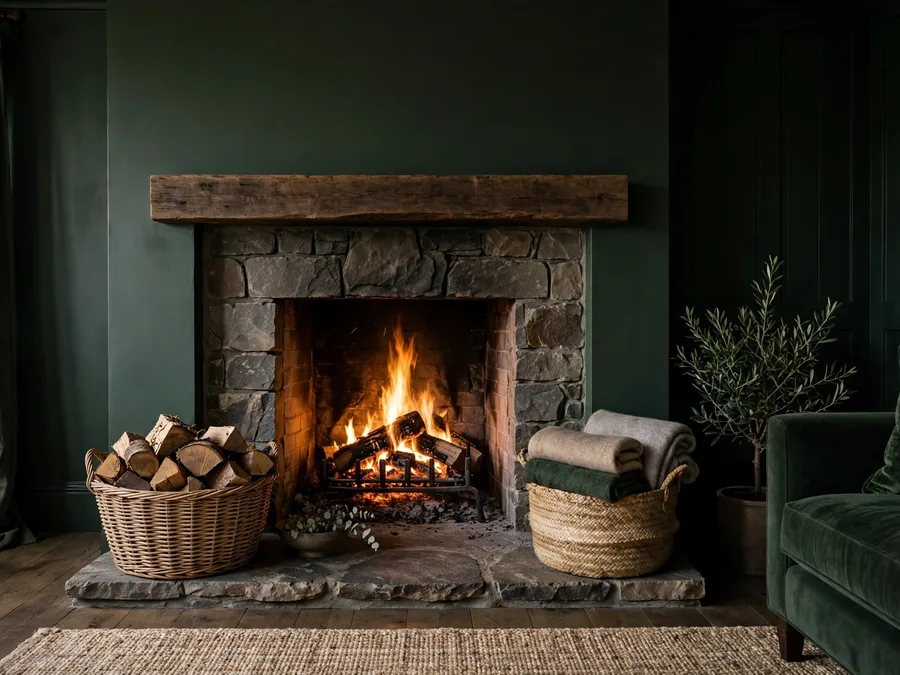
If your room has a fireplace, let it carry the forest-floor half of the story. Face the surround in rough stacked stone or a stone-look tile in grey-brown tones, then run one thick, raw-edged oak mantel shelf across it — 6 inches deep is enough for candles and a small stack of books. The stone brings the cool weight; the unfinished wood edge keeps it from feeling like a showroom.
Trade-off: real stone veneer is heavy and usually a professional job, while peel-and-stick can look flat up close — sample before committing.
Color note: grey-brown stone sits between the green and the wood, stopping the two from clashing — pick stone with warm flecks, never blue-grey, beside deep green.
4. Leather and Wool — the Warm Counterweights
Green rooms fail when everything is the same temperature. Break the cool with one cognac leather piece — an armchair, ottomans, even a worn leather cushion among the linen ones — and a chunky wool throw in oatmeal or rust over the sofa back. Leather’s sheen and wool’s matte fuzz warm the green without adding a new colour family.
The catch: real leather is this list’s budget-breaker, and cheap faux leather peels fast, so one small genuine piece beats a large fake one. Curled in that armchair most evenings, this is the layer you will feel most.
Texture note: pair shiny leather with fuzzy wool in every seating zone — the contrast makes both read richer.
5. Reading Corner Under a Branch-Style Floor Lamp
Claim one corner for a single chair and make it the room’s quiet heart. Place a deep armchair at an angle to the walls, a small round side table in dark wood within arm’s reach, and an arched or branch-style floor lamp behind the chair’s shoulder so its linen shade throws a pool of warm light down onto the page — dappled, like light through leaves. Add one cushion in a fern or mushroom print, the corner’s single patterned piece.
Best for: the reader who wants one seat in the house that feels like a clearing — no screen, no noise, just a chair and a lamp.
6. Media Wall in Matte Charcoal-Green
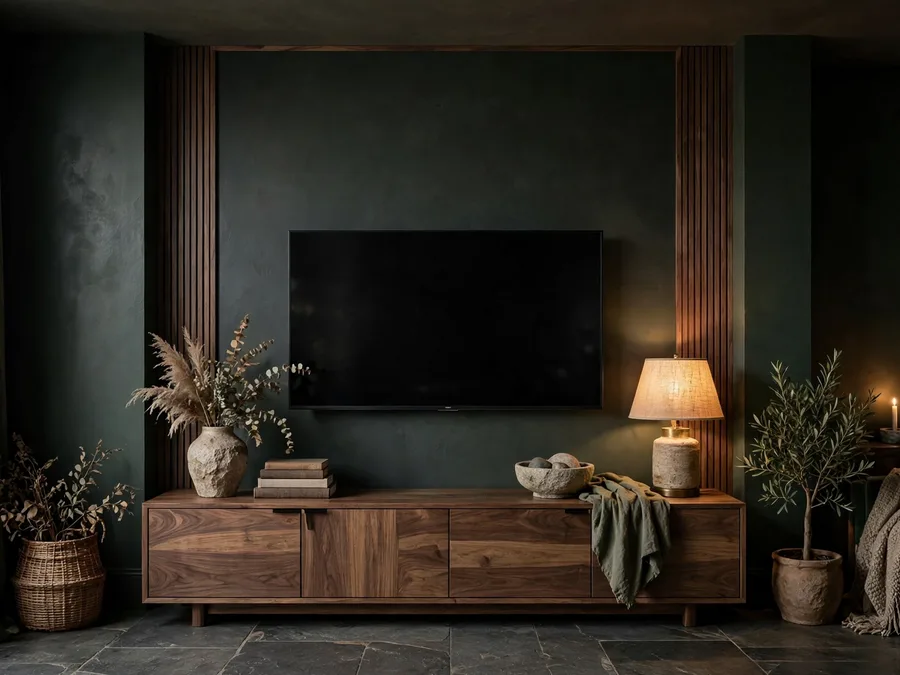
A big black television fights a green room all day. Paint the wall behind it a charcoal-green so deep it reads almost black, and the screen blends in instead of floating. Set a low media console in warm pine beneath, around 16 inches high, and flank the screen with two narrow framed fern prints or linen panels.
The downside: a very dark wall shows dust and swallows small rooms, so this suits walls of 10 feet or wider. Movie nights, though, become properly cinema-dark.
Space note: leave at least 8 inches of painted wall visible on each side of the screen — a screen that fills the wall edge to edge looks like a shop display, not a room.
7. The Throw Layer: Deep Green Over Natural Linen
If a new sofa is not in the budget, a throw does the anchoring instead. Drape a deep-green plush throw across one corner of a neutral sofa in a diagonal fold — the Cozy Cloud Plush Throw from Pottery Barn, $79, in deep green has the weight to stay where you fold it. Layer a thin linen throw beneath it, edges showing, so the green grips texture instead of sliding.
Plush throws shed fibres and need gentle washing to stay soft — a high-touch, high-care layer. On a beige sofa, it is the fastest full change in this list.
Fit check: a 50-by-60-inch throw folded in thirds covers one corner with drape; under 50 inches looks like a towel — measure first.
8. Mushroom and Fern Motifs in Small Doses
Woodland motifs charm in miniature and overwhelm at scale. Keep them to pieces you can hold: two cushion covers in a muted mushroom print on oatmeal linen, a fern-print lampshade on the reading lamp, a carved wooden toadstool on the shelf. Everything else stays plain, so the prints read as finds from a walk, not a theme-park set.
The trade-off is taste, honestly — one print too many and the room tips cute instead of moody, so stop at three motifs total. When guests spot the little toadstool before the big sofa, the dose is right.
Style note: choose motifs in the room’s existing greens and browns, printed on linen or cotton — never bright cartoon colours, which break the spell.
9. Bookshelves Painted Into the Green
Instead of buying new storage, paint the bookcase you have. Coat a plain pine bookcase inside and out with the same deep green as your anchor piece, in wipe-clean eggshell. Style shelves in thirds: books spine-out, a flat stack topped with a small stone bowl, then one shelf left a third empty so the green shows.
Dark shelves do make book titles harder to read in dim corners, and repainting means a weekend of sanding and dust. In return, a mismatched old bookcase becomes part of the architecture of the room.
Easy swap: paint only the inside back panels of the shelves green and leave the frame wood — half the work, and the books sit in green shadow.
10. Faux Fur and Sheepskin Over Hard Edges
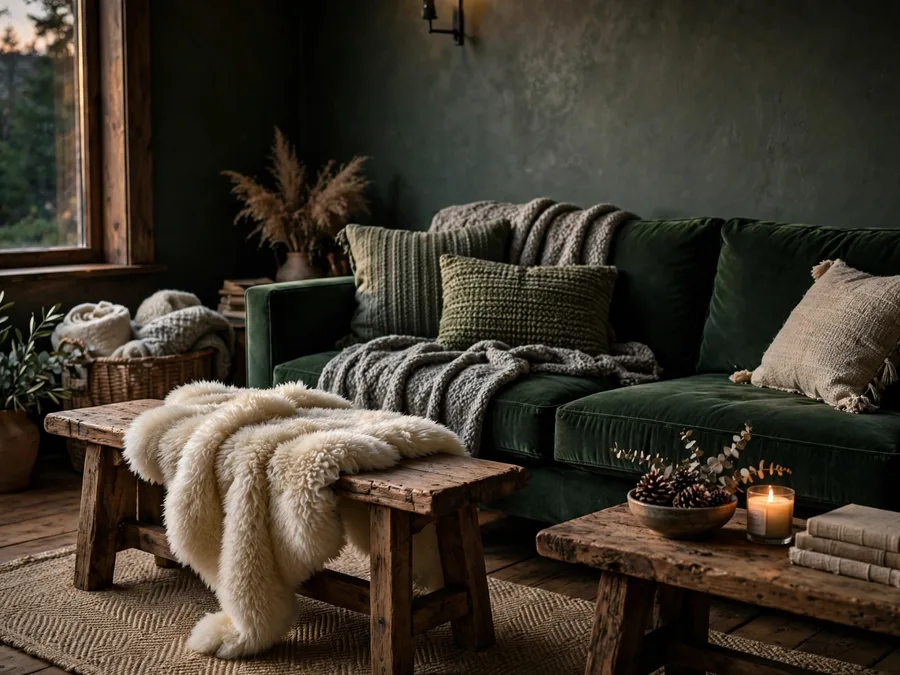
Every forest room has hard edges that need softening: a wooden bench by the window, the arm of a leather chair, the hearth’s stone lip. Throw a faux sheepskin in warm ivory or grey-brown over each, hanging asymmetrically rather than centred. The shaggy outline breaks straight lines the way undergrowth breaks a treeline.
Faux fur is a dust magnet needing a weekly shake outside, and near a real fire it must stay well away from the heat. Draped over the bench you actually perch on to lace your boots, though, it earns its keep daily.
Seasonal swap: in summer, fold the furs away and lay flat-weave cotton cushions in the same spots — same soft outline, none of the heat.
11. Window Seat Piled With Forest Tones
A bay or deep window seat becomes the room’s daylight clearing. Fit it with one long cushion in moss-green wool, then pile the ends with smaller cushions in bark brown, fern green and one cream, mixing a smooth linen face with a knitted one. Keep the middle third clear so someone can actually sit with a mug, and add a low wooden tray that lives on the cushion as a portable table.
Why it works:
- Daylight hits the green cushions and bounces a soft, leafy tint back into the room
- Three tones of green read as depth, like foliage, instead of one flat colour block
- A clear middle keeps it a seat first and a display second
12. Jute and Wool Underfoot Paths
Dress the walking routes too: a flat jute runner from the doorway toward the seating group, a second short one before the fireplace, each about 2 feet wide with a dark-brown woven border. They are the same family of natural fiber rugs used elsewhere in a nature-led home — here, paths through the clearing rather than the clearing itself.
Jute is rough underfoot and cannot be wet-cleaned, so keep it out of the spill zone in front of the sofa. In a hallway opening into the room, though, it sets the tone before a single cushion is seen.
Budget note: two jute runners usually cost less than one mid-size wool rug, and carpet-shop offcuts, edges bound, cost less again.
13. Low Walnut Coffee Table With a Stone Tray
Anchor the centre with a low, wide coffee table in oiled walnut — around 14 inches high, below sofa-seat height — with a single slate tray off-centre on top. The tray corrals the remote, a candle and two books into one island, leaving the rest of the wood bare to show its grain. Dark wood plus pale stone is the forest floor in miniature.
Walnut rings if coasters are ignored, and low tables invite shin bumps in the dark. For a room where everyone lands with tea and a book after dinner, it is the hardest-working square foot you own.
The formula: low walnut table + pale stone tray + one candle and two books, nothing more.
| Texture Layer | Material | Where It Sits |
|---|---|---|
| Floor layer | Wool over jute | Under the whole seating group |
| Seat layer | Velvet, then linen | Sofa body and cushions |
| Drape layer | Plush throw, faux fur | Sofa arms, chair backs, bench |
| Hard layer | Walnut, slate, stone | Tables, trays, fireplace |
| Glow layer | Brass, amber glass, flame | Lamps, sconces, candle clusters |
14. Candle Clusters at Three Heights
Evening glow needs more than lamps. Group candles in threes at three heights — tall pillars on the hearth, mid-height jars on the coffee table tray, tea lights on the mantel — all beeswax, cream or amber glass. Lit together, staggered flames mimic campfire light better than one bright centrepiece.
Real flame near throws demands discipline: keep clusters an arm’s length from fabric, or use flickering LED pillars in risky spots. Nobody relaxes in a room they are fire-watching.
Get the look:
- Main piece: three pillar candles, 6 to 9 inches, on the hearth
- Supporting piece: amber glass jars at coffee-table height
- Texture or material: beeswax and warm glass against stone
- Finishing touch: tea lights on the mantel, lifting the glow
15. Deep-Green Ceiling for a True Cocoon
The boldest move on this list: take the deep green up and over the ceiling in the same matte finish. A dark ceiling lowers the visual lid like a canopy over a forest path, and pale furniture suddenly glows against it. Keep the cornice or trim in the same colour — a white border would chop the effect in half.
Be honest first: this suits ceilings of 8 feet or more with decent windows; in a small, north-facing room it feels like a lid, and repainting it white is nobody’s favourite weekend. In the right room, though, evening arrives the moment you walk in.
Color note: choose a warm, yellow-leaning green for ceilings — blue-leaning greens turn cold and grey overhead.
16. Woven Baskets as Firewood and Blanket Stores
Swap plastic storage for baskets: a tall willow basket beside the fireplace holding split logs, bark side out, and a wide seagrass basket at the sofa’s end holding spare throws, rolled not folded. The weave echoes twigs and reeds, and clutter disappears into something beautiful in ten seconds.
Baskets shed fibres, snag delicate knits, and do nothing to hide anything small — remotes still need the tray. But when the room can be reset for guests faster than the kettle boils, tidiness stops being a chore you dread.
Texture note: mix two weaves — chunky willow for logs, fine seagrass for textiles — so the baskets read as a collected pair, not a matching set.
17. A Green Wingback Chair as Second Anchor
One green hero is a statement; a second, smaller one makes it a scheme. Add a wingback or high-back armchair in the same green family as the sofa but one shade lighter or in a different fabric — wool-blend instead of velvet — angled toward the fire or the window. The tall back gives the seating group a vertical accent that low modern sofas lack, like a single tall tree among shrubs.
Best for: the fireside seat that becomes everyone’s favourite — tall back against draughts, wings that shut out the room when you want to read.
18. Sheer Linen Panels Over Blackout Depth
Layer the windows the way the sofa is layered. Hang deep-green blackout curtains at the window’s outer edges, framing the glass, then sheer natural-linen panels across the middle to filter daylight into a dappled wash. By day the sheers do the work; by night the heavy curtains close and the room seals into its cocoon.
Two sets mean a double track and twice the dusting, and sheers near a smoky fire grey over time. The payoff: light that changes character all day without touching a blind.
Space note: mount the track 4 to 6 inches wider than the frame on each side, so the heavy curtains stack back onto wall, not glass, and never steal daylight.
19. Antler and Horn Accents, Used Sparingly
One antler, treated as sculpture, says woodland; a room full of them says hunting lodge. Choose one naturally shed antler laid along the mantel or mounted above a doorway, or horn-handled pieces on the coffee table tray. Keep every other surface motif-free nearby so the one piece carries its full weight of story.
Real antler divides guests — some love it, some find it morbid — so matte resin replicas are a fair compromise, though they lack the real weight and grain. Either way: one.
Fit check: on a mantel, the antler should span no more than half the shelf’s length; if it crowds the candles and books off, it is too big or the shelf is too busy.
20. The Forest-Floor Coffee Table Vignette
Build a tiny forest floor on the stone tray: preserved moss in a shallow wooden bowl, three pinecones of different sizes, one small brass bird, and two clothbound books beside it. Inside the tray’s edges it reads as a found scene, not clutter, and lifts away in seconds when the table is needed.
Preserved moss crumbles if handled and fades in direct sun, so this vignette belongs on the shaded side of the room. Children and cats will investigate it — accept that as the cost of charm.
Style note: odd numbers and uneven heights make it — three cones, one bird, two books; a neat row of matching objects would look like a shop shelf.

21. Dim-to-Warm Bulbs and Amber Glass
The cheapest transformation here is invisible until dark: dim-to-warm LEDs in every lamp, sliding to candle-like amber as they dim, plus one amber glass shade. Cool bulbs turn deep green walls muddy grey; warm dimming keeps them green and makes wood and leather look richer.
They cost more per bulb and need a compatible dimmer or they flicker — check the pairing before buying a room’s worth. Once fitted, a room that sulked at 7 p.m. starts to glow.
Easy swap: no dimmer? Fixed warm bulbs in the table lamps, ceiling light off — low, warm lamps beat overhead light every time.
| Season | Evening Light Mood | One Simple Swap |
|---|---|---|
| Spring | Lamps on late, sheers open longest | Swap the plush throw for a pale-green cotton one |
| Summer | One lamp only, candles unlit | Fold faux furs away, add flat cotton cushions |
| Autumn | Full cluster: lamps plus all three candle heights | Bring the rust wool throw back to the sofa |
| Winter | Firelight first, bulbs dimmed lowest | Add the second log basket and extra pillar candles |
22. Seasonal Greens Swapped on the Mantel Shelf
Give the mantel one arrangement that changes with the year. In a tall stoneware vase stand three long faux branches — eucalyptus-grey in spring, fern fronds in summer, russet oak in autumn, bare birch in winter. The vase and candles never move; only the branches swap, so the room stays alive to the seasons the way a whole forest home does.
Good faux branches are not cheap, and bad ones announce themselves instantly — buy the best three stems you can, not a bushy bunch of plastic. Stored flat in a labelled box, each set takes two minutes to change over.
Seasonal swap: keep a list inside the storage box — which stems, which month — so changeovers need no remembering.
23. Hide-the-Tech Cabinet in Reclaimed Pine
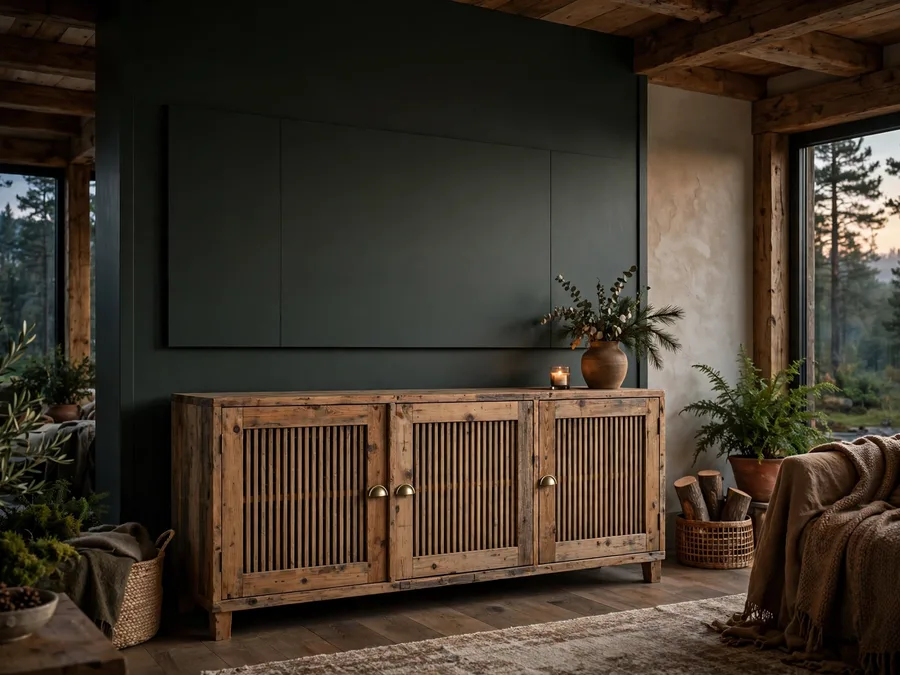
Routers, game boxes and cable nests are the opposite of woodland calm. House them in a low reclaimed-pine cabinet with a slatted front — slats pass remote signals and air while the boxes vanish behind warm, grainy wood. Set it beneath the media wall, a woven basket on top for remotes and chargers.
Enclosed tech runs hot, so check the cabinet back is vented and leave an inch of air around consoles. A cabinet that cooks your equipment is worse than an honest tangle of cables.
Why it works:
- Slatted fronts pass signals and cooling air, so nothing stays on show
- Reclaimed grain hides scuffs that scream on a glossy unit
- One closed door removes a dozen visual interruptions at once
24. Oversized Botanical Art in Thin Oak Frames
One big picture beats a fussy gallery wall in a moody room: one oversized print — misty pines or a vintage fern study — at least 28 by 40 inches, in a thin oak frame with a cream mat, hung opposite the windows so daylight never reflects across it. The cream mat opens a breathing space inside all the depth.
Big prints cost real money to frame, and one hung crooked looks worse than nothing — two fixings and a level, not hope. Hung straight, it becomes the window this room was missing.
Budget note: download a public-domain botanical plate, print it on matte paper at a copy shop, use a ready-made oak frame — same presence, a fraction of gallery prices.
25. A Scent Layer of Cedar and Pine
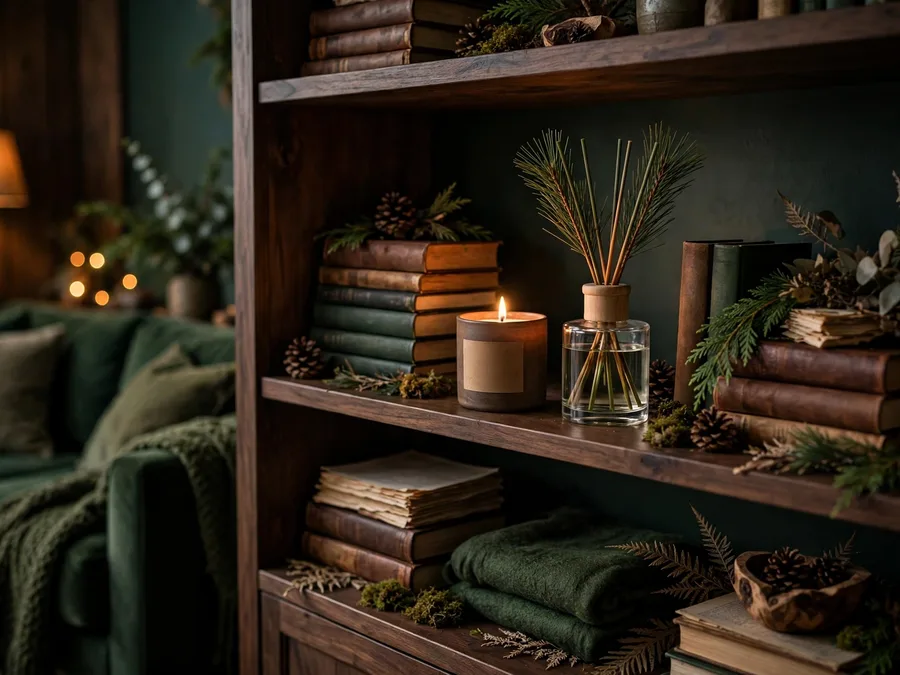
Finish with the sense every photograph forgets. Set a cedarwood candle on the coffee table tray, a small pine or fir reed diffuser on the bookshelf, and a cedar block tucked in the throw basket so opening it releases a breath of woodland. Scent is the layer that makes a green room feel like a forest rather than merely look like one, and it costs less than any cushion in this list.
Keep it subtle — three competing fragrances turn a retreat into a gift shop. One candle lit, one diffuser open, nothing more.
The formula: cedar candle at the centre + pine diffuser at the shelf + cedar block in the basket, layered light to deep.
Start With One Corner and Let the Forest Grow
A forest living room is not bought in a weekend; it settles in layer by layer, the way this list is built — anchor, floor, texture, glow, scent. If the full 25 ideas feel like a lot, remember that the first three layers alone (sofa, rugs, throws) already change how a room feels at 7 p.m., and everything after that is deepening, not fixing.
Your one next step: tonight, before buying anything, switch off your ceiling light and sit in the room lit only by its lamps. Note the one corner that still feels cold or flat — that corner, and the single idea from this list that answers it, is where your forest starts.