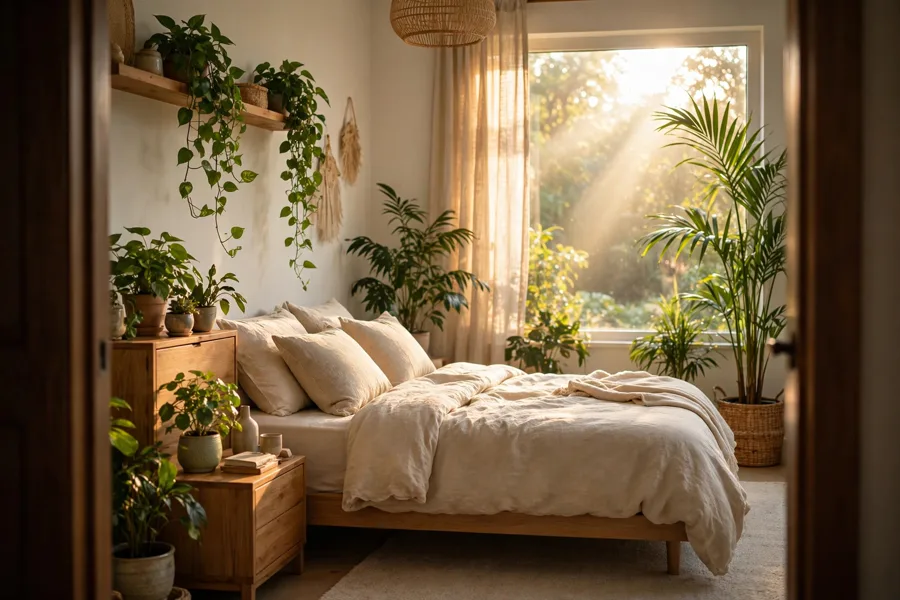
You bring home a beautiful plant on Saturday morning, carry it into the bedroom, and then just stand there. It is too big for the nightstand, it blocks the dresser mirror, and the only free corner is the dark one behind the door. A week later it is dropping leaves in that corner, and the bedroom looks no greener than before — just more cluttered. This is how most bedroom plants fail: not from bad care, but from never having a planned place to live.
The fix is to think in zones instead of spots. Every bedroom already has them — the bright corner, the headboard wall, the windowsill, the dresser top, the floor at the foot of the bed — and each offers different light, space and sightlines. Match the plant to the zone and the room starts to feel designed rather than decorated by accident. Room-by-room guides to greenery bedroom ideas make the same point: the right plant in the right place beats more plants in random places, every time.
Below is a whole-room framework of 20 placements using real plants only. It starts with reading your light, walks zone by zone around the bedroom, pairs each plant with a pot that suits it, and ends with the small habits that keep the arrangement looking deliberate month after month. Pick the zones your room actually has — even three zones done well will change how the room feels when you wake up.
The Greenery Formula That Keeps a Bedroom Looking Layered, Not Scattered
- Light decides first: every placement starts from the light a zone actually receives, because a plant chosen for a bright corner will sulk in a dim one no matter how good it looked in the shop.
- Work in zones: give each area of the room — corner, headboard, sill, dresser, floor — its own green moment instead of scattering single pots wherever a gap appears.
- Repeat the pots: one pot family used across zones makes separate plants read as one planned collection rather than a row of unrelated purchases.
- One star per view: from the doorway and from the bed, let one larger plant lead and keep the rest supporting, so the eye always has somewhere calm to land.
For example, a tall rubber tree in the bright corner, two matching snake plants flanking the headboard, a trailing pothos softening the dresser and one small peperomia on the nightstand gives you four zones, one pot story and a clear star from every angle.
1. Start With a Light Map, Not a Shopping List
Before buying anything, spend one day noticing. Note where sunlight lands at breakfast, midday and late afternoon, and how long it stays — most people are surprised the “bright” corner is bright for under an hour. Sketch the room, marking each zone bright, medium or gentle. That map decides which zones get sun lovers, which get medium-light growers, and which get no plant at all. Ten minutes of looking stops you buying for light you wish you had.
Why it works:
- Plants get matched to light they can use, so growth stays even
- It shows how many plants the room can support well
- Shopping becomes a short list, not guesswork
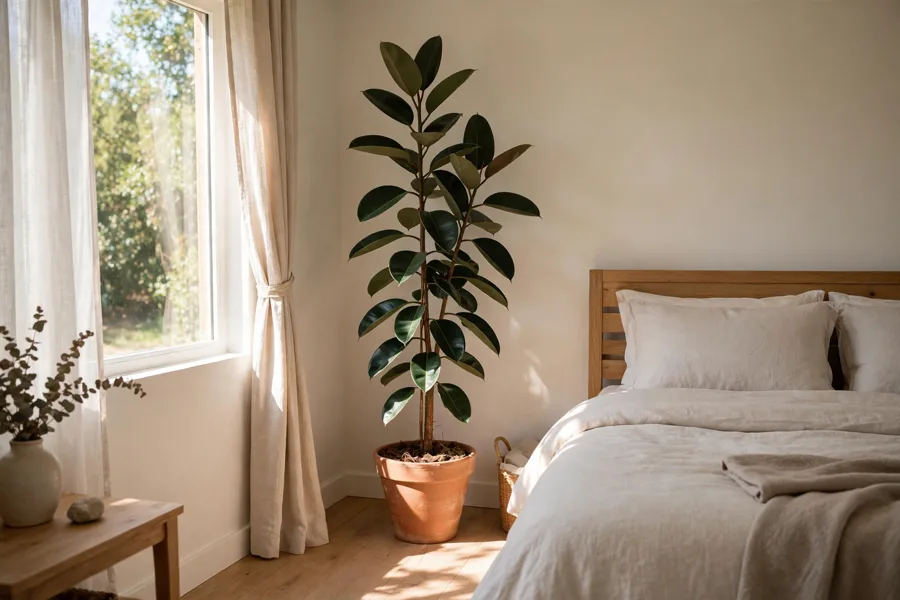
2. Anchor the Brightest Corner With a Tall Floor Plant
A tall floor plant of 4 to 6 feet — a rubber tree, fiddle leaf fig or bird of paradise — turns the brightest corner into the room’s anchor. Set it where the strongest light falls, in a 12-inch-wide pot. From the doorway it is the first thing you see, and smaller plants afterwards are chosen to support it. The same one-big-anchor logic anchors living room plants too, just at a larger scale. The trade-off: tall plants are heavy to shift for watering, so put the saucer on a rolling stand.
Space note: leave 6 to 8 inches between pot and walls, so leaves never touch the paint.
3. Frame the Headboard With a Matched Pair
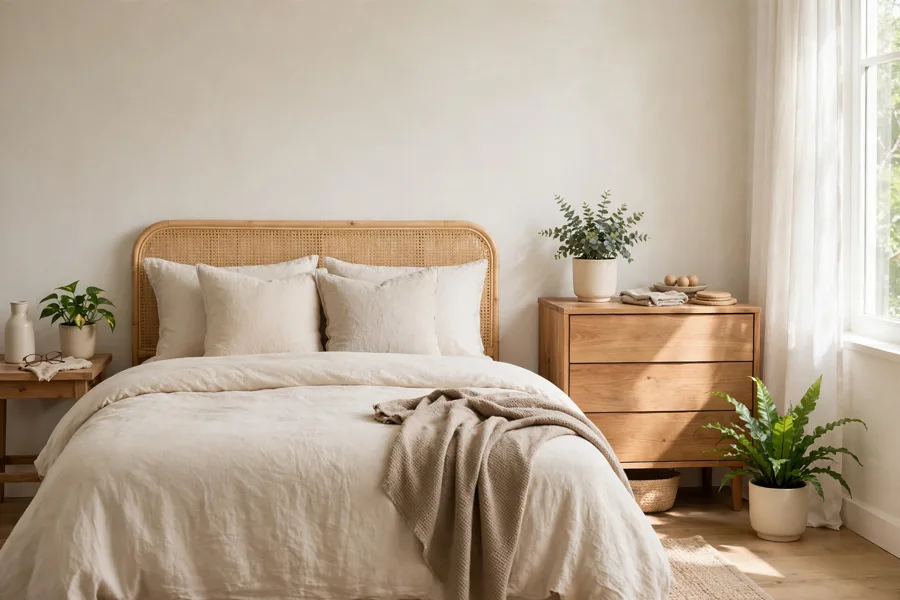
The bed is the room’s biggest shape, and two matching plants either side give the wall a finished, symmetrical frame. Use the same plant twice — snake plants or ZZ plants in identical pots, one on each nightstand. Symmetry does the styling work, so the plants stay simple and sculptural. The downside: pairs must be watered and rotated together, or one outgrows the other and the frame goes lopsided.
The formula:
- Main piece: two matching upright plants, one each side of the bed
- Supporting piece: identical pots in the same finish
- Texture or material: matte ceramic or stone against soft bedding
- Finishing touch: leaves dusted so the pair reads as one set
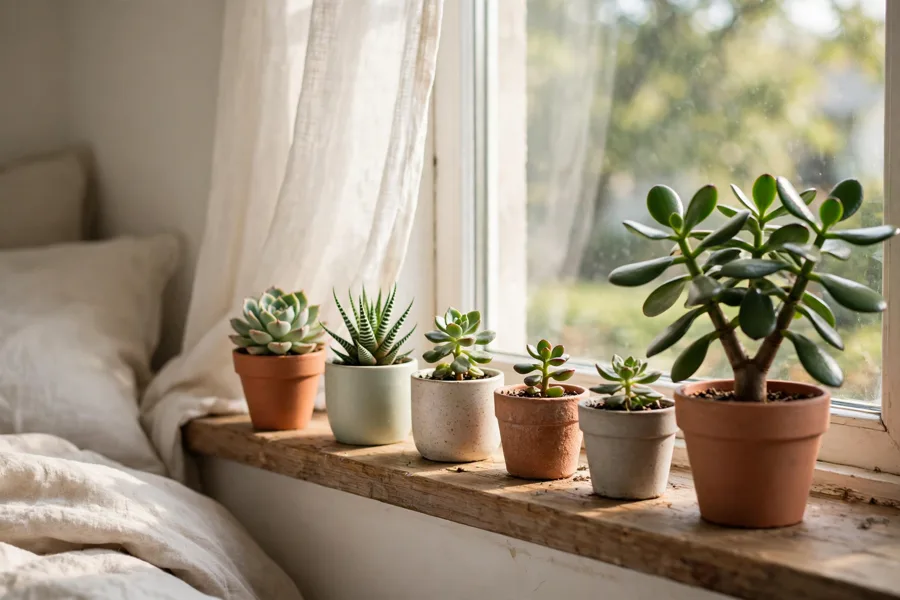
4. Turn the Windowsill Into a Sun-Lovers’ Row
The windowsill is the one bedroom zone with genuinely strong light, so save it for plants that crave it: a small jade, a haworthia or compact succulents in 3 to 4 inch pots. Lined along the sill they catch the morning sun and stay off surfaces you actually use. Rotate the row weekly so they grow straight instead of leaning into the glass. If your sill sits above a radiator, expect faster drying — this row wants water more often than its reputation suggests.
Fit check: measure sill depth first; pots should sit fully on it, not balance on the trim, with an inch between leaves and cold glass in winter.
5. Style the Dresser Top as a Plant Zone
Dressers collect clutter because nothing on them has an assigned place. Claim one end of the dresser as a permanent plant zone: group three plants there — one medium, one small, one trailing over the edge — and leave the other end clear for daily use. Odd numbers and mixed heights keep the group looking arranged instead of stored. The trade-off is dust: leaves near folded clothes need a wipe whenever you dust the dresser, or this zone looks neglected faster than any other.
Get the look: a medium palm at the back, a small round-leaf peperomia in front of it, and one trailing stem tipping over the dresser’s edge.
The five main zones, side by side:
| Zone | Light it usually gets | Plant shapes that suit it | Pot pointer |
|---|---|---|---|
| Bright corner | The strongest in the room | Tall, upright or arching | Heavy pot, 12 inches or wider |
| Headboard and nightstands | Gentle, indirect | Compact, symmetrical pairs | Identical pots for the pair |
| Windowsill | Direct sun part of the day | Small, sun-loving, compact | 3 to 4 inch pots with saucers |
| Dresser top | Medium, reflected | Medium plants plus one trailer | One pot family, grouped close |
| Floor at the foot of the bed | Gentle, partly shaded by the bed | Low and wide | 10 to 12 inch pot, stable base |
6. Pair Each Plant With Its Pot Once, Properly
Bedroom plants look temporary because they still sit in the thin plastic pot they arrived in. Pairing them properly takes ten minutes: choose a pot 1 to 2 inches wider than the grow pot, keep the plant in its nursery pot inside it, and set a saucer underneath. The plant keeps its drainage, the furniture stays dry, and repotting becomes a lift-out job. Tall plants suit heavier pots that won’t tip; trailing plants suit lighter ones you can lift for watering. Skipping the saucer is exactly how water rings end up on dressers.
Texture note: rough terracotta warms sleek modern furniture; smooth glazed ceramic sharpens soft, fabric-heavy rooms.
7. Stand a Tall Plant Beside the Dresser
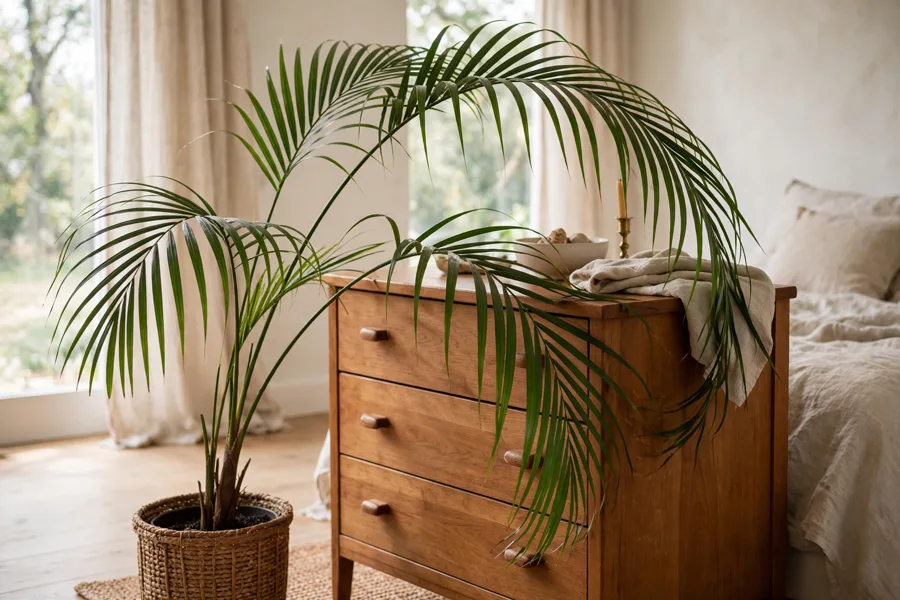
Dressers and wardrobes give bedrooms their hardest straight lines, and a tall, arching plant standing beside them softens the whole wall. A dracaena or a parlor palm in the floor gap beside a dresser adds height without eating the walkway, and its silhouette breaks up the boxy run of drawers. It also balances a corner anchor plant across the room, so the green weight feels shared. The downside: that narrow gap collects dust and dropped leaves where the vacuum barely reaches, so expect a monthly pull-out clean.
Style note: arching leaves suit angular furniture and upright leaves suit soft, rounded pieces — the contrast is what makes both read clearly.
8. Choose One Signature Plant as the Room’s Star
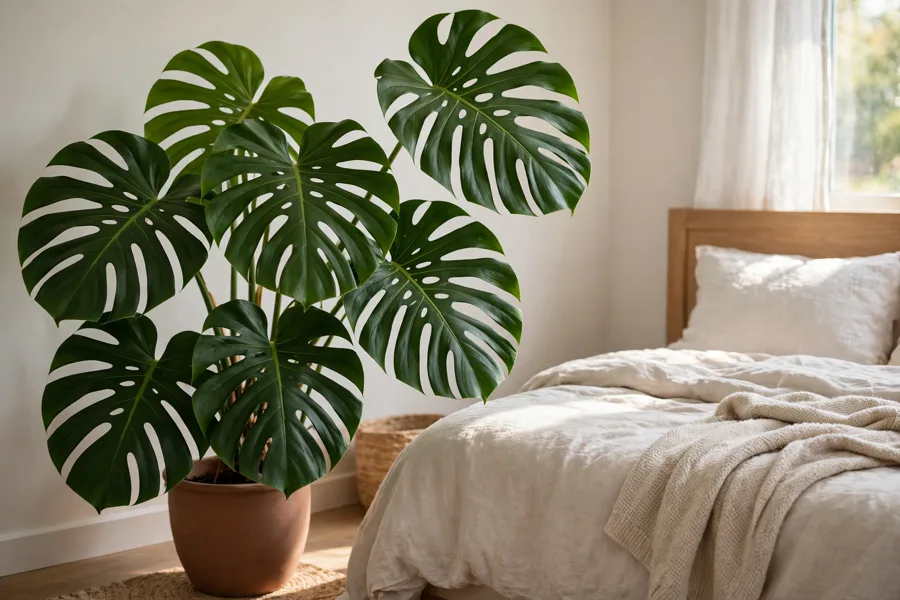
Every greenery bedroom needs one plant to build around, and a monstera is the easiest star to cast: its split leaves read as decoration from across the room, and it grows at a pace you can watch. A medium Monstera Deliciosa from The Sill costs $89 with its planter — a planned purchase, not an impulse one. Place it in your brightest zone, give it space of its own, and let smaller plants fill in around it. One caution: monstera leaves are not pet-friendly, so pet owners should pick a different star.
Best for: a bright corner or the floor beside the dresser, where one statement matters more than plant count.
9. Keep the Nightstand Plant Small and Calm
The nightstand is prime real estate — book, water glass, phone, lamp — so its plant has to earn a tiny footprint. A peperomia or a small African violet in a 4 inch pot adds a rosette of green without crowding the surface or shedding leaves into your book. Keep it on the lamp side of the stand, where the evening light shows the leaves at their best. If you knock things over half-asleep, skip this zone entirely; a plant you resent at 6 a.m. helps nobody.
Space note: if the plant leaves less than a hand’s width of clear space, it is too big for the stand.
10. Fill the Gap Between Window and Wardrobe
Most bedrooms have an awkward leftover strip: too narrow for furniture, too visible to ignore, usually between the window and the wardrobe. A medium plant on a stand claims it perfectly — the stand lifts the leaves into the window’s light, and the vertical shape suits a vertical gap. A rubber plant or a full, bushy pothos works well here. Measure before you buy, though: the plant’s leaf spread, not the pot, decides whether the wardrobe door opens cleanly, and finding out afterwards means moving everything twice.
Get the look: the pot top roughly level with the wardrobe’s mid-height, so the leaves fill the gap’s upper half where the eye notices it.
11. Repeat One Pot Color in Every Zone
Here is the cheapest-looking problem with the easiest fix: five good plants in five unrelated pots look like five separate shopping trips. Repeating one pot colour — all warm white, all terracotta, all charcoal — across the corner, sill, dresser and nightstand makes the collection read as one decision. You do not need identical pots, just the same colour family and a similar weight. It also makes your wider bedroom decor ideas work harder, because the eye reads the green as part of the room’s palette rather than decoration added afterwards.
Color note: white pots nearly disappear against pale walls for a calm look; terracotta adds warmth that suits wood-heavy rooms.
12. Rotate Every Plant a Quarter Turn Each Week
Plants grow toward their light, and in a bedroom most of it comes from one side — so unrotated plants lean, stretch and go bald at the back. A quarter turn weekly, done while you change the bedding, keeps growth even and keeps the silhouette you bought. It is a weekly inspection too: spot dry soil or dusty leaves now, and it is a one-minute fix. Skip it for a month and even a healthy plant looks windswept.
Why it works:
- Even light means even, upright growth
- It doubles as a weekly health check for water and pests
- The view from bed stays as good as from the door
Matching plants to the light your window really gives:
| Your window | The light you really get | Reliable choices | Better to skip |
|---|---|---|---|
| South or west facing | Several hours of strong sun | Jade, rubber tree, bird of paradise | Ferns right on the sill |
| East facing | Gentle morning sun | Monstera, peperomia, pothos | True sun lovers long-term |
| North facing | Bright but sunless | Snake plant, ZZ plant, pothos | Anything expected to flower |
| No window nearby | Borrowed light only | Plants rotated in weekly from brighter rooms | Keeping one plant there permanently |
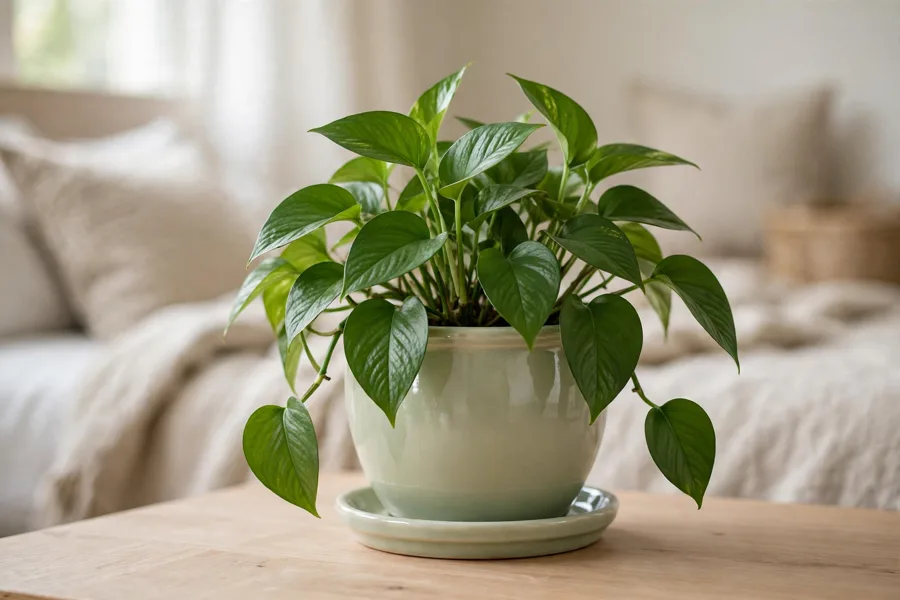
13. Let a Pothos Trail Across the Dresser
Not every plant needs height. A golden pothos set at the back of the dresser, with a few stems guided along the top and one spilling over the front edge, gives the surface a soft line that plays against wood grain and mirror glass. Pin the longest stem along the back edge if it wanders, and trim any stem that reaches the floor — floor-length trails collect dust and get caught in drawers. Pothos forgives middling light, though its leaves slowly lose their gold markings if the spot is dimmer than it looks.
Texture note: glossy, heart-shaped leaves against matte wood is one of the easiest texture contrasts in the whole room.
14. Set a Low, Wide Plant at the Foot of the Bed
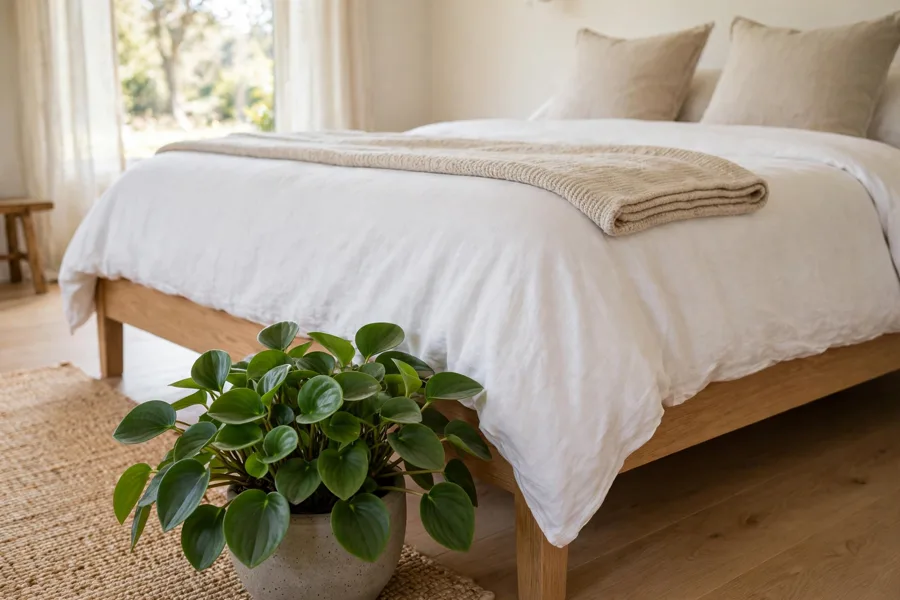
The floor at the foot of the bed is dead space in most bedrooms, and a low, wide plant — a calathea, an aglaonema or a bushy fern in a 10 to 12 inch pot — fills it like a green footstool. It is the plant you see last at night and first in the morning, so choose one that looks good from above — your usual angle. Keep it a clear step from the bed’s edge; leaves brushed by bedding nightly turn ragged fast.
Fit check: walk bed-to-door in the dark — if your shin finds the pot, move it six inches closer to the bed.
15. Give the Bedroom Door Its Own Plant
The few feet inside the bedroom door set the room’s tone, and they are usually bare. One upright plant there — a snake plant is ideal, holding its lines in a narrow footprint — makes the room feel planted from the first step rather than only once you reach the window. It also shrugs off the door zone’s draughts and passing traffic better than anything delicate. Check the swing of the door with the pot in place; a plant clipped daily by a door handle will show damage within weeks.
Style note: a tall, narrow silhouette suits this zone — the plant should echo the door frame’s lines, not fight them.
16. Group Plants in Threes at Staggered Heights
Single plants, one per surface, can look lonely; grouped, they read as a display. On a bench, shelf or dresser, arrange three: tallest at the back, a medium in front, a small one to one side, pots close enough that leaves touch. Odd numbers and staggered heights are the trick — the group works like a flower arrangement, with foliage doing the work. The cost: clustered pots are fiddlier to water, so group similar thirsts together.
The formula:
- Main piece: one tall plant setting height
- Supporting piece: one medium plant in the middle
- Texture or material: two leaf shapes — broad against fine
- Finishing touch: one small plant forward, breaking the line
17. Match the Plant’s Shape to the Furniture Beside It
Pairing is not only about pots. A plant’s silhouette should answer the furniture next to it: broad, arching leaves soften a chunky dresser, neat upright spears suit a sleek modern nightstand, and a soft mound rounds off a sharp-edged bench. When shape and furniture argue — a spiky plant against an already busy carved headboard, say — both look restless. Check each pairing from the doorway, because that is the distance the room is read from. Swapping two plants’ zones often fixes a clash without buying anything new.
Color note: deep green foliage flatters warm woods, while silvery, blue-green leaves sit better with grey and white furniture.
Care for the framework’s most-used plants, at a glance:
| Plant | Water | Light | Watch out for |
|---|---|---|---|
| Monstera | Every 1 to 2 weeks, once the top inches dry | Bright to medium indirect | Leaves are not pet-friendly |
| Snake plant | Every 2 to 3 weeks, sparingly | Almost any light level | Root rot from overwatering |
| Pothos | Weekly, when the surface dries | Medium indirect | Leaf markings fading in dim spots |
| Rubber tree | Weekly in growth, less in winter | Bright indirect | Leaf drop after a move |
| Peperomia | When the soil feels dry to the touch | Medium indirect | Soggy soil in an oversized pot |
| Jade | Every 2 to 3 weeks | The brightest sill you have | Stretching toward the glass |
18. Keep a Recovery Spot for Struggling Plants
Even well-matched plants have rough patches — a scorched leaf, a sulky month after repotting. Instead of nursing a sad plant in the bedroom’s best zone while it recovers, keep a bright spare spot elsewhere, by a bathroom or kitchen window, as the recovery ward. Swap the struggling plant out and a healthy spare in, and the bedroom never has an unhappy plant on show. Most forgive the move and bounce back within a few weeks. It feels ruthless, but it is kinder than watching one decline in prime position.
Easy swap: keep one spare plant living in the recovery spot permanently, so a swap never leaves either place empty.
19. Shift Zones When the Seasons Shift the Light
The light map you made in spring tells lies by November: the sun sits lower, the bright corner moves, and a sill plant that thrived in June can starve by winter. Twice a year, walk the zones and shuffle plants to match the light — sun lovers closer to the glass in winter, tender leaves pulled back from cold panes and summer glare. It is an hour’s work that prevents the seasonal decline many blame on watering. Your future self, not rebuying plants in spring, will thank you.
Seasonal swap: in winter, trade dresser and sill plants — the sill gets the light, the dresser the hardier plant.
20. Add One Zone at a Time and Leave a Surface Bare
It is tempting to green the whole room in one weekend, but the rooms that stay lovely are built a zone at a time: live with the corner plant for a month, then add the dresser group, then the sill. You learn your light and watering rhythm as you go, and each addition fits what is already thriving. Just as important, leave one surface — a nightstand, a shelf — completely plant-free. That breathing room is what makes the green zones look generous instead of crowded.
Budget note: one well-chosen plant per zone, bought slowly, costs less over a year than a trolley of bargains replaced each season.
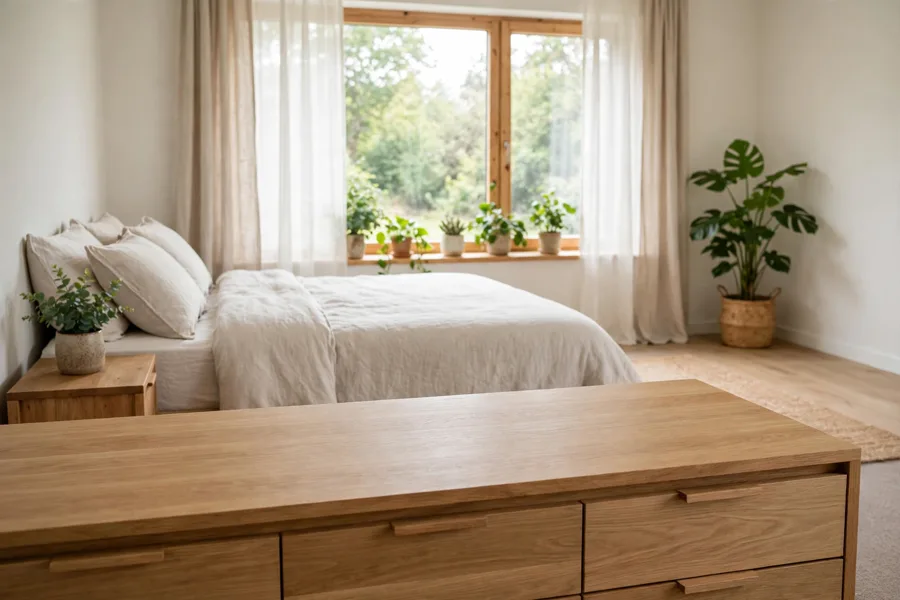
A Greener Bedroom, One Zone at a Time
A greenery bedroom is not really about owning more plants — it is about giving the plants you have a planned place to be. Light first, zones second, pots and pairings third, and the room does most of the rest. If the full framework feels like a lot, start with two zones and stop there; a bright corner and a framed headboard already change how a bedroom feels at waking and at winding down. And if your taste runs calmer than a collection, the restraint behind minimalist bedroom setups pairs happily with this framework — fewer zones, same intention.
Your one next step: tomorrow morning, before you buy or move a single plant, stand in your bedroom doorway with a coffee and name your zones out loud — bright corner, headboard, sill, dresser, floor. Whichever zone catches the best light gets the first plant this weekend, in a pot you would happily repeat three more times.