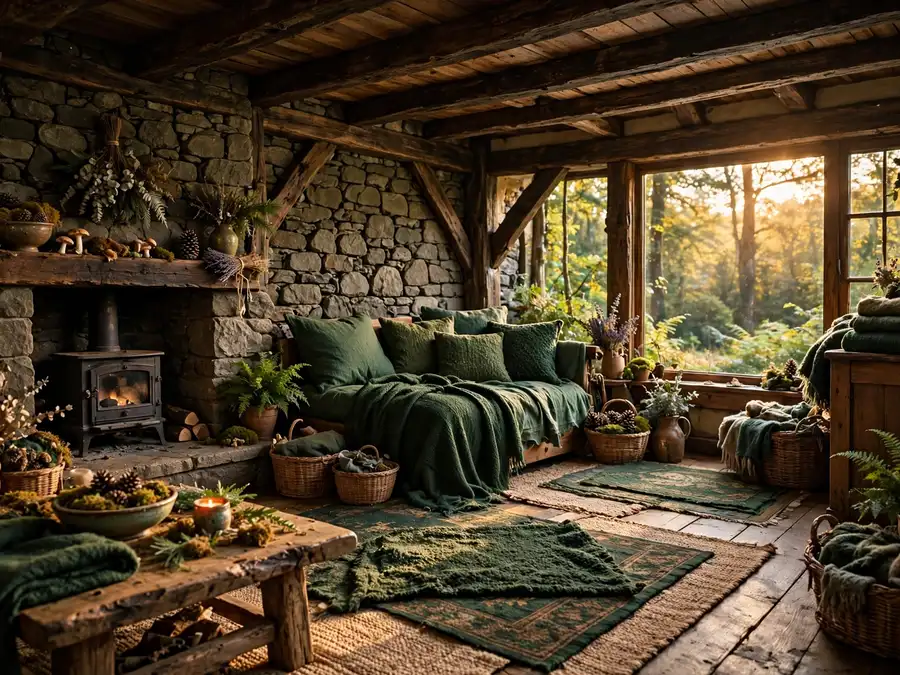
You pin the photos and save the reels: a little cottage in the trees, lamplit and quiet, smoke curling from the chimney. Then you look at your own place — a normal house, a rental, a street nowhere near a treeline — and the whole dream feels like it belongs to somebody else’s life, somebody else’s woods.
It doesn’t. The cottages that get this right are not lucky; they are disciplined. Designers describe the forest cottage mood as cottagecore’s moodier older sibling, and under the romance it runs on plain rules: honest materials, one small palette repeated, and rooms arranged for slow rituals instead of display.
The 17 ideas below build that cottage in layers — bones first, then nooks, textiles, light and scent. Most of them start with basics you probably already own: a wool throw, a wooden chair, baskets, plain linen, a stack of firewood. Pick one corner, start there, and let the trees do the rest.
The Forest Cottage Formula That Keeps Rustic Layers Looking Storybook, Not Cluttered
- Start with the bones: let one honest material — aged wood, rough stone or limewashed plaster — cover the biggest surfaces before you add a single accessory.
- Hold a three-colour forest palette: deep pine green, warm bark brown and soft cream, repeated in every room so pieces can wander from space to space.
- Plan for mud, ash and paws: put washable slipcovers, scrubbable stone and sealed wood exactly where boots, firewood and pets actually land.
- Keep one layer swappable: throws, cushion covers and a single shelf of finds rotate with the seasons while the bones stay put.
Put together, it looks like this: a honey-pine farmhouse table on a flatweave cream rug, pine-green linen cushions along the bench, and a stoneware jug of bare branches standing at the table’s centre.
| Idea | Best For | Key Material |
|---|---|---|
| 1. Beam weight, even faked | Low, plain ceilings | Rough-sawn pine |
| 2. The hearth as storyteller | Fireplace or stove corners | Fieldstone and birch logs |
| 3. Window seat in the greenest view | One deep windowsill | Linen and wool |
| 4. Entry that works like a porch | Doors opening into living rooms | Wicker and galvanised metal |
| 5. Limewash-soft walls | Rooms that feel stark | Limewash or chalky paint |
| 6. Sleeping nook of quilt and iron | Small or sloped-ceiling bedrooms | Iron, cotton quilt, wool |
| 7. Dining bench, not chairs | Tight dining corners | Honey-pine and sheepskin |
| 8. One chair for slow reading | A spare 3 feet of wall | Reclaimed teak |
| 9. Small vintage landscapes | Bare walls over furniture | Gilt and dark wood frames |
| 10. Rugs layered like a forest floor | Cold or echoing floors | Jute and wool |
| 11. Dusk-style lighting | Rooms lit by one ceiling bulb | Amber glass and iron |
| 12. A peg rail where storage runs out | Entries, kitchens, baths | Oak pegs and baskets |
| 13. Quilt stack within reach | Sofa ends and spare chairs | Patchwork cotton and wool |
| 14. Tea tray for slow mornings | A small cabinet or sideboard | Stoneware and worn wood |
| 15. Washstand dressing corner | Bedrooms without a vanity | Ceramic and aged pine |
| 16. Cedar-and-beeswax scent | Drawers, wardrobes, mantels | Cedar wood and beeswax |
| 17. Let the real trees finish the room | Any window, wooded or not | Sheer linen |
1. Give the Room Beam Weight, Even If You Have to Fake It
Real beams are luck; beam weight is a decision. Run two boxed faux beams in rough-sawn pine, stained one shade darker than your floor, along the longest ceiling span, spaced about 4 feet apart. No headroom for both? A single reclaimed beam over the main doorway gives the eye the same heavy, settled line. Keep the finish matte and a little scarred — polished wood reads new, and new reads wrong here.
Fit check: stand in the doorway and reach up; if your palm rests flat on the ceiling, skip full beams and use the single doorway beam instead, so the room gains age without losing height.
2. Let the Hearth Tell the Oldest Story
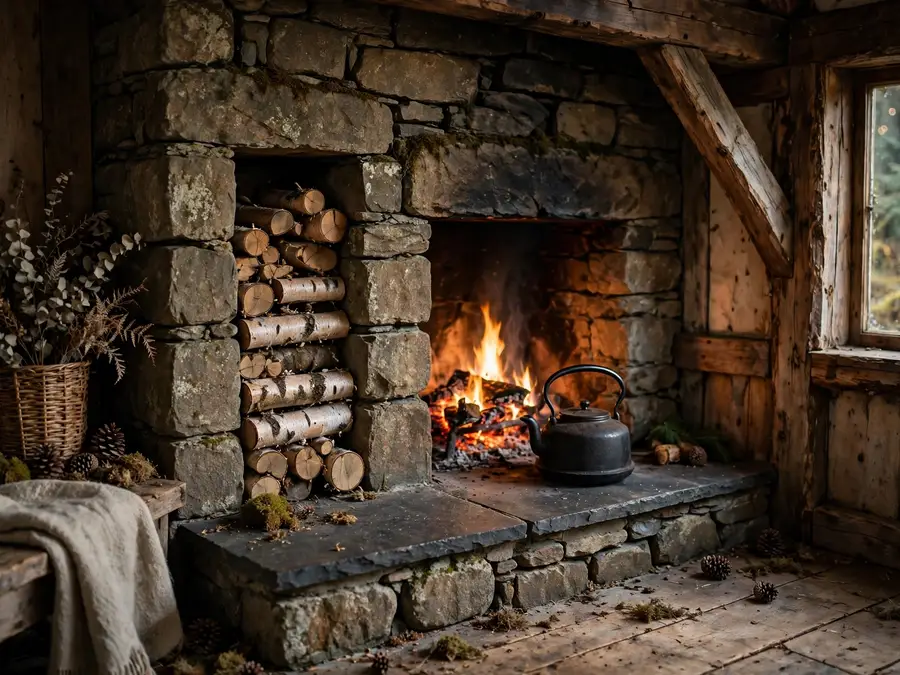
Treat the fireplace or stove corner as the room’s first sentence. Stack birch logs in the dead space beside the firebox — an alcove, a deep basket, or a simple iron log ring — bark side out, ends uneven. Add one blackened-iron kettle or poker set, a flat fieldstone or slate slab as the hearth extension, and a single wool cushion on the floor for the person who always ends up closest to the heat. The trade-off is honest: a working fire means ash on the stone and a weekly sweep, but that lived-in dusting is half the charm.
The formula: fieldstone hearth + stacked birch logs + one blackened-iron kettle.
3. Tuck a Window Seat Into the Greenest View
Find the window that looks at the most green — a tree, a hedge, even a neighbour’s garden — and give it the seat. A bench 16 to 18 inches deep, topped with a firm foam pad in washed cream linen, turns a sill into the cottage’s best room. Prop two cushions in pine green and bark brown against the wall, fold one wool throw over the bench end, and keep a small stack of books underneath.
Get the look:
- Main piece: bench or low chest, 16–18 inches deep
- Supporting piece: two linen cushions, pine green and bark brown
- Texture or material: washed linen over firm foam
- Finishing touch: one folded wool throw at the bench end
4. Make the Entry Work Like a Woodland Porch
A forest cottage starts working at the door, even when the door opens straight into the living room. Lay a coir or woven jute mat inside, set a galvanised boot tray along the wall, and hang three sturdy hooks at shoulder height for the coat, the hat and the dog lead. A lidded wicker basket catches gloves and scarves before they colonise the sofa. If your plot runs to actual trees, the same layering logic stretches further — borrow it from these cozy garden ideas and pull the feeling right up to the threshold.
Best for: cottages and rentals where the front door opens straight into the main room.
5. Wash the Walls in Limewash Softness
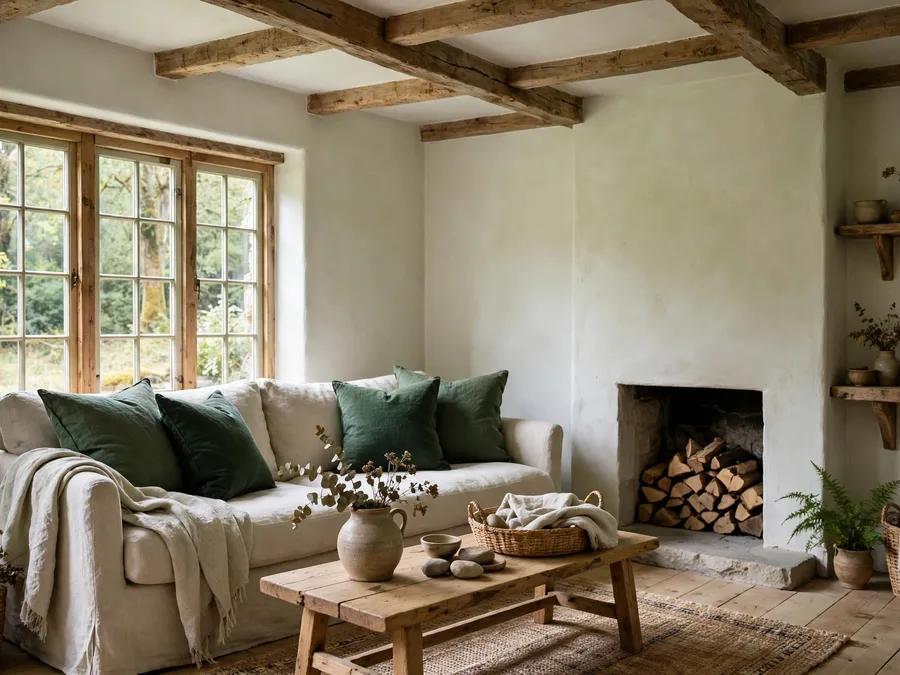
Flat, bright paint is the enemy of this look; cottage walls should feel like weather. Limewash — or a chalky matte paint in warm stone, mushroom or pale sage — goes on with big criss-cross brushstrokes and dries cloudy, so the wall reads as plaster that has been there for decades. Do the whole room if you can; renters can do the one wall behind the bed or sofa and get most of the effect. The colour shifts gently through the day, darker at dusk, which is exactly when this style wakes up.
Color note: hold the palette to pine green, bark brown and cream, and let the limewash be the cream’s textured cousin — never a fourth competing colour.
6. Build the Sleeping Nook Around Quilt and Iron
A black iron bed frame does more woodland work than any headboard shaped like a tree. Dress it plainly: cream cotton sheets, one patchwork quilt folded across the lower third, and a single pine-green cushion against the pillows. Tuck the bed into the quietest corner, or under the slope, and use a scarred oak stool as the nightstand — room for a book, a water glass and nothing else. If a sloped ceiling makes the nook feel tight rather than tucked, a low frame keeps it cosy instead of cramped.
Texture note: the mix is the message — cold iron, soft cotton, one rough wool layer — and it falls apart if a fourth, shinier texture joins in.
7. Settle the Dining Corner on a Bench, Not Chairs
Benches are how cottages seat six people in a corner built for four. Slide a honey-pine farmhouse table, about 60 inches long, against the wall; run one long bench down the wall side and keep just two chairs opposite. A sheepskin or thick wool pad along the bench softens the wood for long evenings, and a stoneware jug of bare branches can hold the centre without blocking faces. When you want to dress that table for a feast day rather than a Tuesday, the settings in these woodland tablescape ideas layer straight over this base.
Space note: leave 24 inches between the bench edge and the wall-side chairs’ pulled-out position, or guests will be climbing in sideways.
8. Claim One Chair for Slow Reading
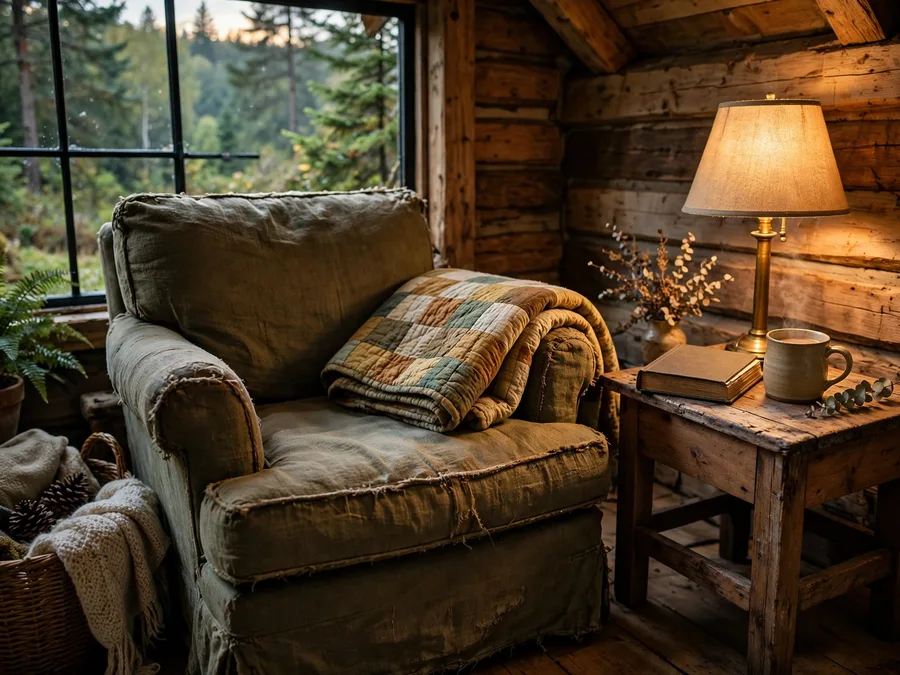
Every storybook cottage has a chair that is clearly somebody’s. Take a thrifted wingback or a slipcovered armchair in moss, olive or faded cream, angle it toward the hearth or the window seat, and give it one serious side table: the reclaimed teak side table from Terrain ($388) is 18 inches across, hand-built from old-house timber, and heavy enough to hold a teapot without wobbling. Add a linen-shaded lamp at shoulder height and a low footstool. The honest cost: reclaimed pieces vary in tone and arrive with nail holes, which here is the point, not a flaw.
Style note: one genuinely old, weighty piece anchors the corner; three small “rustic-style” accessories beside it would cheapen the whole arrangement.
9. Hang Small Vintage Landscapes Like Extra Windows
One big statement print reads gallery; a cluster of small, dim landscapes reads cottage. Hunt thrift shops for little oil or print landscapes — misty hills, dark woods, a river bend — in gilt or dark wood frames, nothing larger than 12 inches across. Hang five to seven of them in a loose rectangle above the sofa, edges uneven, centres at seated eye level. They cost very little, and together they fake a view in a room that has none. If the colours fight, a coat of dark wax on the frames settles them into one family.
Easy swap: trade the landscapes for pages from a damaged vintage nature book, framed the same way, when paintings refuse to turn up.
10. Layer Rugs Like a Forest Floor
A forest floor is never one flat surface, and neither is a cottage floor. Start with a big, plain base — a flatweave jute or cream wool rug that reaches under the sofa’s front legs. Then lay a smaller, softer wool rug in bark brown or faded olive over it at a slight angle, where feet actually land: hearth, bedside, reading chair. The double layer kills echo, warms cold boards and lets you replace the small rug when it wears. Vacuum the jute weekly; grit hides in it and grinds the wool above.
Texture note: keep the base rough and the top layer soft — that contrast underfoot is what makes the room feel gathered rather than decorated.
| Material | Best Spot | Care in One Line |
|---|---|---|
| Aged pine | Tables, benches, shelves | Wipe with a damp cloth; welcome the dents |
| Fieldstone | Hearths, entry floors | Sweep ash weekly; seal once a year |
| Washed linen | Curtains, cushions, bedding | Machine wash cold; skip the iron entirely |
| Wool | Throws, rugs, bench pads | Air outdoors on dry days; store with cedar |
| Blackened iron | Hooks, kettles, lamp bases | Wipe dry; a drop of oil stops rust spots |
| Wicker | Baskets, log carriers, shades | Dust with a brush; keep out of damp corners |
11. Light the Room the Way Dusk Lights the Woods
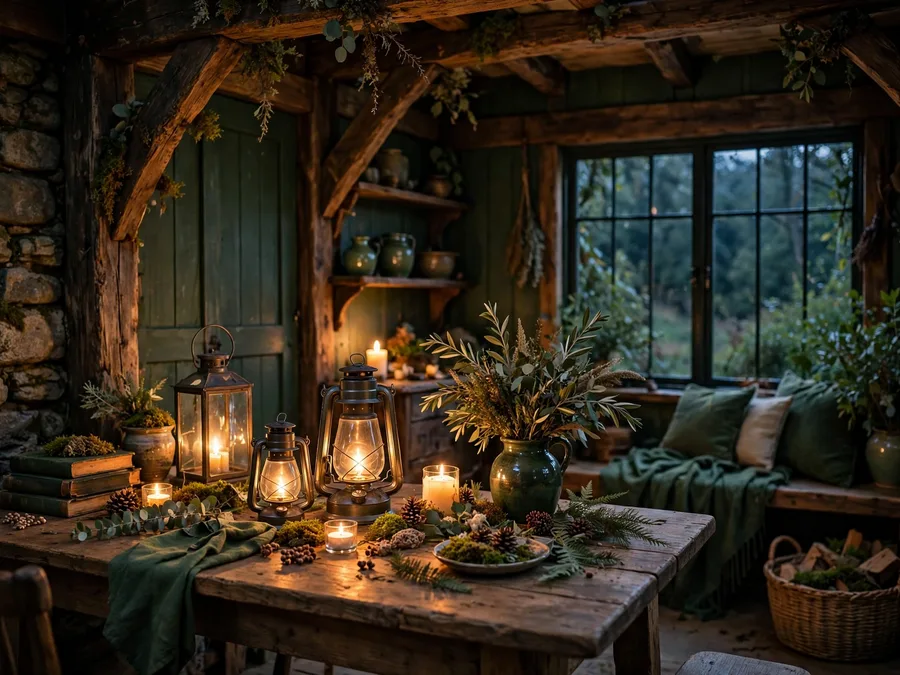
Overhead light is noon; cottages live at dusk. Switch the main bulb off and work in pools instead: a linen-shaded lamp beside the reading chair, one lantern on the mantel, and a candle in amber glass on the table. Keep every bulb warm — 2700K or lower — and low enough that light falls on laps, books and tabletops rather than foreheads. Rooms lit this way feel smaller in the best sense, like a clearing ringed by trees.
Why it works:
- Low, warm pools of light mimic the last light under a tree canopy
- Shadows in the corners make small rooms feel sheltered, not cramped
- Faces and wood grain both look better below 2700K than under white light
12. Run a Peg Rail Where Storage Runs Out
Cottages stored things on walls centuries before “vertical storage” had a name. Fix a solid oak peg rail — pegs every 8 inches, about 66 inches off the floor — along the entry wall, the kitchen’s spare stretch or behind the bathroom door. Hang the everyday things and hang them honestly: the market basket, the good broom, a straw hat, a bunch of dried lavender. Painted the wall colour, the rail disappears; left bare oak, it joins the woodwork story.
Fit check: screw into studs or use proper wall anchors every third peg — a rail loaded with baskets and coats can carry 30 pounds without noticing, or pull out by Friday.
13. Keep a Quilt Stack Within Arm’s Reach
A folded stack of quilts is this style’s version of a stocked pantry. Pile three or four — one patchwork cotton, one plain wool, one faded floral — on a wooden ladder leaned beside the sofa, over the arm of a spare chair, or in a deep basket by the hearth. Guests read the stack as an invitation, and on cold evenings it empties fast. Rotate the top quilt to the bottom monthly so the folds do not set and the faded one gets its turn in the light.
Seasonal swap: in summer the wool quilts go to the cedar chest and the stack shrinks to light cotton throws in cream and sage.
14. Keep a Tea Tray Ready for Slow Mornings
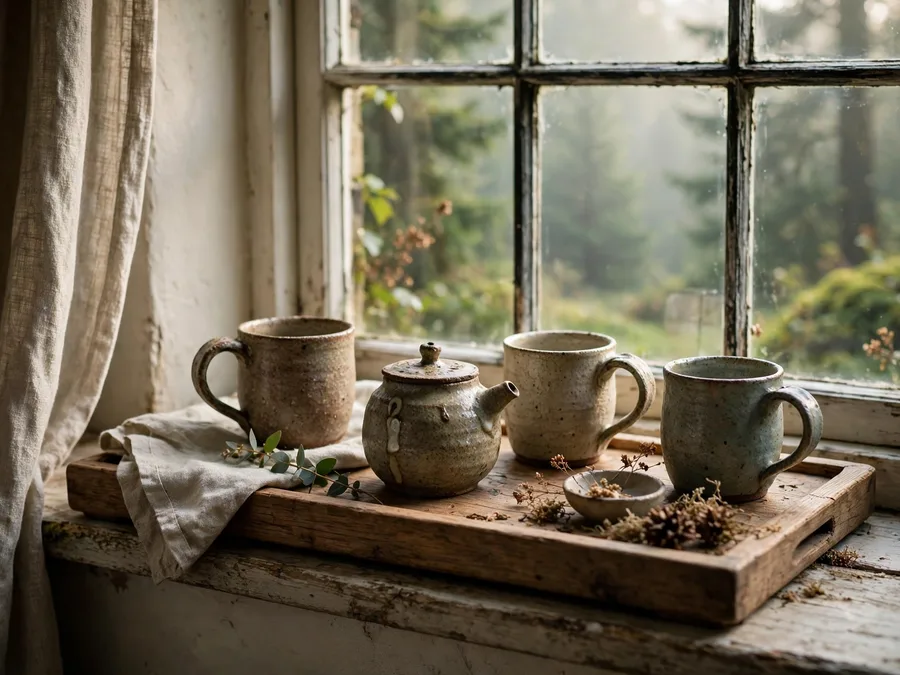
Rituals need equipment left out on purpose. Claim one worn wooden tray on a small cabinet or sideboard and stock it permanently: a stoneware teapot, two handle-less mugs, a small jar of loose tea and a linen cloth folded under it all. In the morning there is nothing to fetch and nothing to decide — just water, heat and ten unhurried minutes by the window. Choose the cabinet near the best early light you have; this tray will quietly reorganise where the whole household starts its day.
Best for: small cottages where the kitchen counter has no spare inch, but the morning still deserves ceremony.
15. Give Getting Dressed a Washstand Corner
Before bathrooms, cottages washed and dressed at a stand, and the corner still works in a bedroom. Find a small washstand, dry sink or narrow dresser in aged pine; set a ceramic pitcher and a wide enamel bowl on top, and hang a round mirror with a worn gilt or oak frame above it. The bowl becomes the honest catch-all for watch, keys and hairpins, and the pitcher takes wildflowers in summer, bare twigs in winter. It asks for 30 inches of wall and makes the whole room feel older, in the good way.
Easy swap: no washstand turning up? A narrow console table and a wall-mounted shelf above it fake the same bones in a weekend.
| Season | Swap In | Slow Ritual |
|---|---|---|
| Spring | Sage cushions, first bare branches in the jug | Open the window seat to morning coffee again |
| Summer | Cotton throws only, pitcher of wildflowers | Tea tray moves to the shadiest window |
| Autumn | Wool back on the bench, amber glass returns | First fire of the year, swept hearth, full log niche |
| Winter | Full quilt stack, extra lantern on the stairs | Candlelit breakfast at the farmhouse table |
16. Scent Every Drawer With Cedar and Beeswax
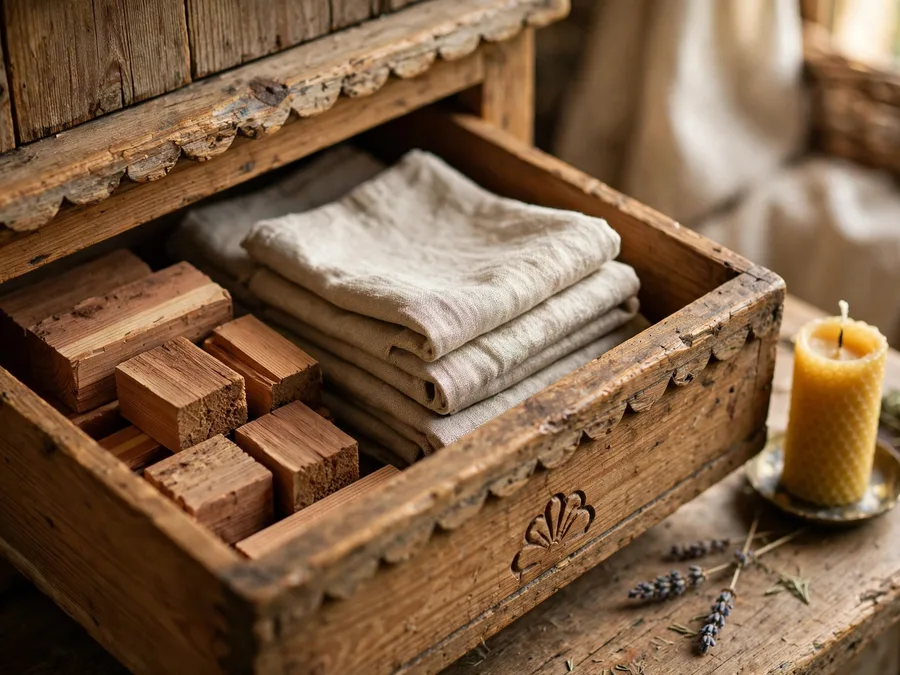
A forest cottage should smell faintly of the woods before it looks like them. Tuck two or three plain cedar blocks into each drawer and the wardrobe — they perfume folded linen and quietly discourage moths — and burn a real beeswax candle on the mantel or the dining table most evenings; its honeyed smell is the background note of every old cottage. Refresh cedar yearly with a light sanding; two minutes wakes the scent back up. Skip the plug-in fragrances entirely: one synthetic note undoes the whole illusion faster than any wrong colour.
Budget note: cedar blocks and a single beeswax candle cost less than one scented plug-in habit, and both last a year or more.
17. Let the Real Trees Finish the Room
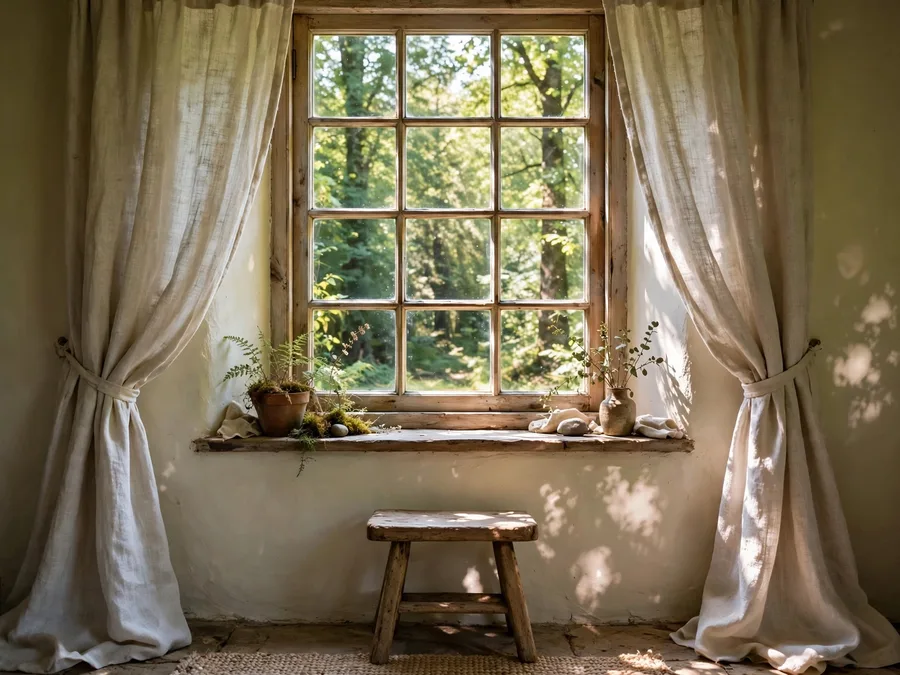
Save the best wall for last: the window. Hang sheer, unlined linen panels that start just below the ceiling and pool an inch on the floor, and let them filter daylight the way a canopy does — moving, green-tinted, never glaring. If your view is brick rather than branches, the trick still works over the landscape gallery from idea 9; the linen softens whatever is behind it. And if one corner could hold this feeling wall to wall, a dedicated forest room is where the palette goes all in.
Color note: choose the sheer in undyed flax or soft cream, never bright white — white reads city-bright against pine green and bark brown and breaks the spell.
A Cottage Is a Pace, Not a Purchase
Nothing in these 17 ideas needs a cottage, a forest or a free weekend with a contractor. They need one corner, a small honest palette, and the patience to add pieces slowly — a beam here, a bench there, a quilt when the right one turns up. That slowness is not the obstacle to the look; it is the look. Houses decorated in a single shopping trip read as sets. Cottages read as lives.
Your one next step: stand in your front doorway tonight, turn off the overhead light, and light one lamp and one candle instead — then choose the single corner that glow flatters most, and give it the first idea on this list this week.