A forest bedroom usually fails at bedtime, not at first glance. The greens read rich in daylight, but at night the room feels heavy, the lamp glare bounces off dark walls, and novelty woodland prints you loved in the store start to look like a theme park. You end up sleeping in a set instead of a sanctuary.
The versions that work flip the order: sleep comes first, and the woodland mood is built only from things that also help you rest — shade-like filtered light, deep greens in soft fabrics, real wood you can touch. A true forest themed bedroom is designed from the pillow outward, and every decorative choice has to earn its place after dark.
Below are 19 ideas that do exactly that, from canopy frames you can fake with curtain track to a three-shade bedding system and a dimming routine for the last hour of the day. Most of them build on basics you likely own already — plain bedding, a wooden stool, warm bulbs — rearranged in forest colours and textures.
The Forest Themed Bedroom Formula That Keeps Deep Greens Looking Restful, Not Heavy
- One anchor of real wood: give the room a single honest timber piece — frame, headboard or stool — and let everything else stay quieter than it.
- Greens in layers, darkest at the bed: keep the deepest green on the duvet, the mid shade on curtains or a rug, and the palest on sheets, so the colour deepens as it gets closer to sleep.
- Light low and warm: plan every light source at or below mattress height for the evening, because overhead glare is what turns moody green walls oppressive.
- One layer you can remove in minutes: keep a throw, drape or print as the only seasonal piece, so the room can lighten in summer without a redo.
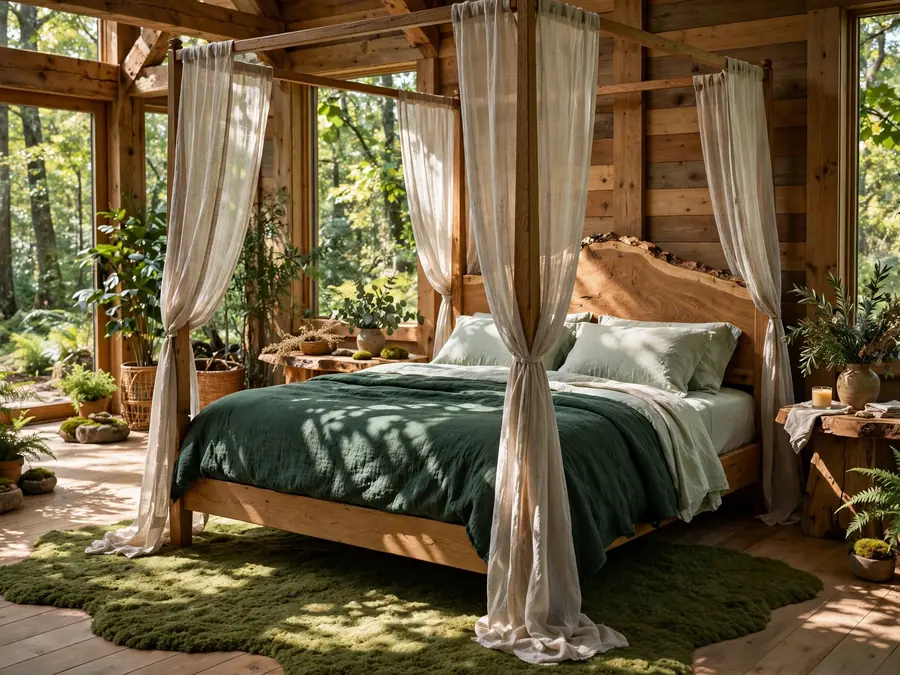
Put together, that looks like this: a slim oak four-poster dressed with a deep forest-green cotton duvet, pale sage sheets, sheer ivory linen panels hanging at the two foot posts, and a bark-brown wool throw folded across the foot of the bed.
| Idea | Best For | Key Material |
|---|---|---|
| 1. Bare wood four-poster | Tall ceilings | Oak frame |
| 2. Sheer linen drapes | Bright windows | Washed linen |
| 3. Ceiling-track canopy | Plain bed frames | Curtain track |
| 4. Deep-green duvet anchor | A one-buy refresh | Cotton waffle weave |
| 5. Three-shade bedding system | Colour confidence | Cotton and linen |
| 6. Bark-brown wool throw | Cold feet, chilly rooms | Wool |
| 7. Branch peg rail | Robe and hat storage | Natural branch |
| 8. Perforated wood lantern | Dappled evening light | Carved wood |
| 9. Moss velvet blackouts | Street-lit bedrooms | Cotton velvet |
| 10. Live-edge headboard | A forever anchor piece | Solid ash slab |
| 11. Fern-print shams | A quiet motif | Printed cotton |
| 12. Low amber lamps | Bedtime reading | Amber glass |
| 13. Pine-green ceiling | Low, plain ceilings | Matte paint |
| 14. Sunset dimming routine | Restless wind-down | Dimmable bulbs |
| 15. Wood slat bed wall | Echoey rooms | Oak slats, felt back |
| 16. Plaid reading chair | A no-phone corner | Wool plaid, oak |
| 17. Storybook guest corner | A visiting grandchild | Cotton, felt |
| 18. Moss-green bed rug | Bare morning floors | Flat-weave wool blend |
| 19. Stump-stool nightstand | Tiny bedside space | Solid stump section |
1. A Bare Wood Four-Poster, Left Undraped
Start with the frame itself as the forest. A slim four-poster in natural oak or warm pine, posts about 78 inches tall with no finials, reads like four young trunks at the corners of the bed. Leave it completely bare — no drapes, no rails of fabric — and dress the bed simply in a deep green duvet and pale sheets. The honest trade-off is height: in a room with ceilings under 8 feet, tall posts crowd the space and can make the bed feel like furniture in a dollhouse.
The formula: slim oak four-poster + deep green cotton duvet + one folded wool throw at the foot.
2. Sheer Linen Drapes That Filter Like Leaf Shade
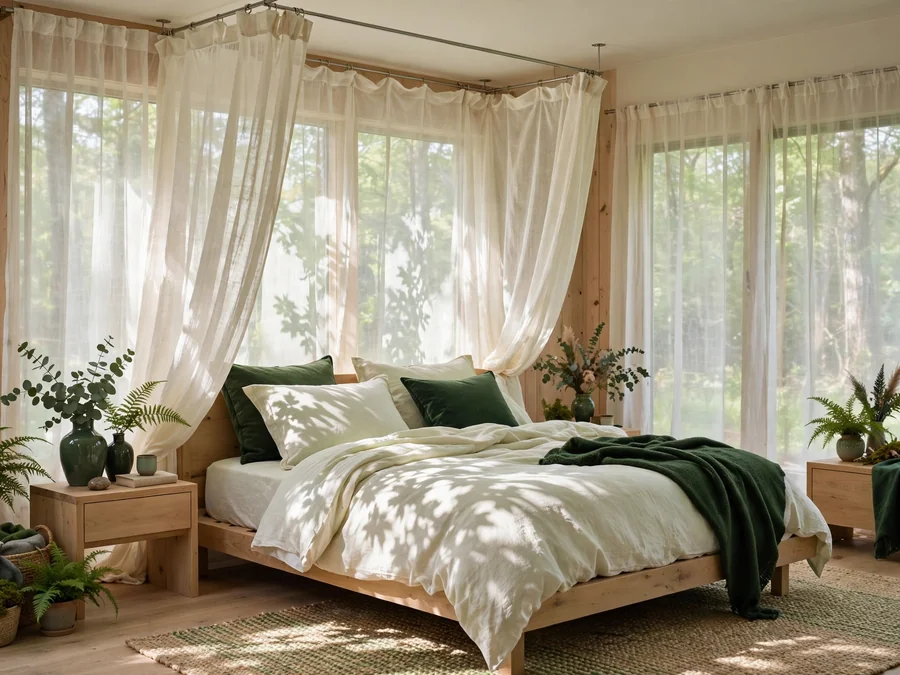
If you do dress a canopy, use washed linen sheers in ivory or pale oat, hung only along the frame’s two sides and left open at the foot. Sun through linen breaks into the same soft dappling you get under a tree canopy. Readers who want the lusher end of this palette will find plenty to borrow in these greenery bedroom ideas, then tone it down for sleep. The trade-off: sheers soften light but block almost none of it at dawn.
Color note: keep the linen undyed or ivory — a warm white, never blue-white, so the light through it stays golden rather than grey.
3. A Ceiling-Track Canopy for a Plain Bed Frame
No four-poster? Mount ceiling curtain track in a rectangle about 12 inches wider and longer than the bed, and hang the same linen sheers from it. From lying down, the effect is identical — fabric floating at the corners, light filtered, the plain frame below invisible. The panels slide fully open for making the bed. The trade-off is commitment: tracks mean screw holes in the ceiling, which renters should skip.
Get the look:
- Main piece: ceiling curtain track, bed size plus 12 inches
- Supporting piece: four washed-linen sheer panels, 84 inches long
- Texture or material: matte white track, undyed linen
- Finishing touch: panels tied back at the head corners by day
4. One Deep-Green Duvet as the Colour Anchor
The fastest honest version of this room is a single purchase: a deep green comforter, everything else unchanged. Choose a textured weave over a flat print — the waffle surface of IKEA’s LUKTVICKER comforter set in green ($79.99 in Full/Queen) catches lamplight in small squares, so the colour reads as leaf shadow, not a flat slab. Add off-white sheets and one bark-brown cushion. The trade-off is care: textured cotton wants a gentle, low-heat dry to keep the weave from tightening.
Fit check: check the drop first — a Full/Queen comforter should fall at least 12 inches down each side of the mattress, or the anchor colour ends in a skimpy line.
5. The Three-Shade Green Bedding System
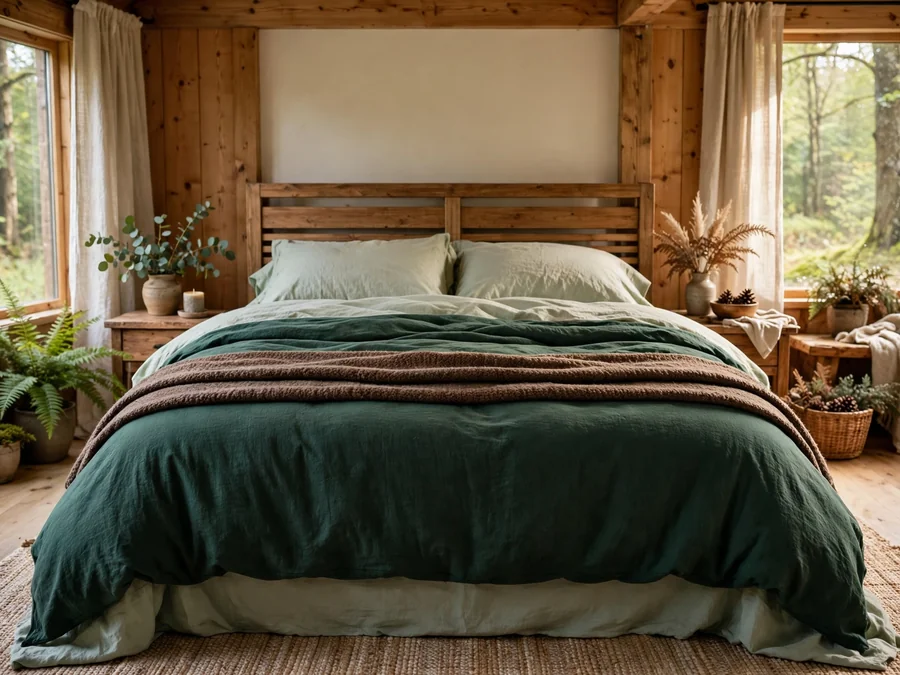
Random greens clash; a graded system doesn’t. Build the bed in three depths: deepest green on the duvet, a mid moss shade on the shams and folded top-sheet edge, and the palest sage on the sheets themselves. Keep every layer a natural fibre — cotton percale, a linen-blend duvet cover — so the shades share one matte, slightly rumpled finish. The trade-off is discipline: a fourth green, or a shiny satin in the mix, breaks the gradient and the bed looks like a bedding aisle. It still looks kind at 6 a.m.
Texture note: hold one finish across all three shades — all matte, all washed — because sheen differences make greens look mismatched.
6. A Bark-Brown Wool Throw at the Foot
Every forest floor has brown in it; the bed needs it too. A wool throw in bark brown, about 50 by 60 inches, folded in thirds across the foot of the bed, stops the green layers reading like a colour chart. Wool matters: its dry, grabby texture sits like bark against smooth cotton, and it adds warmth for the coldest hour before dawn. The trade-off is care — a true wool throw wants airing rather than frequent washing.
Why it works:
- It grounds the greens the way leaf litter grounds a forest floor.
- Wool regulates temperature better than synthetics all night.
- One brown piece means the room never tips into green overload.
7. A Branch Peg Rail by the Door
Swap the usual metal hooks for a peg rail made from a single sanded branch — a straight-ish piece of birch or oak about 36 inches long, fitted with four wooden pegs and mounted at shoulder height by the door. Robes and a sleep shirt hang from it, and the room gains real branch texture at the spot you touch twice a day. Sand it silky and seal it matte so fabric never snags. The trade-off: found wood must be dried and checked for insects first, which takes patience.
Budget note: a fallen branch, sandpaper and four pegs cost almost nothing — the bought version costs ten times more.
8. Dappled Light From a Perforated Wood Lantern
For the shade effect after dark, use one lantern-style lamp with a perforated wood shade, warm bulb inside. The holes throw small pools of light across the wall and ceiling — sun through leaves, indoors, and far gentler on sleepy eyes than a bare bulb. Keep it to one side of the bed only; symmetry makes the effect feel staged. The trade-off is reading: dappled light is mood light, so keep a small focused lamp on the other nightstand if you read in bed.
Easy swap: trade the lantern for a rattan pendant shade laid over the existing lamp base — the dappling is softer, the cost is near zero.
9. Moss Velvet Blackout Panels Behind the Sheers
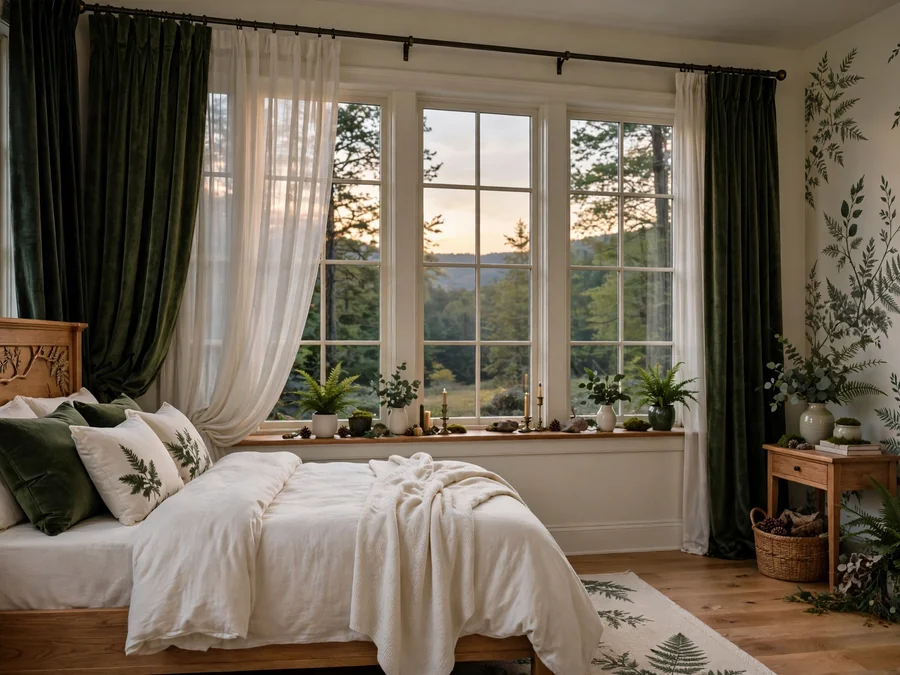
Deep sleep needs real darkness. Hang blackout panels in moss-green cotton velvet on the window wall, behind the pale sheers from idea 2: sheers for the day’s dapple, velvet for the night’s blackout. The pile eats light and sound, and in moss it disappears into the palette instead of reading as a blackout curtain. Panels should clear the floor by half an inch so they fall straight. The trade-off: velvet holds dust and wants a shake outside more often than plain cotton.
Style note: hang the panels on a dark bronze rod, never chrome — warm metal keeps the window wall in the forest palette after dark.
| Bedding Layer | Shade of Green | Fabric and Finish |
|---|---|---|
| Sheets and pillowcases | Palest sage | Cotton percale, matte |
| Folded top-sheet edge | Mid fern | Linen blend, washed |
| Duvet or comforter | Deep forest green | Cotton waffle weave |
| Pillow shams | Mid moss | Printed or plain cotton |
| Throw at the foot | Bark brown (the break) | Wool, dry texture |
10. A Live-Edge Headboard, Sealed Soft and Matte
If one piece gets a real budget, make it the headboard: a live-edge slab of ash or elm, about 48 inches tall at its highest, bark edge softened, the whole face sealed flat matte. It is the tree trunk the bed leans against, and because the edge follows the tree’s own growth, no two are alike. Keep the wall behind it plain pale plaster; this is the calm counterpoint to the wilder bedroom jungle ideas elsewhere on the site. The trade-off is weight — a solid slab needs proper wall fixings and two people to hang.
Best for: a forever bedroom where one honest, heavy piece replaces a whole gallery wall.
11. Fern-Print Shams, Kept Small and Muted
This is how the woodland motif enters quietly: not as a mural, but as a small fern print on the two pillow shams only, in sage on off-white. A small-scale print at the head of the bed reads as texture from the doorway and as pattern only up close — exactly the restraint a sleep-first room needs. Everything else on the bed stays plain. The trade-off is discipline: once a print this pretty exists, every cushion in the store starts suggesting itself, and the bed clutters fast.
Seasonal swap: in spring, trade the fern shams for plain pale-sage linen and the room lightens instantly; the print returns with the first cold nights of autumn.
12. Low Amber Lamps That Pool Light at the Bedside
Height is the unmentioned trick: bedside lamps whose shades sit at or just below pillow level throw light down onto the book and nightstand, not across the room into a partner’s eyes. Choose amber-glass lamps, shades about 8 inches wide, on nightstands level with the mattress top. Amber glass warms even a cheap bulb, pooling light like last sun through trees. The trade-off: low lamps are poor for dressing, so the ceiling light still exists — it just retires an hour before you do.
Space note: leave 4 inches between shade and wall, and keep the lamp’s footprint under a third of the nightstand so book, glasses and water fit.
13. A Pine-Green Ceiling, the Canopy Overhead
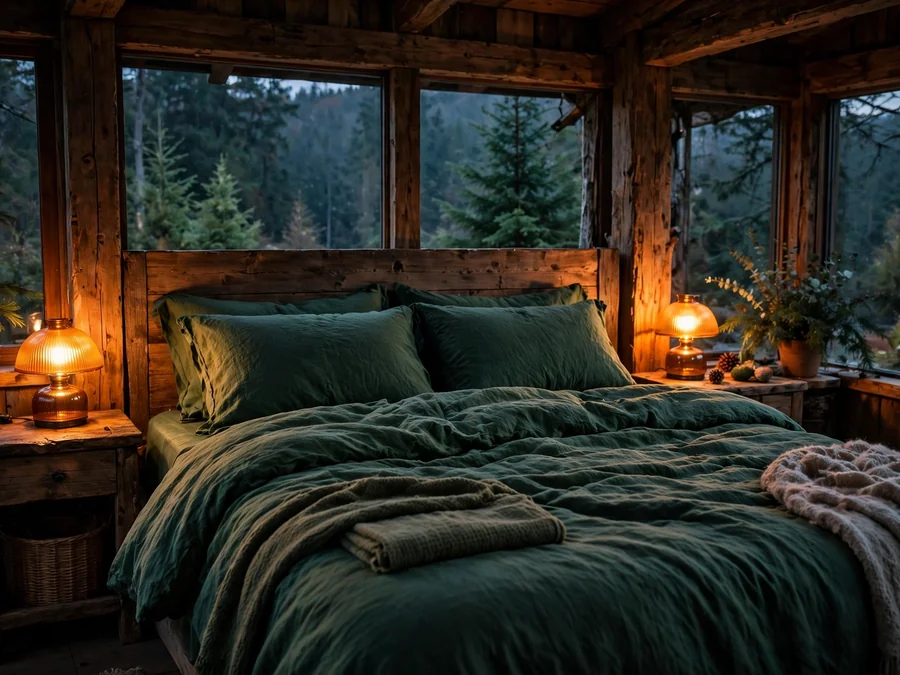
Paint the ceiling — only the ceiling — in a deep pine green, matte, and leave the walls pale. Lying in bed, the last thing you see is the colour of a canopy overhead, and the room feels sheltered in a way four green walls never achieve; by day the pale walls keep it bright. It is also the cheapest transformation in this list. The trade-off: a dark ceiling lowers the feel of the room and shows roller marks, so it suits bedrooms used mostly after dark.
The formula: matte pine-green ceiling + pale plaster walls + warm white sheers at the window.
14. A Sunset Dimming Routine in Three Layers of Light
Treat the last hour like a sunset. Layer one, an hour before bed: ceiling light off, the lantern from idea 8 on. Layer two, half an hour out: lantern off, only the amber bedside lamps. Layer three, lights-out: a tiny warm night-light by the door, for safe trips. Put both switchable layers on dimmers so the routine is one press. The trade-off is setup fuss — the first week you will forget a layer nightly. If your brain races at midnight, this is built for you.
Color note: keep every evening bulb warm amber and banish blue-white bulbs — colour temperature is the difference between sunset and office.
15. Wood Slats Behind the Bed That Hush the Room
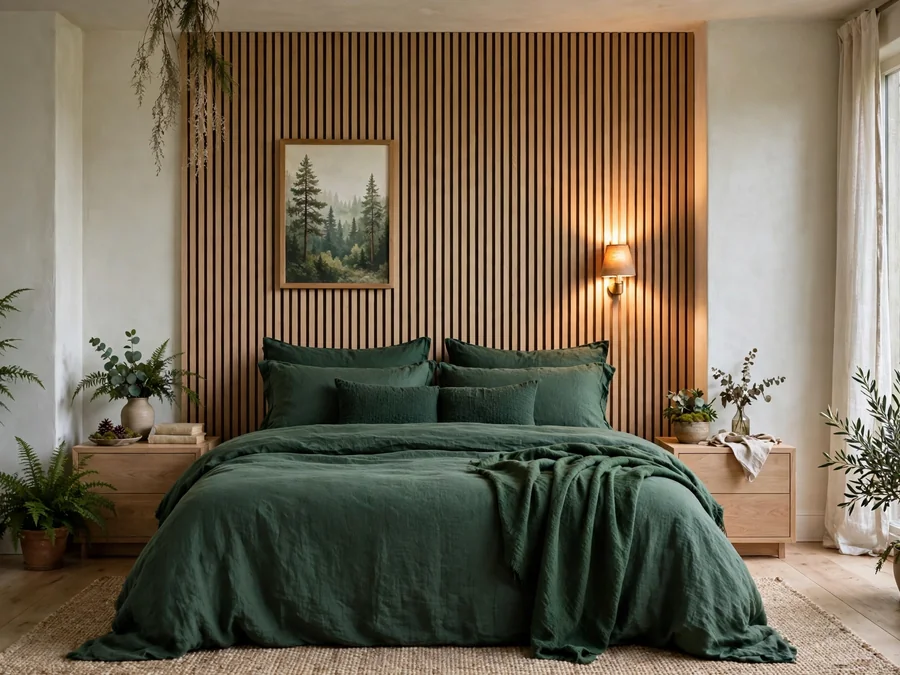
Vertical oak slats on felt backing, behind the bed and 12 inches wider than the frame each side, do two jobs. Visually, a stand of trunks behind the pillows; acoustically, the felt softens echo, so the room sounds quieter — rain, a turning page, everything gentler. Slats 1 inch wide with finger-width gaps keep it light. The trade-off: panels cost more than paint, and grooves want a monthly brush.
Get the look:
- Main piece: oak slat panel on felt, bed width plus 24 inches
- Supporting piece: plain pale wall on both sides
- Texture or material: natural oak, matte felt in moss
- Finishing touch: one amber lamp washing light up the slats
16. A Plaid-and-Oak Reading Chair by the Window
Give the wind-down a seat that is not the bed. An oak-framed chair with one wool plaid cushion in moss and rust, angled by the window with a small stool beside it, becomes the phone-free place. Reading there for twenty minutes, then bed only for sleep, teaches your brain the difference. The trade-off: in a small room it may be the only chair, and it collects clothes unless the idea 7 rail stays easier to reach.
Why it works:
- A separate seat keeps the bed for sleeping only.
- Plaid in forest colours carries the theme without a novelty print.
- Window light by day, amber lamp by night — one corner, both routines.
| Light Layer | Warmth and Brightness | Where It Sits |
|---|---|---|
| Perforated wood lantern | Warm amber, dimmable | One nightstand only |
| Amber glass bedside lamps | Warm, low and focused | Shade at pillow height |
| Ceiling light | Warm white, off by 9 p.m. | Centre of the room |
| Floor-level night-light | Faint amber glow | By the door, ankle height |
17. A Storybook Corner When a Small Guest Stays
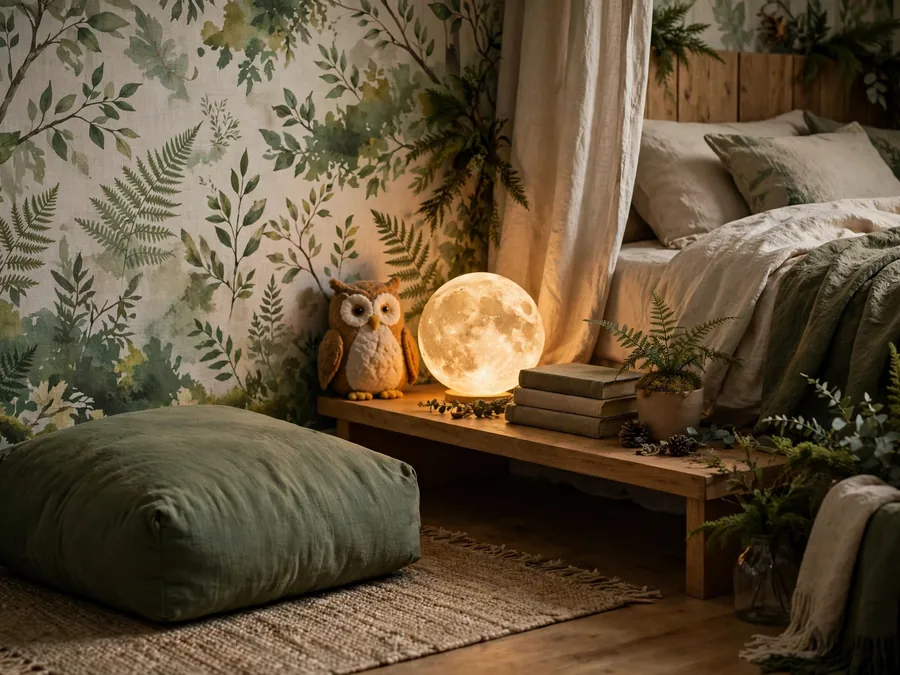
The one child-friendly idea, gentle enough for a grown-up room year-round: a floor cushion in moss cotton beside the reading chair, a round moon lamp on the low shelf, and one soft felt owl on the cushion. When a grandchild stays, it is their reading nest; on ordinary weeks, just a footrest and a lamp. Nothing is cartoonish, and nothing needs storing away. The trade-off is the moon lamp’s glow — use it on guest nights only, because even pretty light is light at sleep time.
Texture note: felt, brushed cotton and one knitted cushion — every surface is soft to a small hand, and none of it rustles.
18. A Moss-Green Rug Sized to the Bed, Not the Room
Bare feet at 6 a.m. should land soft. A flat-weave rug in moss green, extending 24 inches beyond the bed on both sides and at the foot, gives the room its forest-floor layer without the trip hazard of a small rug adrift mid-room. Flat weave: it stays put, vacuums easily and lets the frame’s legs sit level. This single green plane does more than any wall colour. The trade-off: light moss shows dust sooner than a pattern would — choose the heathered version.
Fit check: measure first — you want 24 inches visible each side and at the foot; under 18 looks like a mistake, not a choice.
19. A Stump-Stool Nightstand With a Carafe and One Stem
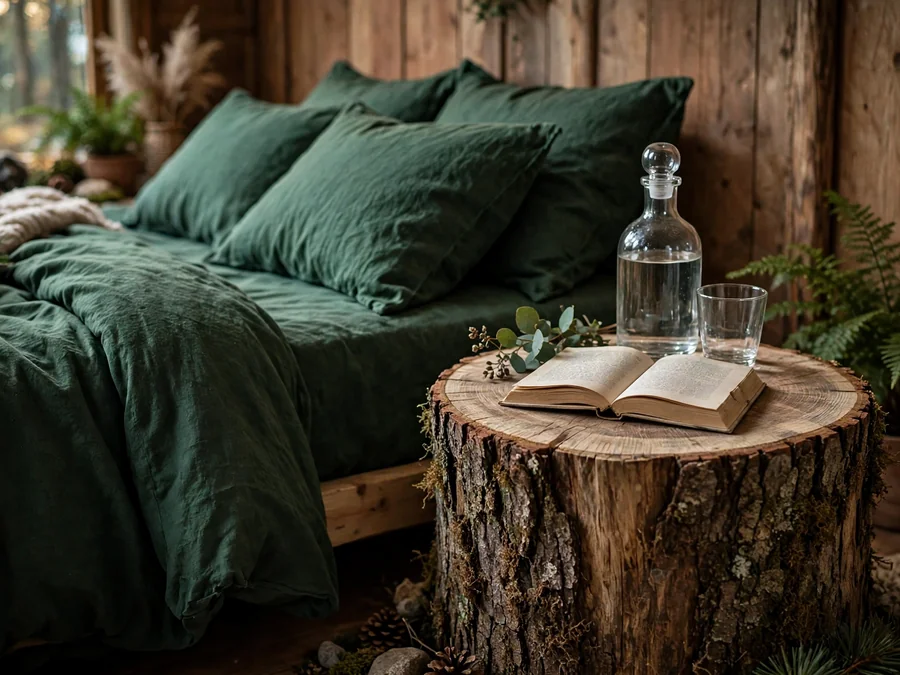
End beside the bed. A section of stump, 16 inches across and sanded on top, makes a nightstand with more woodland truth than any catalogue piece — growth rings, bark edge, real weight. On it, keep only three things: a carafe and cup, your book, and a bottle holding a single stem. That restraint is the point — a cluttered nightstand is the last thing to see before sleep. The trade-off is storage: a stump has no drawer, so the peg rail and under-bed basket take the overflow.
Budget note: firewood yards sell stump sections for the price of a coffee; the real cost is an afternoon of sanding.
From One Green Bed to a Room That Rests You
Nineteen ideas is a menu, not a workload. The room changes character with just three of them working together — one wood anchor, one graded green bed, one light lowered — and the rest can arrive across a year of small weekends. If the mood spreads beyond the bedroom door, the same pine, moss and timber palette is exactly how a forest home holds together from room to room, so nothing you start here will clash with what comes next.
Your one next step: tonight, before anything is bought or painted, move every light in the bedroom down — swap the bedside bulbs for the warmest ones in the house, switch the ceiling light off an hour before bed, and sleep once in the dusk you already own. If the room feels calmer, you have your proof, and idea 4’s deep green bed is where to spend first.