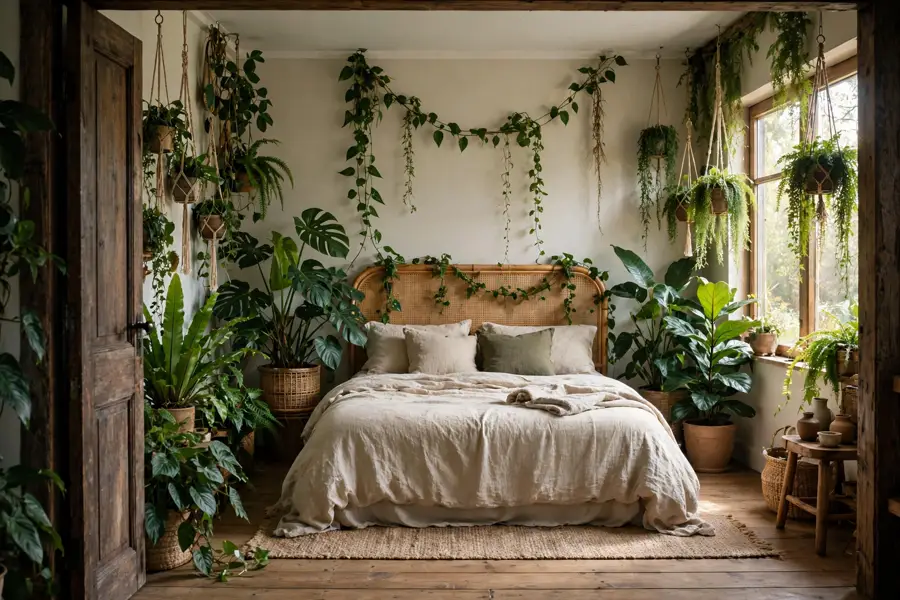
It usually starts innocently: one monstera on the dresser, then a fern beside it because the corner looked empty, then a palm you could not leave behind. A year later the bedroom holds a dozen plants, yet it still does not feel like the lush, sleep-inside-a-greenhouse rooms you keep saving. The plants are fine. What is missing is density — leaves at every height, vines claiming the frames, and green layered on green until the bed sits inside the planting instead of next to it.
That layered effect is exactly what separates a room with plants from a true jungle. The strongest bedroom jungle ideas all build the same way a forest does: a canopy overhead, a busy middle layer, and a soft understory at floor level, with the bed tucked into the middle of it. Nothing here is about restraint. It is about going dense on purpose, then running the simple care system that keeps a crowd of plants alive instead of letting it slide into a slow, crispy decline.
The 18 ideas below work as a build order. Start with measuring and one real anchor plant, stack height and vines through the middle of the list, and finish with the upkeep — watering rounds, pest patrols, and rotation — that a jungle of this size honestly demands. Skip around if you like, but do not skip the last three: density is easy to buy and hard to keep.
The Bedroom Jungle Formula That Keeps Density Looking Lush
Four principles keep a plant-packed bedroom reading as a jungle instead of a storage problem:
- Height before width: fill the vertical column first — floor, surface, and above-head layers — because a jungle is measured in layers, not in pot count.
- Odd clusters over even rows: group plants in threes and fives at different heights so the eye reads one green mass instead of a lineup of separate purchases.
- Green in at least three depths: pair deep emerald, mid green, and one lighter or variegated tone so the layers separate instead of flattening into a single dark blob.
- One care system for the whole crowd: group plants by thirst and light from day one, because 20 plants on 20 different schedules will burn out any plant keeper.
For example: a bird of paradise fanning behind the bed corner, a monstera climbing at its knee, and a pothos trailing off the dresser edge reads as one connected jungle, even though it is only three plants.
1. Measure for the Jungle Before You Buy a Leaf
A jungle fails on logistics more often than on taste. Before anything new comes home, measure the room like a grower: the ceiling height, the swing of the door, the width of the path from door to bed, and the true size of your brightest corner. A statement plant in a 12-inch pot can spread 3 feet wide within a couple of seasons, and it will claim that space whether you planned for it or not. Sketch where the floor plants, the surface clusters, and the trailers will live, and mark the walking lane that must stay clear for laundry baskets and midnight bathroom trips. The honest trade-off: measuring feels unromantic, but skipping it is how a dream jungle turns into an obstacle course.
Fit check: leave at least 24 inches of clear floor between the bed frame and the nearest floor pot, and keep every pot at least 6 inches off the wall so air can move behind the leaves.
2. Anchor the Room With One Big Statement Plant
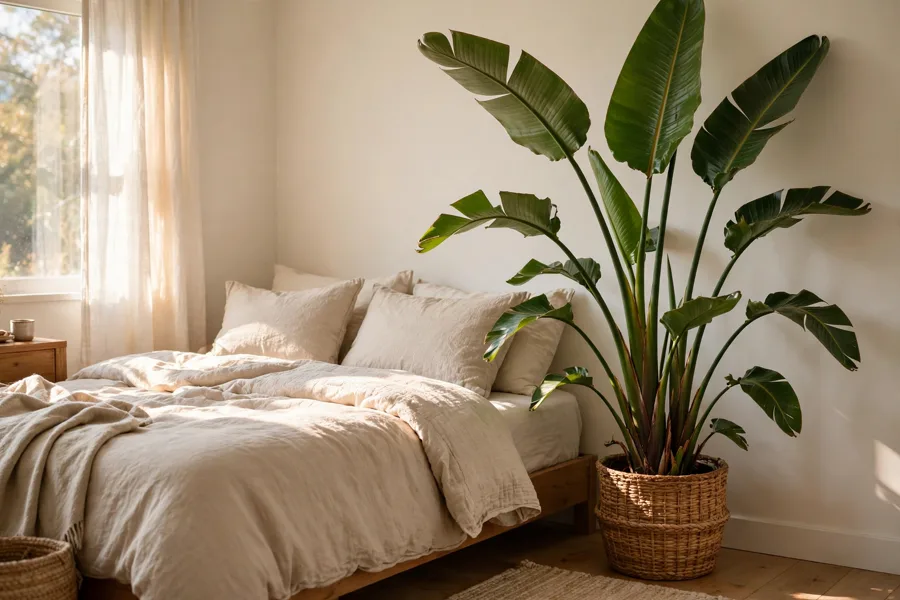
Every convincing jungle has a lead actor — one tall, architectural plant that sets the scale for everything else. A bird of paradise is the classic choice, all upright stems and broad banana-shaped leaves that fan out like a backdrop behind the bed or in the brightest corner. For a proven anchor, the Bird of Paradise from Bloomscape runs $99 and arrives as a large potted plant that is ready to hold a corner from day one. Build the rest of the planting around it rather than buying five medium plants and hoping they add up to the same presence. The trade-off is real: one big plant is one big commitment, and it will sulk if its corner turns out darker than promised.
If your green thumb is already proven by your living room plants, treat this anchor as the same instinct at a bigger scale — one plant chosen for the best light in the room, everything else cast around it.
The formula:
- Main piece: one tall statement plant, 4 feet or taller, in the brightest corner
- Supporting piece: two mid-size plants at its base to hide the pot line
- Texture or material: a woven basket or matte ceramic pot that disappears into the green
- Finishing touch: a pebble tray under the pot to protect the floor and lift humidity
3. Build a Canopy Over the Bed, Not a Tent On It
The canopy is what makes a jungle bedroom feel immersive — foliage overhead when you lie down. The living version comes from trailers, not fabric: set pothos or heartleaf philodendron on a high shelf or rail behind the headboard and train the vines outward along the wall and ceiling line with small clear clips, so the leaves hang above the bed zone while every stem stays off the pillows. Give each vine a direction and it will follow it. The trade-off: vines shed the odd leaf, and a runner left untrimmed will eventually reach the bed, so this layer needs a monthly tidy. If you have ever wanted to fall asleep feeling sheltered rather than exposed, this is the layer that does it.
Texture note: mix one fine trailer with one bold one — delicate philodendron strands against big pothos leaves keep the canopy from reading as a single green curtain.
4. Flank the Bed With Twin Floor Plants
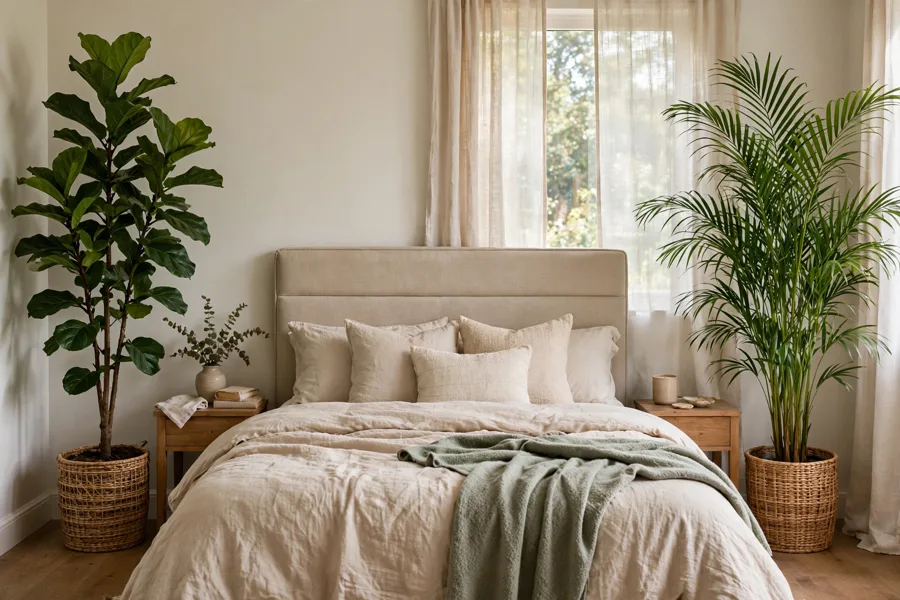
Symmetry is the jungle’s secret structure. Set a tall floor plant on each side of the bed — two dracaenas, two palms, or two fiddle-leaf figs of similar height — and the bed suddenly sits inside a green frame, the way a clearing sits between trees. Matching pairs keep the density from looking accidental, and the vertical lines make a low bed feel grander. Keep the crowns just above headboard height so the frame reads clean. The honest downside: plants this close to the bed compete with nightstands, so lamps and books get squeezed, and a bushy specimen will steal reading light if it leans in. Choose slim, upright growers rather than wide spreaders for this job.
Best for: bedrooms with a wide wall behind the bed and at least 18 inches of floor on each side of the frame.
5. Frame the Window in Living Green
A window already has a frame; a jungle window wears a second, living one. Train a climbing philodendron or pothos up one side of the trim, across the top, and partway down the other side, clipping stems to the wall rather than the glass. The leaves silhouette against the daylight all day, and the window stops being a hole in the planting and becomes its brightest picture. Keep the middle of the glass clear so the room keeps its light. The trade-off: vines can mark paint where they grip, and stems will always lean toward the glass, so expect to re-clip and turn the pot as it grows.
Why it works:
- Backlit leaves glow all day, so the jungle looks alive even from the doorway
- The frame uses wall space the plants would never otherwise claim
- A green border makes even a plain view outside feel like part of the planting
| Statement plant | Indoor height | Light it insists on | Jungle job |
|---|---|---|---|
| Bird of paradise | 5–7 feet | The brightest spot you have | Tall fan of leaves as the room’s backdrop |
| Monstera | 6–8 feet on a pole | Bright, indirect | Climbing mid-canopy with split statement leaves |
| Fiddle-leaf fig | 6–10 feet | Bright and steady, no dark corners | A straight green trunk line that anchors a corner |
| Kentia palm | 6–8 feet | Tolerates medium light | Soft arching fronds that soften hard corners |
6. Stack a Skyline of Heights on the Dresser
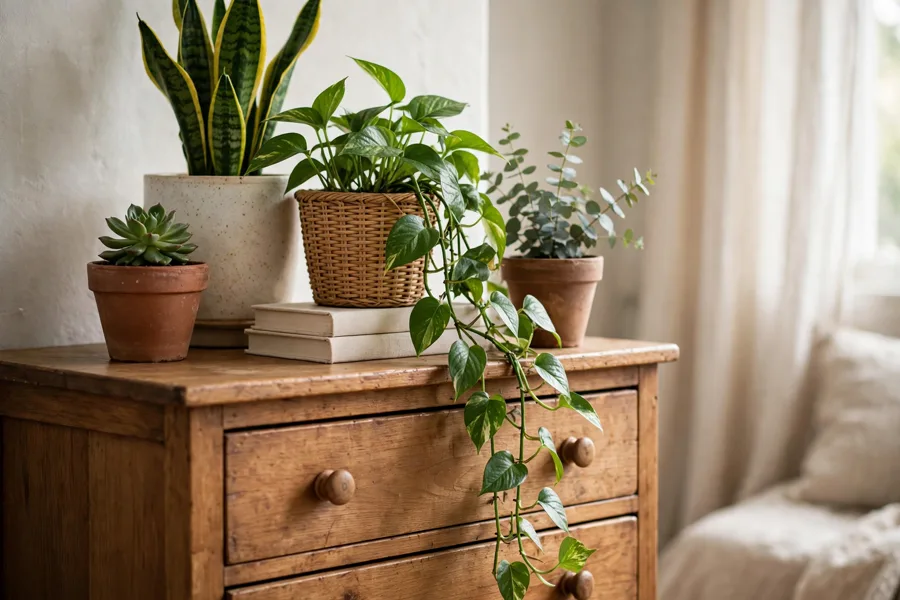
A dresser in a jungle bedroom is not storage with a plant on it; it is a planting bed with drawers. Build it like a skyline: the tallest plant at the back corner, mid-size pots stepping down across the middle, and one trailer spilling over the front edge. Leave a landing strip at the front — about a hand’s width — for the things the dresser still has to hold. The trade-off is maintenance friction: every pot must move for dusting, and one overwatering leaves a ring on the wood, so saucers or a long tray under the whole cluster are non-negotiable. Readers with a dresser that currently holds one lonely candle, this is your fastest square footage of jungle.
Space note: cap the cluster at two-thirds of the dresser top; a fully covered dresser stops being usable furniture within a week.
7. Go Green on Green With Paint and Leaf Tones
White walls make plants look like exhibits; green walls make them look like a habitat. A deep green behind the bed — or bedding and curtains in layered greens — lets real leaves read richer, because the eye stops separating plant from background and takes in one deep field of green. Keep at least three depths in play: a dark base, a mid green, and one pale or silvery leaf, like a satin pothos, to catch light. The honest trade-off: dark paint can make a small or north-facing room feel cave-like, so test a large swatch and keep the bedding on the lighter side of the palette.
It borrows the mood-first thinking behind these cozy bedroom ideas and simply swaps the soft neutrals for saturated green.
Color note: match the paint to the leaves, not the other way round — hold a monstera leaf against the swatch card and pick the shade one step darker than the leaf.
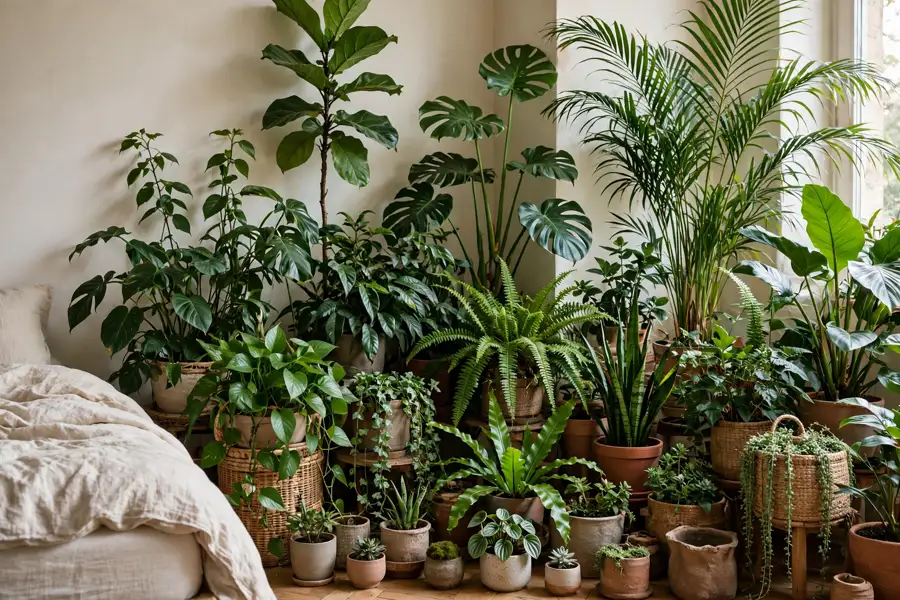
8. Turn One Corner Into a Full Green Corner
Pick the corner nearest the window and commit to it completely: floor to nearly ceiling, nothing but plants. Start with the tallest plant at the back, build a middle ring of medium pots on the floor and a low stand, then tuck trailers on a small shelf or stool so their vines stitch the levels together. A dedicated green corner gives the whole room its jungle headline, and it concentrates care in one place. The downside nobody mentions: corners are where watering cans forget to go, so put the thirstiest plant at the front edge where you will see it wilt first. If your bedroom has one dead corner doing nothing, this is its promotion.
Get the look: tallest plant at the back, mediums in the middle, one trailer up high, one small plant at the front — then step back and fill only the gaps you can actually see.
9. Frame the Mirror With a Living Vine
A dresser or wardrobe mirror is the jungle’s best amplifier: frame it with a real vine and the reflection doubles every leaf in the room. Train a pothos or philodendron around the mirror’s edges with removable clips, keeping the stems on the frame and the wall, never across the glass. Start sparse — a vine fills in fast, and a frame that is too dense swallows the reflective center that makes the trick work. The trade-off: bedroom mirrors fog and gather dust, and cleaning glass through a curtain of stems is fiddly, so leave one corner of the frame bare as your access point. Check the fit monthly; a happy vine can outgrow its frame in a single season.
Fit check: keep vines to the outer 2 inches of the frame and leave at least 70 percent of the glass uncovered, or the mirror stops working as a mirror.
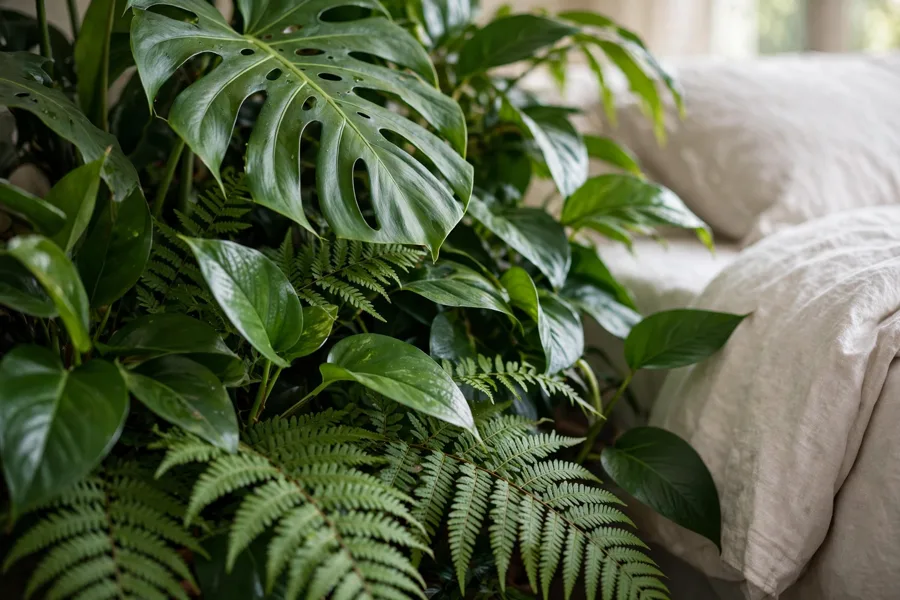
10. Layer Leaf Shapes the Way You’d Layer Fabric
Density looks rich when the leaves themselves vary. Build every cluster from three shape families: one bold and architectural (monstera, bird of paradise), one fine and feathery (fern, palm), and one glossy and simple (rubber plant, hoya). Repeat those same three families around the room and the jungle feels designed rather than accumulated. The trade-off: shape layering tempts you into one of everything, and a dozen species means a dozen slightly different thirsts. Cap the variety — three or four species repeated boldly will always beat ten species used once. Stand in the doorway when you judge it; a jungle is read from six feet away, not from beside the pot.
Style note: if a cluster looks flat, the fix is almost never another plant — it is a different leaf shape next to the ones already there.
11. Run a Trailer Along the Headboard Wall
Above the headboard is the most underused planting real estate in the bedroom. Mount a long picture ledge or a slim shelf 12 to 18 inches above the headboard and line it with trailing pothos, string of turtles, and philodendron, letting the vines fall in uneven lengths like a green fringe. Nothing touches the bed, yet the whole sleeping zone sits under foliage. The trade-off: everything on that ledge must be watered from a stool, and a pot knocked at that height makes a real mess, so use lightweight pots, secure them, and water with a small spouted can. Measure twice here — the ledge must be shallower than the headboard is deep.
Texture note: alternate a fine trailer with a chunky one along the ledge; the uneven rhythm of leaf sizes is what keeps the fringe looking wild instead of trimmed.
| Jungle layer | Height zone | Fill it with | The job it does |
|---|---|---|---|
| Canopy | Above 5 feet | Trailers on shelves and rails, tall crowns | Foliage overhead, so the bed feels sheltered |
| Mid-story | 2–5 feet | Monstera on a pole, medium palms, rubber plant | The main green mass at eye level |
| Understory | 1–2 feet | Ferns, calathea, fittonia on stands and dressers | Soft texture that fills the gaps |
| Ground line | Floor level | Big floor pots, statement plants | Anchors the whole planting to the room |
| Edges | Frames and lines | Pothos and philodendron vines | Stitches windows, mirrors, and shelves into the green |
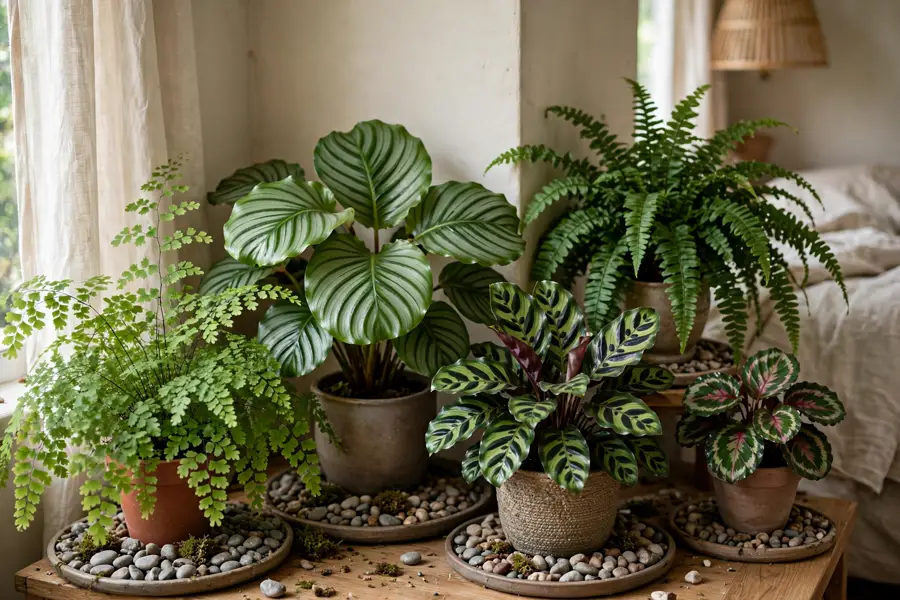
12. Give Humidity-Lovers Their Own Microclimate Corner
Ferns, calatheas, and fittonias sulk alone in a dry bedroom and thrive shoulder to shoulder. Group them in one dedicated corner on pebble trays, pots nearly touching, so every watered plant humidifies its neighbors — a small shared microclimate instead of a humidifier fighting the whole room. Keep the group near, not in, the brightest light, and park a small watering can in the corner permanently; this is the cluster that punishes forgetfulness first. The honest trade-off: a humidity corner is the highest-maintenance square in the jungle, and if your schedule cannot stretch to it, swap the ferns for tougher peperomias and keep the look without the drama.
Easy swap: no pebble trays? A wide, shallow bowl of water tucked behind the pots does half the job while you source them.
13. Let the Pots Carry a Second Color Story
When the leaves are all green, the pots become the room’s other design decision. Pick one pot family — weathered terracotta, matte black, or woven baskets — and repeat it at every size, so 20 plants read as a collection instead of a yard sale. A single repeated pot style also calms the visual noise that density creates, and it makes new additions easy: if it is not in the family, it does not come home. The trade-off is weight and cost at scale; terracotta is heavy on shelves and baskets hide whether soil is dry, so keep the biggest plants in the lightest pots that still look the part.
Budget note: one pot family bought in multiples costs less per pot than single statement pieces, and plain nursery pots slipped inside baskets count — nobody sees the inner pot.
14. Water in Rounds, Not in Panic
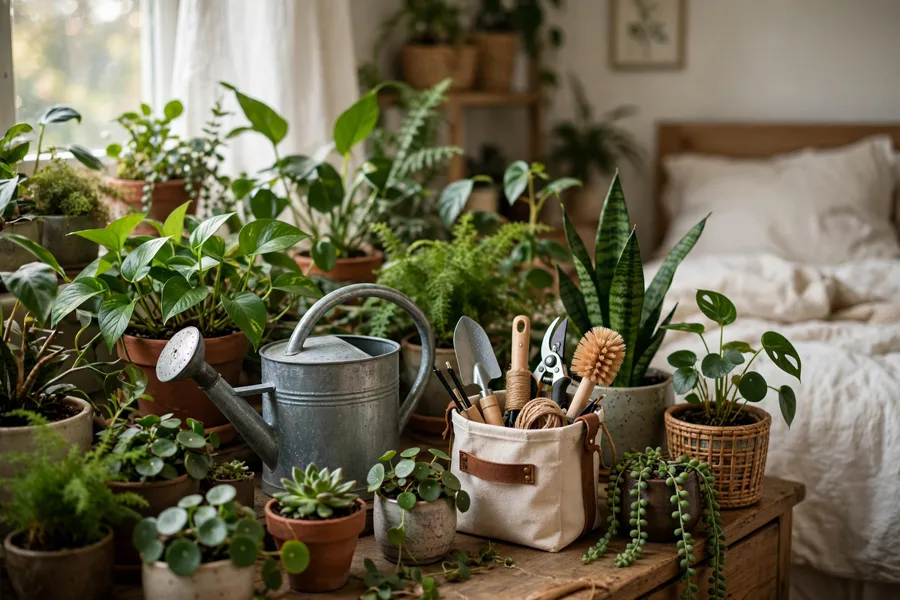
Twenty plants do not get watered plant by plant; they get watered in rounds. Sort the jungle into two thirst groups when you place it — the weekly drinkers and the every-two-weeks crowd — then run one round per group on fixed days, carrying water in a tray or caddy and checking soil with a finger or a wooden skewer as you go. Bottom-water the dresser and shelf clusters by standing them in a tray for twenty minutes where they sit. This is the system that keeps density sustainable. The trade-off: a full round takes real, unglamorous time, so attach it to something you already do — a podcast, a Sunday playlist — or it will quietly stop happening.
Why it works:
- Grouping by thirst means no plant is drowned or droughted by a one-size schedule
- A fixed route through the room means no corner plant is forgotten for a month
- Checking soil as you go catches problems while they are still one yellow leaf
15. Rotate Everything a Quarter Turn
In a dense jungle, light is a shared resource and the front row hogs it. Build rotation into the routine: small and medium pots get a quarter turn every time you water them, and once a month the back row and the front row of each cluster trade places, so the plants hidden behind the monstera get their weeks in the bright seats. Mark the schedule on painter’s tape under the pots if your memory needs help. The trade-off: the biggest floor plants are genuinely heavy to spin, so set them on plant caddies or furniture pads from the start — retrofitting a caddy under a 6-foot palm is a two-person job.
Space note: rotation only works if clusters are planted with a hand’s width of slack; pack pots rim to rim and nothing can turn.
16. Run a Weekly Pest Patrol With a Flashlight
Pests are the jungle tax, and they travel fast in a crowd where leaves touch leaves. Once a week, take a flashlight and walk the room slowly, checking the undersides of leaves and the joints of stems for the early signs — webbing, sticky residue, tiny white tufts. Catching spider mites or mealybugs on one plant is a wipe-down with a damp cloth and a few weeks of isolation; catching them after they have crossed three touching plants is a project. The trade-off is vigilance itself: ten unhurried minutes, every week, forever. Skip the patrol for a month in a dense bedroom and the jungle will eventually introduce you to its wildlife.
Best for: any cluster where leaves overlap — the tighter the jungle, the more this habit matters.
| Care task | Rhythm | What it involves |
|---|---|---|
| Watering round | Twice a week | Walk both thirst groups with a caddy; water only the pots that test dry |
| Leaf check | Weekly | Flashlight under leaves and along stems; wipe anything suspicious |
| Quarter turn | Every watering | Turn small pots; swap cluster front and back rows monthly |
| Dusting | Monthly | Damp cloth on the big leaves — dusty leaves photosynthesize poorly |
| Reset and prune | Each spring | Cut back legginess, root the prunings, repot what has outgrown its pot |
17. Build the Nightstand Jungle Shelf
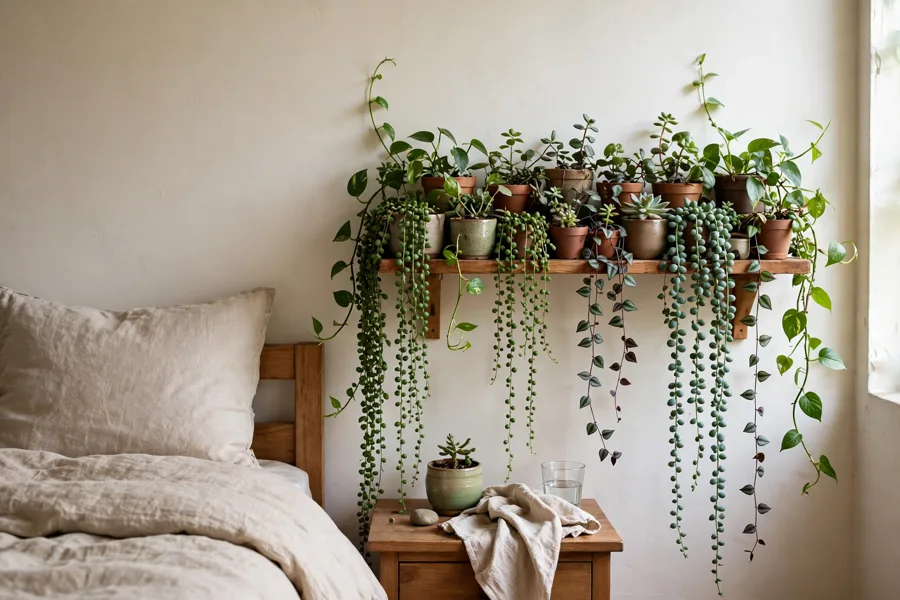
The last bare surface in most bedrooms is the wall beside the nightstand — spend it on green. Mount one sturdy shelf at pillow height-plus, roughly above the lamp’s glow, and crowd it with small plants: a trailing peperomia over the edge, a compact fern, one glossy little statement like a hoya. Treat the shelf run the way you would any bedroom wall decor — one deliberate green line at eye level when you sit up in bed. The trade-off: watering above a lamp and books demands care, so everything on this shelf lives in a cache pot with no drainage surprises. It is the layer of jungle you actually see last at night.
The formula:
- Main piece: one trailing plant spilling over the shelf edge
- Supporting piece: two compact upright plants in the family’s pot style
- Texture or material: a warm wood shelf that matches the nightstand
- Finishing touch: the lamp below it, so the leaves catch light from underneath at night
18. Prune for Density, Not for Tidiness
A jungle stays thick because it is cut back on purpose. Pinching the growing tips of trailers and leggy stems forces side shoots, and side shoots are what density is actually made of. Root the pruned cuttings in water and plant the best of them back into the mother pot or a gap in a cluster — the jungle literally thickens itself. Work in rhythm with the seasons: spring is for hard pruning, repotting, and rearranging while growth is fast; winter is for leaving the plants alone beyond water and light. The trade-off: a freshly pruned plant looks worse for a few weeks, and impatience with that phase is how jungles get replaced instead of renewed.
Seasonal swap: in winter, swap the pruning shears for restraint — cut the watering rounds down, stop feeding, and let the jungle rest until the light returns.
Living With the Jungle You Built
A bedroom jungle is not a weekend project with an end date; it is a small ecosystem that happens to contain a bed. Build it in layers — anchor, canopy, clusters, corners — and it will look intentional from the first week. Keep it with systems — watering rounds, a pest patrol, a quarter turn here and there — and it will still look intentional in year three, which is the part most plant-packed bedrooms never reach. The plants will keep growing into the room. Your job is simply to keep up with them.
Your one next step: stand in your bedroom doorway with a tape measure, find the brightest corner, and measure it properly — then order or bring home the one tall anchor plant that corner deserves, and let the jungle build outward from there.