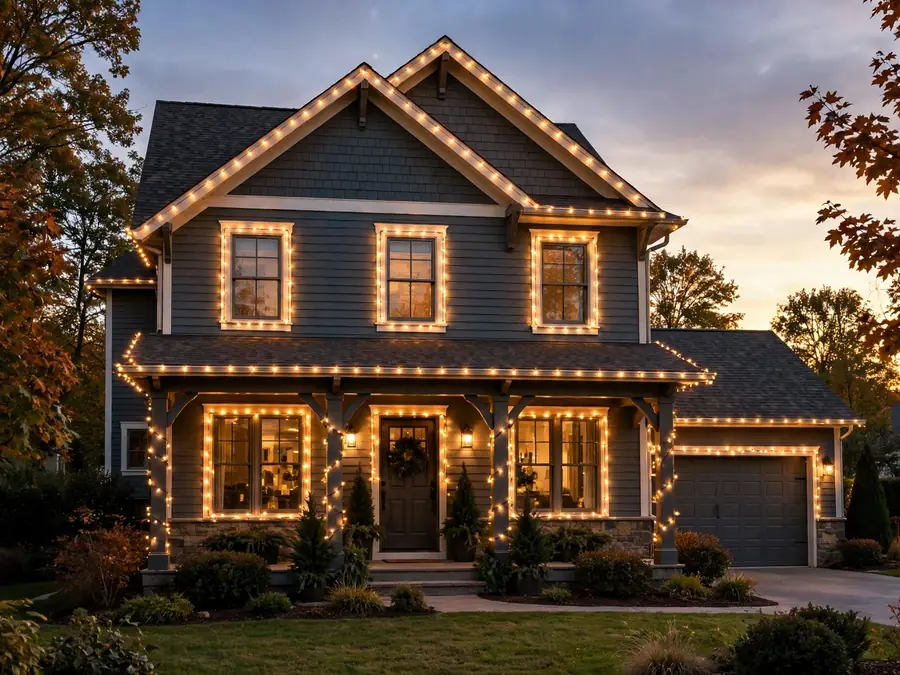
House lights are the display everyone on the street actually sees, yet most homes end up with the same accidents: lines that sag between clips, warm bulbs mixed with cool ones from a leftover box, and one heroic ladder session that nobody wants to repeat. The result looks accidental, as if the lights landed on the house rather than being designed for it.
The houses that look professionally lit all follow the architecture instead. Straight lines trace the rooflines, frames of light pick out the windows and doors, one color story runs from gutter to porch, and clips, poles and timers quietly do the dangerous and tedious work in the background.
Here are 19 ideas for lights on the house itself, every one of them planned from the ground, hung safely with feet kept low, and set to switch on together at dusk so the whole design appears at once, every night of the season.
The House Lights Formula That Keeps Bright Looking Classy
- Follow the architecture: rooflines, eaves, windows and doors are the pattern; lights just trace what the house already draws.
- One color story per house: warm white alone, or a deliberate pattern, but never the leftover-box mixture.
- Clips and poles, not ladders and staples: gutter and shingle clips with an extension pole keep feet low and wires undamaged.
- Timers make it a system: everything wakes at dusk together, so the design appears as one piece, every night.
For example: warm-white C9s clipped dead straight along the front gutter (architecture, one color), icicles on the porch eave, windows framed in matching minis (traced features), all on one timer set for five o’clock (system) give a house that looks professionally lit from the street.
| # | Idea | Best For | Budget |
|---|---|---|---|
| 1 | Roofline C9 Bulbs in a Dead-Straight Line | The classic outline | Mid |
| 2 | Under-Eave Spotlights Washing the Walls in Warm Light | Architecture lit like a hotel | Mid |
| 3 | Gable Peaks Outlined Right to the Ridge | Architecture, traced | Mid |
| 4 | Garage and House Lines Matched in One Style | Two structures, one display | Low to mid |
| 5 | Front Door Frame Wrapped in Lighted Garland | The welcome, lit | Low to mid |
| 6 | Columns Wrapped in Spirals of Warm White | Porch pillars with presence | Low |
| 7 | Chimney Outline Rising Above the Roof | A silhouette in the sky | Mid to high |
| 8 | Two-Story Symmetry: Matching Lights on Both Levels | Balanced tall houses | Mid |
| 9 | Porch Ceiling String Lights in Straight Rows | A lit ceiling outdoors | Low to mid |
| 10 | Ridge Line Lights for a Rooftop Glow Line | The spine of the display | Mid to high |
| 11 | Bay Window Icicles Hung at Two Lengths | Layered sparkle | Low to mid |
| 12 | House Corners Strung with Vertical Light Drops | Edges that define the shape | Mid |
| 13 | All Warm White for a Classic Manor Look | One color, full confidence | Mid |
| 14 | Red and White Alternating Roofline Pattern | Candy-cane order | Mid |
| 15 | Spotlit Wreath Centered High on the Gable | One hero, high up | Low to mid |
| 16 | Lights Behind the Shutters for a Halo Edge | A glow with no visible source | Low |
| 17 | Timer-Synced Whole-House Switch-On at Dusk | The nightly reveal | Low |
| 18 | Hidden Cords: Clips, Channels and Matching Wire | The invisible work | Low |
| 19 | The Photo Test: One Drive-By Check at Night | Quality control from the car | Very low |
1. Roofline C9 Bulbs in a Dead-Straight Line
Run warm-white C9 LED bulbs along the front gutter in one unbroken line, each bulb clipped upright with all-in-one shingle-and-gutter clips spaced about 30 cm apart so every glowing tip sits at the same height. Choose opaque ceramic-look bulbs for a soft, classic glow rather than clear ones, and keep the wire pulled gently taut between clips so no loop sags between bulbs. From the street, the roofline reads as a single ruled line of light tracing the whole front of the house.
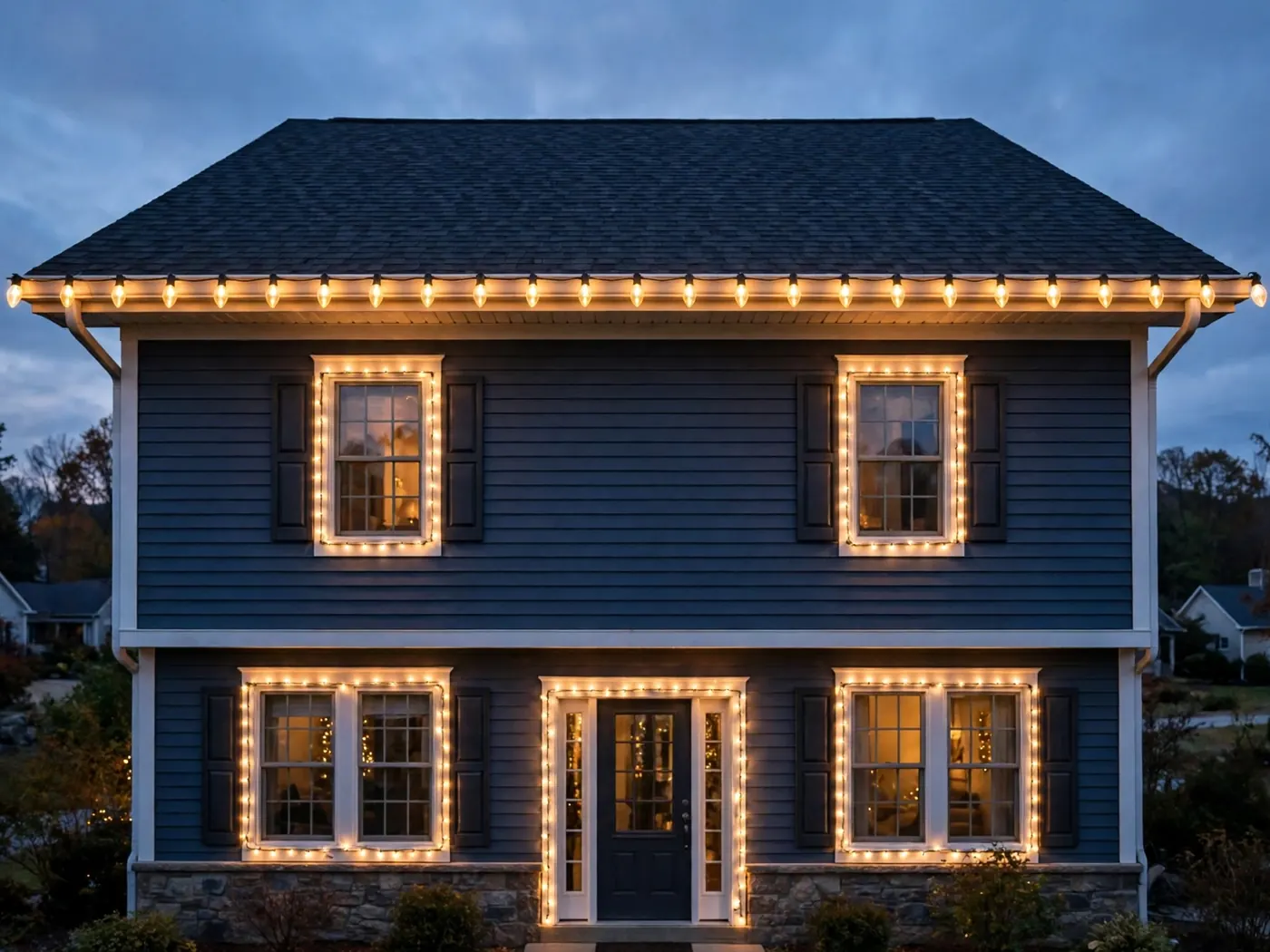
Best for: Ranch and two-story homes with a long, straight front gutter that faces the street.
2. Under-Eave Spotlights Washing the Walls in Warm Light
Mount three or four small warm-white LED spotlights under the eaves, angled down so their beams wash the front walls in soft pools of light between the windows. Space them evenly, roughly 1.5 to 2 metres apart, and pick narrow 2700K beams so the brick or siding glows the way hotel facades do at night. Nothing hangs or dangles; the light itself becomes the decoration, and the house’s own texture does the showing off.
Space note: On a two-story frontage, one spotlight per window bay is plenty; wider spacing keeps the wash elegant instead of floodlit.
3. Gable Peaks Outlined Right to the Ridge
Trace both sloping edges of the front gable with warm-white C9 strings, meeting exactly at the ridge peak so the triangle of the roof is drawn in light. Use shingle clips on the slopes and a single clip anchor at the peak, keeping every bulb pointing outward at the same angle. The outline turns an ordinary roof bump into the house’s signature shape after dark, visible from the end of the street.
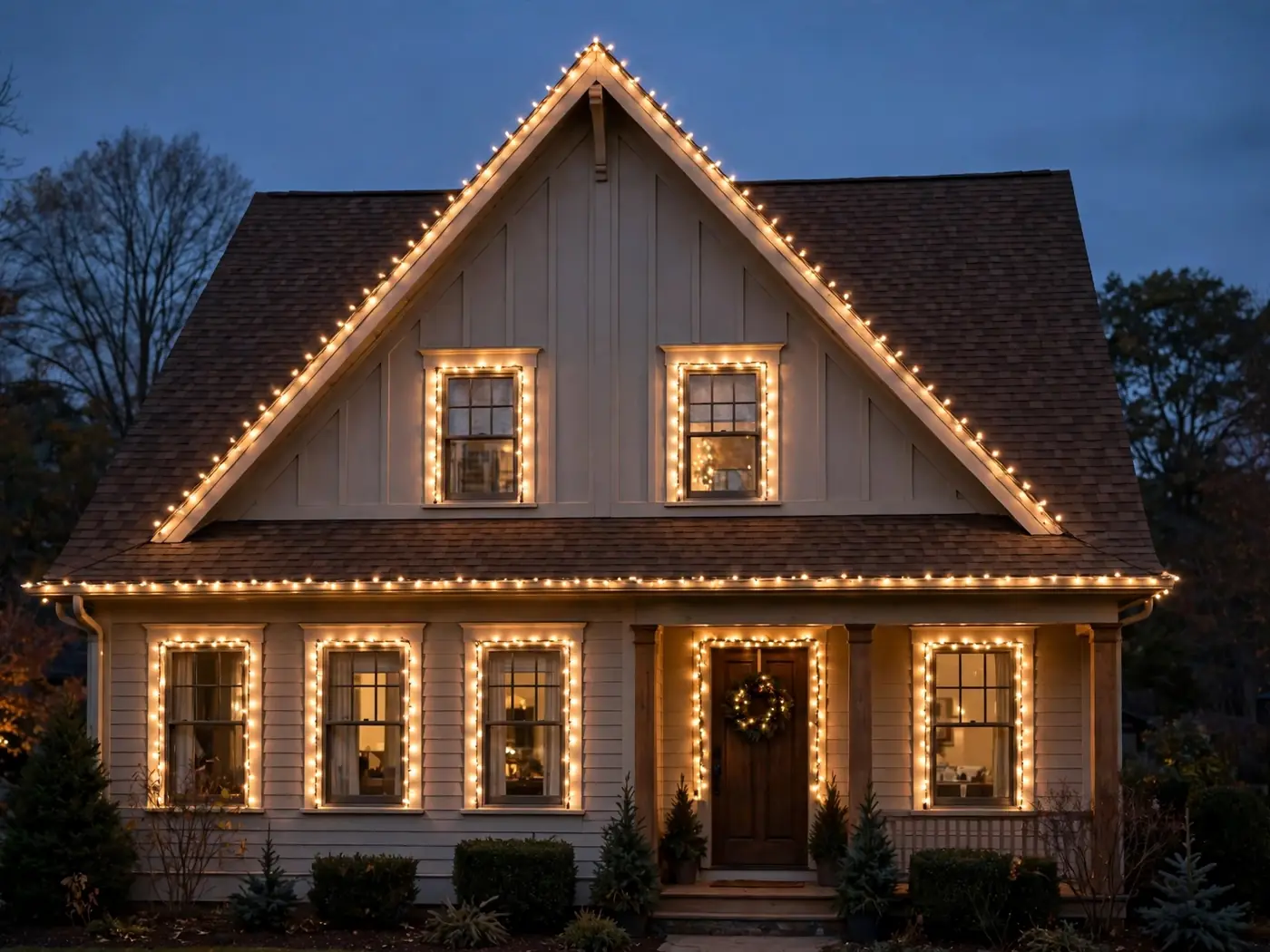
Fit check: Measure each slope with a string first and buy for that length plus one metre, because a run that stops 30 cm short of the peak ruins the symmetry.
4. Garage and House Lines Matched in One Style
Repeat the exact same bulb, color and clip spacing on the garage that you used on the house roofline, whether the garage is attached or sits a few metres away. Warm-white minis outlining the garage door frame and a matching C9 run along its eave make the two buildings read as one planned display instead of two separate weekends of work. Keep both on the same timer channel so they switch on together.
Style note: Matching bulb temperature is the whole trick; two shades of white side by side looks like a mistake, while identical bulbs look deliberate.
5. Front Door Frame Wrapped in Lighted Garland
Frame the front door with a pre-lit faux-pine garland, 2.7 metres long, studded with warm-white mini lights and hung on clear adhesive hooks along the top and sides of the trim. Let it sit flat against the frame rather than swagging, so the doorway becomes a glowing rectangle that pulls every eye to the entrance. Add one plain red bow at the top centre only, and let the light do the rest.
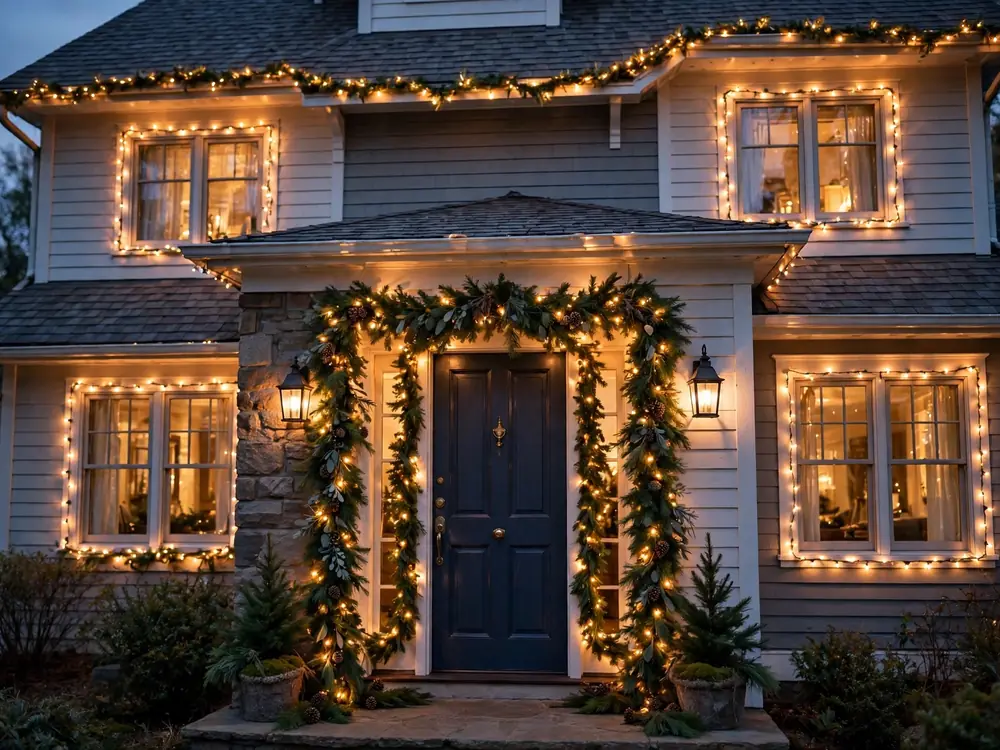
Easy swap: Swap the red bow for a gold or plaid one to shift the doorway from classic Christmas to a smarter, tailored welcome.
6. Columns Wrapped in Spirals of Warm White
Wrap each porch column with a warm-white mini-light string in an even spiral, turns spaced about 20 cm apart from capital to base, secured with clear clips at top and bottom so nothing slides. Two matching columns lit the same way turn a plain porch into a pair of glowing pillars, and the spiral rhythm looks deliberate even in daylight when the lights are off. For the wider picture, these exterior christmas light ideas pair the house display with the spaces around it.
Seasonal swap: After New Year, rewrap the same columns with the lights alone and no garland for a clean winter-evening glow that carries through to spring.
7. Chimney Outline Rising Above the Roof
Outline the chimney where it rises above the roof with warm-white C9s clipped along its top rim and down both visible edges, so the house gains a small glowing tower against the night sky. Use a single string so the color matches perfectly, and route the lead wire down the back slope where nobody sees it. It is the one element drivers notice from two streets away.
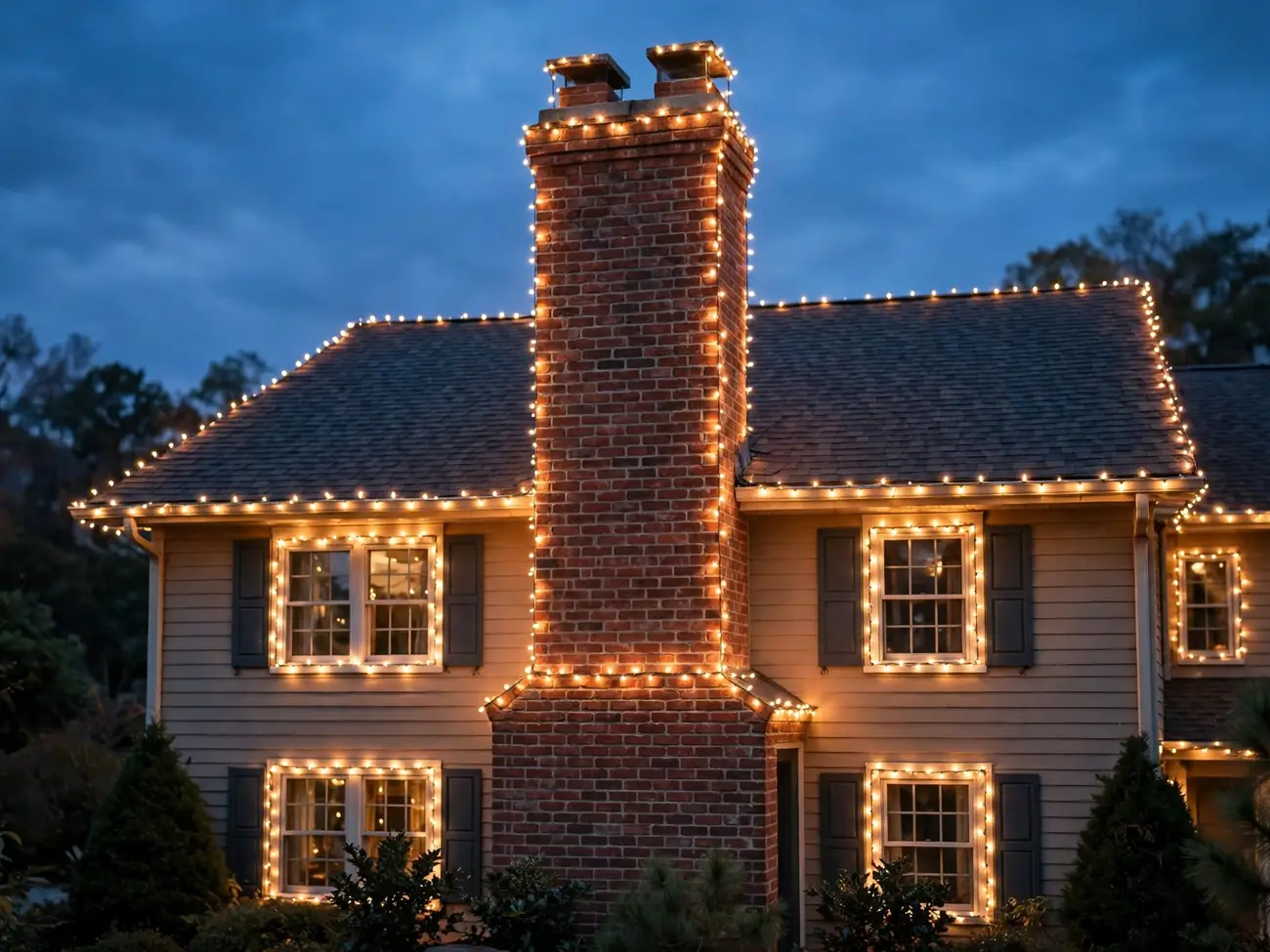
Why it works:
- It adds height, so the whole display feels taller and grander.
- The chimney is already a focal point, so lighting it feels natural.
- A single short string covers it, making the impact cheap for its size.
8. Two-Story Symmetry: Matching Lights on Both Levels
Give a two-story house the same treatment on both levels: a warm-white C9 line along the main roofline, then the identical line repeated along the first-floor eave or porch roof below it. Frame the upstairs windows to match the downstairs ones, with the same bulbs, spacing and color. The repetition makes height look intentional and grand rather than top-heavy, and from the street the house reads as one stacked, balanced design.
Budget note: Buy the second level’s strings in the January sales for next year; identical warm-white C9s are the easiest stock to match later.
9. Porch Ceiling String Lights in Straight Rows
String warm-white globe lights across the porch ceiling in three or four straight parallel rows, each row fixed with screw-in hooks spaced about a metre apart so the lines stay ruler-straight. The rows turn the ceiling itself into a canopy of light that glows down onto the door, the mat and anyone standing there. Christmas lights have dressed porches for over a century, and this is their most architectural form: light as a ceiling, not a tangle.
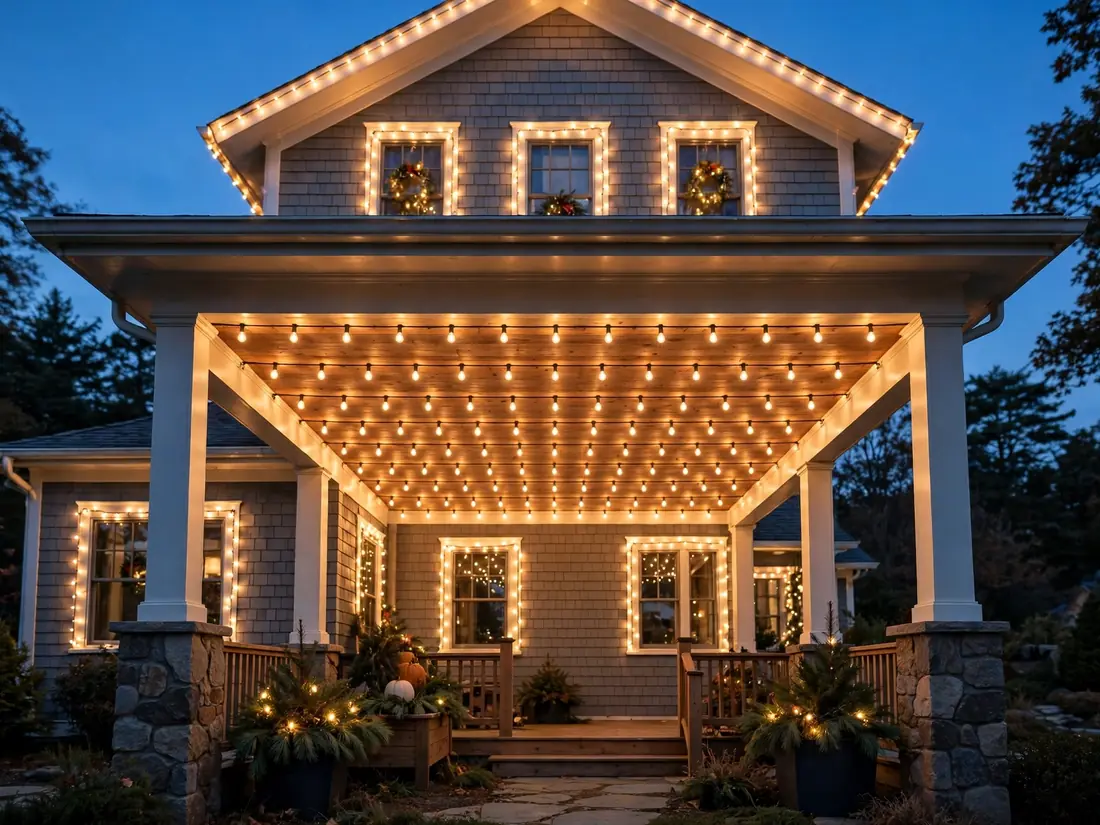
The formula: straight ceiling rows + matching door-frame minis + one timer for the whole porch.
10. Ridge Line Lights for a Rooftop Glow Line
Run a single line of warm-white C9 bulbs along the very ridge of the roof, clipped with ridge clips that grip without nails, so the house gains a glowing spine from gable end to gable end. Keep it to the front-facing ridge only, and let this be the highest line in the whole display. Paired with a gutter line below it, the two parallel lines frame the roof plane beautifully.
Get the look:
- Main piece: Warm-white C9 string on ridge clips along the peak.
- Supporting piece: Matching C9 gutter line one level down.
- Texture or material: Opaque ceramic-look bulbs against dark shingles.
- Finishing touch: Both lines on one timer, switching on together.
11. Bay Window Icicles Hung at Two Lengths
Hang two icicle strings across the bay window’s eave at staggered lengths, the drops alternating between about 45 and 70 cm, so the sparkle falls in two soft tiers instead of one flat curtain. Warm-white LEDs keep the tiering gentle, and because the bay projects from the house, the light catches three angles of glass at once. If the ground below needs its own dressing, christmas yard decor ideas handle the lawn while the house keeps the light show.

Color note: Stay with one warm white throughout; icicles mixed with cool-white roofline bulbs make the bay look like a different house entirely.
12. House Corners Strung with Vertical Light Drops
Mark each front corner of the house with a vertical drop: a single string of warm-white minis run straight down the corner boards from eave to ground, clipped every 40 cm so the line stays plumb. Two lit corners bookend the whole facade and quietly explain the house’s shape in the dark, like the corner lines on a drawing. Keep the drops plain, with no garland, so the geometry stays crisp.
Texture note: Against brick, the small steady points read as a dotted seam; against smooth siding they reflect faintly and look almost doubled.
13. All Warm White for a Classic Manor Look
Commit the whole house to warm white and nothing else: C9s on the roofline, minis on the windows and door, icicles on the porch eave, all in the same 2700K glow. The discipline is the decoration. Without any color competing, the architecture becomes the pattern, and even a modest house takes on the calm, expensive look of a manor at Christmas. Buy every string in one trip so the whites truly match.
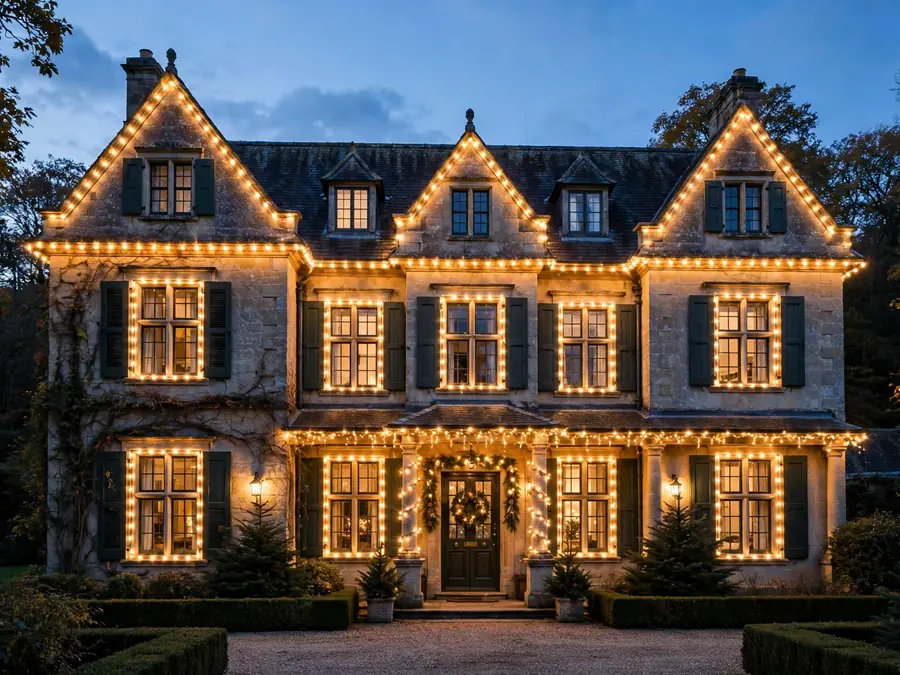
Best for: Brick, stone and white-painted houses where one warm glow flatters the material instead of fighting it.
14. Red and White Alternating Roofline Pattern
Build the roofline from alternating red and warm-white C9 bulbs, one for one, all the way along the gutter, using a custom-spaced string or a swappable-bulb C9 set so the pattern never breaks. The candy-cane rhythm is cheerful but completely orderly, and it reads from far down the street as a deliberate design rather than random color. Keep every other element on the house plain warm white so the pattern owns the show.
Space note: The pattern needs a long, straight run to read properly; on short or broken rooflines, limit it to the longest single stretch.
15. Spotlit Wreath Centered High on the Gable
Hang one oversized wreath, 90 cm across, centred high on the front gable, and light it with a single warm spotlight mounted on the eave below so the circle glows like a moon against the siding. A plain green wreath with one red bow is enough; the height and the spotlight do the drama. It is the natural peak of front porch christmas decor ideas taken up the wall: one hero piece, perfectly placed.
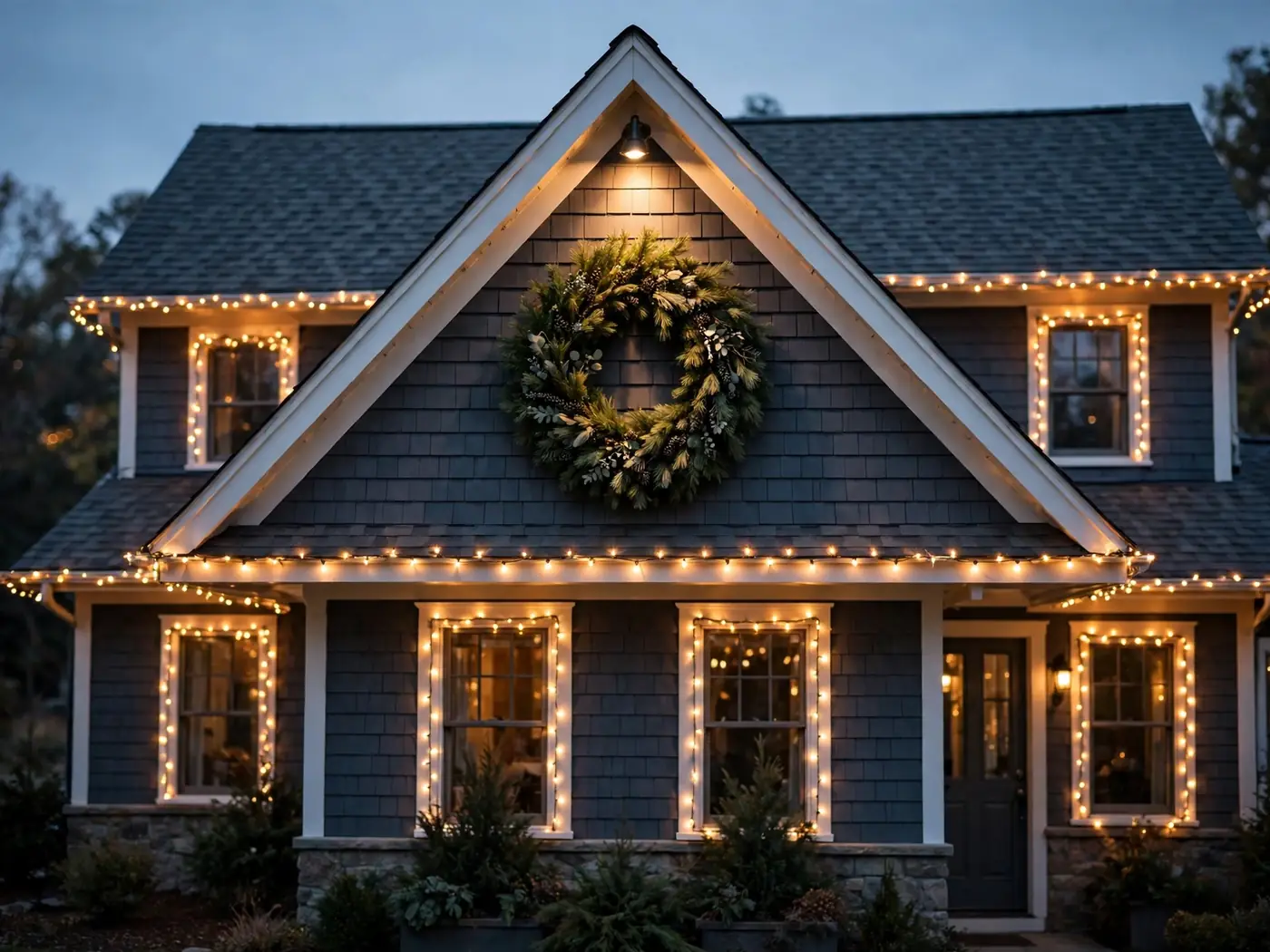
Fit check: Stand at the street and centre the wreath on the gable’s peak line, not the wall; from below, centred-on-peak is what reads as centred.
16. Lights Behind the Shutters for a Halo Edge
Slip a warm-white mini string behind each pair of front shutters, clipped along the inner edges so no bulb is directly visible and the light spills out as a soft halo around the shutter frames. The windows gain a gentle backlit edge, like light leaking from a cosy room, and in daylight the hardware is almost invisible. Match the halo color to the window frame lights so the whole wall agrees.
Style note: The hidden source is the luxury here; light you can feel but cannot find always looks more expensive than visible bulbs.
17. Timer-Synced Whole-House Switch-On at Dusk
Put every string on the house — roofline, windows, porch, gable — onto outdoor timers set to the same dusk moment, so the entire display appears at once like a curtain going up. Use one timer or smart plug per circuit, set them all to switch off together at eleven, and the show runs itself for the whole season with no nightly socket rounds. The choreography costs almost nothing and changes everything.
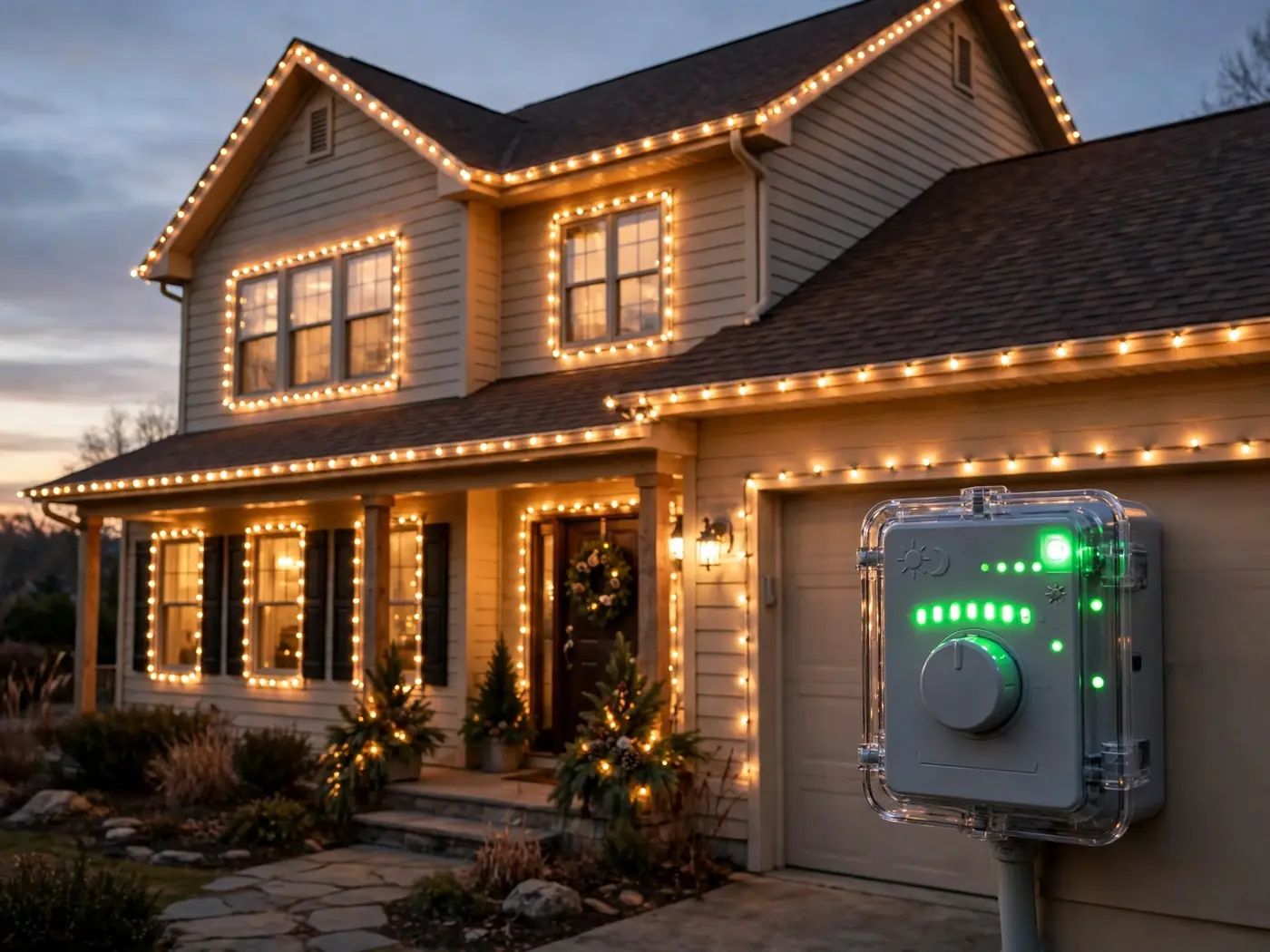
Easy swap: Swap basic timers for one smart outdoor plug and the whole house can be run, dimmed or rescheduled from your phone.
18. Hidden Cords: Clips, Channels and Matching Wire
Make the wiring disappear: run extension cords that match the siding color, tuck vertical drops into the shadow lines beside downspouts, and use clip channels along the eaves so no loose cable crosses a wall. Choose green wire on garland and white wire on white trim, and coil every spare metre out of sight behind the porch columns. In daylight, the house should show clips and bulbs only, never spaghetti.
Seasonal swap: Leave the eave channels and clips in place year-round; at Halloween and the Fourth of July only the strings change, not the hardware.
19. The Photo Test: One Drive-By Check at Night
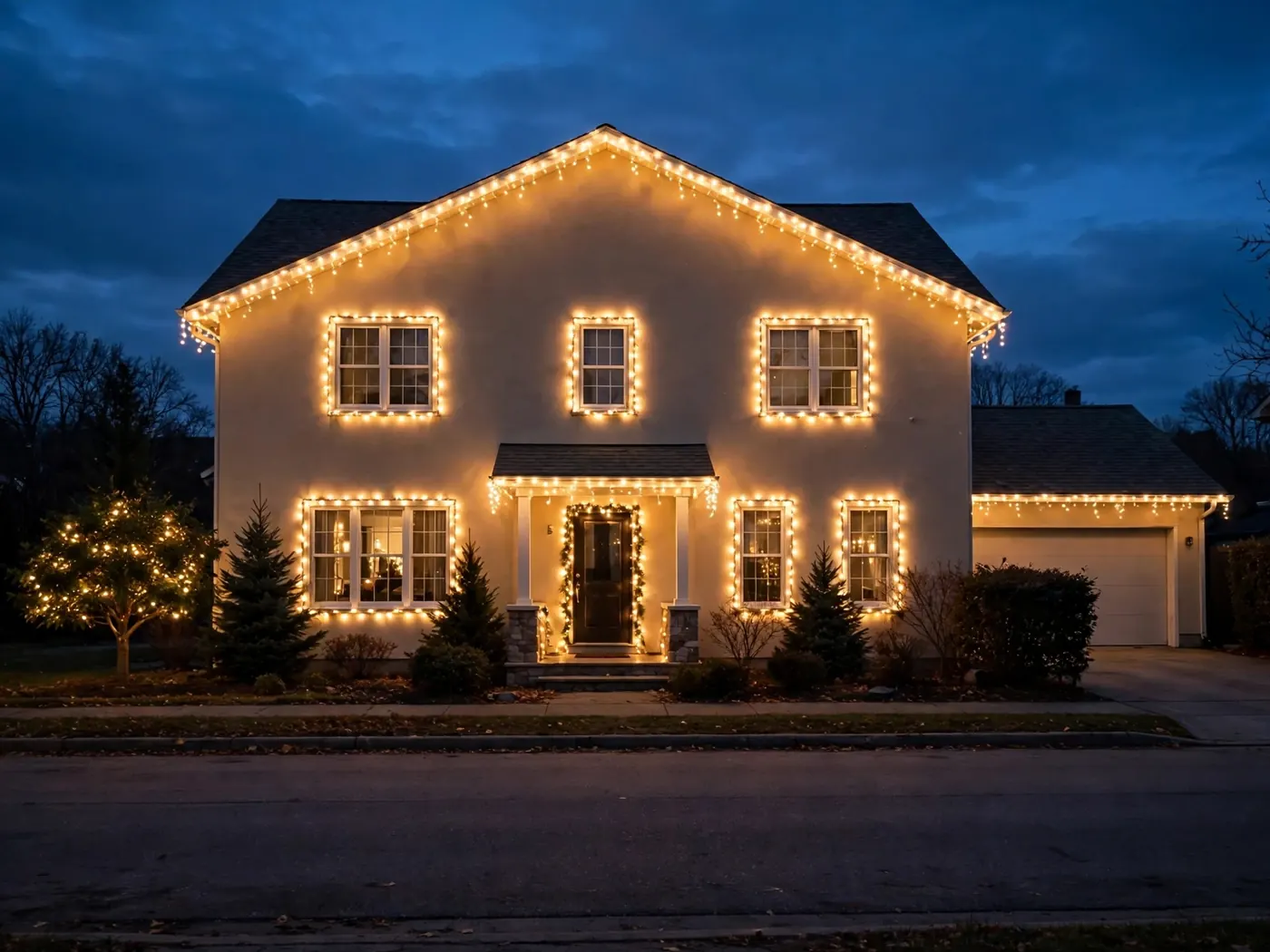
On the first evening the display is finished, drive slowly past your own house and take three phone photos from the street: one straight on, and one from each corner angle. A sagging run, a dead section, one window brighter than the rest — the camera shows all of it instantly, while you still have the weekend to fix it. It takes five minutes, and it is how the best-looking house on the block quietly happens.
Why it works:
- The street view is the one every guest and neighbour actually sees.
- Photos flatten the scene, so uneven brightness and gaps jump out.
- One early check replaces a season of small, visible flaws.