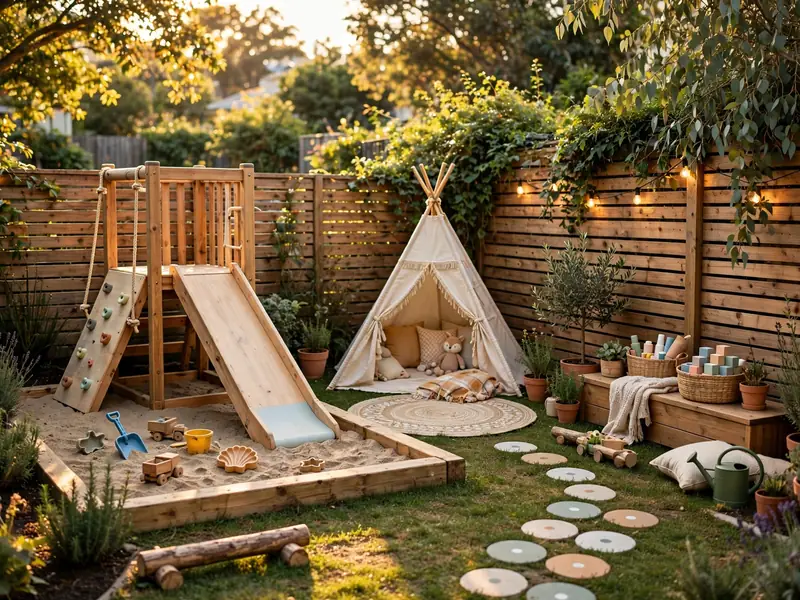
Every family yard has dead spots: the bare corner behind the fence, the muddy strip by the gate, the cracked slab nobody crosses. While those patches sit ignored, the same good stretch of lawn gets worn to dirt by every game, every bike, every single afternoon.
Kids do not need a new yard. They need the dead spots claimed, one corner at a time, each given a single clear job and just enough kit to do that job well. A cleaned, anchored corner with one honest purpose beats a full redesign every time.
Here are 15 weekend makeovers that turn a yard’s most ignored patches into its hardest-working play spots. Each one takes a day or two, uses basics most sheds already hold, and needs no landscapers and no rebuild.
The Backyard Refresh Formula That Keeps Old Looking New
- One spot, one job: a corner that tries to be everything serves nothing; give each makeover a single purpose.
- Clean and edge before adding: a swept, trimmed, edged spot already looks halfway transformed before anything new arrives.
- Anchor it with one strong piece: a single bench, frame or surface gives the spot its identity; the rest is dressing.
- Link the spots with a path: stepping stones or a mown route turn separate corners into one backyard journey.
For example: the bare corner behind the shed, swept and edged (clean start), given a gravel pad and a crate castle (one job, one anchor), then joined to the lawn by five stepping stones (the link), goes from forgotten to fought-over in a single weekend.
| # | Idea | Best For | Budget |
|---|---|---|---|
| 1 | The Bare Corner Turned Climbing Corner | The classic dead spot | Mid |
| 2 | The Dead Side Yard Turned Games Alley | Narrow strips, used at last | Low to mid |
| 3 | The Forgotten Strip Behind the Garage Turned Den Alley | Hidden space, claimed | Low |
| 4 | The Muddy Patch Turned Gravel Play Pad | The spot that never dries | Mid |
| 5 | The Old Flower Bed Turned Sand and Dig Bed | Retired beds, new career | Low |
| 6 | The Concrete Slab Turned Painted Games Court | Hard standing, repurposed | Low |
| 7 | The Slope Turned Terraced Play Steps | Awkward gradients | Mid |
| 8 | The Garage Wall Turned Sports Wall | A blank wall, employed | Mid |
| 9 | The Neglected Shed Side Turned Tool and Toy Station | Order from a junk strip | Low |
| 10 | The Dark Under-Deck Space Turned Fort | The spookiest square metres | Low to mid |
| 11 | The Rainy-Day Porch Corner Turned Craft Deck | Wet weekends saved | Low |
| 12 | The Tired Deck Turned Outdoor Lounge for Kids | Old decking, soft landing | Mid |
| 13 | The Back Steps Turned Plant and Paint Steps | Steps that earn their keep | Very low |
| 14 | The Laundry Poles Turned Swing and Shade Posts | Hardware already standing | Low to mid |
| 15 | One Path Linking Every Made-Over Spot | The finishing touch | Low |
1. The Bare Corner Turned Climbing Corner
Every yard has one: the bare corner where grass gives up and bikes rust. Clear it Saturday morning, rake the soil and lay a 6-by-6-foot pea gravel pad over landscape fabric. Against the two fence sides, bolt an A-frame climbing wall built from five 8-foot pressure-treated 2x4s, with jute rope rungs knotted every 12 inches and handholds painted terracotta and sage. Drop a flat-topped stump in the center as the summit seat. By Sunday, the deadest square in the yard is the first place kids sprint to.
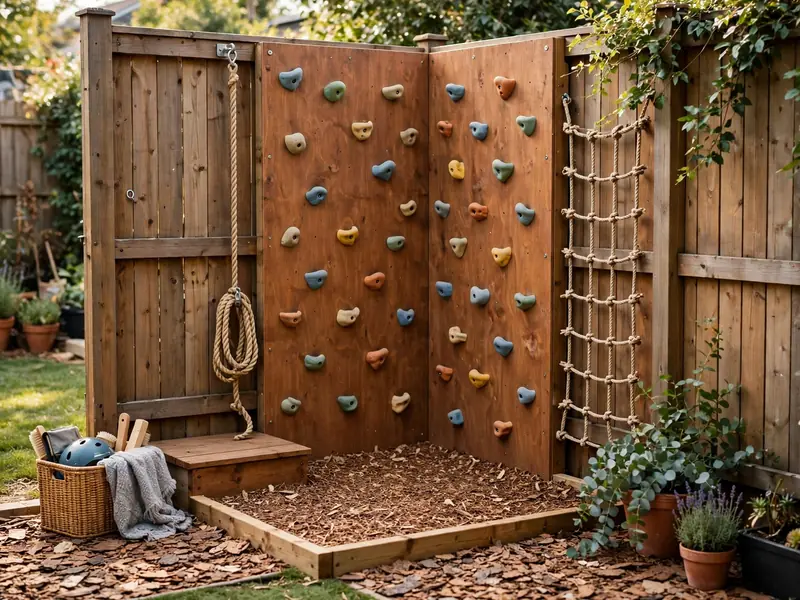
Seasonal swap: in winter, unhook the rope rungs and lean a white tarpaulin panel against the frame, and the corner turns into a snow-fort base instead.
2. The Dead Side Yard Turned Games Alley
The narrow strip beside the house usually stores bins and nothing else. Move the bins to the garage end, sweep the concrete, and paint a scoring triangle at the far end in white masonry paint. Mount a ring-toss board with five brass hooks on the fence at child height, hang a chalk scoreboard beside it, and run solar lights along the wall. The forgotten passage becomes a games lane.
Why it works:
- The long, thin shape suits target games perfectly, with built-in throwing distance.
- Everything mounts on the fence, so the floor stays clear.
- The games live there permanently, so there is nothing to set up or pack away.
3. The Forgotten Strip Behind the Garage Turned Den Alley
Nobody ever walks behind the garage, which is exactly why kids will love it. Weed the strip, lay a path of six concrete pavers, and stretch a green canvas tarp between the garage wall and the fence as a sloped roof. Under it, set two wooden crates as seats and a third as a table, and hang a battery lantern from a wall hook. String a washing line across for pegging up drawings and secret maps. One hidden strip becomes the headquarters of every game.
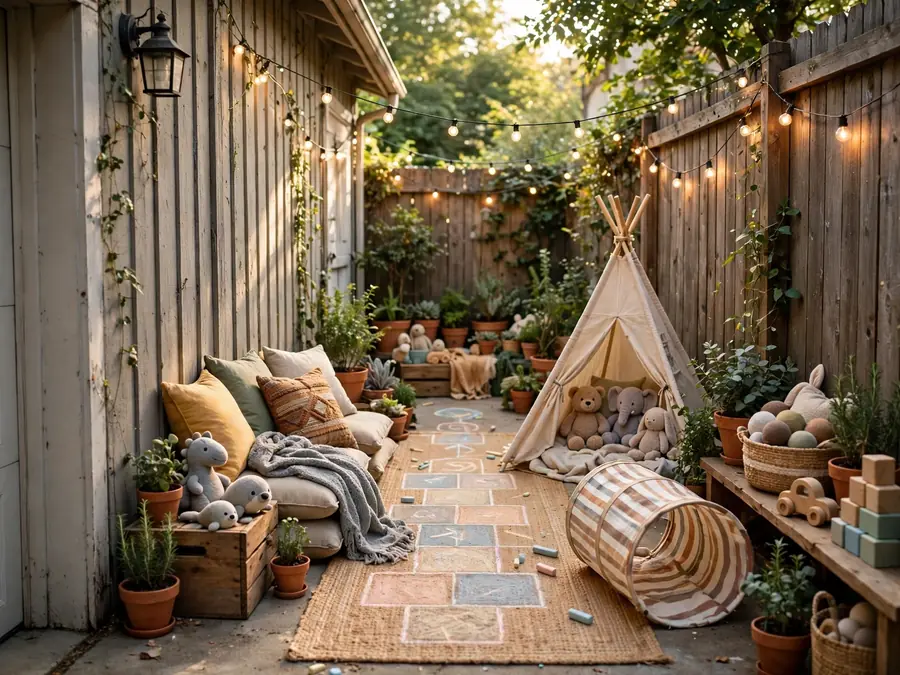
Budget note: the tarp, crates, and pavers are the only real purchases here; the lantern, line, and pegs come free from shed and kitchen drawers.
4. The Muddy Patch Turned Gravel Play Pad
The patch by the gate never dries, and shoes come in muddy from October to April. Dig out 3 inches of topsoil across a 7-by-5-foot rectangle, line it with weed membrane, and fill it with golden pea gravel raked level. Edge it with chunky log rounds so the gravel stays put, and the swamp becomes a dig-and-drive pad for toy trucks and scoops. If your whole plot is compact, these small backyard ideas for kids show how to give every small zone a job like this one.
The formula: the gravel pad + the log-round edging + the buried treasure tin that keeps young diggers coming back.
5. The Old Flower Bed Turned Sand and Dig Bed
When a flower bed gives up, hand it to the kids instead of replanting forever. Fork out the spent plants, loosen the dark soil, and top it with 4 inches of pale play sand. Sink a row of river stones along the front edge, and tuck one corner with tough mint for scented digging. The bed’s new career starts the same afternoon.
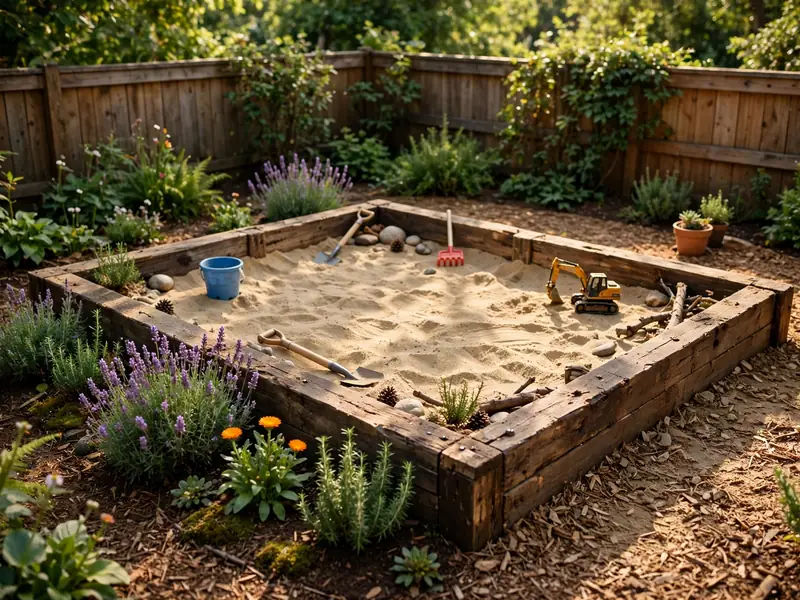
Get the look:
- Main piece: the sand-filled bed inside its original timber boards.
- Supporting piece: two child-size spades and a galvanized bucket at the end.
- Texture or material: fine pale play sand over dark, loosened soil.
- Finishing touch: a painted sign reading Dig Zone, staked at the corner.
6. The Concrete Slab Turned Painted Games Court
An old slab where a shed once stood looks bleak, but it is a games court waiting for paint. Pressure-wash it, let it dry, and mark out a hopscotch grid, a four-square box, and a snail track in white and sky-blue masonry paint with a 2-inch brush. Add a painted target circle in warm yellow at one end for beanbag throws. The games never need setting up, nothing needs storing, and the yard’s ugliest feature becomes its hardest-working one by lunchtime.
Color note: white lines keep games readable at a glance, sky blue softens the grey concrete, and that yellow target adds the cheerful hit without turning the slab into a rainbow.
7. The Slope Turned Terraced Play Steps
Slopes defeat mowing and ball games alike, so turn the bank into wide play steps. Dig three level terraces down the slope, front each with chunky railway-style sleepers pinned with rebar, and fill the treads with bark mulch. Set a flat reading stone on the middle terrace and leave a grass strip at the side for sliding down. It borrows the oldest trick in the garden: terracing, which stops soil washing downhill and turns a bank into usable levels.
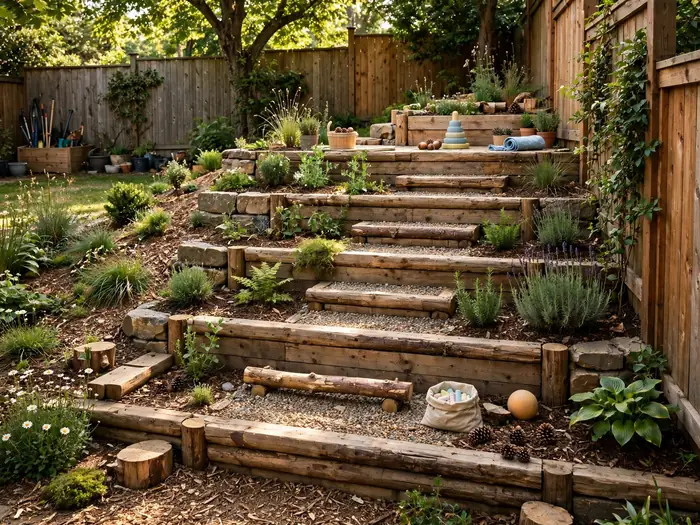
Texture note: rough sleeper fronts, springy bark underfoot, and one smooth stone to sit on give small hands three different surfaces to read as they climb.
8. The Garage Wall Turned Sports Wall
A blank garage wall is a rebounder going spare. Paint a 5-foot white target square at child height in masonry paint, add a smaller red inner square, and mount a mini basketball hoop at 7 feet on the left side. Chalk throwing lines on the drive at 8 and 12 feet for different ages, and fix a mesh ball bin beside the door so everything parks itself. Balls that once scattered across the whole drive now answer to one home wall, and practice starts the second kids get home.
Best for: ball-mad kids in homes where the drive meets the garage wall and lawn space is too precious to lose.
9. The Neglected Shed Side Turned Tool and Toy Station
The strip beside the shed collects broken pots and lost balls, and nothing else. Clear it out, lay four pavers as a floor, and screw a row of hooks into the shed wall for bats, nets, and helmets. Stand a lidded storage bench under the eaves for balls and rackets, and hang a whiteboard where kids log what is borrowed. These are the backyard ideas for kids that work the hardest: nothing new to play on, just everything finally findable in one place.
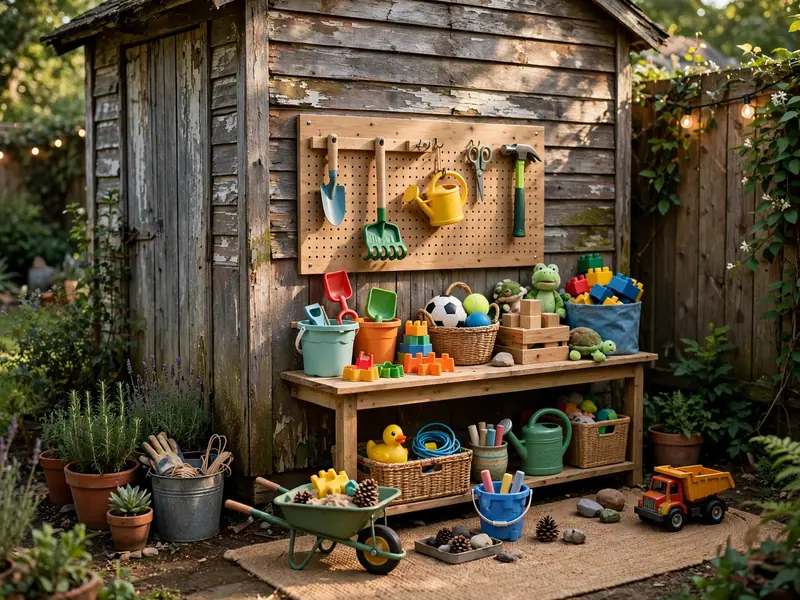
Space note: the strip only needs to be 3 feet wide, because wall storage keeps the floor clear, so the narrowest shed side becomes a working station.
10. The Dark Under-Deck Space Turned Fort
Under-deck space is gloomy, dry, and thrillingly secret: a fort with the roof already built. Sweep out the leaves, lay an offcut of outdoor carpet or foam mats over the gravel, and hang a canvas curtain across the open side on a tension wire. Inside go two beanbags, a crate bookshelf, and a battery lantern on a hook, with bunting strung along the joists. The spookiest square metres of the yard become the most requested reading den by Sunday afternoon.
Fit check: measure the head height first; if a kneeling adult fits under the lowest joist, children will play happily, but under 3 feet of clearance, keep it as toddler crawl space only.
11. The Rainy-Day Porch Corner Turned Craft Deck
A porch corner usually holds a broom and a dying plant. Swap in a child-height folding table, two stools, and a rolling crate of paper, paints, and glue sticks, all tucked under the roofline. Hang a string of clip pegs along the rail to dry artwork, and lay a washable mat under the table to catch drips. Rainy weekends stop cancelling outdoor time, because this corner works in any weather the forecast invents.

Style note: a striped mat in navy and cream, plus one neat row of pegged-up artwork, makes the corner look like a tiny deliberate studio rather than stored clutter.
12. The Tired Deck Turned Outdoor Lounge for Kids
Stained, splintery decking puts everyone off, but kids do not need a new deck; they need it softened. Sand the worst boards, lay interlocking foam tiles in charcoal and cream across the center, and build a low sofa from two pallet bases with thick outdoor cushions. Clip a shade sail to the rail posts to kill the glare, and let a storage box double as the snack table. The deck the family avoided all summer becomes movie-night headquarters by the weekend.
Easy swap: swap the shade sail for a pop-up gazebo in the colder months and pile on outdoor blankets, and the lounge keeps working through winter weekends too.
13. The Back Steps Turned Plant and Paint Steps
Back steps are pure traffic: up, down, ignored. Give every tread a job instead. Paint the risers in graduated shades of teal, set a small herb pot on every second step, and chalk a hopscotch start on the bottom tread. Wrap the handrail in solar fairy lights so the steps glow after dark. Good backyard landscaping designs always use a level change instead of fighting it, and these steps now earn their keep as planter, game, and lamp in one.
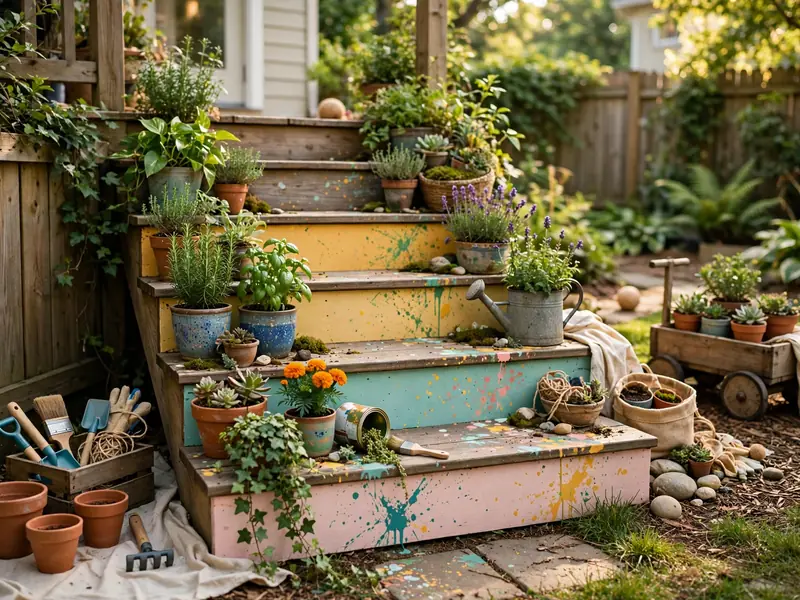
Seasonal swap: in autumn, swap the herb pots for small pumpkins and pots of mums on each tread, and the steps turn into a fall display instead.
14. The Laundry Poles Turned Swing and Shade Posts
The T-shaped laundry poles are concreted in and going nowhere, so put them to work. Bolt a crossbar between the pole tops, hang a belt swing from rated chains on one side, and stretch a shade sail from pole to pole. Underneath, park a sand-and-water table in the shade. Hardware that dried washing for decades now anchors the coolest seat, and not one hole was dug to build it.
Why it works:
- The poles are already concreted in, so nothing needs digging or setting.
- One structure gives both motion and shade, the two things kids ask for most.
- The swing hangs over existing grass, so every landing stays soft.
15. One Path Linking Every Made-Over Spot
Finish the yard by joining the dots. Lay a winding path of flat stepping stones, one every child’s stride at roughly 18 inches apart, from the climbing corner past the games alley, across the gravel pad, and up to the fort door. Edge the route with low solar lights so it glows at dusk. Separate corners suddenly read as one designed backyard, and kids travel the path like a story, visiting every made-over spot in turn.
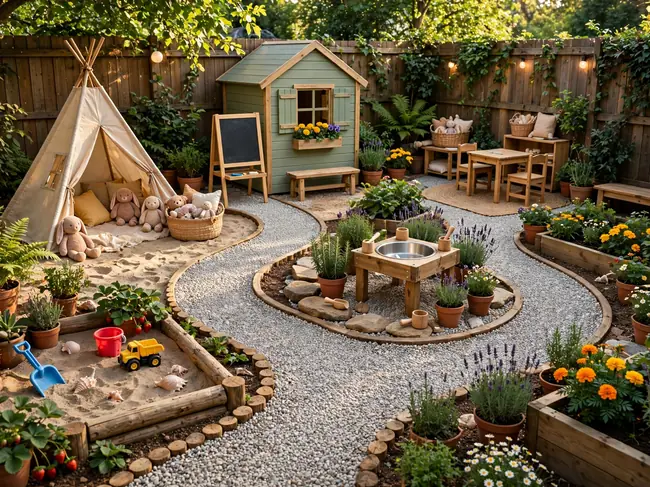
Budget note: stones are the only real cost, and seconds-quality pavers from a builders’ yard do exactly the same job for about half the price of brand new.