Your saved photos are full of calm, empty rooms. Your own home is full of the people, laundry and paperwork of real life. That gap is the frustration: every minimalist picture seems to demand a bigger house or a different personality before it can work for you.
Here is the reframe worth keeping: you do not need more rules for a minimalistic home. You need better examples — people whose way of living with less is clear enough to watch working, not just admire.
And borrow carefully. Never copy a whole look; steal one working detail instead — the question asked before buying, the order they tidy in, the limit they refuse to cross. One small habit, borrowed well, changes more than a mood board ever will.
The seven guides below live with less in very different ways: a Tokyo writer with almost nothing, an American father guarding his weekends, a Swedish grandmother sorting a lifetime of treasures. That variety is the point — somewhere in it is a version of simple that fits your real address.
What Makes a Minimalistic Home Icon Worth Following?
A useful icon is not the person with the emptiest room, but the one whose method you could explain back next week — why this chair stays, why that drawer closes easily, why nothing new came home.
That is the real skill inside simple minimalist decor: not a look, but a decision you can watch being made. When choices follow a pattern you can name, you can borrow the pattern without buying anything they own.
- A personal test applied to every object, every time
- A clear order for tackling the home
- Limits you can count — garments, shelves, things
- Warmth kept deliberately, so less never turns bare
- A next step small enough for a Tuesday
Follow people like that, and your question changes — from “Where did they get that?” to “Why does that work so well?” The second question is the one that changes your home.
| Icon | Best Inspiration For | The Detail Worth Borrowing |
|---|---|---|
| Marie Kondō | Deciding what deserves to stay | The hold-it-and-ask joy test |
| Joshua Becker | Owning less with a reason | Name the purpose, remove distractions |
| Fumio Sasaki | Proving less can feel liberating | Freedom from owning almost nothing |
| The Minimalists | Testing what you actually use | Packing-party test for unused things |
| Courtney Carver | Beginning without the overwhelm | Small steps, starting with clothes |
| Francine Jay | Resetting one whole room | Empty everything, gatekeep what returns |
| Margareta Magnusson | Editing a lifetime, kindly | One small box of personal treasures |
Marie Kondō and Joshua Becker — Decide What Deserves to Stay
Marie Kondō. The Japanese organizing consultant became famous for one gentle test: hold each possession and keep it only if it sparks joy. Her order matters too — she tidies by category, not by room: clothes first, then books, papers and miscellany, with sentimental items last, when your judgment is strongest. Everything that stays earns a designated home.
The translation needs no special products. Work one category at a time: gather every item into one pile, hold each piece, keep the joyful, thank the rest and let it go. Fold clothes upright in rows, and a normal dresser behaves like her famous drawers.
| Situation | Base Pieces | Why It Works |
|---|---|---|
| A chaotic clothes drawer | Fold each keeper upright in rows | Everything visible, nothing buried |
| Books spilling off shelves | Gather every book into one pile | Seeing the total changes choices |
| Kitchen tools never used | Ask the joy question, item by item | Feelings decide faster than logic |
| Guilt over sentimental clutter | Save this category for last | Your judgment is trained by then |
In an ordinary home, her lesson sounds like this: the junk drawer disappears, because everything in it earned its place.
Joshua Becker. The voice behind Becoming Minimalist began in his garage, spending a fine Saturday cleaning around boxes instead of playing with his young son — and realizing his possessions were quietly owning him. His definition runs deeper than tidiness: promote what you value most, and remove whatever distracts from it.
Borrow his purpose-first order. Before touching a shelf, name what you want the room to be for. Then edit against that answer: duplicates, spares and someday items go first. It costs almost nothing — it mostly stops things arriving — and it suits families, because nobody must live in an empty box.
For a busy household, Becker is the permission slip: less stuff is not the goal. More Saturday is.
Fumio Sasaki and The Minimalists — Test How Little You Truly Need
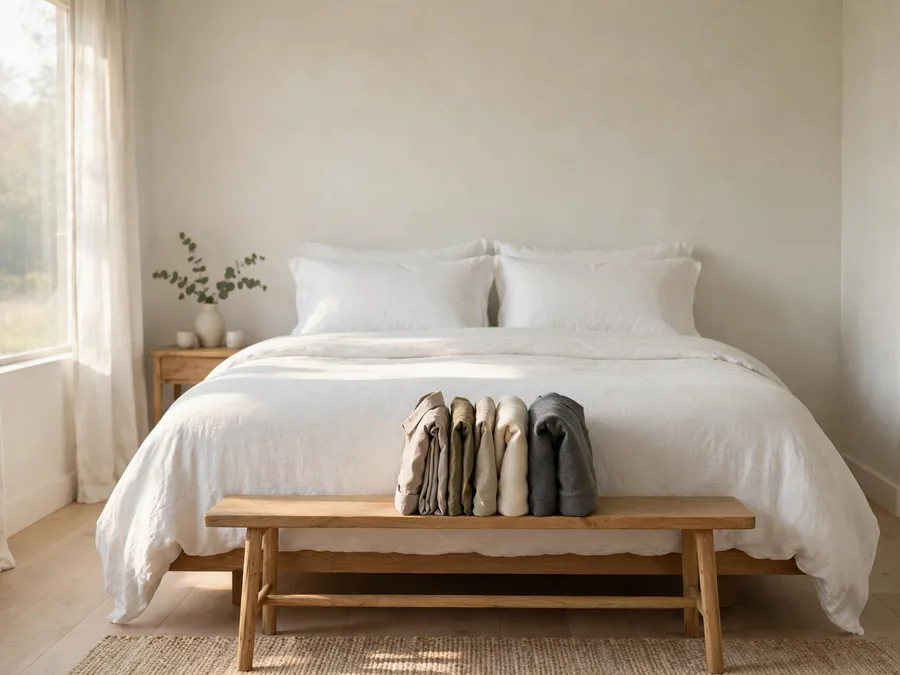
Fumio Sasaki. This Japanese writer, author of Goodbye, Things, took the experiment furthest: a small Tokyo apartment, a few changes of clothes, a single towel doing duty for bath and dishes, a mat and low table instead of a sofa set. His rooms look almost empty, and that is the point: minimalism, for him, is an ongoing question — how little does a person need?
You are not moving onto a floor mat. Borrow the experiment: cut one wardrobe or shelf to a week’s trial minimum, and notice honestly what you miss. Most people find their essentials list was mostly habit, and that cleaning and storing shrink with it.
Reality check: Sasaki’s near-empty flat suits one person who loves the experiment. A family home should borrow his question — how little could we live with here? — not his count.
His gift is perspective: after his room, your own essentials list gets shorter by itself.
Joshua Fields Millburn & Ryan Nicodemus. Known together as The Minimalists, these longtime friends replaced guessing with experiments. The famous one is Ryan’s packing party: he boxed up everything he owned, then unpacked only what he genuinely needed over the following weeks. Most never left the boxes — proof we use far less than we keep.
Run the small version: box one crammed cabinet, label it, and live normally for two weeks. Whatever you never reach for has answered you — at no cost but a cardboard box.
Budget note: their 20/20 rule settles the rest — if a just-in-case item could be replaced in twenty minutes for twenty dollars, the spare can go.
For chronic keepers of spares, their tests turn worry into an answer.
Courtney Carver and Francine Jay — Shrink the Job Until It Feels Easy
Courtney Carver. The writer behind Be More with Less came to simplicity through her health: living with a serious diagnosis taught her that stress was a possession too, and she began removing it piece by piece. Her best-known invitation is Project 333: dress from a capsule of thirty-three items for three months, and learn that a limit can feel like relief, not loss.
Her method is deliberately tiny: one drawer, one shelf, one challenge finished before the next begins. Follow that pace past the wardrobe and the calm spreads — into dressers, onto surfaces, and toward the kind of cozy minimalist bedrooms where everything left is there on purpose.
Start small: pick the challenge that feels almost too easy — one drawer tonight, not the whole house — and let the finished feeling pull you forward.
If big projects tire you before you start, Carver is your pace: gentle, tiny, finished.
Francine Jay. Author of The Joy of Less, Jay treats every object like an applicant for a job in your home. Her STREAMLINE method is a ten-step reset with a strict gatekeeper: empty the room completely first, and let an item return only when it can state its reason and claim its place.
Use it on the room that defeats you. Carry everything out, then let back only what earns its return; give each category a container as its limit, because a full container is the signal to stop. The method runs on honesty and a free afternoon.
Jay is the icon to borrow when a single room keeps winning: empty it, and let only the worthy back in.
Margareta Magnusson — Edit Your Things for the People You Love
Margareta Magnusson. This Swedish artist introduced the world to döstädning — death cleaning — in The Gentle Art of Swedish Death Cleaning, and there is nothing morbid about her version. It is the slow, good-humored sorting of your belongings in later life, so loved ones inherit your stories instead of unsorted work. Begin, she suggests, with impersonal things — stored boxes, clothes, kitchen duplicates — and save photographs and letters for last.
Borrow her two kindest tools at any age. Keep one small box of personal treasures that is just for you, no explanations needed. And give useful things away now, to people who would enjoy them, while you can watch them being enjoyed.
Her lesson lands at every age: the kindest clutter decision is the one you make yourself, while it is still easy.
Copy the Principle, Not the Room
Be honest about those perfect rooms: they were styled for a camera, lit like a stage, and half their contents carried out first. Copying one means buying the props of someone else’s life, then wondering why the calm never moves in.
What travels from home to home is never the object; it is a relationship. Proportion: a few larger pieces calm a room that twenty small ones agitate. Contrast: one dark, textured thing wakes a pale space. Repetition: the same simple basket in every room ties a house together. Balance: one full corner answered by one empty one.
So skip the catalogue of minimalist styling tricks and spot which relationship is doing the work in a room you love. Rebuild that relationship with the furniture, boxes and blankets you own. It will not match the photograph; it will match your life.
| Instead of Copying This | Borrow This Principle |
|---|---|
| A designer’s exact white sofa | One calm base color, repeated |
| A professionally styled shelf | Group in threes, leave gaps |
| An empty Tokyo apartment | One surface kept completely clear |
| A capsule wardrobe from a challenge | Limits that fit your actual week |
| A grandmother’s tidy cottage | Everything kept has a named home |
Borrowed principles end copy-shopping — and what grows instead is your own taste.
Build Your Own Home Formula From the Icons You Like
Do not marry one icon. Livable homes come from a small committee: Kondō’s tenderness for deciding, Becker’s purpose for why it matters, Carver’s tiny pace for starting, Jay’s firm gate for the room that relapses. Two or three voices, each doing a different job, beat one guru.
Formula: one clear purpose per room + one small zone finished completely + the joy test on everything that stays + one surface left empty on purpose
Vary the recipe slowly: change one part at a time — pace this month, test next — and live with each change before judging it.
The best icon is the one who helps you understand what you already like — and hands you a kind way to keep more of it.
Frequently Asked Questions
Do I have to follow all seven of these people?
No — two or three is plenty; more voices mean more noise. Pick the icon whose life looks like yours, plus one who stretches you.
What if my partner or family is not minimalist?
Edit only your own things, and shared surfaces by agreement. A calmer corner persuades better than a lecture, and resistance fades when nobody’s treasures are touched.
Can these ideas work in a rented home?
Yes — all seven methods concern what you own, not what you build. Containers, limits and editing need no permission, and they move with you.
Do I have to throw away sentimental things?
No. Kondō saves them for last, when judgment is strongest; Magnusson keeps a treasure box of her own. The point is choosing on purpose, not keeping from guilt.
Where do I start if the whole house feels like too much?
Take Carver’s pace and Jay’s map: one small zone, emptied fully, finished completely. One finished drawer proves the method and makes the next zone easier.