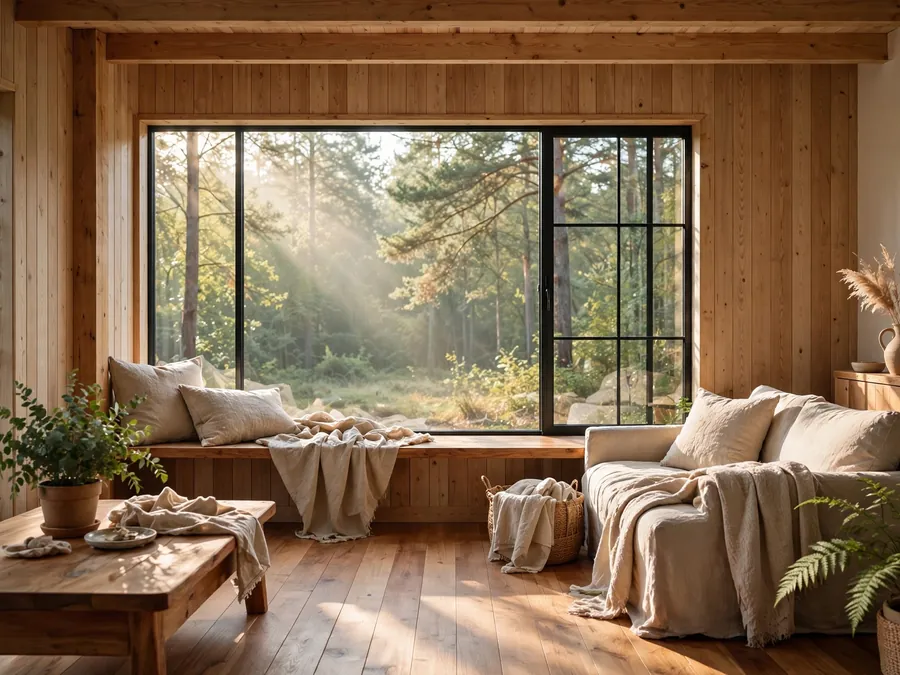
Most days now start and end the same way: eyes on a screen, shoulders up, the home reduced to a corridor between charging points. Meals get eaten standing, evenings disappear into feeds, and the rooms you pay for barely get lived in. Nothing is exactly wrong — it is just all slightly too fast, all the time.
The fix is not a cabin in the woods or a month off grid. It is a rhythm: small daily habits borrowed from forest living, where light, weather and season set the pace instead of notifications. Writers on the forestcore way of life keep landing on the same point — slow the routine down, and the home starts to feel like shelter again.
Below are ten of those habits, from the first curtain you open to the last page you read. None needs a big house, a garden or new furniture; most use what you already own — a window, a mug, a basket, a candle. Start with two and let the week teach you the rest.
The Forest Living Formula That Keeps Everyday Life Feeling Slow, Not Rushed
- Anchor the day to light, not alerts: open curtains before screens in the morning and soften the lamps before bed, so the day has a visible start and a visible finish.
- Let natural materials set the pace: wood, linen, wool and stone ask for hands and a little time — a wooden board, a real mug, a woven basket — and that small friction is what slows a routine down.
- Protect one unplugged hour: choose the hour your home is busiest with screens and defend it daily, because a habit that needs perfect weeks will not survive real ones.
- Bend the rhythm, never break it: shrink any habit to five minutes or move it to another day when life crowds in; a bent habit returns tomorrow, a broken one quietly disappears.
A slow weekday on this formula looks like: curtains open at seven, tea steeping on the wooden board while eggs cook, phones in the hall basket by nine, and one candle lit on the table when the light outside turns amber.
| Habit | Best Moment | What You Need |
|---|---|---|
| Open the Curtains First | First minutes of the day | One window, one warm lamp |
| Breakfast at a Real Table | Early morning | A table, a mug, a real plate |
| Ten-Minute Green Pause | After lunch | A window, balcony or door |
| One Seasonal Thing a Week | A weekday evening | One seasonal ingredient, cast iron |
| Phones in a Basket | From 9 p.m. | A woven basket, an alarm clock |
| One Candle at Dusk | The workday’s end | One scented candle |
| Evening Air | Before the last wash-up | A window or balcony, a blanket |
| One Drink Made by Hand | Morning or evening | A pot, a filter or a pan |
| Sunday Reset | Sunday, 30 minutes | A timer, a basket, a cloth |
| Real Pages Before Sleep | The last 10 minutes | A paper book, a warm lamp |
1. Open the Curtains Before You Touch Your Phone
Make daylight the first thing that reaches you, not notifications. Walk to the main window, pull the curtains wide, and stand there for one full minute while the kettle heats. On bright days, crack the window 2 or 3 inches and let the morning air in; on grey days, switch on the warmest lamp instead and keep the same pause. The trade-off is real: in mid-winter the light is weak and the glass is cold. The habit still works, because the point is the pause before the feed, not the weather.
Best for: small apartments and north-facing rooms, where the morning light has to be invited in on purpose.
2. Sit Down for Breakfast at a Real Table
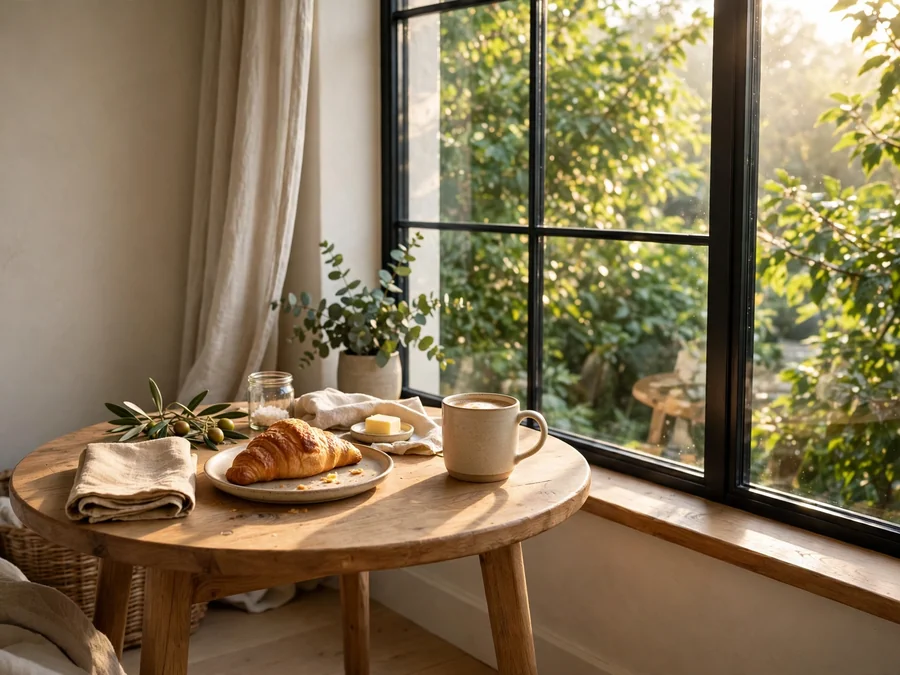
Give breakfast a chair and ten unhurried minutes. Eat at the table — even a 24-inch folding one — with the phone face-down in another room and something warm in a real mug. Keep it plain: eggs, oats, toast, fruit, whatever is in season. One green thing in view — a tree, a herb pot — turns the meal into a clearing in the day. It is the daily habit that makes a forest home feel lived in, not just styled. Most mornings will not manage ten minutes; five honest ones beat a scrolling half-hour at the counter.
The formula: a real plate + a hot drink in a proper mug + ten minutes seated, phone elsewhere.
3. Take a Ten-Minute Green Pause
Once a day, usually after lunch, stop and look at something alive for ten minutes. Sit by the greenest window you have, step onto the balcony, or stand at the door with a cup of water in hand. No podcast, no messages, no weeding or pruning — the plants are not a task here. Watch what has changed since yesterday: a new leaf, a shifted shadow, rain still sitting on the rail. The catch: ten quiet minutes feel strangely long at first; they shrink within a week.
Why it works:
- It gives your eyes a far, soft focus after screen hours.
- It ties the day to the season, not the calendar.
- It costs nothing and needs no equipment at all.
4. Cook One Seasonal Thing Every Week
Pick one evening a week — Thursday works well — and cook one thing truly in season: October squash, June strawberries, the first corn, the last tomatoes. Keep the rest ordinary so the habit survives busy weeks. Cast iron, a wooden board and one sharp knife are the whole kit; the ritual is choosing, washing, chopping slowly and eating while it is hot. Seasonal food costs less at its peak, which quietly helps the budget. The week gains a small harvest marker.
Get the look:
- Main piece: one seasonal ingredient at its peak
- Supporting piece: a cupboard staple like rice or eggs
- Texture or material: cast iron and worn wood
- Finishing touch: fresh herbs torn over at the table

5. Let the Phones Sleep in a Basket by the Door
From about 9 p.m., every phone in the home goes into one woven basket on the hall table, chargers and all, and stays there until morning. The basket needs to sit within earshot for genuine emergencies but outside every bedroom. What fills the gap is the point: books, conversation, the window, sleep arriving earlier than expected — the same unhurried mood that cozy garden ideas chase outdoors, kept indoors. The honest trade-off is the alarm clock — a basic one costs a few dollars and never shows you the news at 6 a.m.
Space note: keep the basket on a surface 36 to 40 inches high by the entry, close enough to hear, far enough to forget.
| Day | Morning Anchor | Evening Anchor |
|---|---|---|
| Monday | Curtains before phone | Phones in the basket by 9 |
| Tuesday | Breakfast seated, ten minutes | One candle at dusk |
| Wednesday | Curtains before phone | Evening air, ten minutes |
| Thursday | Slow drink made by hand | Seasonal cook night |
| Friday | Breakfast seated, ten minutes | Phones in the basket by 9 |
| Saturday | Green pause after lunch | Evening air, unhurried |
| Sunday | Slow drink made by hand | Thirty-minute reset, then pages |
6. Trade the Big Light for One Candle at Dusk
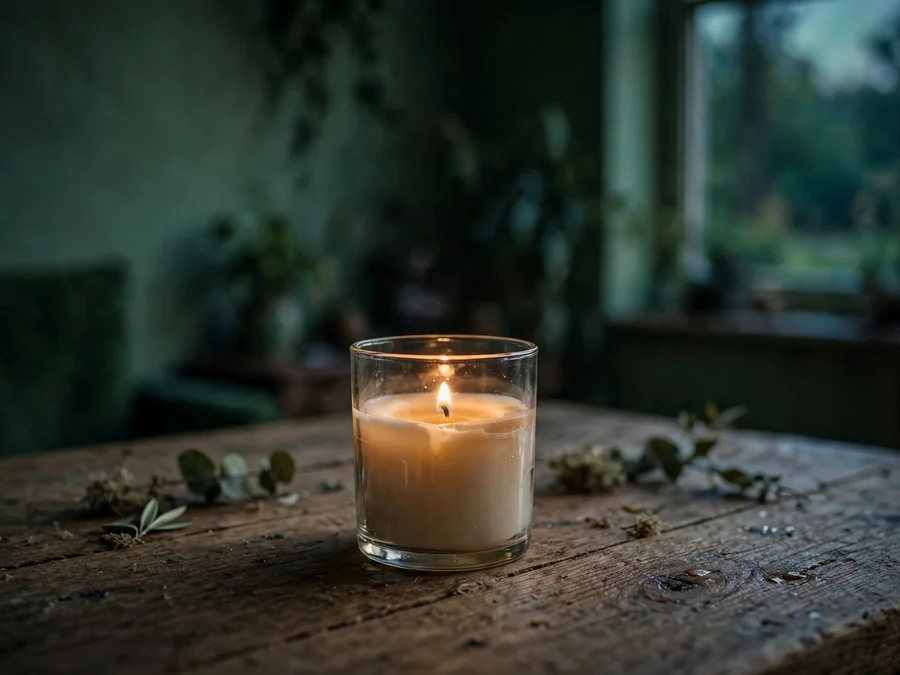
When the workday ends, skip the overhead light. Put one candle on the table where you actually sit — the IKEA ADLAD scented candle in its glass jar costs $1.29 and smells of forest and amber — and let that small flame mark the border between day and evening. Eat, read or talk inside its circle; rooms beyond it can go dim and quiet. Candles demand respect: keep the flame on a heat-safe surface, away from curtains, and out before sleep. The reward is an evening with edges, instead of one long fluorescent blur.
Budget note: one 20-hour candle gives you roughly three weeks of dusks; a supermarket tealight works too — the ritual is the flame, not the brand.
7. Take Ten Minutes of Evening Air
Before the last wash-up, open a window wide or step to the balcony for ten minutes of real air. Wrap up in the thickest blanket you own and just stand there: rooftops going dark, a neighbour’s radio, the temperature dropping the way it does under trees. In deep winter this shrinks to two minutes at a cracked window, and that still counts. The trade-off is heating — ten open minutes in a small flat costs little, but close the window fully afterwards so the room warms back up.
Color note: watch the light do its shift — amber to blue-grey to near-black. When the colours go, the day is done, and screens will only argue.
8. Make One Drink Slowly, by Hand
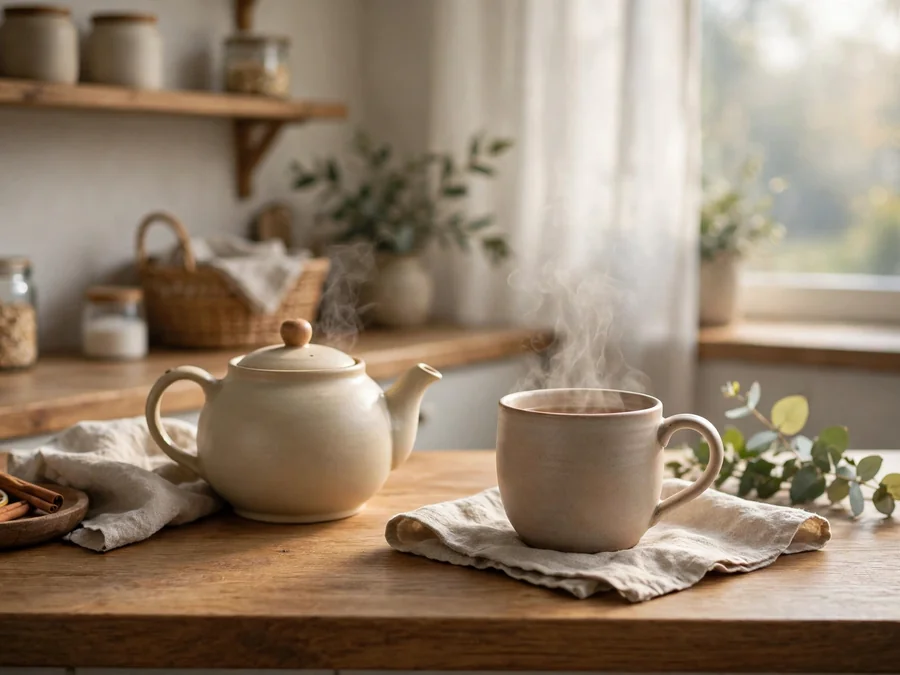
Choose one daily drink and make it the slow way: tea leaves in a pot, coffee through a paper filter, cocoa whisked on the stove. The two or three minutes of pouring, waiting and warming your hands on the mug are the habit — not the drink itself. Use the same chipped mug if you like; familiar objects speed nothing up and settle everything down. It will feel inefficient for the first days, especially before work. Then one morning you will notice you are guarding those minutes like a small fence around the day.
Easy swap: if mornings are chaos, move the slow drink to the evening — a herbal tea made by hand ends the day just as well.
9. Give Sunday a Thirty-Minute Reset
Once a week, set a timer for thirty minutes and walk the home back to calm: clear the flat surfaces, shake the rugs outside, wipe the stove, put one found thing back where it lives. Stop when the timer stops, finished or not — the limit is what makes it repeatable. The trade-off is half an hour of Sunday; the return is a Monday that starts in a room already breathing. It is the plain, weekly version of the charm a forest cottage keeps all the time.
Seasonal swap: in spring, open every window while you reset; in winter, light the candle first and reset inside its smaller, warmer circle.
| Season | Morning Shift | Table Shift | Evening Shift |
|---|---|---|---|
| Spring | Windows open with the curtains | First greens and herbs | Longer green pause outdoors |
| Summer | Earliest light, cool air first | Fruit, corn, quick salads | Balcony sit after dark |
| Autumn | Lamp-lit slow start | Squash, apples, mushrooms | Candle lit earlier |
| Winter | Warm lamp, shorter pause | Roots, citrus, stored things | Two minutes at a cracked window |
10. Read Real Pages for the Last Ten Minutes
End the day the way evenings ended before feeds: with paper. Keep one book — a novel, a field guide, anything with pages — beside the bed or the sofa, and read for the last ten minutes before sleep. A warm lamp at shoulder height, roughly an arm’s length away, is enough light; the bright ceiling light stays off. Some nights you will manage three pages, some nights thirty, and both count. It is a small, stubborn way of telling your brain that the day is over and the woods are quiet.
Fit check: set the lamp so the page sits 12 to 16 inches from your eyes; if you squint or lean in, move the light, not the book.

Slower Days Are Built, Not Found
None of these habits asks for a new life, a bigger home or a move to the trees. They ask for the same day, walked a little more slowly, with the windows, the table and the evening given back their jobs. Pick the two that feel easiest, keep them small, and let the rest arrive when the first two start to feel ordinary — that is exactly how a rhythm forms.
Your one next step: tonight, put one basket by the door for the phones and light one candle when work ends. Two habits, no shopping, no renovation — and tomorrow morning, open the curtains first and see whether the day feels any different.