
A tree skirt is the cheapest square footage in holiday decorating, and it does three jobs at once: it covers the stand and the tangle of cords, it catches fallen needles, and it gives presents a backdrop that makes them look twice as generous. Like its partner at the top of the tree in our guide to tree toppers and tree skirts, it is one of the two anchors that make a tree look finished rather than just decorated.
Most people buy one the way they buy wrapping paper — grabbed in a hurry, sized by guesswork. This guide slows that down. First, a real size chart so the skirt actually fits your tree and stand. Then an honest comparison of skirts, collars and baskets. Then seventeen ideas grouped by style and effort, each marked with its budget tier, so you can match the base of the tree to the room, the budget and the amount of sewing you are genuinely willing to do.
The Size Guide: Match the Skirt to the Tree
Two measurements decide everything: the diameter of the skirt, and whether it fits around your stand. The working rule is that a skirt should reach at least to the drip line of the lowest branches — ideally a couple of inches past it — and must always cover the stand’s feet completely. Note that stand sizes vary a lot between real trees and artificial Christmas trees, so measure your stand’s widest point before ordering anything, and add two inches of slack.
| Tree Height | Skirt Diameter | Collar Diameter |
|---|---|---|
| 4.5 ft | 36 in | 22–24 in |
| 6 ft | 42–48 in | 24–27 in |
| 7.5 ft | 48–56 in | 27–30 in |
| 9 ft | 56–64 in | 30–33 in |
| 12 ft | 64–72 in | 33–36 in |
- Too small is the common failure. A skirt that ends inside the branch line looks like a doily under a tree; when in doubt, size up.
- Check the center opening. The slit and center hole must clear your trunk and stand neck — most skirts open 4–6 inches at the center.
- Slim and pencil trees break the rule. Their branches are narrow, so size the skirt to the stand instead: stand width plus 8–10 inches all round.
- Tabletop trees need only a 20–24 inch mini skirt, a scarf, or a fabric square tucked around the pot.
Skirt, Collar or Basket? The Honest Differences
A fabric skirt is the soft option: it drapes, it folds flat into a drawer for eleven months, and it is the only type that truly hides cords, because they can run underneath it. Its weaknesses are movement — skirts bunch, drift and get dragged by pets and toddlers — and the fact that cheap thin fabric looks cheap. A collar is a rigid ring of metal, wood or woven material that stands around the base. It looks crisp and modern, never bunches, and wipes clean, but it stores awkwardly, costs more, and must be sized precisely to your stand or it will not fit at all. A basket works for potted and smaller trees: casual, sturdy and gift-friendly around it, though it hides nothing below pot height and suits rustic rooms better than formal ones. In short: choose a skirt for softness and storage, a collar for a clean modern line and pet resistance, and a basket when the tree is small and the room is relaxed.
Fabric Classics
Tartan Plaid Flannel Skirt
The traditional Christmas base, and still the easiest to live with. A red-and-green tartan in brushed flannel reads instantly festive, hides needle drop and small stains better than any plain fabric, and suits every ornament scheme from woodland to classic. Look for a skirt with a proper slit and ties or Velcro at the back so you can fit it around an already-decorated tree, and choose the 48-inch size or larger for a standard tree so the plaid pools slightly on the floor.

Budget tier: $$ — mid-range, widely sold ready-made.
Chunky Cable-Knit Skirt
A cream or oatmeal cable-knit skirt gives the base of the tree the same cozy texture as a winter sweater, and it is the natural partner for Scandinavian and neutral decorating schemes. Real knitted skirts are heavy enough to stay put without bunching, which solves the fabric skirt’s worst habit. The trade-off is care: knits stretch if dragged, so lift rather than pull when you adjust it, and store it folded with tissue so the cables keep their shape.
Budget tier: $$ — mid-range; chunky yarn versions cost more.
Pom-Pom Trim Canvas Skirt
Plain natural canvas, finished with a row of playful pom-pom trim around the edge — simple in the middle distance, charming up close. The neutral base works with literally any color scheme, which makes it the right buy if you change your tree’s colors every few years. It is also one of the easiest skirts to make: a circle of canvas, hemmed, with trim stitched or glued around the rim. Choose white pom-poms for a snowy feel or red for a classic one.

Budget tier: $ — budget, especially made at home.
Gold Brocade Skirt
For a formal tree — the kind with glass ornaments, ribbon and a strict color palette — a gold brocade skirt is the finishing layer that makes the whole thing look deliberate. The woven metallic pattern catches tree light and throws a warm glow onto the lowest branches and the presents. Brocade is stiff, so it holds a smooth, tailored circle rather than draping, and it pairs best with traditional red-and-gold or all-gold schemes drawn from these Christmas tree themes.
Budget tier: $$$ — splurge fabric; buy once, use for decades.
Ruffled Taffeta Skirt
Layers of ruffles give the tree a full, almost ballgown silhouette at the base, and taffeta’s slight sheen keeps it dressy without any sparkle. It is a strong choice under slim trees, where the ruffle volume replaces the width the tree itself does not have, and under pastel or vintage-style schemes. Ruffles do collect dust and needles between the layers, so plan on a gentle shake outdoors mid-season and a proper clean before storage. It is also forgiving of slightly uneven floors, since the lowest ruffle hides the hemline completely.
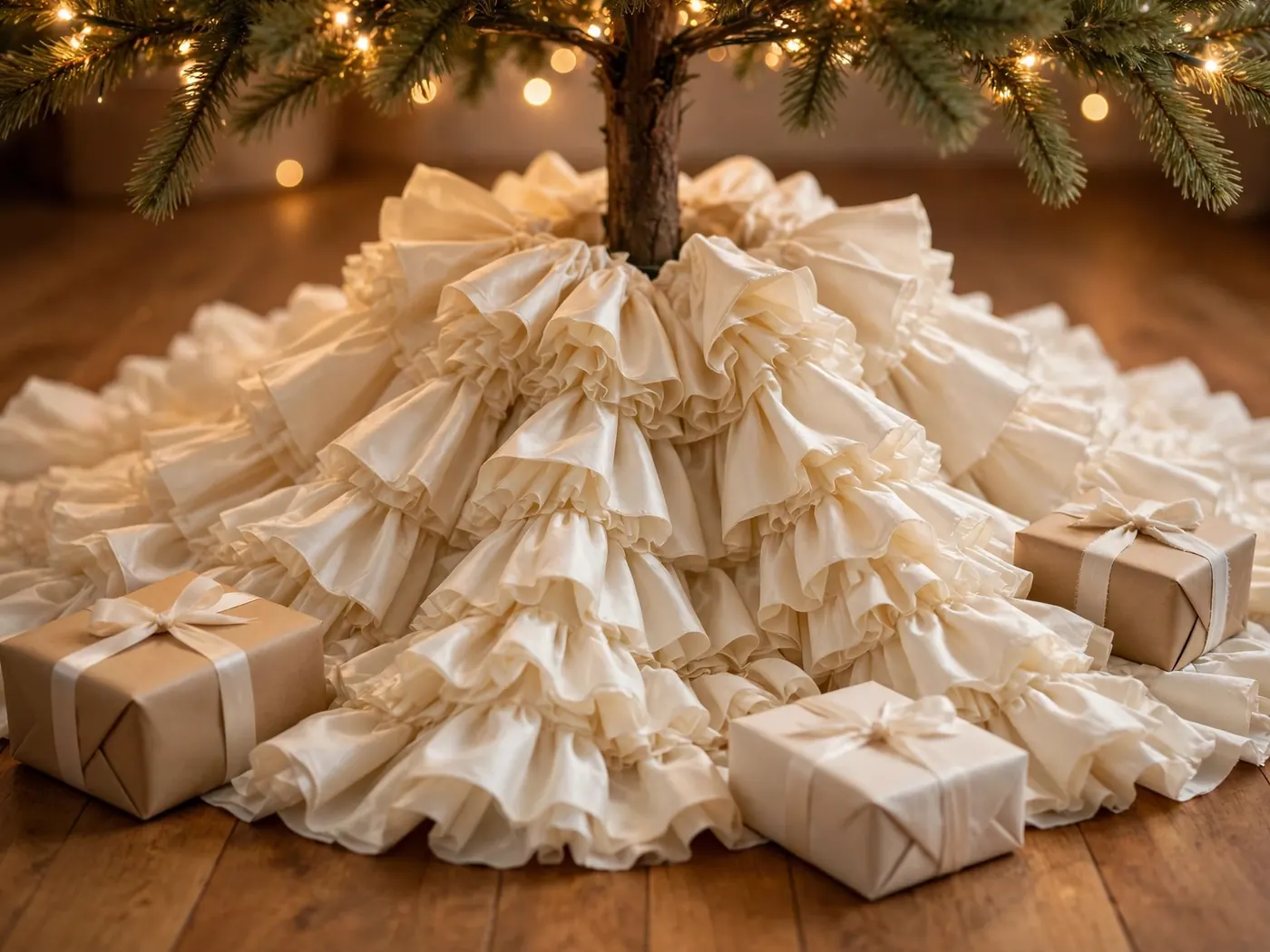
Budget tier: $$ — mid-range.
Monogrammed Family Skirt
A plain, good-quality skirt — deep red, forest green or natural linen-look fabric — personalized with the family name or initial embroidered near the front edge. It turns the most-forgotten part of the tree into the keepsake part, and it photographs beautifully with children and presents in front of it. Order personalization early: custom embroidery queues fill up by late November. If you sew, this is an evening’s work on a ready-made plain skirt and far cheaper than ordering custom.
Budget tier: $$$ — splurge when ordered custom; $$ if you add the monogram yourself.
Rustic and Natural
Burlap Skirt with Lace Trim
The farmhouse standard: natural burlap softened with a band of cream lace around the edge, so it reads rustic rather than rough. Burlap is inexpensive, forgiving of wrinkles, and the right weight to lie flat under the tree. One practical warning — raw burlap sheds fibers and has a strong earthy smell for the first few days, so unroll it outdoors or in a garage before bringing it to the tree, and choose a lined version if it will sit on pale carpet.

Budget tier: $ — budget.
Sheepskin-Style Throw Skirt
Instead of a cut skirt, drape a faux sheepskin throw or small rug around the base, tucking the edges under the stand. The irregular organic edge looks like snow piled softly around the trunk, and the deep pile is the most convincing snow effect on this list. It suits woodland, alpine and neutral schemes beautifully. Shake it out weekly — that pile collects needles like a magnet — and keep it out of reach of any dog who will claim it as the best bed in the house.
Budget tier: $$ — mid-range for a good faux sheepskin.
Bentwood Slat Collar
A ring of vertical or horizontal wooden slats, joined with rope or a flexible backing so it wraps around the stand and fastens at the back. It gives a tree the tidy, crafted look of a wooden planter while hiding the stand completely, and unlike fabric it cannot be dragged, bunched or slept on by the cat. Measure your stand before buying — collars are the least forgiving type on sizing — and check there is a gap or hinged section for watering a real tree.
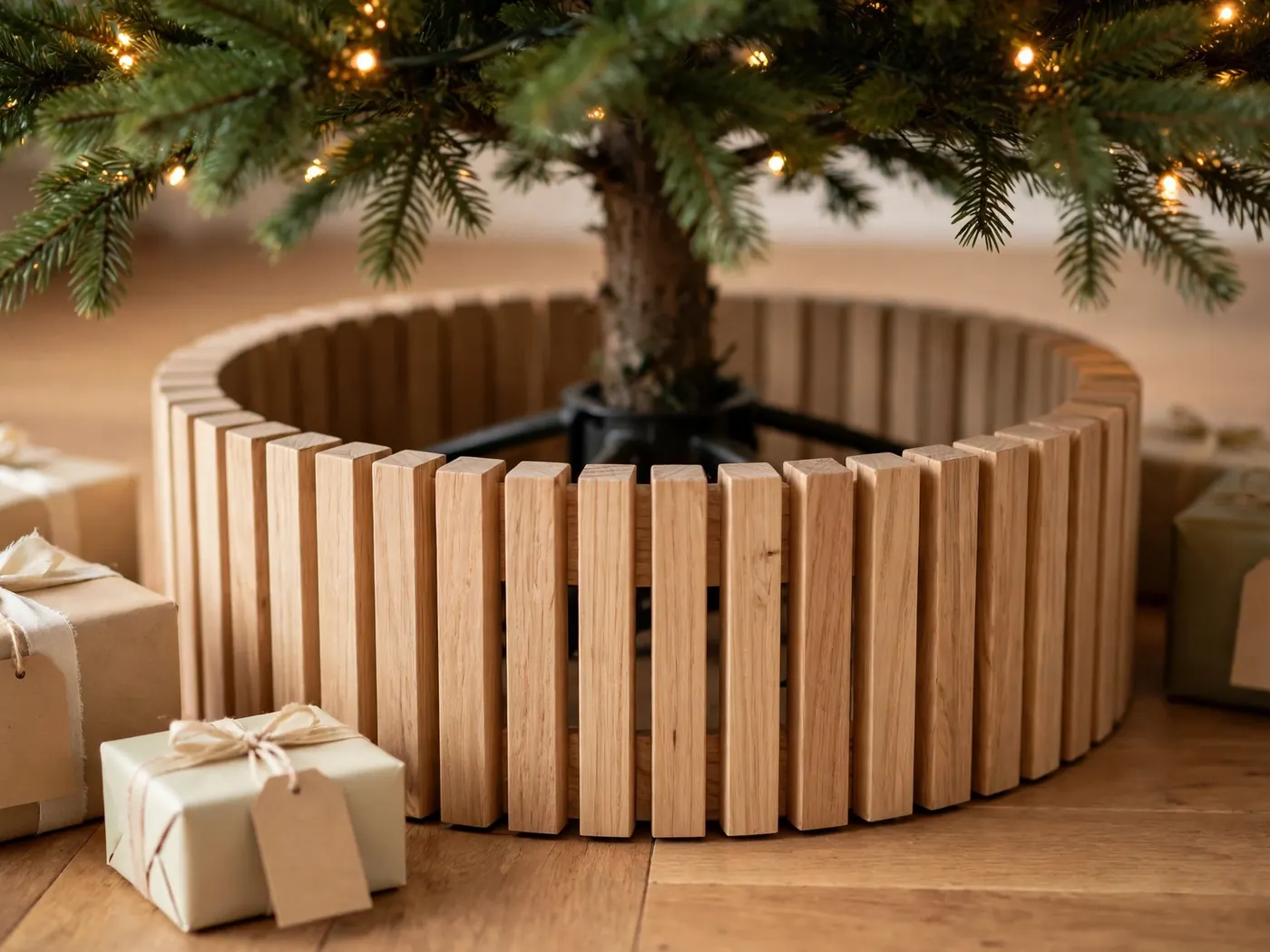
Budget tier: $$ — mid-range.
Jute Rope Coil Skirt
Made by coiling thick jute rope into a flat spiral mat, stitched or glued as you go, this skirt has a wonderful handmade texture and costs almost nothing if you make it. Bought versions are reasonable too. The natural tan color grounds bright trees and pairs well with wood, rattan and linen elsewhere in the room. Because it is a mat rather than a draped fabric, it lies perfectly flat and stays where you put it — a quiet advantage on hardwood floors.
Budget tier: $ — budget, near-free if homemade.
Hand-Crocheted Cotton Skirt
A crocheted skirt in undyed or cream cotton has the heirloom quality of something made by a grandmother — because it often is. The open stitchwork shows the floor through it, so it suits light, airy schemes and smaller trees best, and the soft drape handles uneven floors gracefully. If you crochet, a simple granny-style skirt in chunky cotton works up over a few evenings; if you buy, handmade marketplaces are the place, and prices reflect the hours in it.
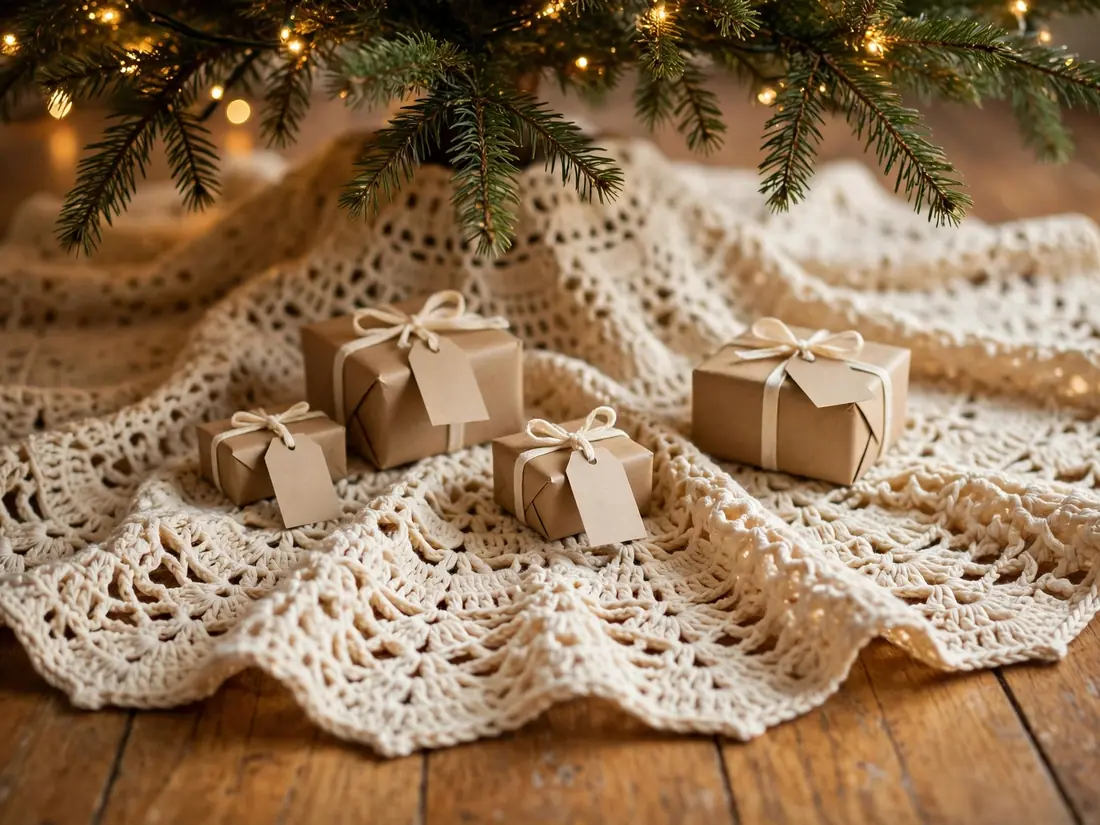
Budget tier: $$$ — splurge bought handmade; $ in yarn if you crochet it yourself.
No-Sew and Five-Minute
Draped Throw Blanket Skirt
The fastest good-looking fix on this list: take a cozy throw — plaid, cream knit or faux fur — bunch and swirl it around the base so the folds pool naturally, and tuck the corners under the stand. No cutting, no sewing, and when the season ends the “skirt” goes back on the sofa. It works because the folds imitate fabric drape better than a flat cheap skirt does. Choose a throw with texture; flat fleece reads as exactly what it is.
Budget tier: $ — free if you already own the throw.
Two-Yard Fabric Drape
Buy two yards of any fabric you love — velvet-look, linen-look, a festive print — and simply drape it around the base, gathering it into soft folds and tucking the raw edges underneath where nobody sees them. No circle to cut, no hem to sew, and the fabric returns to the craft stash in January. This is the best route when you want an exact color match to your scheme and the ready-made skirts are all half a shade off.

Budget tier: $ — budget; two yards of most fabrics is inexpensive.
Round Tablecloth Swap
A round Christmas tablecloth, draped over a small round side table or directly around the base, is a tree skirt you already own. The 60–70 inch tablecloths sold for holiday tables land squarely in tree-skirt size territory, many are already patterned to match your dinnerware, and the center can be cut with a small slit if you want the trunk through the middle — or simply bunched around the stand without cutting. After Christmas it goes back to the table drawer.
Budget tier: $ — free from the linen drawer.
Ring of Wrapped Gift Boxes
Wrap a dozen empty boxes in your best paper, tie them with ribbon, and arrange them in a ring around the base to hide the stand entirely. Early in the season, before real presents accumulate, the ring looks abundant and deliberate; as real gifts arrive, the empties quietly retire to a closet. Use boxes of two or three heights for a natural skyline, and weight the lightest ones with a book inside so the cat cannot rearrange your work.

Budget tier: $ — budget; boxes and paper scraps.
Coiled Garland Base
Take one long garland — frosted greenery, tinsel, or wooden beads — and coil it in a spiral around the base of the tree, two or three loops deep, so it reads as a nest the tree is sitting in. It takes five minutes, costs one garland, and is the easiest base cover to match to the tree, because you can use the same garland style as the mantel for a pulled-together room. Add a few leftover ornaments tucked into the coil to finish it.
Budget tier: $ — budget.
Hat Box Tree Collar
A large round hat box — or any sturdy decorative storage box with a separate lid — with its bottom cut out becomes an instant tree collar: rigid, tidy and surprisingly elegant in a patterned or fabric-covered finish. Drop it over the stand before the tree goes up, or cut a vertical slit up the back to fit it around an assembled tree. Vintage-style hat boxes from craft stores are inexpensive, stack for storage, and come in patterns no tree-collar maker bothers with.
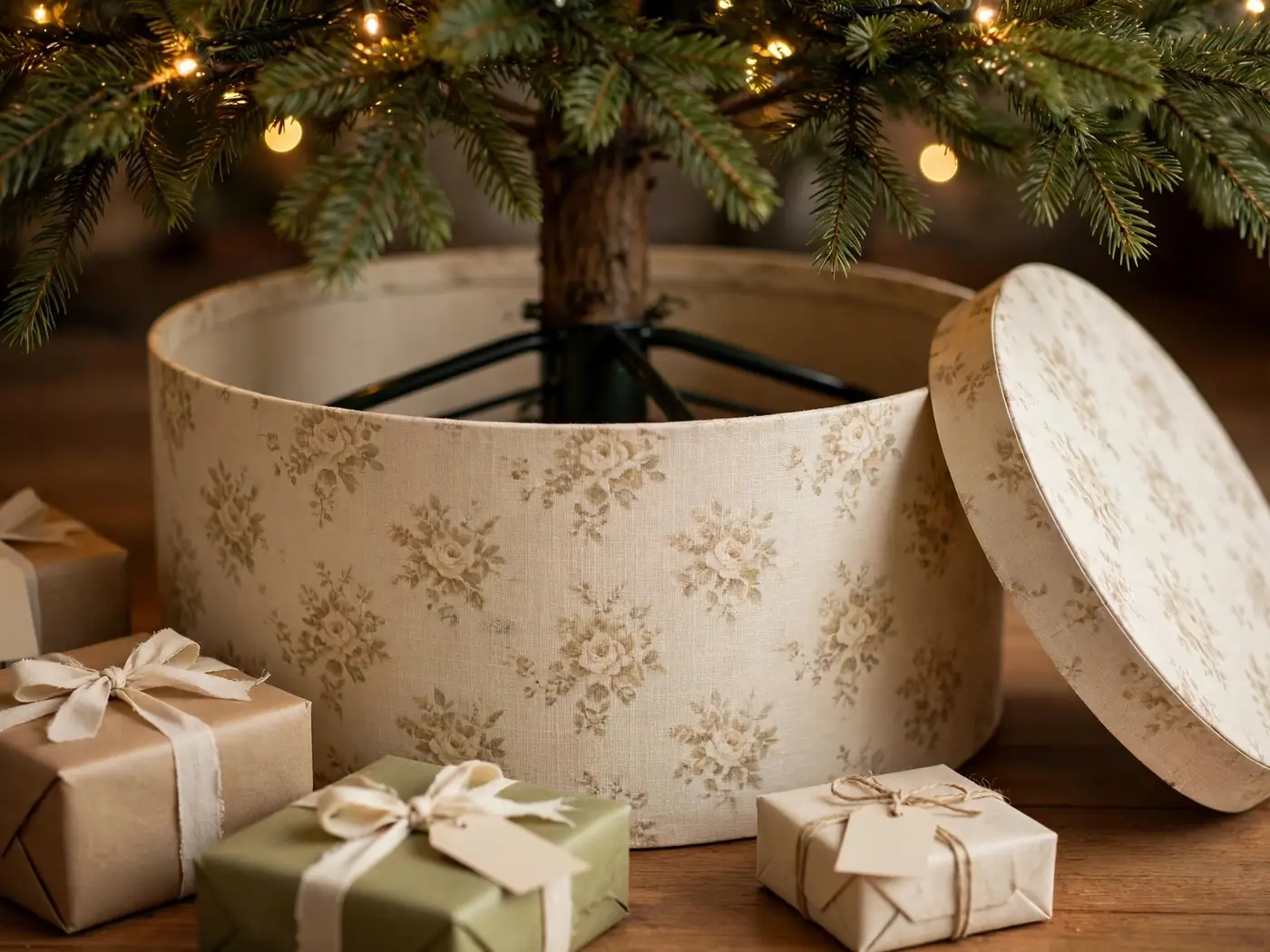
Budget tier: $ — budget.
Pet-Proofing and Quick Fixes
Bunching and drifting. Fabric skirts wander because they are light and the floor is smooth. A non-slip rug pad cut to size underneath, or a few strips of museum putty at the stand feet, ends the daily re-centering ritual. Heavier fabrics — knit, brocade, lined burlap — bunch far less than thin polyester.
Hiding cords properly. Run the light cord out through the skirt’s back slit, then along the wall under a cord cover, rather than across open floor under the skirt where feet find it. Never leave a coiled extension cord buried under fabric.
Keeping a white skirt clean. Choose washable fabrics for white and cream skirts, spot-clean sap with a little rubbing alcohol on a cloth, and store the skirt washed — stains set over eleven months in a box and greet you next December.
The cat-napping problem. Cats claim tree skirts because they are soft, warm and smell of the family. A rigid collar is the only base cover a cat cannot turn into a bed; with fabric, give the cat a decoy blanket nearby and accept a certain amount of occupation as a decorating cost.
FAQ
What size skirt does a 7.5-foot tree need?
A 48–56 inch diameter skirt covers the stand and reaches the drip line of a typical full 7.5-foot tree. If your tree is extra wide, or you like the fabric pooling on the floor, go to the top of that range or beyond — extra diameter looks generous, while too little looks like a mistake.
Can I wash a tree skirt?
Most cotton, canvas and polyester skirts are machine washable on a gentle cycle; velvet, brocade, sequined and embellished skirts should be spot-cleaned or dry-cleaned. Whatever the fabric, wash or clean it before storage, not after — a season of dust and sap left in a box is much harder to remove.
What should go under a skirt with a real tree?
A waterproof tray or a plastic tree mat goes under everything, skirt included. Real trees get watered, stands overflow, and sap drips — the tray protects the floor, and the skirt goes over the tray’s edges to hide it. Check the tray’s diameter against the size chart above so the skirt still covers it.
My stand is wider than the skirt’s center hole. What now?
Use the skirt’s back slit: most skirts open fully along one radius, so you can wrap the fabric around the stand and overlap the edges rather than threading the trunk through the center hole. If the skirt still will not close, a wrap-style drape or a collar sized to the stand is the honest fix.
Decide the size first, pick the type that suits your household, and the base of the tree stops being the part you apologize for. For more styling direction once the base is sorted, the editors at Homes & Gardens share further tree skirt ideas worth browsing — then close this tab, measure your stand, and buy once.