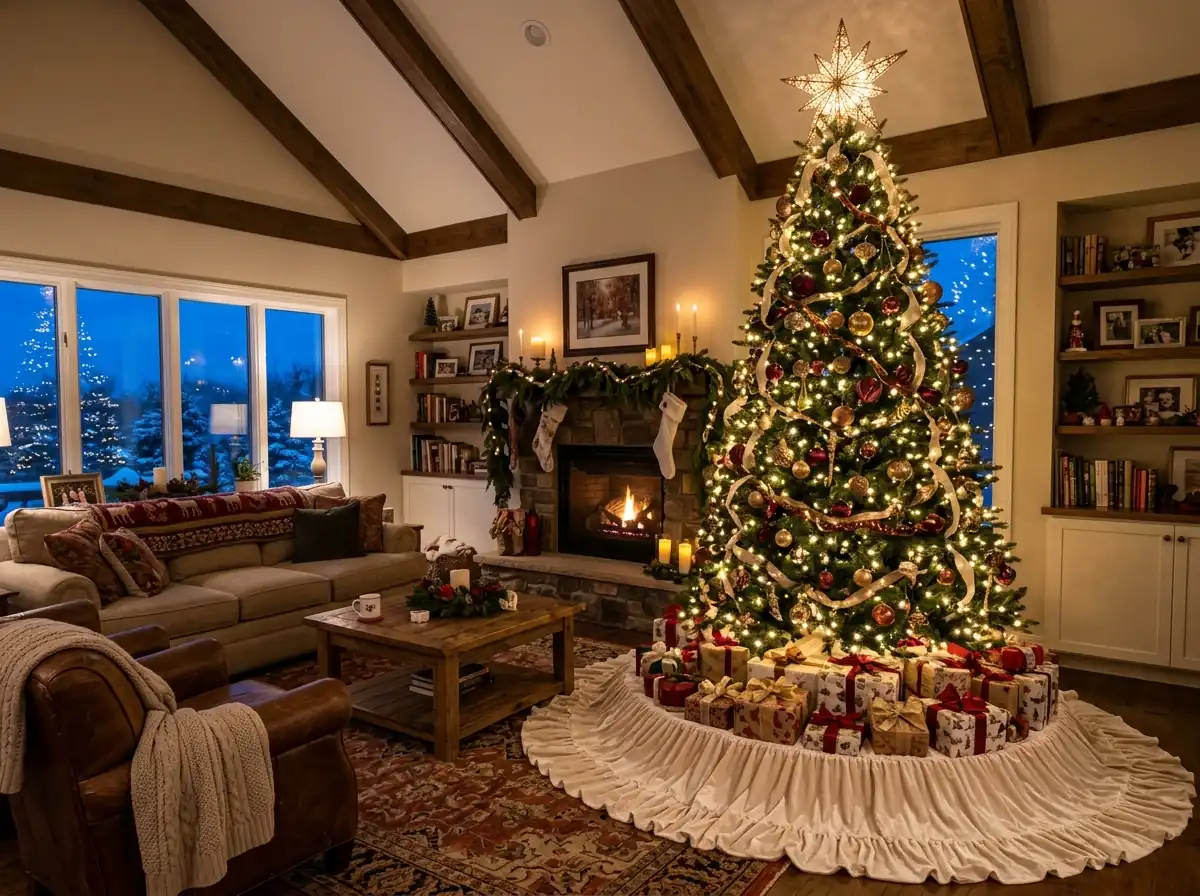
Your tree can be perfect for eleven months of planning and still look unfinished in the last five minutes — because the top is bare, or the stand is sitting there in plain view like scaffolding nobody remembered to remove. It happens in most homes: the ornaments get all the attention and all the budget, and the two pieces that frame the tree get whatever is left over.
The topper is the full stop at the end of the tree’s sentence, and the skirt or collar is the ground it stands on. Get those two right and the tree looks intentional from across the room; get them wrong — too small, too shiny, clashing with everything below — and no ornament can rescue it. The good news is that both are one-time decisions: a topper and a base that suit your tree will serve for a decade.
Below are the statement toppers and the skirts and collars worth considering, with the sizing rules that keep them in proportion. If you are browsing for ideas, the season’s favourite Christmas tree toppers and skirts show which finishes most homes are pairing together this year.
Two Anchors, One Tree: Read This Before You Buy Either
- Proportion before personality: a topper should read clearly from the doorway; if you have to squint, it is too small for the tree.
- One metal, one mood: let the topper’s finish echo something already on the tree — a ribbon edge, a bauble finish — rather than introducing a new metal.
- The base must swallow the stand: measure the stand’s widest point first; a skirt or collar that shows the feet has failed at its only job.
- Decide the silhouette: soft and draped (a skirt) or structured and tidy (a collar) — the tree’s base should match the room’s furniture, not fight it.
With those rules set, the toppers come first — and whichever theme you have chosen from this year’s Christmas tree themes for 2026, there is a finisher below that belongs on it.
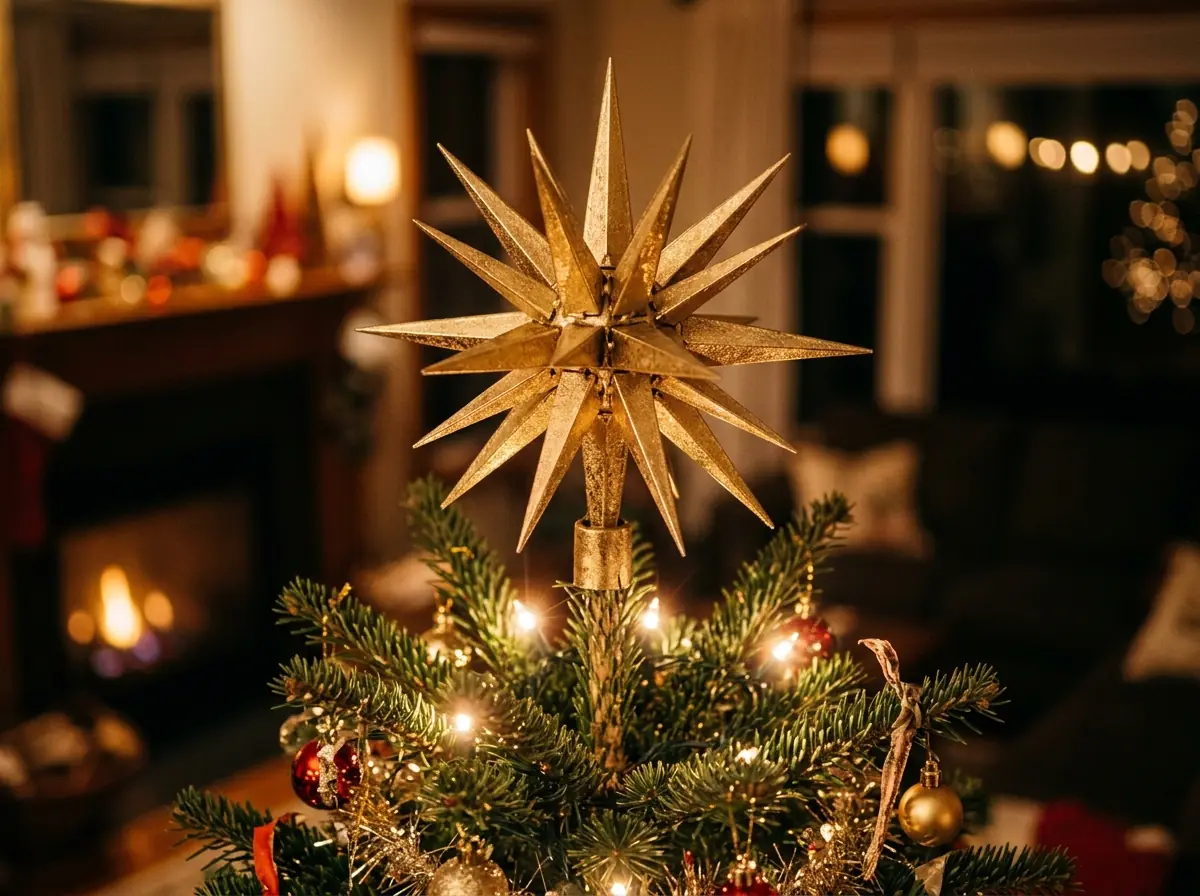
The 3D Metal Moravian Star
The Moravian star is a burst of points in every direction, and in brushed or polished metal it catches light from the whole room, not just the tree’s own strands. It suits tall trees and high ceilings, where a flat topper would disappear. It mounts on a simple spike or clamp and holds its shape season after season. The trade-off is presence: this star keeps drawing the eye upward, so on a tree in a small room it can feel like the loudest thing in the house.
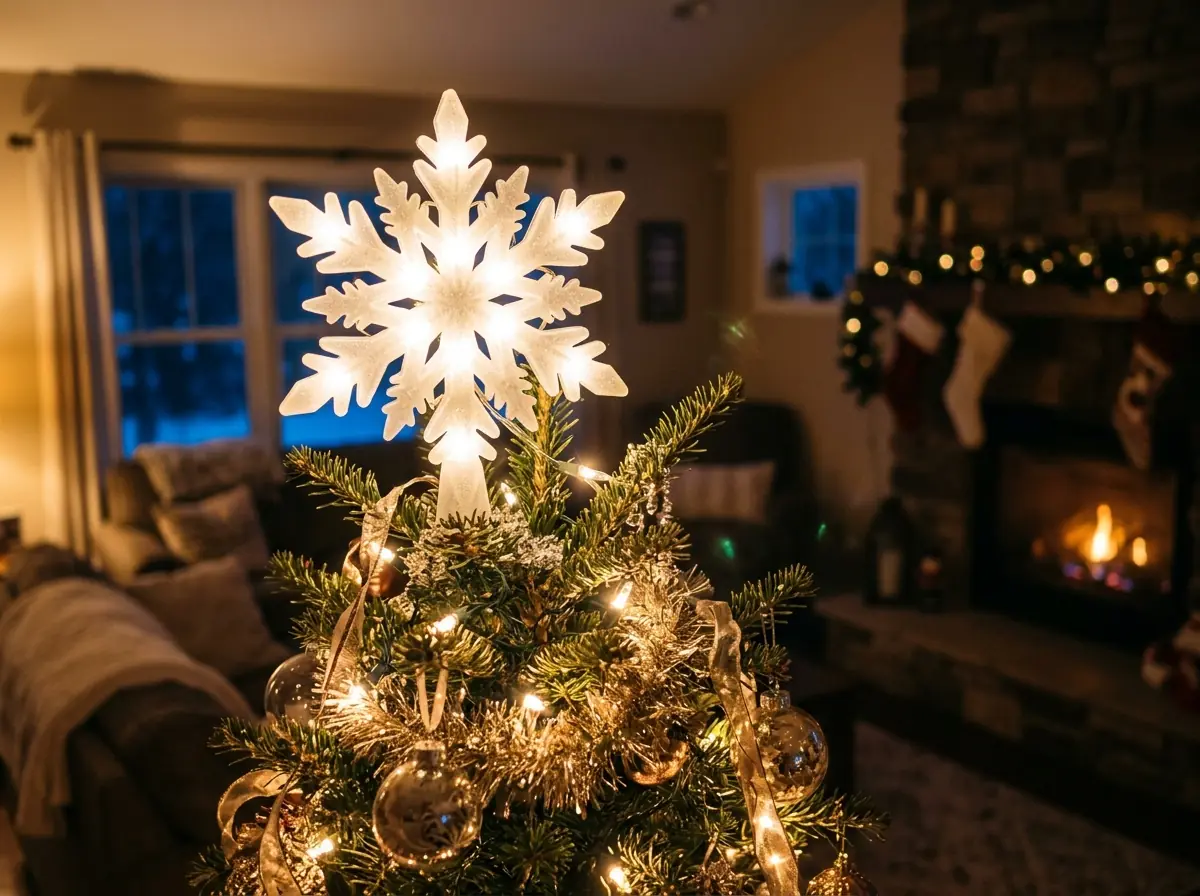
The Lighted Snowflake Topper
A snowflake that lights itself solves the oldest topper problem — the dark gap between the last strand of lights and the top of the tree. Warm-white versions blend into a lit tree; cool-white ones read icier and more modern. Battery models avoid the cord down the back, though the version that lasts is usually the plug-in with the cord run discreetly along the trunk. The honest cost is one more thing to plug in, and a dead bulb in a snowflake shows more than a dead bulb anywhere else on the tree.
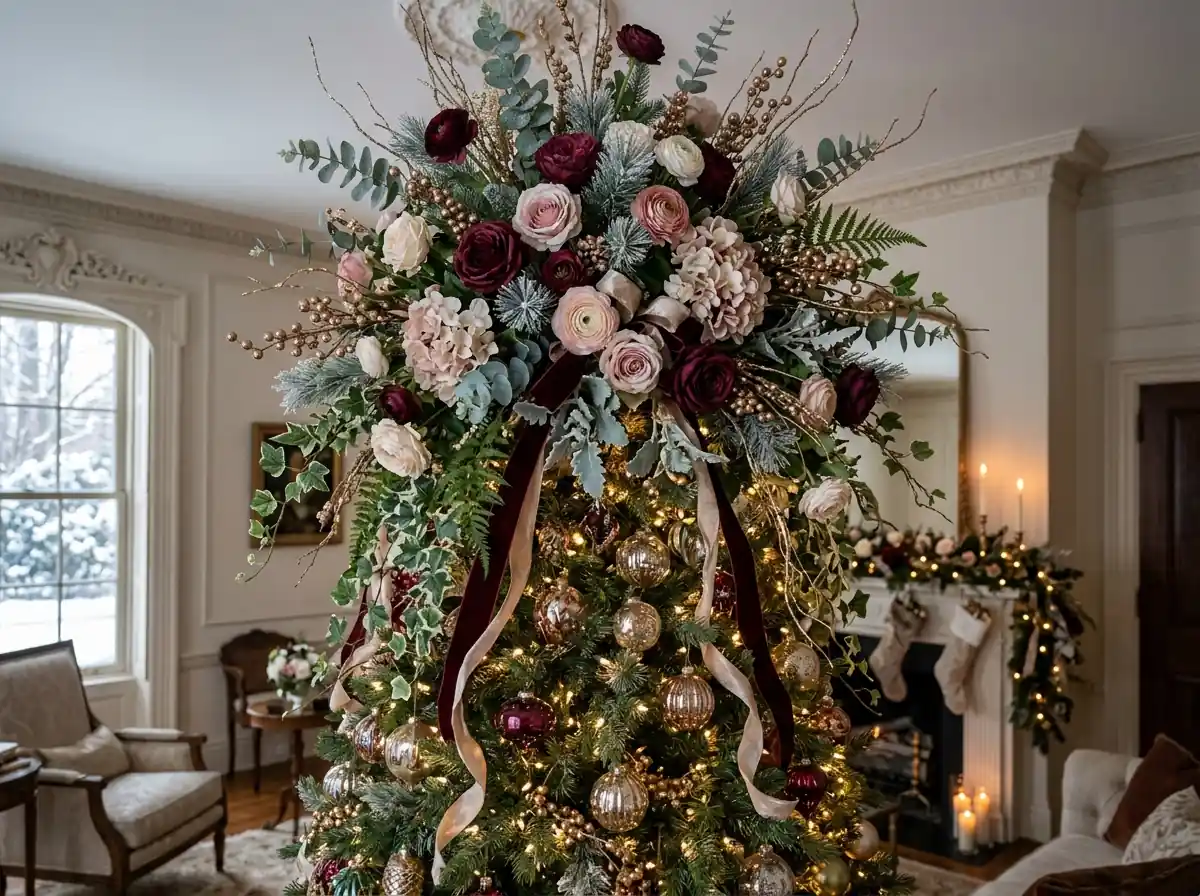
The Floral Spray Topper
Instead of one object, a spray: silk flowers, berries, and picks bursting upward and outward from the treetop like the opening of a bouquet. It is the softest finish on this list and the natural partner for floral or garden-leaning trees. Build it loose — picks wired in at angles, never a tight dome. Its weakness is gravity and time: picks slip a little lower each year, and silk blooms fade if the tree stands in direct sun, so this topper needs five minutes of reshaping every season.
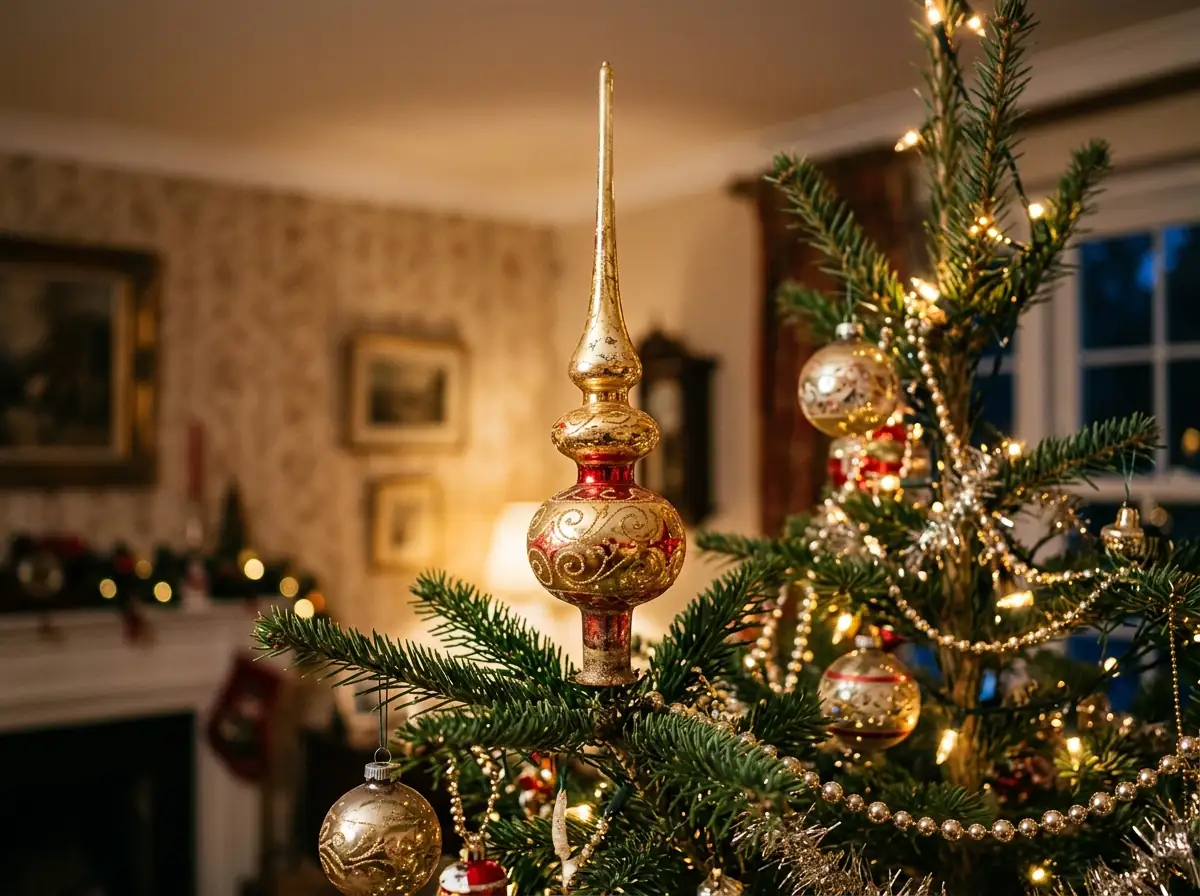
The Vintage Glass Finial Topper
The finial is the classic spire — a stacked glass tower of spheres and points, hand-finished the way ornaments were made generations ago. The Kurt S. Adler Early Years Glass Tree Topper, Set of 2, 13 in, at $30.25, is the sensible way to buy one: the set of two means a spare is already in the box, or a second smaller tree gets a matching finish. Glass at the top of a tree is a real commitment, though — it is the first piece to fall if the tree is knocked, and it should be the last thing placed and the first thing removed, every single year. Homes leaning into retro Christmas decor will find this is the topper that does the most work for the theme.
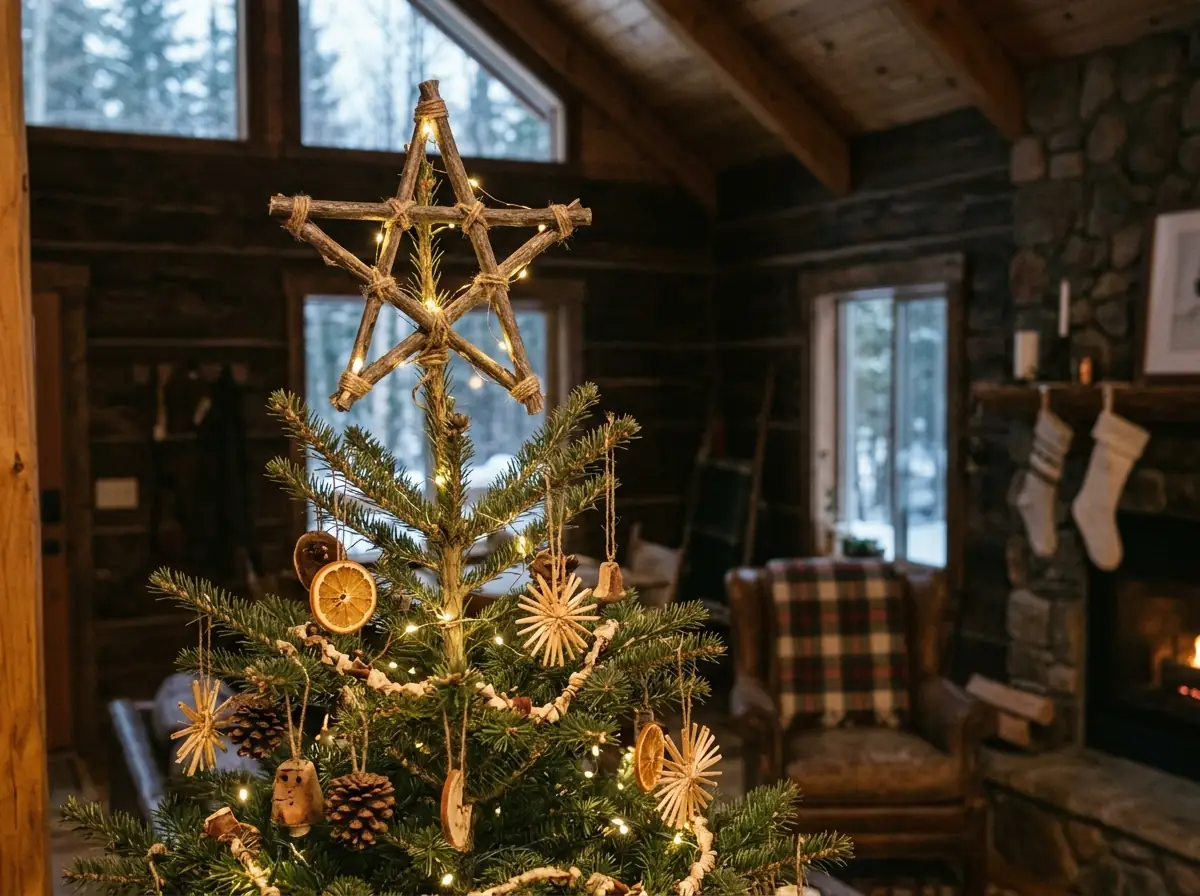
The Rustic Twig Star
A star woven from bare twigs and vine, left unpainted or dusted lightly white, finishes woodland and farmhouse trees without a hint of shine. It is light — a real advantage on slim top branches — and it costs less than almost anything else here. What it gives up is definition after dark: unlit and unglittered, a twig star nearly vanishes against a dark window, so it earns its place in daylight rooms and on trees near lamps.
| Tree style | Topper that fits | Fitting note |
|---|---|---|
| Traditional, full and symmetrical | 3D metal Moravian star | Seat it deep on the top branch so it reads centred from every side |
| Scandi and minimal | Rustic twig star | Keep it the only rustic note, or repeat twig once more lower down |
| Glam and metallic | Floral spray burst or vintage glass finial | Tie the spray loosely — a spray wired rigid looks like a hat, not a finish |
| Dark room, evening tree | Lighted snowflake | Run its cord down the trunk side, hidden against the branches |
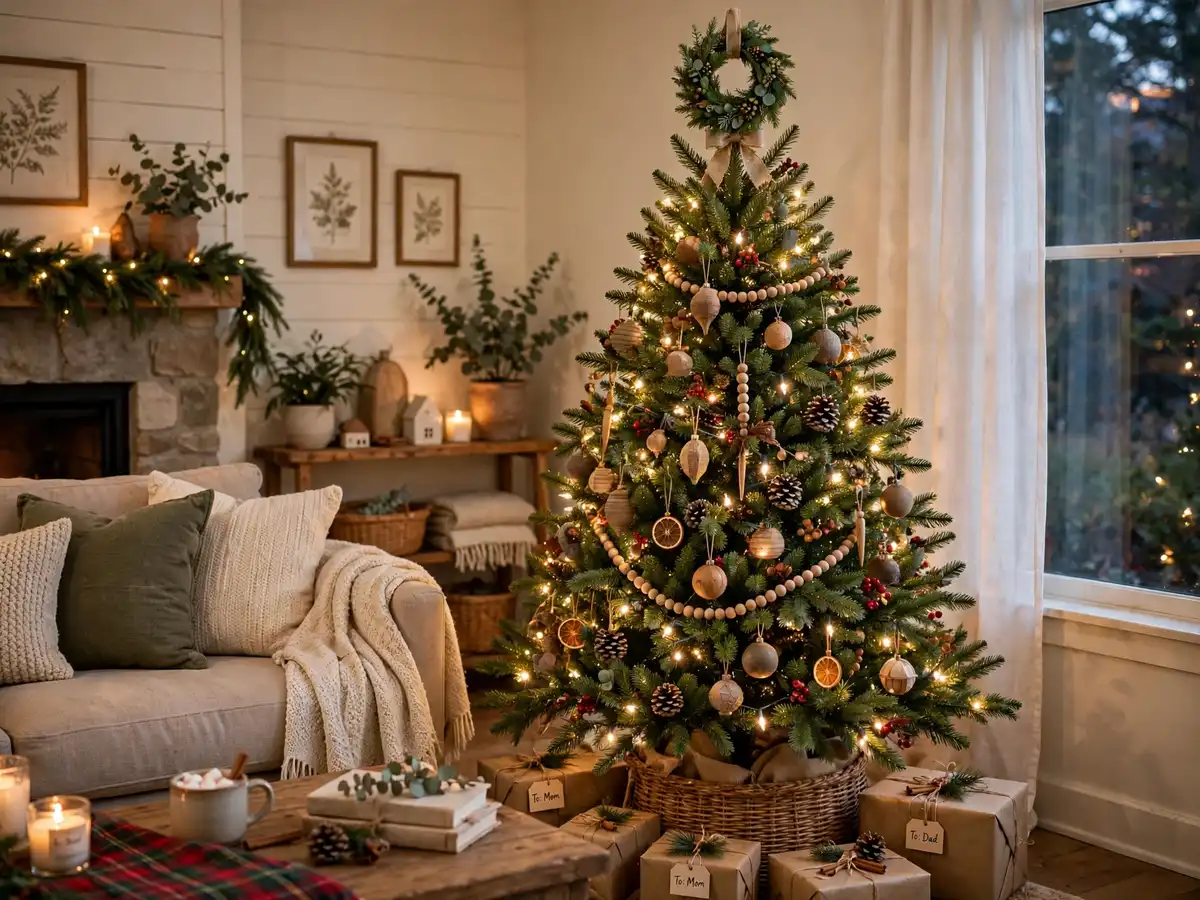
The Mini Wreath Topper
A mini wreath makes a gentle topper for a shorter tree: choose a plain green wreath about 20–25 cm across and slip its centre ring down over the tree’s top spike, so it sits like a halo where a star would go. Push it down until snug, then straighten it from the front so it hangs level.
If the spike is thin, wrap florist tape or a twist of wire around it first to give the wreath something to grip. The trade-off is weight: a wreath is heavier than most toppers, so on a very slim or artificial top branch it can lean the tip sideways over the season.
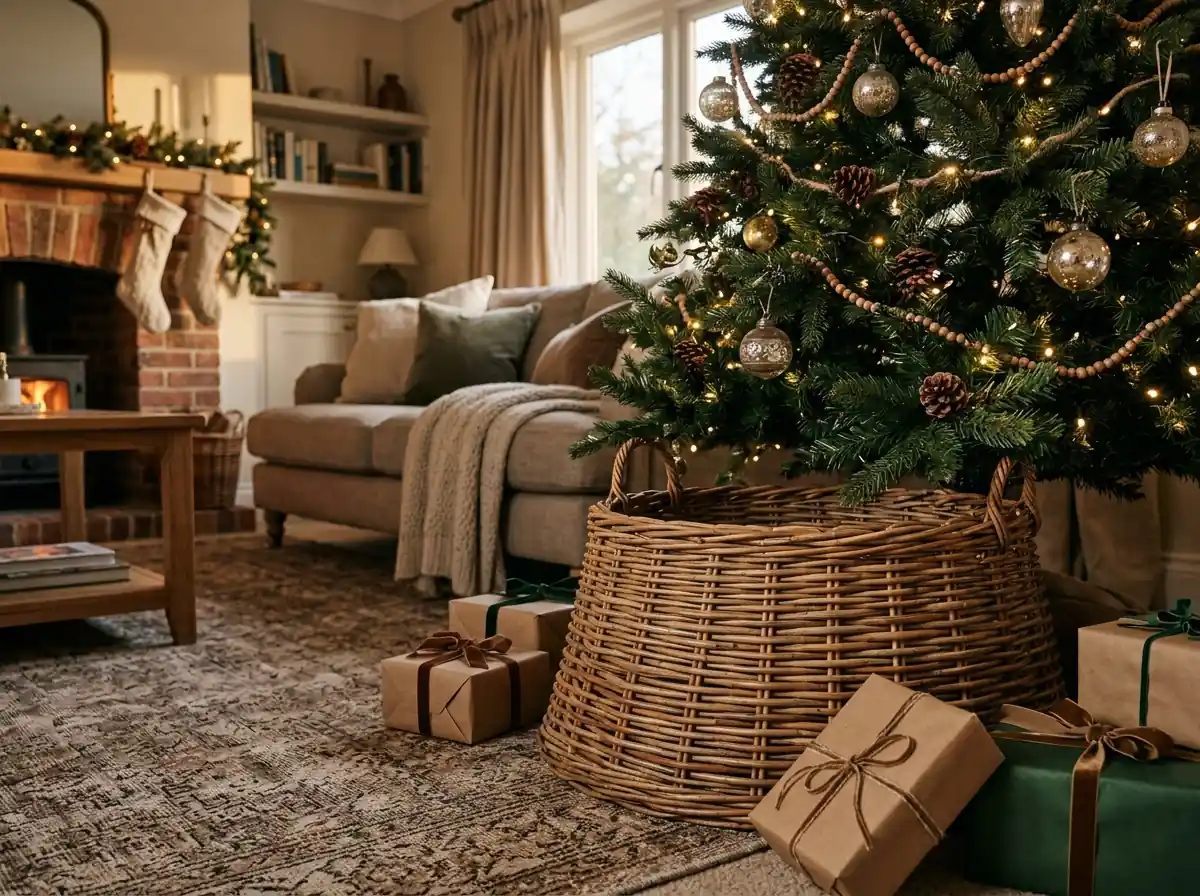
The Woven Basket Tree Collar
A collar instead of a skirt: a woven basket ring that sits around the base like the tree grew out of a planter. Seagrass and willow versions hide the stand completely and give the tree a clean, finished edge that vacuuming around is easy. The fit is the catch — collars are rigid, so the stand must measure smaller than the collar’s inner diameter with room to spare, and a collar that has to be forced on will crack at the weave by its second season.
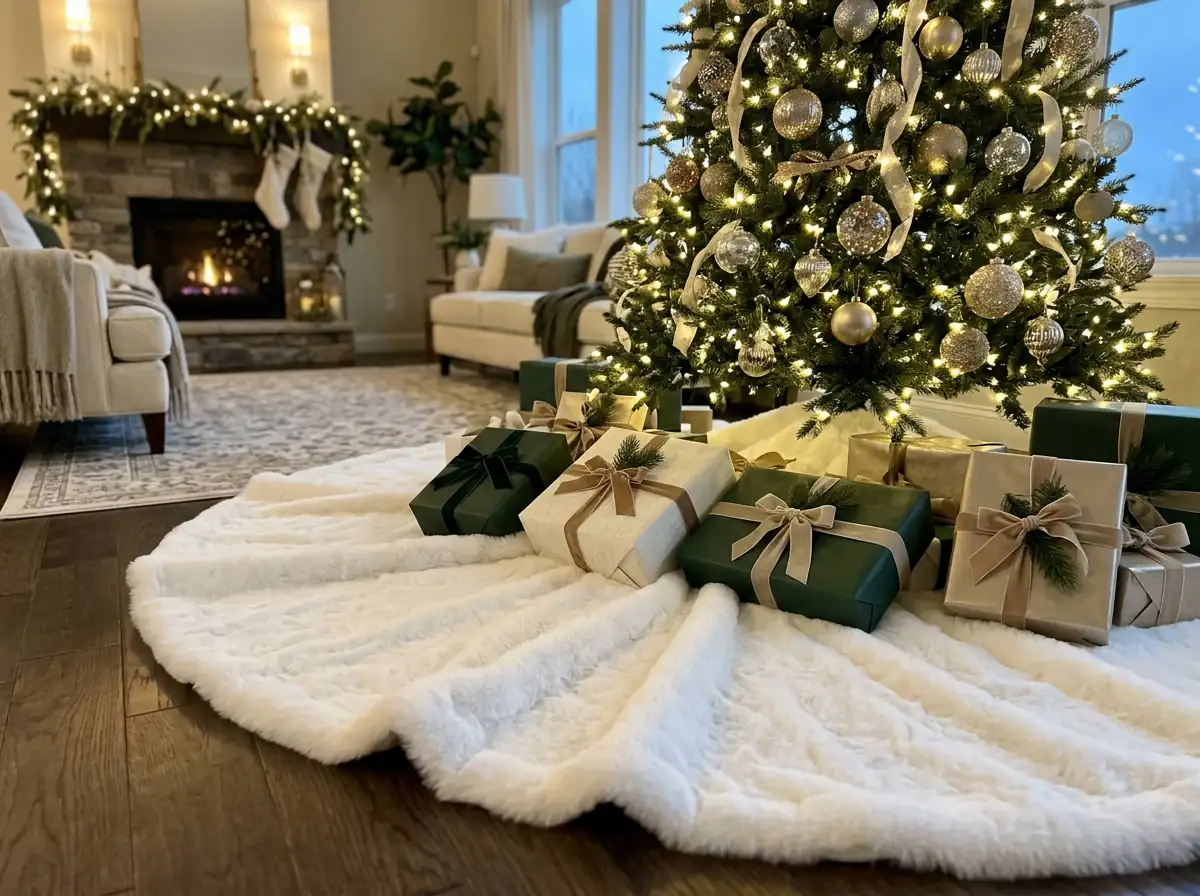
The Faux Fur Skirt
A white or ivory faux fur skirt spreads like snow under the tree and makes every present on it look more expensive. It is the softest base here and the one children and pets vote for unanimously — which is also its problem. Faux fur shows every dropped needle, holds pet hair, and cannot be shaken clean the way fabric can; it needs a gentle wash and a full day to dry, so it is a poor choice for a real tree that drinks water daily.
The Plain Velvet Skirt
No trim, no pattern — just deep velvet in one color, pooling slightly at the edges. Velvet absorbs light instead of bouncing it, so the base of the tree goes quiet and the ornaments above it look brighter by contrast. It drapes over any stand shape, folds flat for storage, and works under formal and traditional trees alike. Its one demand is color discipline: velvet in the wrong shade — too bright, too blue — sits under the tree arguing with it all season.
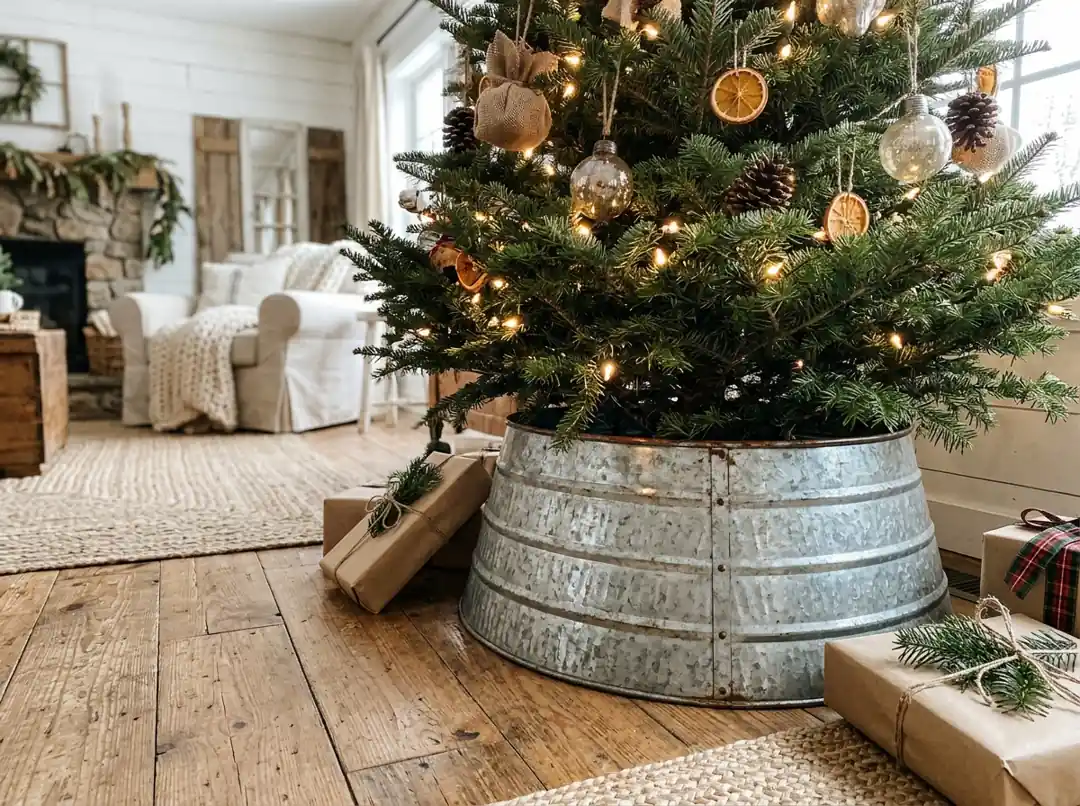
The Galvanized Metal Tree Collar
A ring of galvanized steel around the base gives the tree an industrial, farmhouse edge and the most durable finish on this list — it cannot stain, tear, or fade. It also reflects the tree’s lights in a soft, weathered way that new metal does not. Mind the edges and the fit: cheaper collars have sharp rims that scratch floors and fingers, and like all rigid collars it must be measured against the stand before ordering, not after.
| Situation | Better choice | Why |
|---|---|---|
| Pets or toddlers at the base | Collar (basket or metal) | Nothing to pull, chew or trip on, and the stand stays hidden |
| Real tree that needs watering | Skirt | Fabric lifts aside in seconds; a collar has to come off to reach the water |
| Very small floor footprint | Collar | It ends at the stand’s edge instead of spreading across the floor |
| Gifts are part of the display | Skirt | Parcels sit softly on fabric and the skirt frames them like a stage |
The Embroidered Linen Skirt
Natural linen with a stitched border — a row of trees, stars, or simple red running stitch — is the heirloom option: quiet up close, clearly handmade in character, and better looking in its fifth year than its first. Linen wrinkles honestly and softens with washing, which suits its character. The trade-off is price and pace; embroidered linen costs more than plain fabrics and reads understated from across the room, so it rewards close-up rooms — small spaces, trees near seating — more than grand ones.
No Skirt at All: The Crate and Bucket Trick
The boldest base is not a base at all: set the stand inside a vintage wooden crate or a galvanized bucket, pack the gap with straw, fabric, or tissue, and let the container be the finish. It works especially well on smaller trees and in rooms with a rustic lean — and it is a natural partner for tartan Christmas decor ideas, where the tree already carries the pattern and the base should stay plain. Two cautions: a real tree’s water reservoir must stay reachable for daily watering, and the container must be stable — a bucket that fits the stand snugly, not one the tree can tip inside.
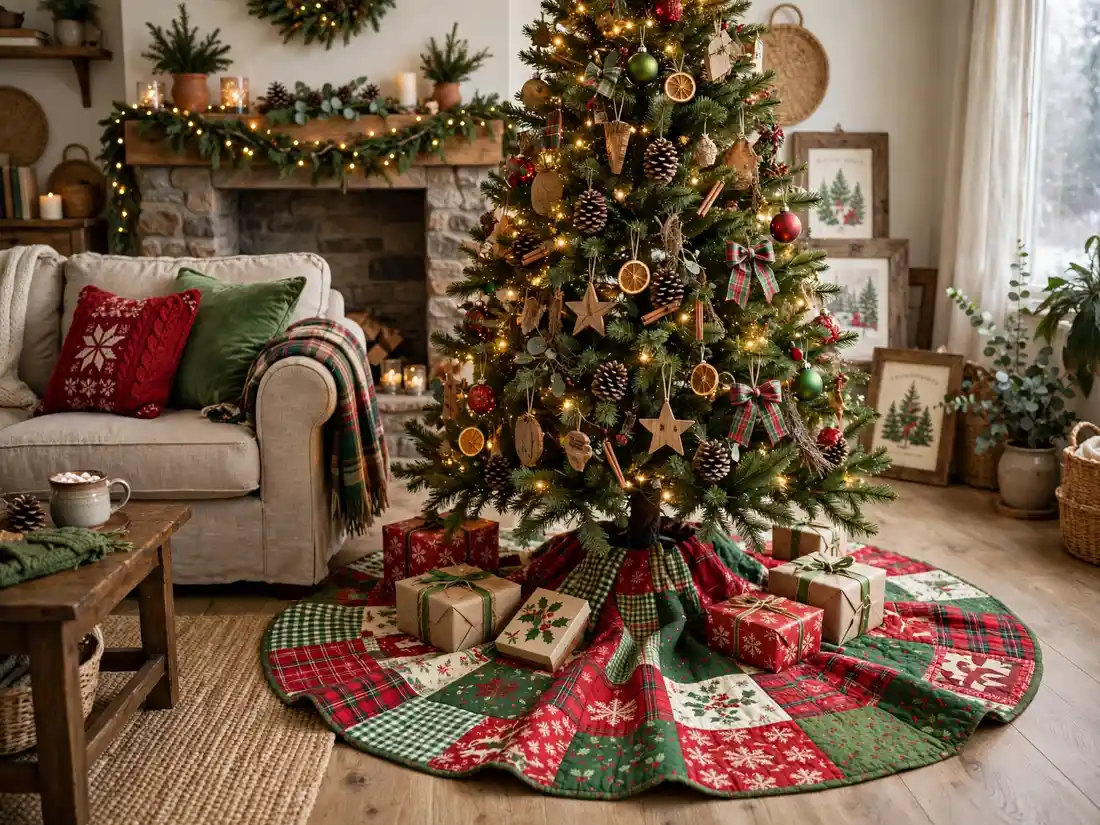
The Quilted Patchwork Skirt
A quilted patchwork skirt wraps the tree stand in mixed holiday prints — plaids, sprigs and little motifs stitched into squares — and gives the whole tree a handmade, handed-down feel. Lay it print-side up and ease the padding flat with your hands so presents sit steady instead of sliding on the loft.
It suits a family tree better than a formal one, and mixes happily with almost any ornament colours because the prints already contain them all. The honest downside is storage: all that quilting folds down bulky, and it will claim a shelf or a storage box of its own for the other eleven months.
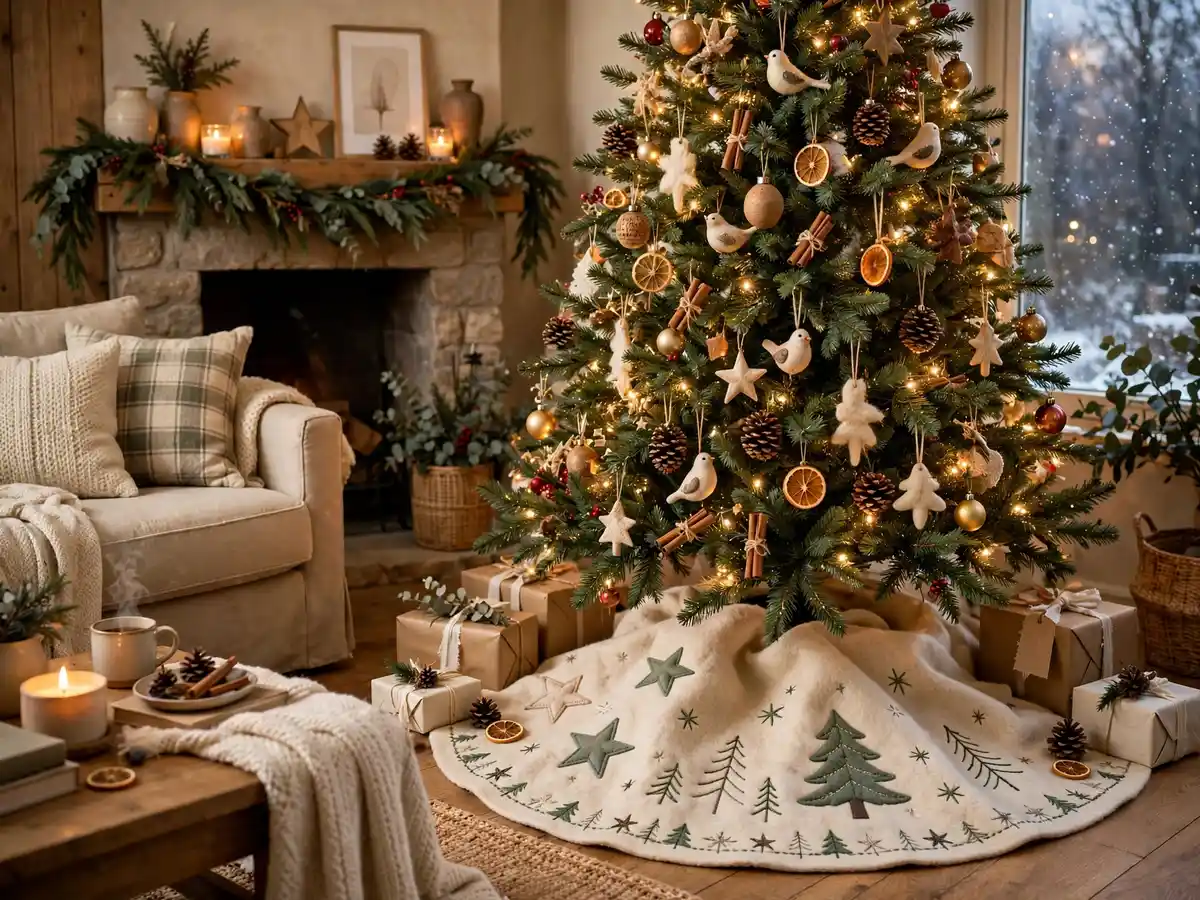
The Embroidered Felt Skirt
A felt skirt embroidered with simple stars, trees and snowflakes brings a quiet, storybook look to the base of the tree. Felt lies flat straight out of the box, needs no ironing, and its soft edge is kind to wooden floors and to small hands that rearrange the presents daily.
Choose motifs in one thread colour for a calm look, or let each panel carry a different little scene. The trade-off is that felt shows everything: pale dust, fallen needles and pet hair all cling to it, so it wants a lint roller passed over it every few days through December.
Size It Right: Topper and Base Measurements That Work
Three rules cover almost every tree. First, topper proportion: the topper should measure roughly a tenth of the tree’s height — a 7.5 ft tree carries a 9–12 in topper comfortably — and it should add presence without adding so much height that the tree crowds the ceiling. Second, skirt diameter: the skirt or collar should extend close to the tree’s widest branches without passing them, typically a diameter about two-thirds of the tree’s full width, and always at least 6 in wider than the stand on every side. Third, collar fit: measure the stand’s widest point and choose a collar at least 2 in wider, or the collar will not drop over it. When in doubt between two sizes, take the larger — a base that looks generous reads as luxury, while one that looks skimpy reads as a mistake.
| Tree height | Topper size | Skirt or collar diameter |
|---|---|---|
| 6 ft | 8–10 in | 36–42 in |
| 7.5 ft | 9–12 in | 48–56 in |
| 9 ft | 12–15 in | 60–72 in |
Your one next step: before you buy anything, measure two things tonight — the width of your tree stand at its widest point, and the distance from the top of your tree to the ceiling. Write both numbers on the box where the ornaments live. Every topper and base you ever consider will be decided by those two figures, and you will never have to guess at them in a store aisle again.