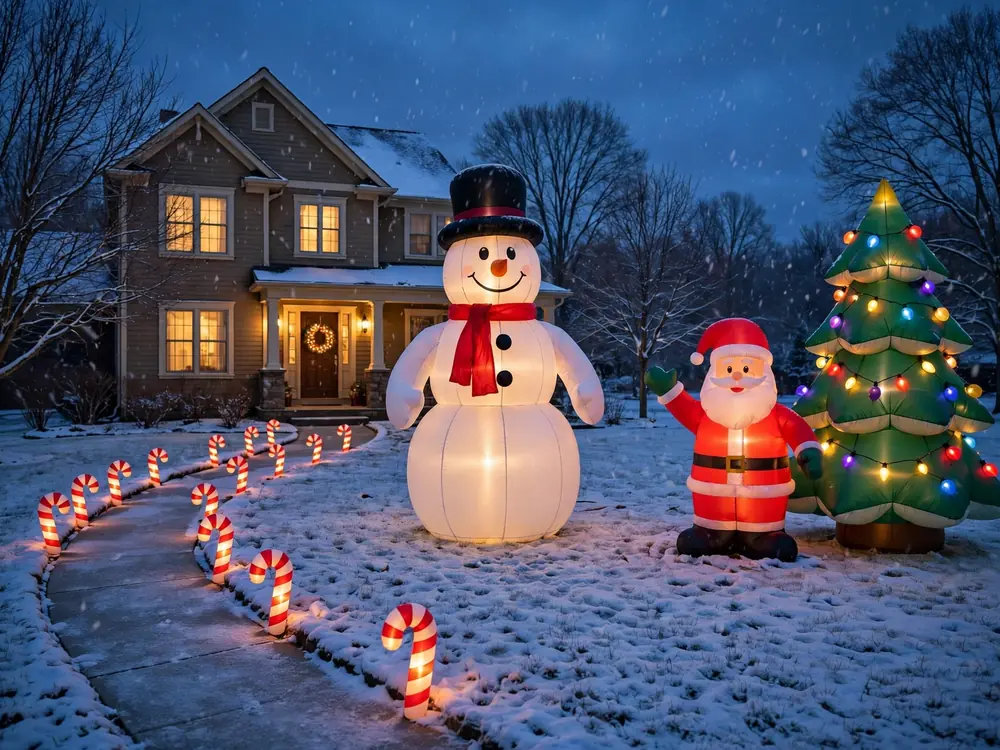
An inflatable can turn a plain front yard into a full Christmas display in about the time it takes to brew coffee. Unroll it, stake it down, plug it in, and a flat lawn suddenly has a twelve-foot snowman waving at traffic. But the yards that stop cars are rarely the ones with the most inflatables. They are the ones where each piece has a job: one hero, a supporting cast, something guiding visitors up the walk, and maybe a surprise up high. This guide treats inflatables as display design, not just shopping, so your yard looks planned instead of crowded.
Below you will find quick picks matched to common yard situations, then seventeen display ideas grouped by the role each piece plays. Every idea carries a size and power note so you can check it against your space and your outlets before you buy. After the ideas comes a step-by-step setup walkthrough, a troubleshooting section for the problems almost every owner meets, and answers to the questions people ask before their first season. Pair your inflatables with the right lighting and the whole scene doubles in impact after dark, so it is worth browsing some exterior Christmas light ideas that fill the garden while you plan the layout.
Quick Picks: Match the Inflatable to Your Yard
- Small yard or porch only: Skip the giants. One 4 to 5 foot figure beside the door, or a pair of small pieces flanking the steps, fills a compact space without swallowing it.
- Tight budget: Buy one good mid-size piece this year and add one each season. A single well-anchored 6 foot inflatable on a timer looks better than three cheap ones sagging by week two. Fill dark gaps cheaply with net light ideas for bushes that cover evenly so the yard reads full at night.
- Windy street: Choose low, wide shapes over tall, thin ones, budget for extra tether lines and sandbags, and pick a sheltered spot near the house rather than the open middle of the lawn.
- One big statement: A 10 to 12 foot hero piece placed where the street sightline hits it first. Give it clear space on every side so its scale reads as confidence, not clutter.
| Inflatable Type | Typical Size | Best Yard | Power Note |
|---|---|---|---|
| Single hero piece (Santa, snowman) | 8–12 ft tall | Medium to large lawns with a clear street sightline | One fan, one outlet |
| Character group scene (sleigh, nativity) | 5–6 ft tall, 6–12 ft wide | Wide frontages with level ground | One or two fans |
| Pathway and porch pieces | 4–5 ft tall | Small yards, porches, walkway edges | One fan; weight the base on hard surfaces |
| Archway | 8–9 ft tall | Long, plain front walks | Usually two fans; four anchor points |
| Roofline piece | 3–4 ft | Single-story rooflines and porch roofs | Small fan; cord must reach an outlet below |
The Hero Piece
Giant Snowman Greeter at the Center of the Lawn
Every display needs one piece the eye lands on first, and a 10 to 12 foot snowman is the friendliest hero you can choose. Set him off-center rather than dead middle, angled a few degrees toward the street so his wave reads to passing cars. Because he is round and top-heavy, anchor every tether point the manufacturer provides and add two sandbags at the base on exposed lawns. Keep smaller pieces at least a few feet away so they do not crowd his silhouette. At night his internal lights pull the whole yard toward him.
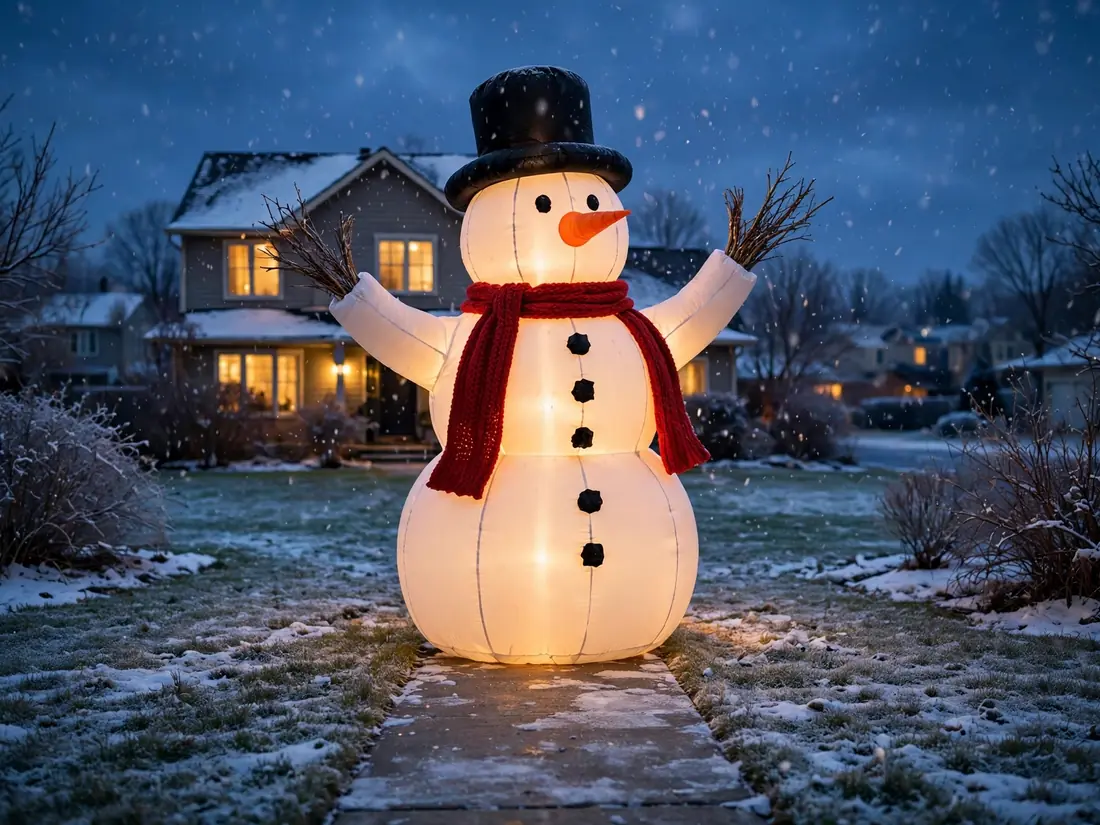
Size & power: 10–12 ft tall, roughly 5 ft wide · built-in fan, usually 1.5–2 amps · needs one outdoor outlet within cord reach.
Santa’s Sleigh with a Two-Reindeer Team
A sleigh scene suits wide frontages where a tall piece would look lost.The long, low shape stretches across the lawn and tells a story at a glance: Santa, sleigh piled with gifts, and two reindeer ready to launch. Run the team on a gentle diagonal pointing toward the street corner, which makes it feel ready to take off. Level ground matters; a slope makes the front reindeer sag. Give it a clear runway with no shrubs breaking the line, and let it be the only large piece on that side of the yard.
Size & power: 4–5 ft tall, 9–12 ft long · one or two built-in fans · check total length against your frontage before ordering.
Nativity Scene as the Front-Yard Focal Point
An inflatable nativity gives a display a calm center that balances all the glitter around it. The wide, stable shape suits front-and-center placement on a flat patch of lawn, ideally where a porch light or a soft spotlight can add a gentle glow from the side. Keep the scene on its own so the figures read clearly from the street; busy pieces crowded against it shrink its impact. Families who prefer a faith-focused yard can make this the only large piece and surround it with nothing but simple white lights. It also photographs beautifully for the neighborhood page.
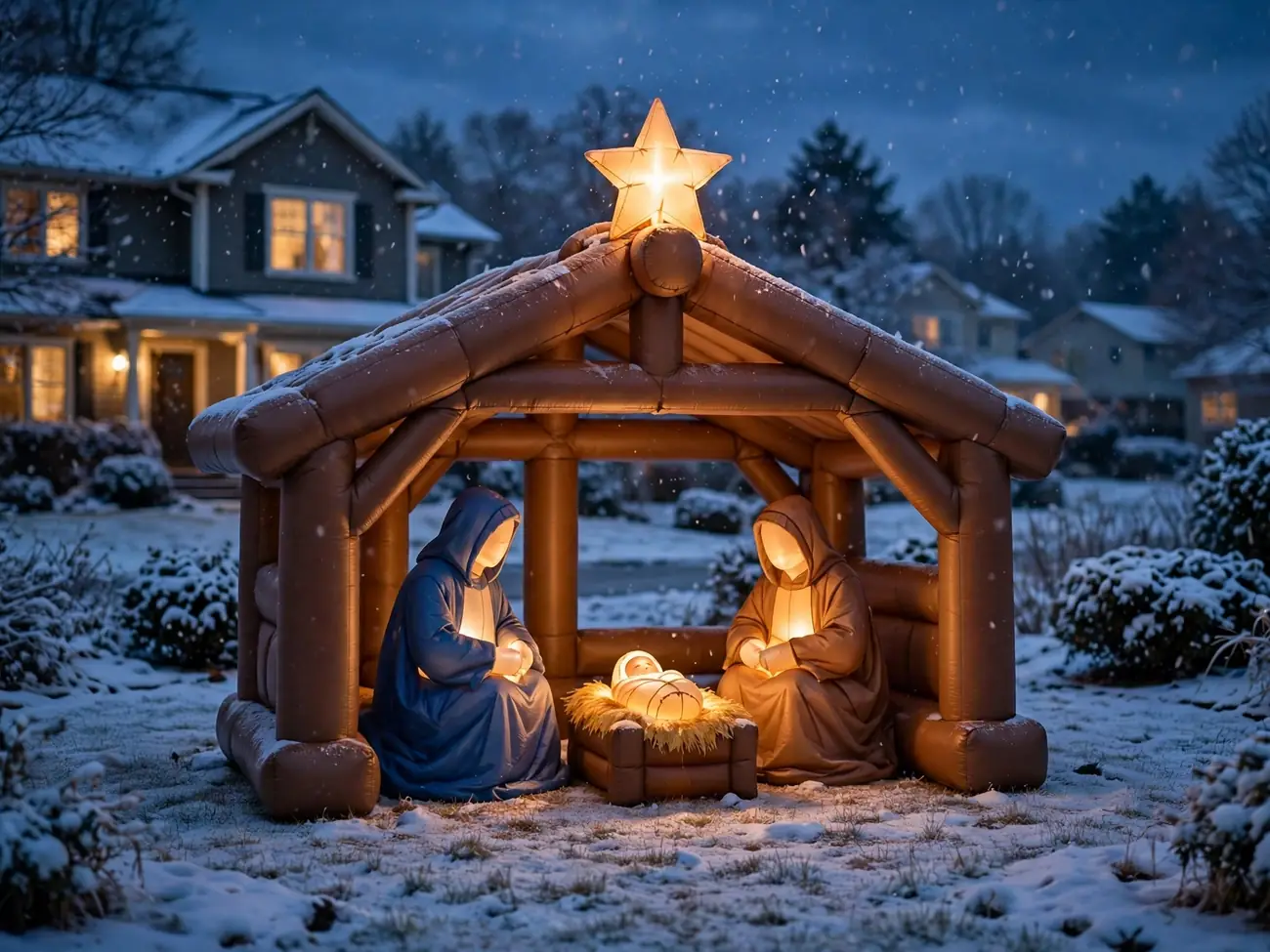
Size & power: 5–6 ft tall, 6–8 ft wide · built-in fan · one outlet; side lighting optional but recommended.
Giant Snow Globe with Santa Inside
The snow globe inflatable is the hero for people who want one piece that does everything: height, light, motion, and a scene inside a scene. Santa or a snowman stands inside a clear dome while small foam snow swirls around him, which keeps moving even on windless nights. Place it where viewers can stop and watch, near the walk or driveway edge rather than the far corner of the lawn. Keep sharp garden edging clear of the dome; the clear panel is the part you least want scuffed or punctured.
Size & power: 6–8 ft tall · fan plus a small internal blower for the snow · draws slightly more power than a plain figure; use its own outlet if possible.
Towering Inflatable Christmas Tree
An 8 to 10 foot inflatable tree is the hero that suits any house style, from brick colonial to ranch. Printed ornaments and a star topper mean it arrives fully decorated, and its cone shape sheds wind better than most tall figures, which makes it a smart hero for exposed yards. Stand it where a real tree would go: beside the window, at the corner of the house, or anchoring the end of a flower bed. A green hero also frees you to keep everything else red and white, giving the yard an instant color scheme.
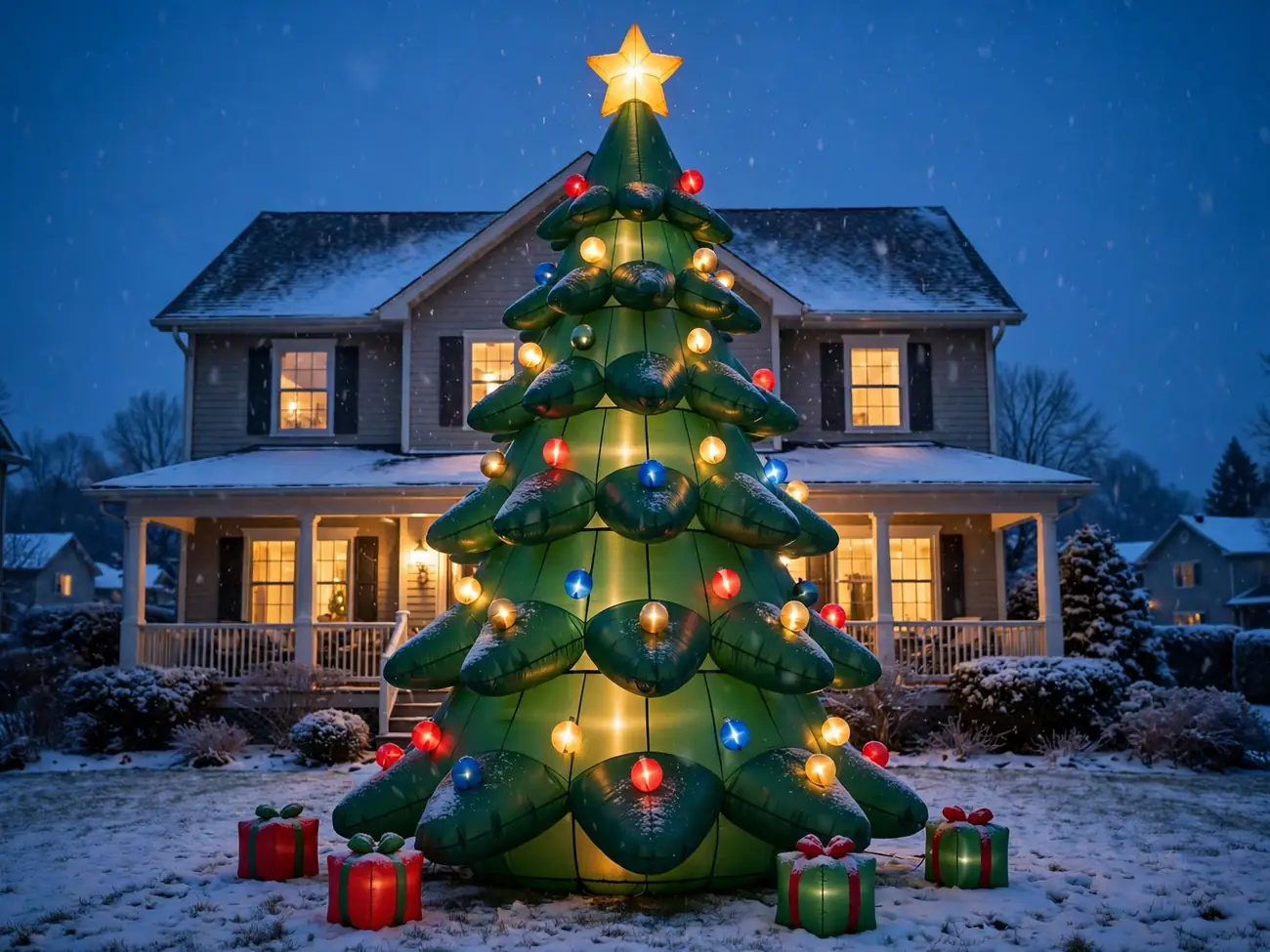
Size & power: 8–10 ft tall, about 4 ft wide at the base · built-in fan · very stable shape; standard stakes usually enough.
The Supporting Cast
Gingerbread Man with a Candy House Sidekick
Supporting pieces earn their place by echoing the hero or adding a second theme, and a gingerbread pair does both for a candy-themed yard. Set the gingerbread man and his little candy house a few feet to one side of your main piece, close enough to read as a group but not touching it. The warm brown and candy colors contrast nicely against a white snowman or a green tree hero. Keep the pair on the same side of the yard so the candy theme reads as one deliberate corner instead of sprinkles scattered everywhere.
Size & power: 4–5 ft tall · built-in fan · light enough to move while you fine-tune the grouping.
Penguin Family Cluster
Three penguins in graduated sizes, a tall parent and two chicks, make the easiest supporting group you will ever arrange. Cluster them close together on a slight rise or at the edge of a flower bed, turned at slightly different angles, like a family mid-waddle rather than a product lineup. Their black and white coloring pops against green lawns and reads clearly from the street. If your hero is red-heavy, like a big Santa, the penguins’ cool tones calm the palette down. A cotton snow blanket under them doubles the charm.
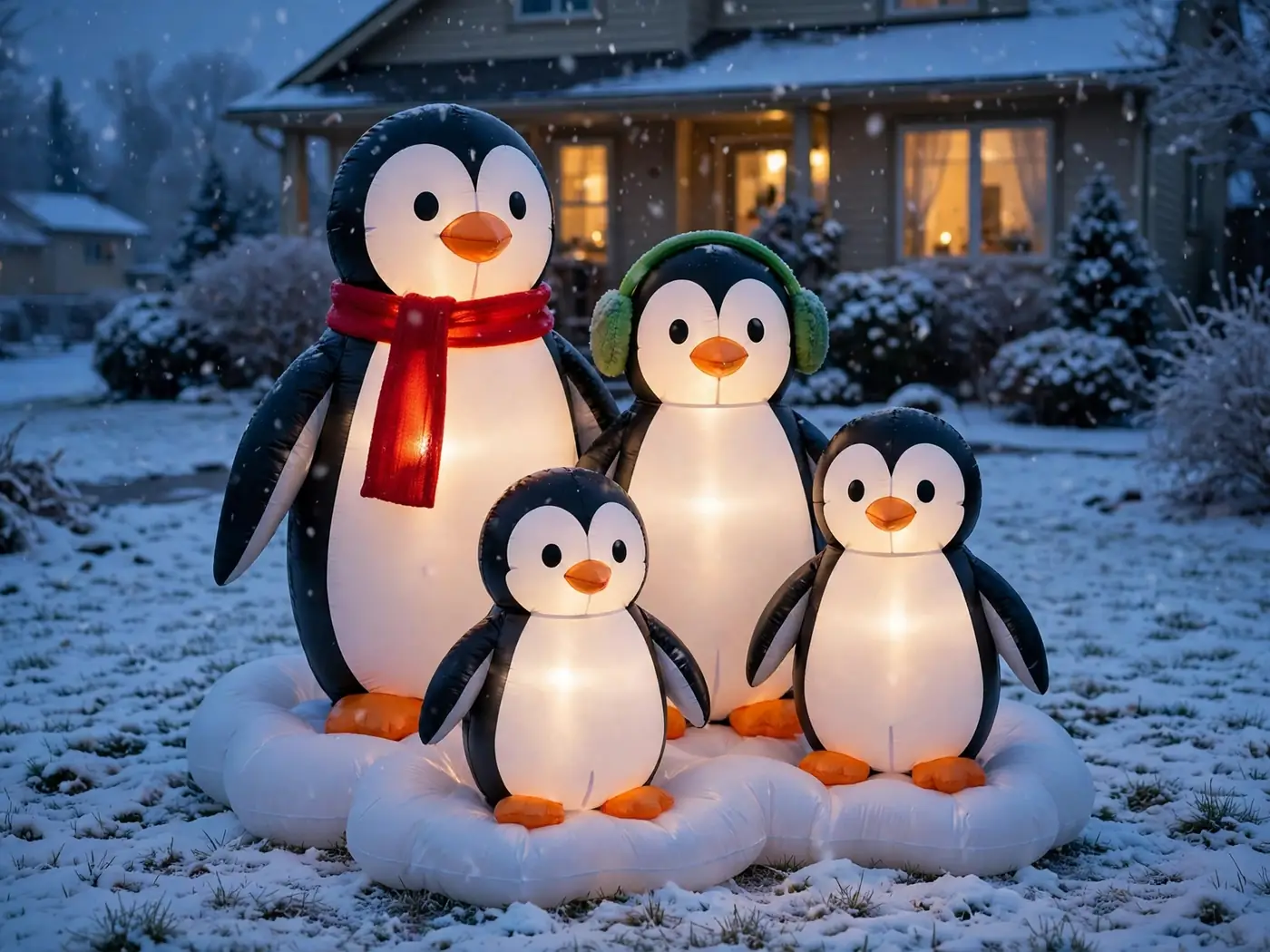
Size & power: 3–5 ft tall as a set · usually one fan for the group or small individual fans · low and stable in wind.
Nutcracker Soldiers Flanking the Garage Doors
Symmetry is the cheapest design trick in any yard, and two nutcracker soldiers standing guard at the garage give you instant formality. Matching pairs frame whatever sits between them, so this group works best when the garage is a plain backdrop rather than a busy one. Stand them on the driveway edges, not on the driveway itself, and check that car mirrors clear their hats. Their tall, narrow shape makes them the most wind-sensitive pieces in this list, so use every tether and consider sandbags hidden behind their boots on gusty streets.
Size & power: 6–8 ft tall, under 2 ft wide each · built-in fans · plan on extra anchoring; they are tall for their footprint.
Polar Bear and Cub on an Iceberg
A polar bear with her cub gives a yard a gentle winter scene that stays up happily past Christmas and well into January. The wide iceberg base makes this one of the most stable inflatables you can buy, so it suits the open middle ground between your hero and the street. Angle the bears toward each other rather than the road and the scene feels natural instead of staged. White figures can wash out against snow, so on snowy lawns place the piece against dark shrubs or a fence where the silhouettes stay crisp all season.
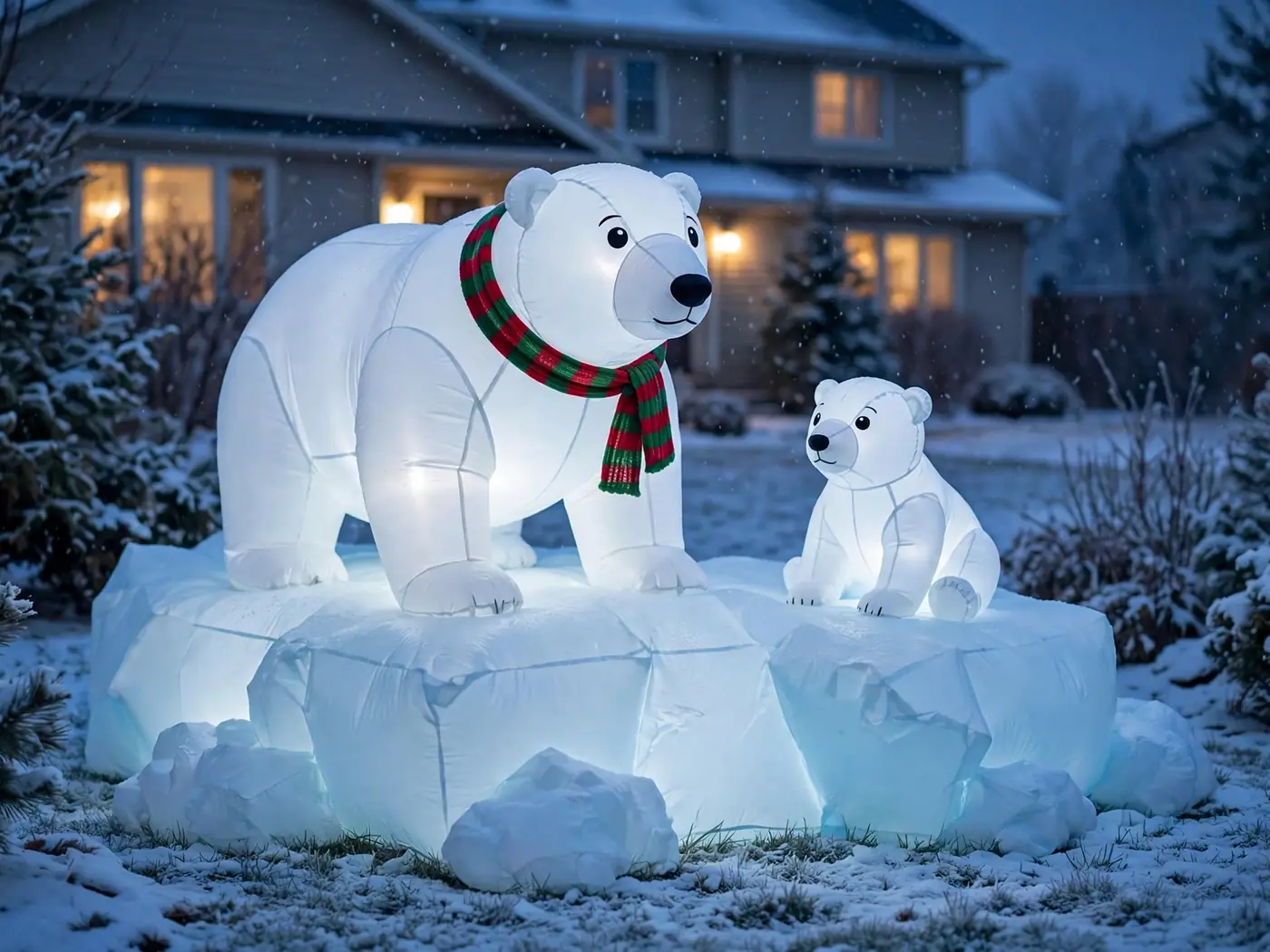
Size & power: 4 ft tall, 6–7 ft long · built-in fan · very stable; standard stakes are fine.
Caroling Trio with Songbooks
Three carolers holding songbooks bring a human note to a yard full of characters, and they belong close to the house where their detail can be appreciated. Tuck them beside the front door, at the corner of the porch, or under a window, the spots where real carolers would stand. Their smaller scale means they disappear from the street if you push them too far out, so keep them in the near zone. If your hero is a nativity, carolers are the perfect bridge between the sacred scene and the playful pieces elsewhere in the yard.
Size & power: 4–5 ft tall · built-in fan · best within 15 ft of where viewers stand.
Pathway and Porch
Inflatable Archway Over the Front Walk
An arch turns a plain walkway into an entrance, and guests feel the display start the moment they step through it. Choose a candy cane or garland-printed arch to match your theme, center it carefully over the path, and anchor all four feet, because arches catch wind like sails. Check the clearance honestly: delivery drivers, tall guests, and anyone carrying a casserole need comfortable headroom. An arch also solves a design problem for long, plain fronts, since it gives the yard a middle layer between the lawn pieces and the door, tying the whole route together.
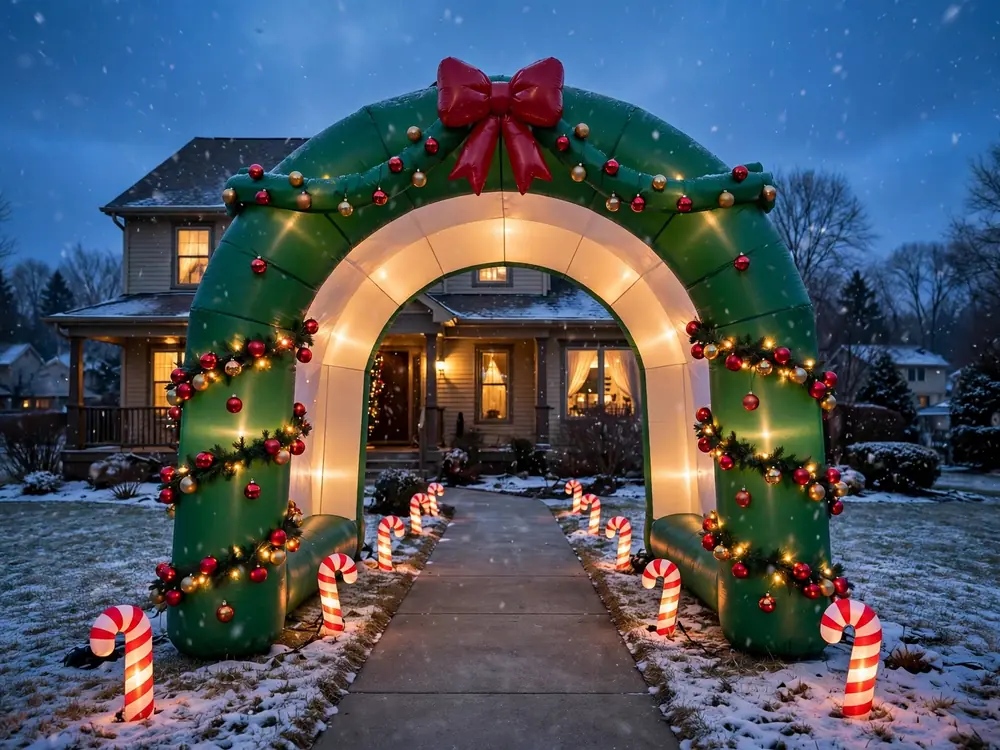
Size & power: 8–9 ft tall, 5–6 ft wide · two fans on most models · four anchor points minimum.
Lantern-Holding Santa Beside the Front Door
A single medium Santa holding a lantern is the classic porch greeter: welcoming, clearly visible, and small enough for almost any entry. Place him on the side of the door opposite the handle swing, far enough back that the door clears his hat. The lantern’s warm light near the doorstep is genuinely useful on dark December evenings, not just decorative. Because he stands on a hard surface, skip the lawn stakes and use the base weights or a sandbag tucked behind him, and route his cord along the wall so nobody trips on the way in.
Size & power: 4–5 ft tall · built-in fan · needs weighting on hard surfaces where stakes cannot go in.
A Stack of Light-Up Presents for the Porch Corner
Every porch has one dead corner, and a stack of glowing gift boxes is built to fill it. The cube shapes sit stable on concrete, stack visually against a wall, and their ribbon prints carry the theme without another character competing with your door greeter. Group them tight into the corner and angle the stack slightly outward. Gift boxes also pair well with a plain wreath and nothing else, which makes them the right choice for a porch that needs to stay calm because the lawn is already doing the talking. They store small, too, deflating into almost nothing.
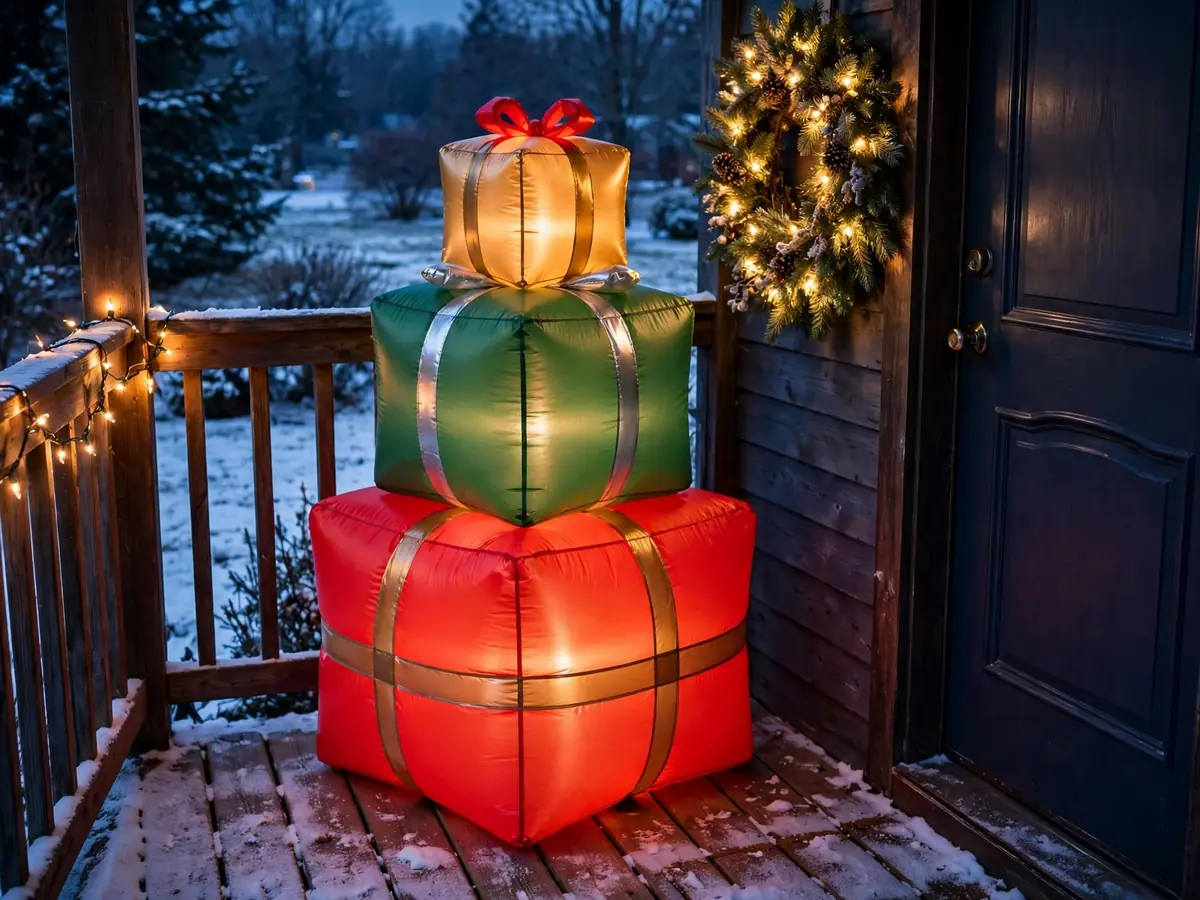
Size & power: 4–5 ft tall as a stack · built-in fan · the most porch-friendly footprint on this list.
Giant Inflatable Wreath for the Gate or Garage
A flat-backed inflatable wreath, three to four feet across, decorates the vertical surfaces lawn pieces cannot reach: the garden gate, the garage door, or a blank stretch of fence. It hangs or leans rather than standing, so it suits renters and anyone whose yard is mostly driveway. The built-in lights make it read at night from the street, which is more than most real wreaths can claim. Hang it from a sturdy hook or over-the-door hanger rated for outdoor use, and add one bottom tether so it rests against the surface instead of swinging.
Size & power: 3–4 ft across, under 1 ft deep · built-in fan · needs a hook or hanger plus one bottom tether.
Roofline and Second Story
Santa Climbing a Ladder Toward the Roof
A climbing Santa brings the one thing flat lawn displays lack: a story in motion. He hangs from a ladder against the house wall, sack on his back, halfway to the roof, and every kid on the street will check his progress nightly. Fix the ladder top to a sturdy hook under the eaves, never to the gutter itself, and let Santa’s weight rest partly against the wall. Keep him clear of windows you open and of any security lights. From the street, this single piece makes a plain house front look fully decorated.
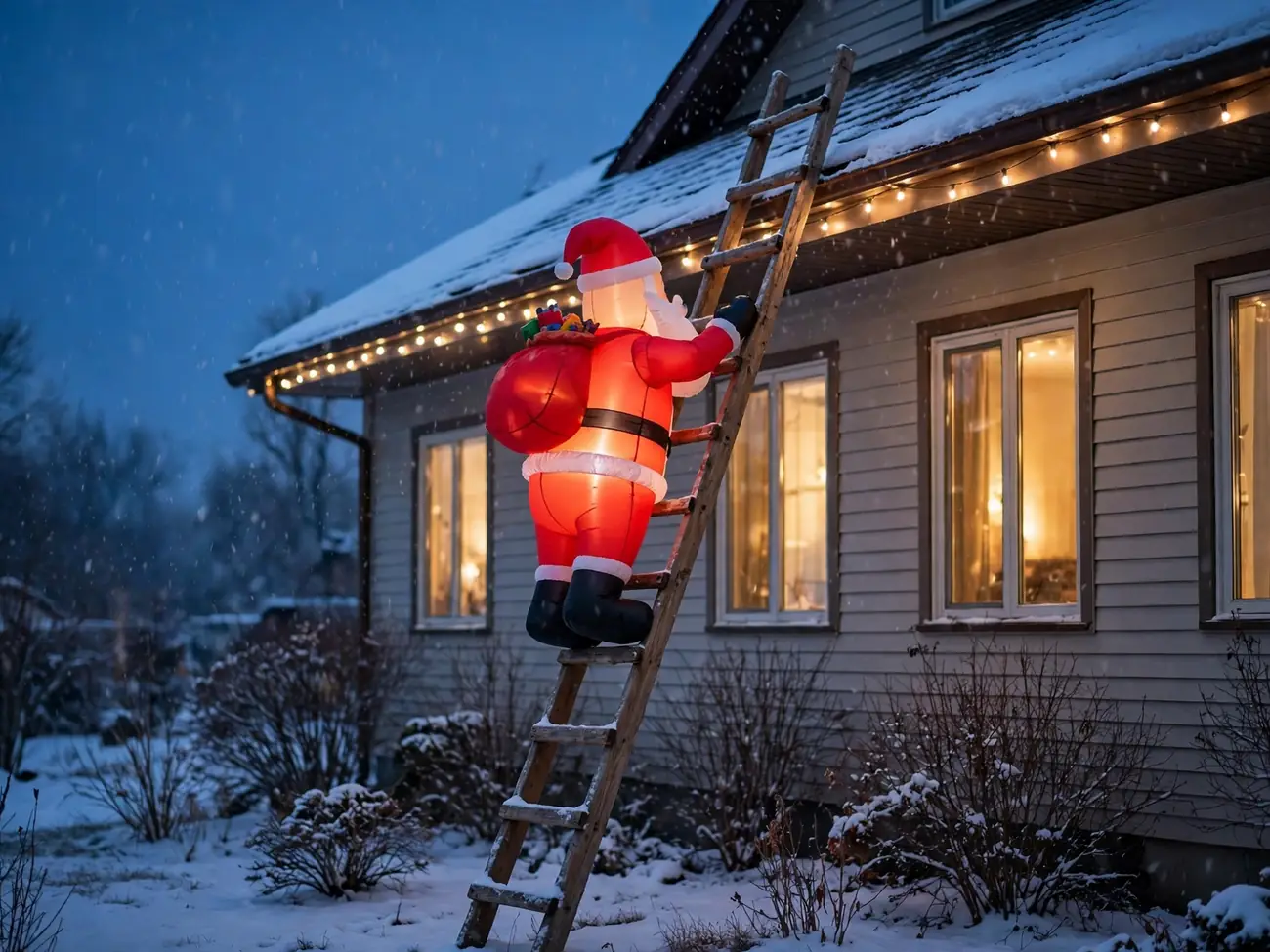
Size & power: Santa 3–4 ft, ladder 8–12 ft · small built-in fan · the mounting point carries real weight, so fix it to structure, not trim.
Reindeer Peeking Over the Roof Edge
A reindeer head and front legs draped over the roof edge is a small piece with an outsized effect, because it puts a face exactly where nobody expects one. It works best on a single-story roofline or above a porch roof, where the face is close enough to read. Secure it with straps run over the ridge, following the maker’s instructions, and pad any contact points so shingles are not rubbed raw. Pair it with the climbing Santa on the opposite side and the whole roof becomes a scene.
Size & power: 3–4 ft wide · small built-in fan · cord must reach down to an outlet, so measure before you climb.
Santa’s Legs Kicking from the Chimney
The stuck-in-the-chimney Santa, just boots and legs kicking above the chimney pot, is the funniest piece you can put on a house and the one neighbors photograph most. It needs a real or decorative chimney in good condition; strap the base firmly around the flue or the mounting frame the design provides, and check it after the first windy night. The joke lands best on an otherwise classic display, where the formality makes the surprise funnier. If your chimney is hard to reach safely, hire the install out; no laugh is worth a ladder accident.
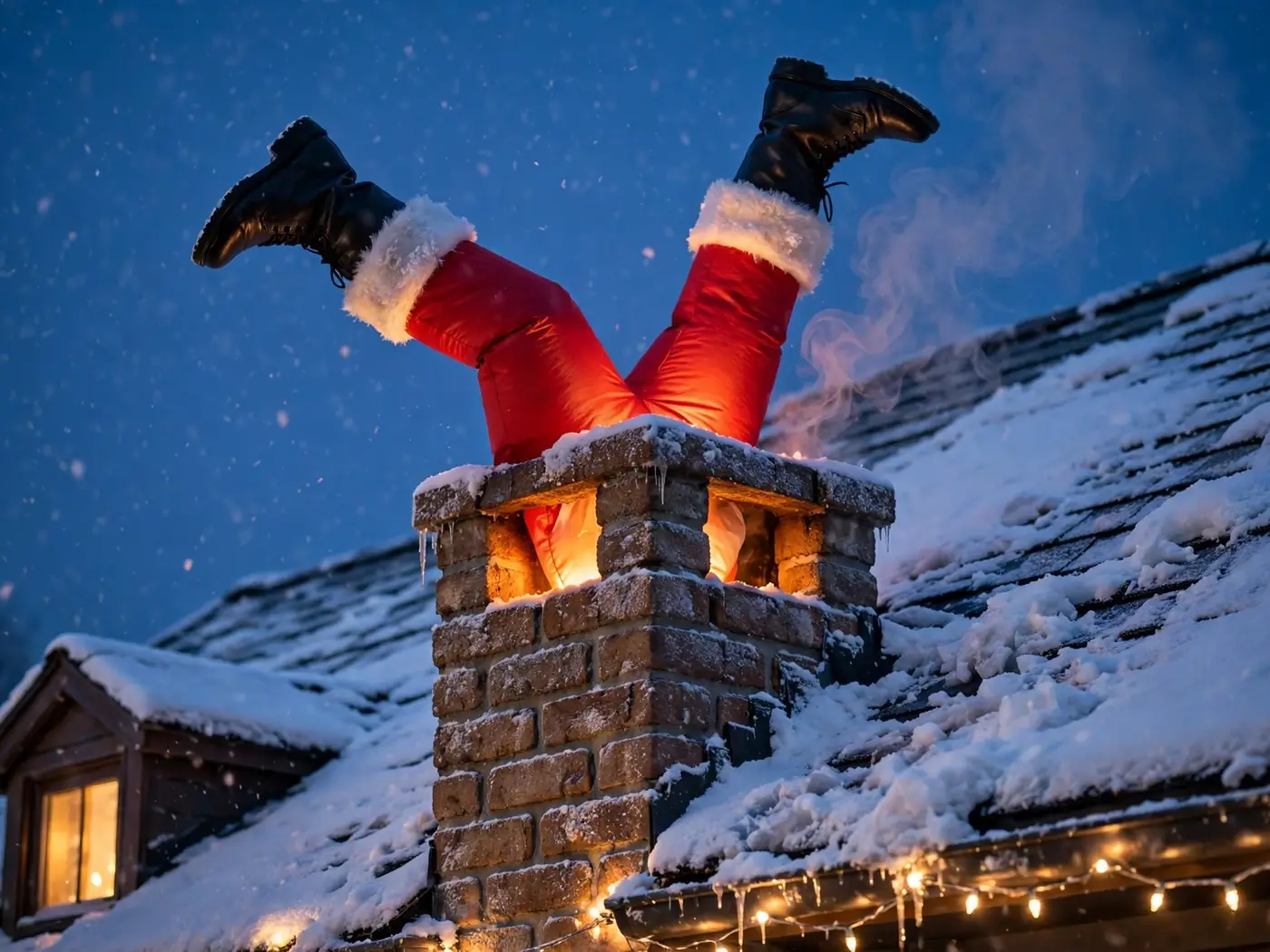
Size & power: 3 ft tall above the chimney · small built-in fan · professional installation is a fair choice for steep roofs.
Set It Up Right: Step by Step
Step 1: Walk the yard first. Stand at the street and choose the hero spot by sightline, then place supporting pieces in a loose triangle around it. Check every spot for sprinkler heads, roots, and slopes.
Step 2: Lay it flat and close everything. Unroll the inflatable fabric-side up, zip every deflation zipper fully closed, and untwist the fan intake so nothing blocks it.
Step 3: Stake before you inflate. Push the base stakes in at a slight angle away from the piece. It is far easier to position a flat inflatable than to wrestle a full one.
Step 4: Plug in and guide it up. Connect to a GFCI-protected outdoor outlet, following the NFPA’s holiday safety guidance on outdoor electrical use, and walk the piece upright as it fills, keeping fabric off the fan intake.
Step 5: Tether and adjust. Tie the tether lines to their stakes with a little tension on each, then step back to the street and adjust angles from the viewer’s side, not the owner’s.
Step 6: Set the timer. Most owners run inflatables from dusk to bedtime. A timer saves power, rests the fan, and means the display is lit exactly when the street is watching.
Troubleshooting: When Inflatables Misbehave
- It will not inflate fully: Check the deflation zipper first; a zipper open by an inch is the most common cause. Then clear leaves or fabric away from the fan intake and confirm the piece is not twisted at the base.
- It keeps falling over: The tethers are doing too little. Add lines on the windward side, shorten the existing ones so the piece cannot build momentum, and add sandbags at the base. In strong gusts, deflate it; fabric and fans are not built for storms.
- The fan is too noisy: A fan sitting on concrete or deck boards amplifies its own hum. Slide a rubber mat or a square of outdoor carpet under it, and keep the intake clear, since a starved fan works harder and louder.
- Rain and wet weather: Inflatables can run in light rain, but never pack one away wet. After a soaking, run the fan for an extra hour to dry the fabric inside and out, or mildew will greet you next December.
Frequently Asked Questions
Can I leave my inflatable running all day and night?
You can, but most owners do not. Fans are built for long runs, yet a timer schedule of late afternoon to bedtime cuts power use, reduces wear, and keeps the display feeling like an event. Deflating during the day also protects the fabric from sun and curious dogs.
How much wind is too much for an inflatable?
When gusts start snapping the tether lines and the piece leans hard or lifts at the base, it is time to unplug. Tall, narrow pieces give up first. A calm evening after a windy day is the right moment to re-stake anything that shifted.
Can inflatables stay out in the snow?
Light snow is fine, but heavy wet snow can collapse a deflated piece and trap moisture inside. Brush accumulation off gently, and if a storm is coming, deflate, let the fan dry the fabric, and bring the piece under cover until it passes.
How many seasons should an inflatable last?
A mid-quality inflatable that is dried before storage, kept in a sealed bin, and run on a timer usually serves several seasons. The fan is the part that fails first, and on many models it can be replaced without replacing the whole piece.
Think of your yard the way a stage designer would: one hero, a cast that supports it, a welcoming path, and one surprise up high. Get those four layers right and even a modest collection of inflatables looks like the display on the street that everyone slows down for. If you want to build the rest of the yard around them, our roundup of Christmas yard decor ideas for a festive outdoor welcome covers the lights, wreaths, and porch touches that finish the scene.