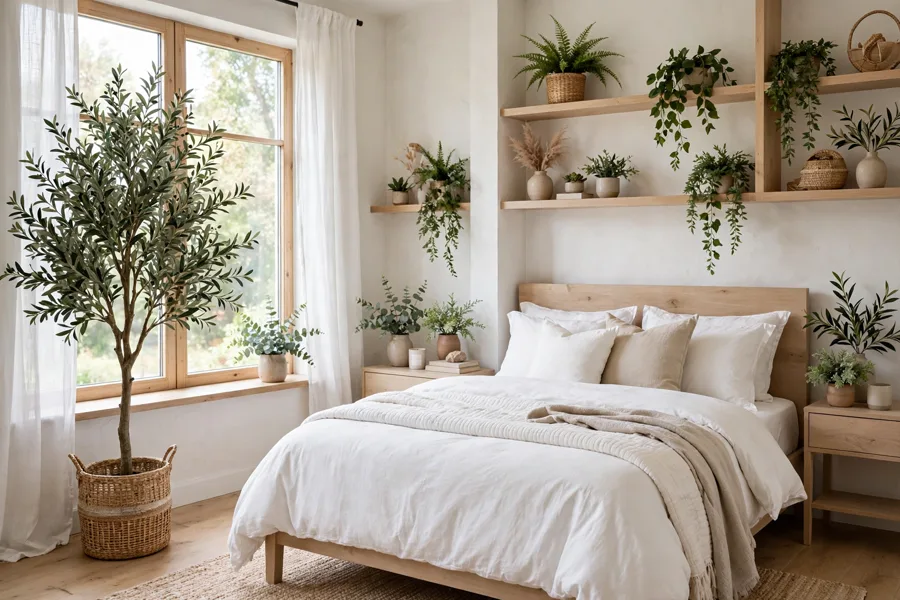
There is a corner in almost every bedroom where real plants quietly give up. It sits between the wardrobe and the door, the window faces the wrong way, and by mid-afternoon the light is gone. Two ferns and a pothos can yellow there in a single season, and each replacement feels less like decorating and more like a subscription to disappointment. The room still needs that green corner, though, because without it the whole bedroom reads flat and unfinished.
The honest fix for that corner is not a tougher plant. It is a good fake, chosen carefully enough that nobody leans in to check. That is why faux greenery bedroom ideas start with realism, not quantity: modern faux plants use wired stems, matte leaves, and uneven colouring that hold up at arm’s length, which is as close as most bedroom greenery ever gets. One convincing piece in the dead corner does more than five glossy bargains scattered everywhere.
The fourteen ideas below stay strictly faux. Each one names a bedroom spot, the fake plant that suits it, and the detail that keeps it believable, from reading leaf colour before you buy to the ten-minute dusting routine that stops faux plants from announcing themselves. Where a real plant genuinely wins, that is said plainly too.
The Faux Greenery Formula That Keeps Fake Plants Looking Real, Not Plastic
- Matte beats shiny: real leaves scatter light, so choose faux foliage with a flat, slightly dusty finish and walk away from anything that gleams under the shop lights.
- Variation beats uniformity: convincing faux plants mix two or three greens, carry a few smaller new leaves, and never repeat the same leaf shape in a perfect pattern.
- Real containers beat nursery plastic: the thin black pot a faux plant ships in is the loudest tell, so plan a ceramic pot, basket, or stoneware vase into every purchase.
- Believable placement beats random placement: put faux plants where a real one could plausibly live, near some light or on surfaces people actually style, not balanced on top of a wardrobe.
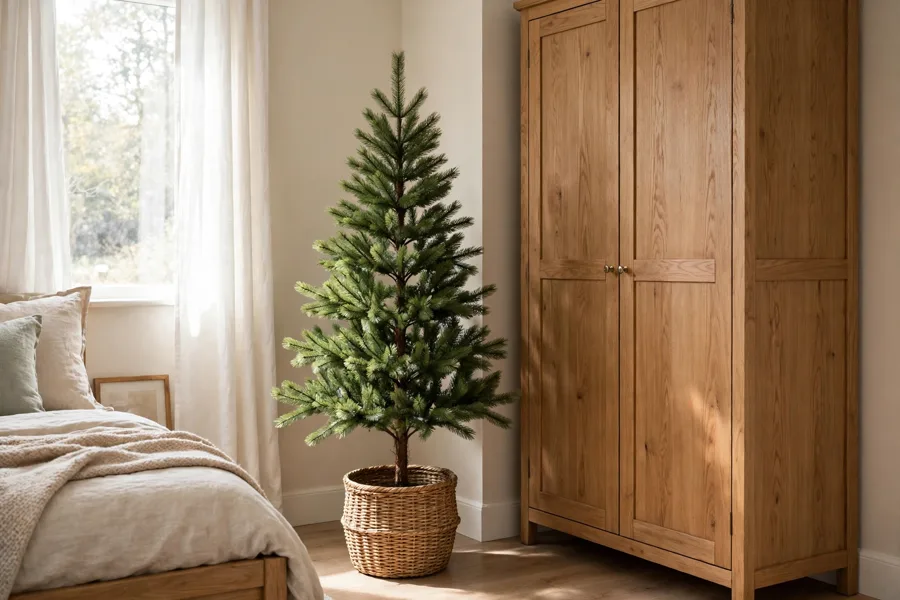
Picture it working together: a 4-foot faux pine in a seagrass basket filling the dead corner, a small matte fern on the nightstand, and eucalyptus stems in a stoneware vase on the headboard shelf, three pieces at three heights with not a glossy leaf among them.
1. A Faux Tree for the Corner No Window Reaches
Every bedroom has one corner the light never visits, and it is exactly where a faux tree earns its price. Choose a single stemmed tree between 4 and 5 feet tall so it reads as furniture, not filler, and set it in a basket or heavy pot that hides the weighted base. Terrain’s Artificial Potted Pine Tree stands 4 feet tall at $148, and its soft, irregular needles suit a corner that would starve a real pine by February. The trade-off is that a tree this size commits the corner, so measure before ordering. If your dead corner has been swallowing real plants for years, this is the permanent answer.
The formula:
- Main piece: one 4 to 5 foot faux tree with a single natural-looking trunk
- Supporting piece: a woven basket or stoneware pot wide enough to hide the base
- Texture or material: matte needles or leaves, never a glossy finish
- Finishing touch: two or three real pinecones or books stacked at the base
2. A Nightstand Plant That Never Needs a Morning Light Check
The nightstand is the one surface you see at pillow distance, so the faux plant there has to survive close inspection. Keep it small, 8 to 12 inches tall, with dense small leaves rather than a few big theatrical ones; a faux fern, a compact faux peperomia, or a tight cluster of faux succulents all sit comfortably beside a lamp and a water glass. Bend two or three stems slightly outward before placing it, because perfectly upright growth is a machine’s habit, not a plant’s. It will never drop leaves into your book or demand a Saturday repotting. Rooms styled around green bedroom designs often start with exactly this one small, believable touch.
Get the look: small dense faux plant, stems bent gently outward, in a pot no wider than 6 inches so the lamp and clock still fit.
3. Read the Leaves Before You Buy: Colour Tells the Truth
Stand in the shop and look at one leaf, not the whole plant. Convincing faux leaves carry at least two greens, a deeper tone along the vein and a paler one at the tip, and the underside is lighter than the top, exactly as real leaves grow. Cheap faux fails here first: one flat green from stem to edge, identical leaves stamped in rows, and edges so smooth they look cut from felt. Turn the plant slowly and check the joins where leaves meet stems; wrapped wire and a slight colour change pass, but visible glue blobs do not. It takes thirty seconds and saves every later styling effort.
Color note: if every leaf on the plant is the same green, put it back; variation in tone is the single strongest sign of a believable faux.

4. A Trailing Faux Pothos Across the Dresser Top
A dresser top is long, flat, and usually crying out for something that breaks its straight lines. A faux pothos or faux ivy with wired vines does it in one move: set the pot at one end, then drape two vines along the top and let a third fall 12 to 18 inches down the dresser front, bending each vine into soft, uneven curves. Wired stems hold the shape for months, which a real trailing plant achieves only with patient training. The honest downside is dust, because horizontal leaves collect it visibly, so this piece joins the monthly wipe list. If your dresser currently holds only a lamp and a tangle of chargers, start here.
Texture note: mix one trailing faux with the hard surfaces around it, wood, glass, and ceramic, so the soft irregular vines carry the whole arrangement.
| Question | Real Plant | Good Faux Plant |
|---|---|---|
| Light needed | Some, even for tolerant types | None at all |
| Watering | Weekly to monthly, forever | Never |
| Upkeep | Feeding, pruning, repotting | A monthly dust and occasional wash |
| Away for three weeks | Needs a plant sitter | Looks exactly as you left it |
| Pollen and soil smells | Both possible | Neither |
| Feel and scent up close | Alive, cool, faintly earthy | Convincing to the eye, neutral to the nose |
5. The Allergy-Friendly Bedroom: Greenery With Zero Pollen
A bedroom is the worst room in the house for pollen, because you breathe it at close range for eight hours with the door shut. Faux greenery removes the problem completely: no pollen, no soil mould, no fungus gnats rising off a damp pot at 2 a.m. Choose pieces with smooth, wipeable leaves, since heavily textured or fabric foliage holds household dust that can bother sensitive sleepers almost as much. Keep bedroom faux count modest, two or three pieces, and wipe them with the weekly sheet change so the room stays genuinely low-allergen rather than just pollen-free on paper. For anyone who has ever sneezed their way through spring in a plant-filled room, this is reason enough on its own.
Best for: hay fever sufferers, asthma households, and anyone whose bedroom door stays closed all night.
6. The Interior Wall That Real Plants Give Up On
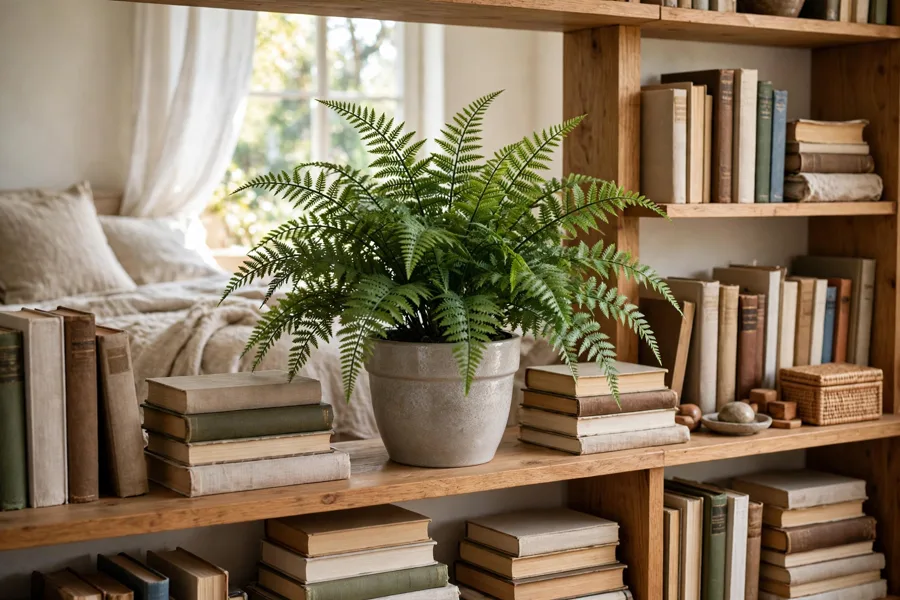
Many bedrooms have one long interior wall, opposite the window, that gets no direct light at all. Real plants there stretch, pale, and lean within a month. A faux fern or a full faux philodendron on a wall shelf owns that wall honestly: place it at seated eye level, roughly 4 feet up, and let a few fronds spill past the shelf edge so the silhouette stays loose. Pair it with a framed print or a small stack of books so it reads as a styled shelf, not a plant hospital. The trade-off is reach: a shelf that high needs a step stool on dusting day.
Space note: keep 2 to 3 inches between the plant and the wall so fronds sit naturally instead of flattening against the paint.
7. Faux Eucalyptus Stems on the Headboard Shelf
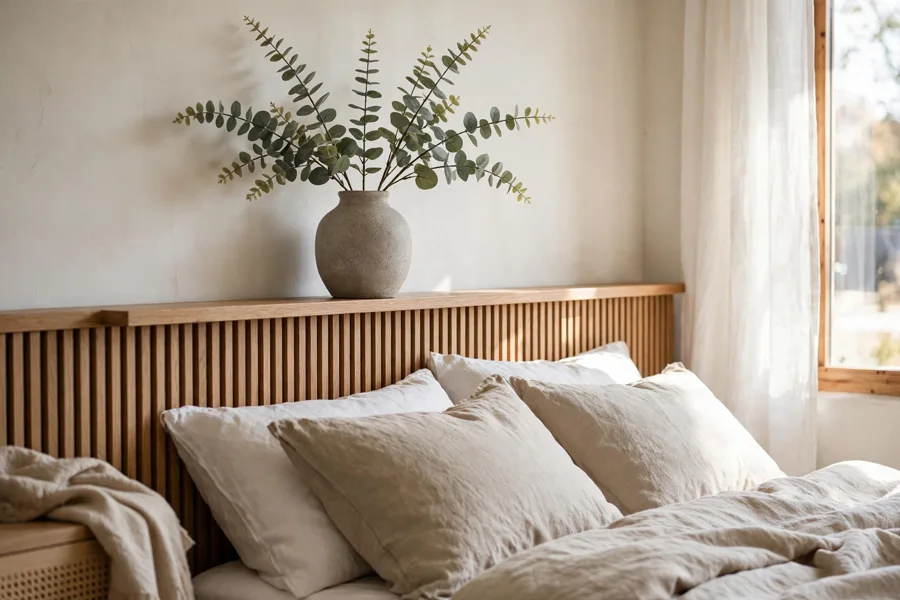
A narrow headboard shelf, often only 4 to 5 inches deep, cannot hold a pot but takes a vase beautifully. Three to five faux eucalyptus stems in a stoneware or amber glass vase give that soft blue-green arc above the pillows, and the round leaves hold their shape far better than dried stems, which shed onto the bedding within weeks. Cut or bend the stems so the tallest reaches about 14 inches; taller stems crowd a seated reader’s head. The look borrows the airy feel of spring bedroom decor without a single petal to fade by midsummer. One caution: secure the vase, because a knocked stem arrangement at midnight is nobody’s friend.
Fit check: measure the shelf depth before buying the vase; its base must sit fully on the shelf with an inch to spare front and back.
8. Pair Faux Green With Real Texture: Linen, Wool, and Wood
Faux plants look most real when everything touching them is genuinely real. Set a faux olive or faux fig against washed linen bedding, a wool throw with a visible weave, and a wooden stool or tray, and the eye reads the whole group as natural before it ever studies the leaves. The reverse is also true: a faux plant beside a polyester throw and a plastic lamp gets judged as part of a plastic set. You do not need many textiles, just honest ones at the plant’s own level. If a corner still looks staged, swap one synthetic item near the plant for a natural fibre before blaming the plant itself.
Style note: repeat one real material, wood, linen, or wool, at least twice in the plant’s sightline so the grouping feels deliberate.
| Bedroom Spot | Best Faux Pick | Why It Works There |
|---|---|---|
| Dark floor corner | Faux pine or faux olive tree, 4 to 5 feet | Fills vertical space where no real tree survives |
| Nightstand | Small faux fern or faux peperomia | Dense small leaves hold up at pillow distance |
| Dresser top | Trailing faux pothos | Wired vines drape and stay put for months |
| Headboard shelf | Faux eucalyptus stems in a vase | No soil or water to spill onto bedding |
| Interior wall shelf | Faux fern or faux philodendron | Tolerates the wall that gets no direct light |
| Wardrobe top | One full faux trailing ivy | Seen from below and far away, so detail matters less |
9. Ditch the Nursery Pot: The Two-Minute Realism Upgrade
Most faux plants arrive in a thin black plastic nursery pot, and that pot gives the game away faster than the leaves do. Drop the whole thing, pot and all, into a ceramic planter, a stoneware crock, or a woven basket one size larger, then cover the gap at the top with real moss, small pebbles, or a layer of actual potting soil. The plant itself has not changed, but every signal around it now says real. This upgrade costs less than the plant did and takes about two minutes per piece. The only catch is weight: a ceramic pot plus a weighted faux base gets heavy, so place it once, properly.
Easy swap: keep one good spare planter in the house and every new faux plant gets upgraded the day it arrives, before it is placed.
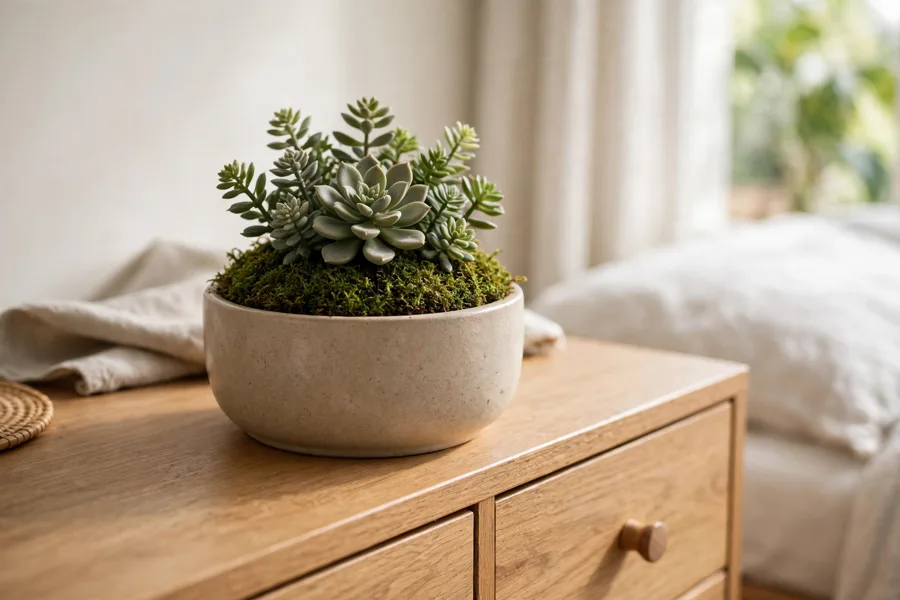
10. Rotate Stems, Not Whole Plants, With the Seasons
A full faux plant is a commitment, but a vase of stems is a wardrobe. Keep one good vase on the dresser or headboard shelf and rotate what stands in it: faux eucalyptus through spring, faux olive branches in summer, faux ruscus or dried-look grasses as the light turns in autumn. Each swap takes a minute, costs a fraction of a new plant, and stops the room from freezing into one permanent arrangement your eye stops seeing. Store the off-season stems flat in a drawer or tall box so the wired leaves do not crush. It is the easiest seasonal refresh in the bedroom, and it never involves keeping anything alive through winter.
Seasonal swap: buy stems in odd numbers, three or five per type, so each rotation fills the same vase with the same full silhouette.
11. The Ten-Minute Dusting Routine That Keeps Faux Looking Alive
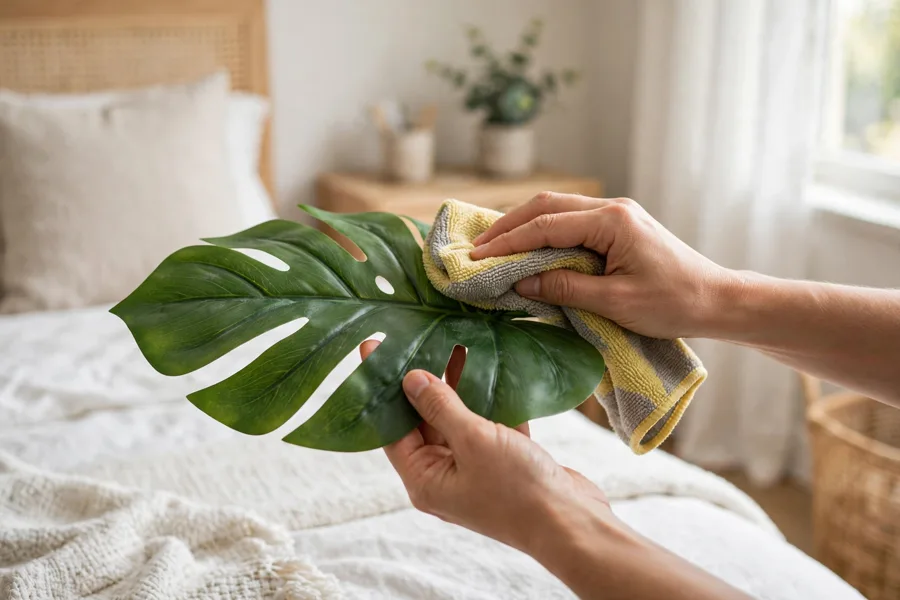
Dust is the one thing that truly betrays a faux plant, because real leaves in a lived-in room get rained on, wiped, and turned, while a fake sits still and greys. The routine is short: once a month, work top to bottom with a microfiber cloth, supporting each leaf from underneath so stems do not bend out of shape. Twice a year, take smaller pieces to the sink or shower and rinse them lukewarm, then shake and air-dry before replacing. Skip feather dusters, which mostly move dust onto the bedding below. Ten minutes a month is the entire maintenance contract, and it is written out in full below.
Why it works:
- A monthly wipe stops dust building into the grey film that reads as fake from across the room
- Supporting each leaf while wiping keeps wired stems in their trained, natural positions
- A twice-yearly rinse reaches the leaf joints and stem bases a cloth cannot
| Cleaning Task | How Often | How |
|---|---|---|
| Leaf wipe-down | Monthly | Microfiber cloth, leaf supported from below, top of plant first |
| Full rinse | Twice a year | Lukewarm shower or sink rinse, shake off, air-dry fully |
| Pot and base check | Twice a year | Wipe the pot, top up moss or pebbles, re-bend any flattened stems |
| Nightstand pieces | Weekly, with the sheet change | One quick cloth pass, since they sit closest to pillows |
| High shelf and wardrobe-top pieces | Every two months | Step stool, cloth, and a once-over for faded leaves near lamps |
12. Spend on the Hero, Save on the Fillers
Faux budgets stretch furthest when the money follows eyesight. The piece at pillow or seated eye level, the nightstand plant or the corner tree you see from the bed, deserves the better budget: hand-finished leaves, wired stems, convincing colour. Pieces seen from across the room or from below, the ivy on the wardrobe top, the fern on the high shelf, can be honest mid-range buys, because distance forgives what closeness would catch. Reversing the spend is the common mistake: a premium plant nobody gets near, and a bargain one six inches from your pillow quietly failing every night. Buy the hero first, live with it a week, then fill around it.
Budget note: one strong eye-level piece plus two modest fillers costs less than three mid-range plants and looks better than all of them.
13. One Real Plant by the Window, Faux Everywhere Else
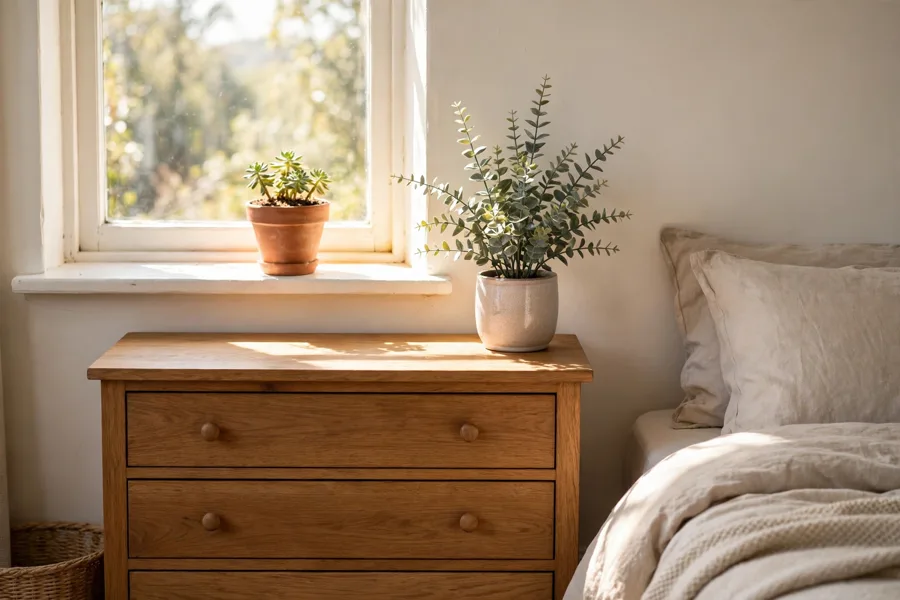
If the bedroom has one genuinely bright spot, give it to one real plant and let faux carry the rest of the room. A real herb, a small real fern, or a cutting in water on the windowsill brings the scent, the slight movement, and the pleasure of one living thing, while the faux tree, stems, and trailers hold the dark zones no real plant would tolerate. Visitors’ eyes land on the living plant first and generously extend the benefit of the doubt to everything green beyond it. It is the same mixed approach used across bedroom decor ideas that have to work in real, imperfect light. One plant to water is a pleasure; nine is a rota.
Get the look: put the real plant closest to the window and the faux pieces progressively deeper into the room, so the light story stays believable.
14. Greenery That Survives Your Travel Schedule and Your Lease
Two groups get more from faux than anyone: people who travel, and people who rent. Travel for three weeks and a faux bedroom looks identical on your return, with no plant sitter to recruit, no key to hand over, and no crispy fern to apologise to. Rent, and faux asks nothing of the property: no water marks on the landlord’s windowsills, no soil spills on pale carpet, no hanging baskets screwed into walls you do not own. The honest trade-off is that you give up the small ritual of care some people genuinely love. If your suitcase lives half-packed by the door, though, faux is not the compromise option; it is the correct one.
Best for: frequent travellers, shift workers, and renters whose leases ban wall fixings or fuss over water damage.
Begin With the Corner That Defeats Every Real Plant
A believable faux bedroom is not built by filling every surface with plastic green. It is built by choosing the two or three spots where a real plant would suffer most, the dark corner, the interior wall, the shelf above the pillows, and placing one well-chosen, matte, varied faux piece in each, properly potted and properly dusted. Do that, and the room gains the calm of greenery with none of the quiet guilt of another plant fading in the corner.
Your one next step: stand in your bedroom doorway tonight and name the single spot where a real plant has failed or would fail first, then measure its height and width and shop for one faux piece in exactly that size, good leaves, real pot, nothing else yet.