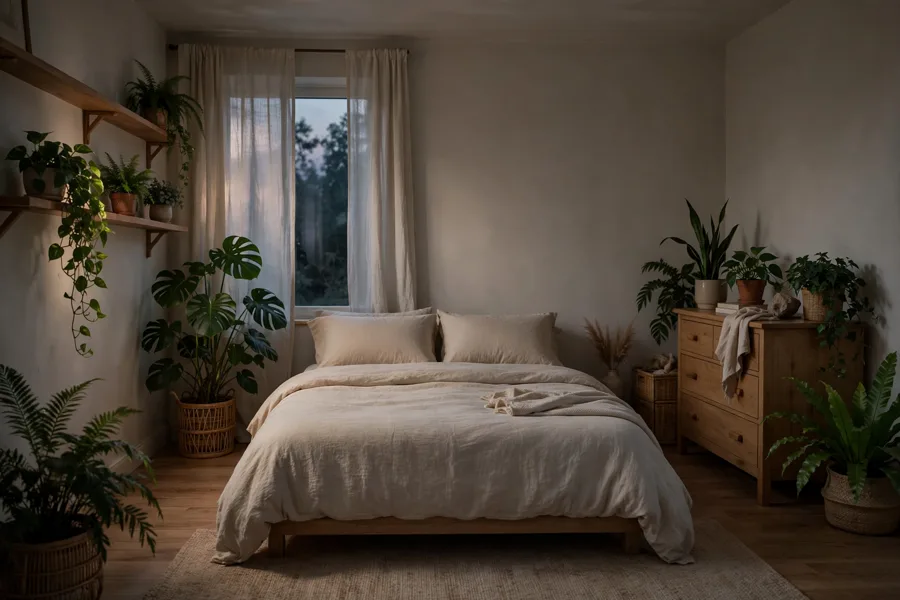
A north-facing bedroom gives you one small, grey window and a dresser that never sees a sunbeam — and somehow every plant bought for it ends the same way. The fern crisps at the edges within a month. The succulent stretches tall and pale, leaning like it is trying to leave the room. Even the plant labelled “easy” at the garden centre fades to a few tired leaves beside the wardrobe. The room is not the problem, and neither are you: most houseplants are simply sold for brighter homes than this one.
It helps to know what “low light” actually means, because it does not mean no light. It means the soft, indirect daylight a few feet inside a north-facing or shaded window — bright enough to read by at midday, never a direct sun patch. A small group of plants evolved on forest floors and can live in exactly that for years, which is why guides to low-light bedroom plant ideas keep circling back to the same tough names: snake plant, ZZ plant, pothos, cast iron plant. Almost everything else is a short rental, not a resident.
The twelve ideas below are built for dim and north-facing bedrooms only. They pair the plants that honestly tolerate shade with the tricks that stretch the light you already have — mirrors, rotation, sheers — and they say plainly where tolerance ends. When a corner is truly dark, the honest fix turns out to be a bulb rather than another hopeful plant, and that option is here too, without any guilt attached.
The Low-Light Formula That Keeps Dim Corners Looking Alive
A dim bedroom does not need more plants; it needs a stricter way of choosing them. Four principles do the choosing:
- Light first, plant second: judge the room at midday on a grey day, not on the brightest morning of the year, and buy for the dimmest version of it.
- Survivors over showpieces: every plant here tolerates shade as a permanent address, not as a temporary setback it is waiting to escape.
- Spend the daylight twice: mirrors, pale pots and glossy leaves all hand a share of the window’s light back to the plants instead of swallowing it.
- Water for the room you have: soil in a dim bedroom dries slowly, so a fingertip in the mix matters more than any watering calendar.
Put together, it looks like a snake plant holding the far corner, a ZZ plant and a pothos sharing the dresser’s brighter end, and a mirror on the opposite wall returning the favour to all three.
1. Snake Plant for the Corner the Window Forgot
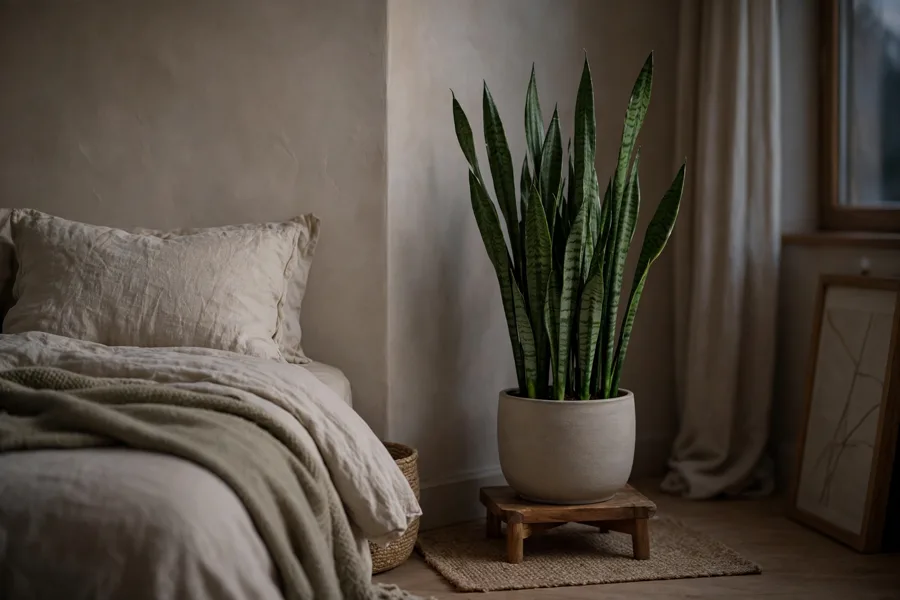
Every dim bedroom needs one plant that treats low light as a long-term arrangement, and the snake plant is the most forgiving of them. Set a plant 2 to 3 feet tall in the corner farthest from the window, where its upright blades add height without taking the good spot. It stores water in those thick leaves, so a drink every few weeks is plenty — in dim light, extra water is the usual way these die. The Snake Plant Zeylanica from The Sill starts at $59 in its smallest size. The honest trade-off is speed: growth is slow, and the bright leaf edges may soften to plain green.
The formula:
- Main piece: one snake plant, 2 to 3 feet tall, in the room’s dimmest corner
- Supporting piece: a low stand that lifts the pot 6 to 8 inches off the floor
- Texture or material: a matte ceramic pot that hides the plain nursery pot inside
- Finishing touch: empty floor around it, so the vertical lines stay clean
2. ZZ Plant on the Dresser
If the snake plant is the anchor, the ZZ plant is the one that makes a dim dresser look deliberate. Its stems carry rows of glossy oval leaves that catch whatever light the room offers, so it reads as decoration rather than survival. Those leaves grow from fat underground rhizomes that store water, which is why a forgotten watering barely troubles it. It grows slowly — a stem or two a season — and it is the same toughness that earns it a permanent place among living room plants, though here the shine works harder.
Why it works:
- Underground rhizomes store water, so missed waterings rarely hurt it
- Glossy leaves reflect scarce light instead of absorbing it all
- Upright, tidy growth suits a dresser shared with books and a lamp
3. Golden Pothos Trailing From the Highest Shelf
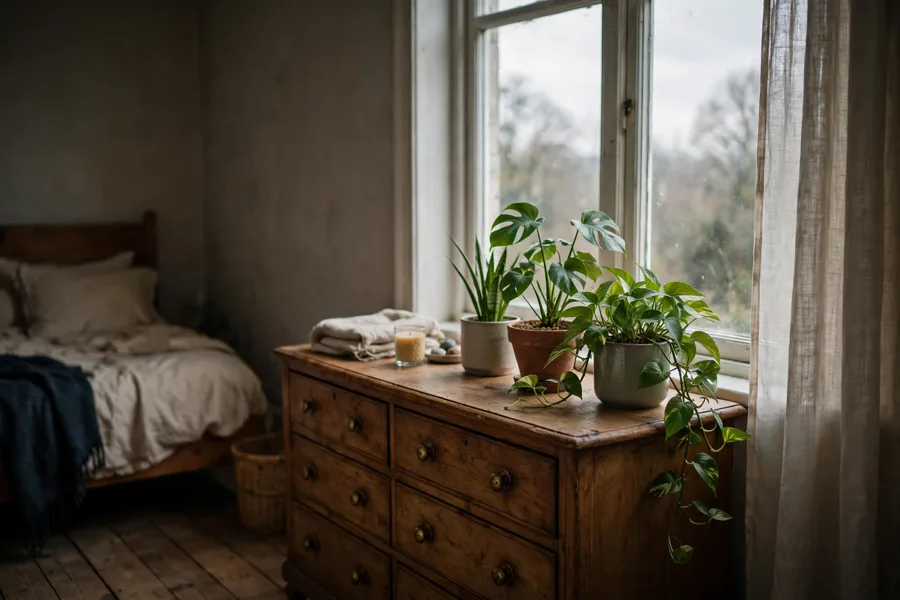
Golden pothos is the trailing plant that still performs in a dim room, as long as it starts up high. Set the pot on a wardrobe or bookshelf 5 to 6 feet up, close to the window wall, and let the vines fall through the best light rather than training them into the dark. In low light the stems space out and stretch, so pinch the growing tips every couple of months to push fullness back toward the pot. If your shelf catches the last of the evening light, this is the plant that will show you it noticed.
Color note: expect new leaves to come in smaller and mostly plain green — the gold marbling is a bright-light luxury, so pick golden pothos for toughness and leave the neon and marble types to sunnier rooms.
4. Cast Iron Plant for the Darkest Corner
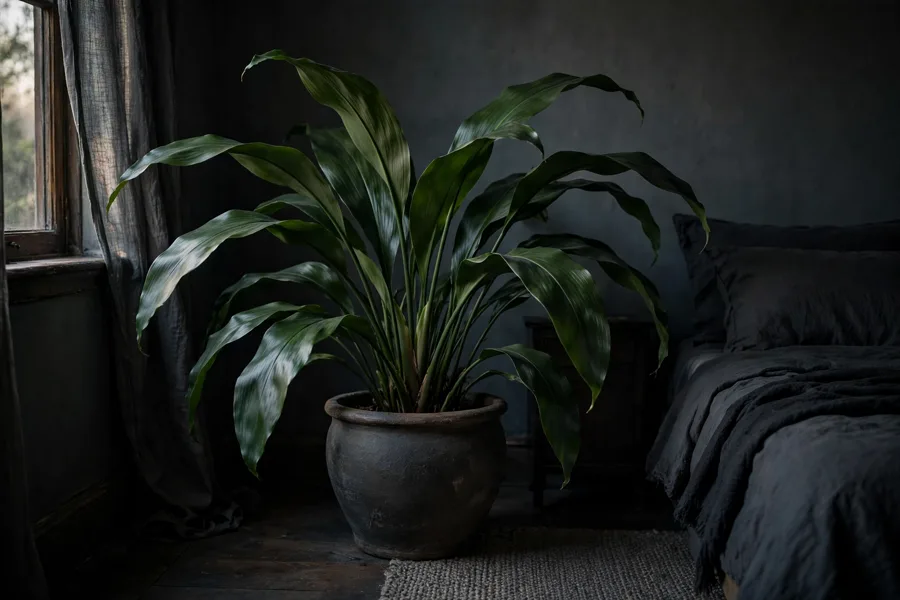
The cast iron plant earned its name in Victorian parlours darker than most modern bedrooms, and it is still the safest answer for the corner the window barely reaches. Broad, deep-green leaves rise straight from the soil to about 2 feet, giving a floor pot real presence without flowers or fuss. It asks for water only when the top couple of inches of soil are dry, and it forgives the weeks when even that gets forgotten. Growth is slow — a handful of leaves a year — so buy the biggest plant you can find, because it will not hurry to fill its pot.
Best for: the corner with no direct view of the window at all — and for pet owners, since it is one of the few true shade plants considered safe around cats and dogs.
| Plant | Light it can handle | Water in a dim room | The honest catch |
|---|---|---|---|
| Snake plant | Low light, far corners | Every 3 to 4 weeks | Very slow; leaf edges may lose their colour |
| ZZ plant | Low to medium indirect | Every 3 to 4 weeks | Rhizomes rot if the soil stays wet |
| Golden pothos | Low light, high shelf | When the top 2 inches are dry | Stems turn leggy; leaves go plain green |
| Cast iron plant | The lowest light on this list | When the top 2 inches are dry | Slow — buy a large plant to start |
| Chinese evergreen | Low light, same room as the window | Lightly moist, never soaked | Silver varieties need more light |
| Peace lily | Low light | It droops when thirsty — water then | Blooms are rare in shade |
| Parlor palm | Low to medium indirect | Evenly moist | Brown tips in dry, heated air |
5. A Mirror That Spends Daylight Twice
A mirror cannot make light, but it can spend the same daylight twice. Lean or hang one on the wall opposite the window, angled so the glass catches the window itself; the reflected light lands nearby, and plants placed in that path get a second serving. It works best for the shelf or dresser end that sits just outside the window’s natural reach. Check the reflection before fixing anything, though: a mirror that mostly shows the bed and the laundry chair is decorating, not helping, and the plants get nothing from it. Renters can lean a framed mirror on the dresser instead — no holes, same borrowed light.
Fit check: a mirror 24 to 36 inches wide is enough for one plant group; go bigger only if it also passes the “what does it reflect” test from where you lie in bed.
6. The Rotation Roster That Shares the Good Seat
Plants in dim rooms rarely die from one bad week; they fade from a permanently bad seat. A slow rotation fixes that without buying anything. Once a week, turn every pot a quarter-turn so all sides take a share of the window and growth stays even. Once a month, swap seats: the plant from the darkest corner trades places with one from the dresser for a few weeks of recovery light, then swaps back. Nobody lives in the worst spot forever, and nobody hogs the best one. Mark it on the calendar, because the system fails the first month it depends on memory.
Space note: keep one “recovery seat” permanently free at the window end of the dresser — about 18 inches of clear surface — so swaps take two minutes instead of a full rearrangement.
| What plant labels call it | What it looks like in a bedroom | What honestly grows there |
|---|---|---|
| Bright indirect | A soft glow within about 3 feet of the window; you could read there all day | Everything on this list, plus most medium-light plants |
| Low light | A north or shaded window, 4 to 6 feet into the room; a sun patch never lands here | Snake plant, ZZ plant, pothos, cast iron plant, Chinese evergreen |
| Deep shade | Far corners and windowless walls, where midday already feels like evening | Nothing thrives long-term — rotate plants through, or add a grow light |
7. Sheer Curtains That Stop Stealing Light
Many dim bedrooms are dim by curtain, not by architecture. Heavy lined drapes left drawn against a grey day can cost plants most of the light the window actually offers. The fix is a double rod: blackout curtains for the night, plus a pair of sheers that stay across the window through the day, filtering the light instead of blocking it. Sheers also soften a room in the same direction as the layered looks in green bedroom designs, where pale fabrics do much of the work. The trade-off is privacy after dark, so the blackout layer has to be genuinely easy to pull shut, or sleep will pay for the plants’ gain.
Texture note: a linen-look sheer keeps a soft, visible weave in daylight and stops a north-facing room from feeling flat and washed out.
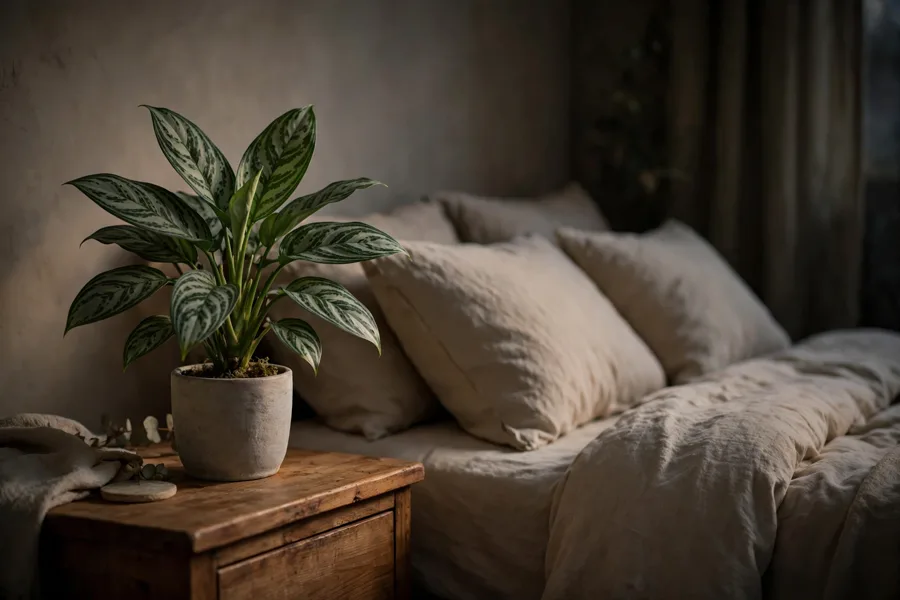
8. Chinese Evergreen on the Nightstand
Chinese evergreen is the plant for anyone who wants patterned leaves without a sunny sill to pay for them. It grows slowly into a neat mound 12 to 18 inches tall — nightstand size — and its marked leaves read as decoration in a room that gets little else. It tolerates the light on the far side of a bed as long as the window is in the same room, and it likes its soil lightly and evenly moist rather than soaked or bone dry. Dry winter air can crisp the leaf edges; a spot near your other plants, where the air stays a touch more humid, helps.
Style note: choose the mostly-green varieties for a dim room — the silver- and pink-heavy types are bred for brighter spots and their patterns fade fastest in shade.
9. Peace Lily, Bought for Leaves Instead of Flowers
A peace lily in a dim bedroom is a lesson in honest expectations. The plant itself is content: broad, dark leaves stay glossy in light that would starve most flowering plants, and the whole thing droops dramatically when it is thirsty, then stands back up within hours of a drink — the clearest watering signal any plant gives. What low light takes away is the flower. White blooms are a bright-light reward, and a shade-kept lily may produce one a year, or none at all. Buy it for the leaves and treat any bloom as a bonus, and it will never disappoint you.
Get the look: one lily in a plain white pot at the dresser’s window end, leaves dusted monthly — in a dim room, dust blocks a real share of the little light each leaf can use.
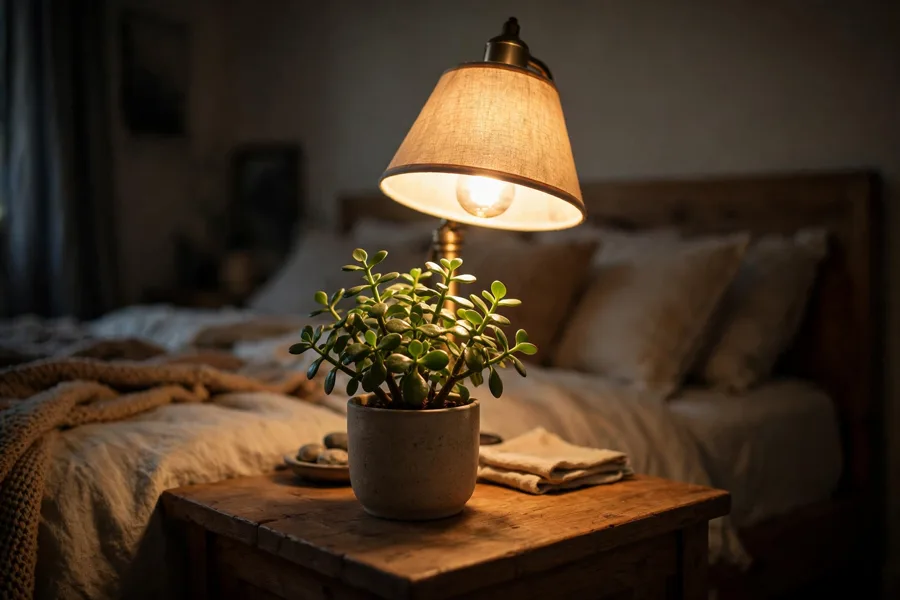
10. A Grow Light in the Bedside Lamp
Some bedrooms are past the point where plant choice can save them: a window the size of a tea towel, another building 6 feet away, daylight that never properly arrives. In that room the honest answer is a grow light, and it is simpler than the equipment lists suggest. Screw a full-spectrum LED bulb into the bedside lamp, keep it 12 to 24 inches above the plant, and run it on a timer that switches off before bedtime, because light spill is the enemy of sleep. Choose warm-white light rather than purple — this is a bedroom, and you have to live in the glow too.
Budget note: one bulb and a plug-in timer in a lamp you already own costs less than replacing a third dead plant — and it ends the replacement cycle for good.
11. Parlor Palm in the Room’s Best Dim Seat
The parlor palm is the soft option: fine, feathery fronds that take the hard edge off a dim room’s corners. Give it the best seat a low-light bedroom has — beside the window wall rather than across from it — and it will hold its shape for years, growing slowly to 2 to 4 feet. It is also one of the few larger plants considered safe around pets, which settles the floor-plant question in a lot of homes. Its weakness is dry air: heating can brown the leaf tips, so keep it on the room’s humid side, away from vents and radiators.
Seasonal swap: as the days shorten, slide the palm a couple of feet closer to the window for winter, then ease it back in spring when the light returns.
12. Heartleaf Philodendron Along the Headboard Shelf
Heartleaf philodendron is pothos’s softer relative — smaller leaves, a finer vine, the same willingness to live on borrowed light. Trail it along a headboard shelf or the top of a bookcase where the line of green can run uninterrupted, and trim any stem that comes back with long bare gaps. Those gaps are the plant reporting that its seat is too dark, and the fix is a move toward the window, not more water. A single confident trail of green also does the work of a whole gallery wall in a dim room, which is the same one-strong-move thinking behind most bedroom decor ideas that actually change how a room feels.
Easy swap: pothos and heartleaf philodendron trade places happily — if one sulks in its seat, swap their spots for a month before spending anything on a replacement.
| Care task | In a dim room | Why it matters more here |
|---|---|---|
| Check the soil before watering | A finger 2 inches down, not the calendar | Soil dries slowly without sun or heat on it |
| Dust the leaves | Once a month, with a damp cloth | Dust steals light the leaf cannot spare |
| Quarter-turn each pot | Weekly | Stops the one-sided lean toward the window |
| Feed | Once or twice in spring and summer, at half strength | Slow growth needs little, and excess salts linger in damp soil |
Begin With One Plant and the Light You Actually Have
A dim bedroom does not need a dozen plants bought in one hopeful weekend. It needs one genuinely shade-tolerant plant in a seat chosen honestly, then the small habits — a quarter-turn here, a mirror there — that share the light around. Add a second plant only when the first has held its leaves and its shape for a couple of months. That patience feels slow, but a room with three settled plants looks calmer, and stays calmer, than a room cycling through replacements.
Your one next step: stand in the bedroom at midday tomorrow and find the spot, roughly 4 to 6 feet from the window, where you can still read a page comfortably. Put one snake plant there this week — every other idea on this list gets easier once the first plant is alive, settled, and clearly in no hurry to die.