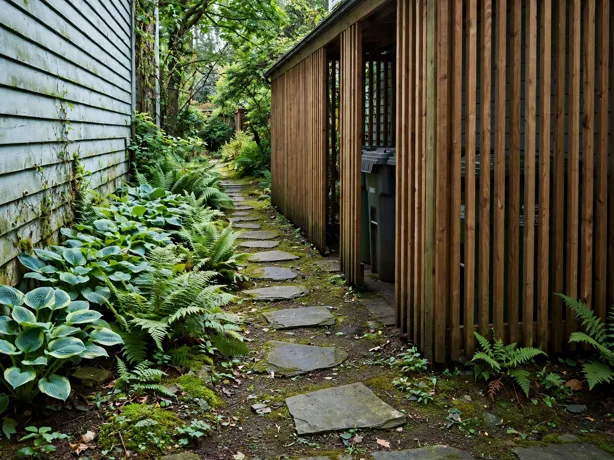
Side yards usually fail as dumping strips: the bins live there, the mower lives there, the grass dies in permanent shade, and every trip through means squeezing past the wall with something awkward in your hands. It is the most walked strip of the yard and the least gardened, so it ends up feeling like a gap between two houses instead of part of the garden.
A side yard works when the walk line stays clear and the walls do the gardening. Planting goes vertical or in one narrow ribbon, screens turn the utilities into a backdrop, and every choice is measured against one question: can you still carry a bin, a bike, or a wheelbarrow through without a fight?
These 17 side yard landscaping ideas are built on real widths and clearances, most of them finishable in a day with shade-tough plants and simple screens. Pick the ones that match your strip, and the passage starts earning its keep.
The Side Yard Formula That Keeps Narrow Strips Looking Useful
- Protect the walk line first: keep one clear route of at least 80 cm for bins, bikes and wheelbarrows before planting anything.
- Garden on the walls: climbers, wall shrubs and screens use the fence and house wall, because floor space is the one thing a side yard lacks.
- Plant for the light you have: most side yards are shade corridors, so choose plants that thrive in low light instead of struggling sun-lovers.
- Screens must open: bin and meter screens on hinges or sliders keep access easy, so the tidy look survives real life.
For example, a 1.2-metre side strip with stepping pads down the middle, a fern and hosta ribbon on the shady side, a hinged slatted screen hiding the bins and one scented climber at the gate feels like a garden passage, not a gap between houses.
| # | Idea | Best For | Budget/Effort |
|---|---|---|---|
| 1 | Shade Fern Strip Planting | Permanent shade strips | Low cost / one afternoon |
| 2 | AC and Bin Screen Planting | Ugly utility corners | Low cost / one afternoon |
| 3 | Stepping Pads with Ground Cover Joints | Muddy through-routes | Medium cost / one weekend |
| 4 | Flat Wall Shrub Screen | Bare fence walls | Medium cost / one afternoon |
| 5 | Potting Bench Working Side Yard | Gardeners with no workspace | Low cost / one afternoon |
| 6 | Bike and Gear Storage Screen Bed | Bikes cluttering the strip | Medium cost / one weekend |
| 7 | Scented Wall Climber Strip | Passages you walk daily | Low cost / one afternoon |
| 8 | Drainage Swale Planting | Strips that flood | Medium cost / one weekend |
| 9 | Gate Entry Pocket Bed | Bland side gates | Very low / one hour |
| 10 | Feather Reed Grass Privacy Row | Overlooked side strips | Low cost / one afternoon |
| 11 | Laundry Line Green Screen | Utility-feeling strips | Low cost / one afternoon |
| 12 | Narrow Raised Bed Run | Strips with dead soil | Medium cost / one weekend |
| 13 | Hosta and Heuchera Shade Ribbon | Deep shade ribbons | Low cost / one afternoon |
| 14 | Night-Light Low Planting Strip | Dark evening routes | Low cost / one afternoon |
| 15 | Fruit Hedge Edible Screen | Productive privacy seekers | Medium cost / one weekend |
| 16 | Rain Barrel Hidden Planting Corner | Downpipe corners | Low cost / one hour |
| 17 | Firewood Stack Green Wall Bed | Wood stores by the wall | Low cost / one afternoon |
1. Shade Fern Strip Planting
In a side strip shaded by the house on one side and the fence on the other, ferns do the job lawn never could. Plant a ribbon 18 inches wide along the fence: three Japanese painted ferns, two autumn ferns, and a run of soft shield ferns, spaced 16 inches apart so the fronds knit together by midsummer. Edge the ribbon with one row of flat river stones to hold the soil back, then mulch with fine bark. Water weekly through the first season; after that, rainfall carries them.
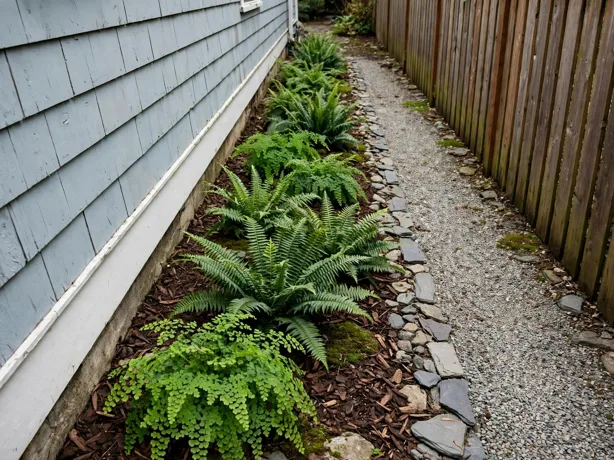
Texture note: Fine, layered fronds in silver-green and copper against rough bark mulch give this strip its whole look — soft up close, tidy from the gate.
2. AC and Bin Screen Planting
Give the AC unit and the wheelie bins one shared screen and the whole strip calms down. Build a slatted cedar panel 5 feet tall on two posts, hinged on one side so it swings open for the meter reader, and set it 12 inches in front of the unit so air still flows freely. Plant one evergreen clematis at each post and a skirt of liriope along the base. If the rest of your passage needs the same treatment, these side house walkway ideas pair screens with slim planting just as neatly.
Best for: side strips where the bins and AC unit are the first things you see from the gate.
3. Stepping Pads with Ground Cover Joints
Where the strip turns to mud every winter, a single line of big stepping pads fixes the floor without paving the whole width. Use stone or concrete pads 24 by 16 inches, set on a shallow gravel bed with their tops dead level, down the center of the strip.
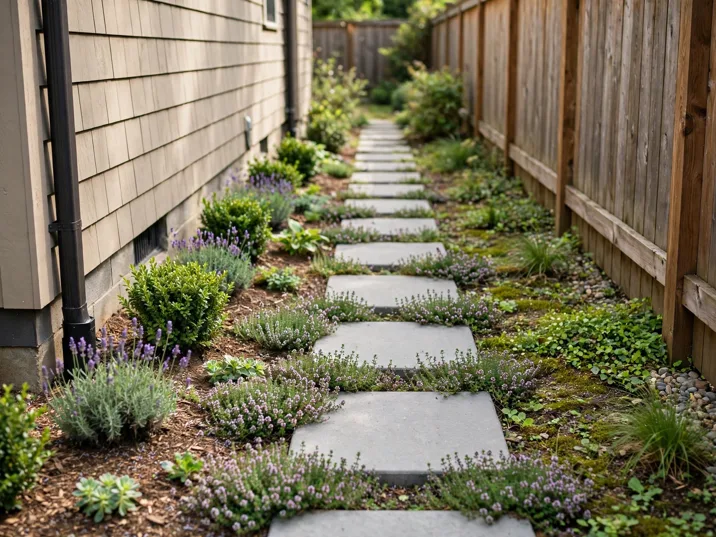
Leave 6-inch joints between pads and fill them level with creeping thyme or Irish moss, which takes foot traffic and stays green. Keep the planted joints inside the pad line, so the clear walking width never drops below 32 inches.
Space note: On a 4-foot strip, the pads take the middle 24 inches and the margins stay planted but shallow, so elbows and bin handles pass without brushing wet leaves.
4. Flat Wall Shrub Screen
A wall shrub trained flat against the fence gives a side wall a green face for the depth of a dinner plate. Fix wires at 12-inch intervals up the fence, tie in a pyracantha or camellia, and prune any outward-pointing shoot twice a year. The plant finishes about 8 inches deep, so a 3-foot strip keeps nearly all its width. Orange berries carry the color through winter, when a shaded strip looks bleakest. If your fence is the ugliest part of the yard, this fixes it for almost no floor.
Fit check: Hold a broom handle along the fence before planting: if it clears the walk line with the shrub’s 8-inch depth added, the mature plant will too.
5. Potting Bench Working Side Yard
A side strip that catches real sun is the best potting bench spot most gardeners own without knowing it. Stand a bench 4 feet long against the house wall, deep enough to hold an open bag of compost, with a lower shelf for stacked pots, and back it with a low clipped hedge along the fence so the work zone reads green instead of cluttered. Hang hand tools on hooks beneath the bench top and keep one lidded bin below for mix and offcuts.
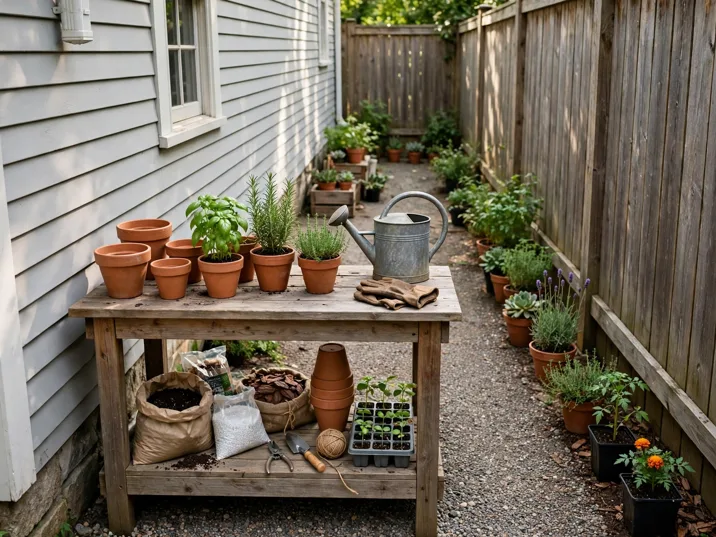
Style note: One galvanized watering can left out on the bench and a row of matching terracotta pots turn a work corner into something you are happy to walk past.
6. Bike and Gear Storage Screen Bed
Bikes stored in the side strip fail when they lean, rust, and eat the route one handlebar at a time. Anchor a simple hoop rack to the fence so two bikes stand upright in a bay only 20 inches deep, then screen the bay with a trellis panel planted with evergreen honeysuckle. Run a narrow bed of black mondo grass at the trellis base to hide the mud line around the wheels. The bikes stay grab-and-go, the route past them keeps its full width, and from the gate the strip reads as planting rather than parking.
Easy swap: Trade the trellis panel for a tall slatted gate section if you want the bikes hidden completely instead of softened behind leaves.
7. Scented Wall Climber Strip
A climber is the cheapest way to make a passage feel planted, because it covers wall instead of floor. Run one star jasmine on wires held 6 inches off the fence boards on the shady side: it keeps its leaves all year and perfumes the strip in June.
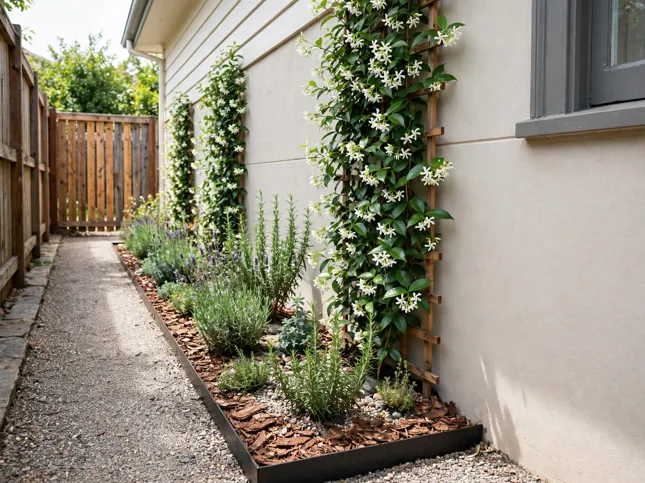
Where the strip catches morning sun, add one clematis in a pocket bed 12 inches wide at the fence base and let it thread up through the jasmine for a second flowering. Both plants together take under a foot of floor, so the walk line stays untouched.
Seasonal swap: Add a Virginia creeper on the end fence for fall: red in October, bare for winter light, covered by spring.
8. Drainage Swale Planting
Low side strips collect roof water and stay sour all winter. Dig a shallow swale down the center line, about 8 inches deep and 18 inches wide, line it with river rock, and plant its banks with moisture lovers: Siberian iris, marsh marigold, and cardinal flower where sun reaches. Water moves slowly and sinks instead of pooling against the house. For height above a swale like this, these trellis privacy ideas show panels on posts above wet ground.
Why it works:
- Slowed water soaks in instead of pooling against the foundation.
- Thirsty roots drink the swale dry between storms, keeping the route passable.
- Rock and flowers make drainage read as a planted stream bed, not a repair job.
9. Gate Entry Pocket Bed
The few feet inside the side gate set the tone for the strip, so spend your smallest effort there. Clear a pocket bed 3 feet wide by 2 feet deep on the sunniest side of the gate and plant it tightly: one lavender at the back, three black-eyed Susans in the middle, and a clump of blue fescue at the front edge.
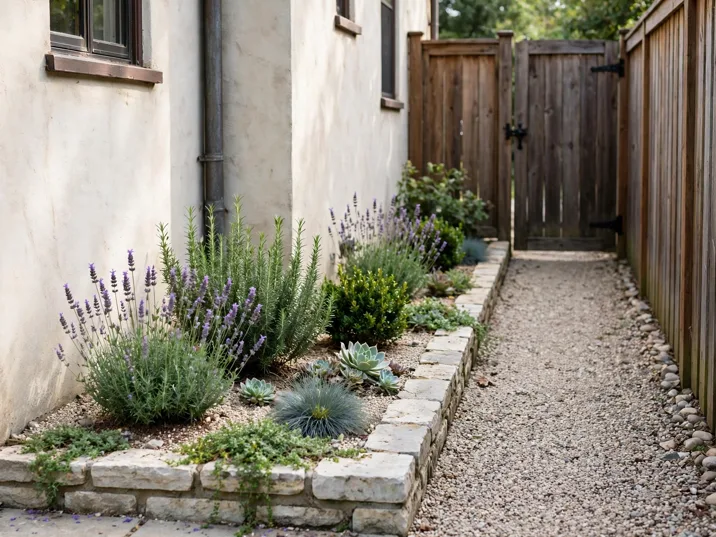
Edge it with bricks set on edge from a leftover stack; it asks for ten minutes of care a month. It is the cheerful thing that meets you at the gate.
Budget note: The pocket costs one nursery trip — four plants — and the edging is free if you raid the brick pile behind the shed.
10. Feather Reed Grass Privacy Row
Feather reed grass is the privacy plant that respects a strip, because it grows up instead of out. Plant a row of ‘Karl Foerster’ 18 inches apart along the fence; each plant finishes 12 to 18 inches wide but 5 feet tall. It screens the neighbor’s window from spring through late winter, rustles instead of rusting, and never demands the ladder work a hedge does. Cut it to the ground in late winter and it is back to full height by June. The overlooked strip stops feeling like a corridor between two houses.
The formula: feather reed grass row + dark gravel mulch strip + one clipped boxwood ball at the gate end
11. Laundry Line Green Screen
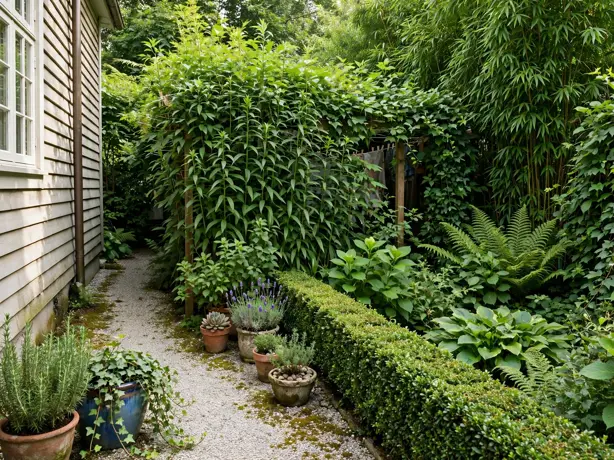
A laundry line makes a side strip feel like a utility yard, but a green screen behind it changes the whole picture. Plant three columnar hornbeams, or fix one pleached hedge panel on a frame, on the far side of the line so shirts and sheets hang against leaves instead of the neighbor’s wall. Keep the screen inside the line’s own footprint, so nothing steals width from the route you carry the basket along.
Get the look:
- Main piece: pleached hornbeam panel on a simple post-and-wire frame
- Supporting piece: green liriope ribbon planted along the screen’s base
- Texture or material: matte green leaves set against a pale gravel margin
- Finishing touch: line posts painted the same color as the fence
12. Narrow Raised Bed Run
Where side strip soil is rubble and old mortar, a narrow raised bed beats fighting it. Build a run of beds 18 inches wide and 12 inches tall along the fence: wide enough for two staggered rows of herbs or salad greens, narrow enough to reach across without ever stepping in. Fill with topsoil and compost, and keep a clear 32-inch route on the house side. It is the same one-ribbon logic behind most small garden ideas: one strip, worked well, instead of a plot spread thin.
Color note: Stain the boards a deep green and the run disappears into the planting, leaving the herbs and lettuces as the strip’s only color story.
13. Hosta and Heuchera Shade Ribbon
The deepest-shade ribbons, where sun never lands at all, belong to hostas and heucheras planted as one repeating band. Run blue ‘Halcyon’ hostas 20 inches apart down the fence side, set gold-edged hostas in front of them, and weave heuchera ‘Caramel’ between every pair as a warm underlayer. The finished band is about 24 inches wide, holds its pattern from April to frost, and never asks for sun it is never going to get.
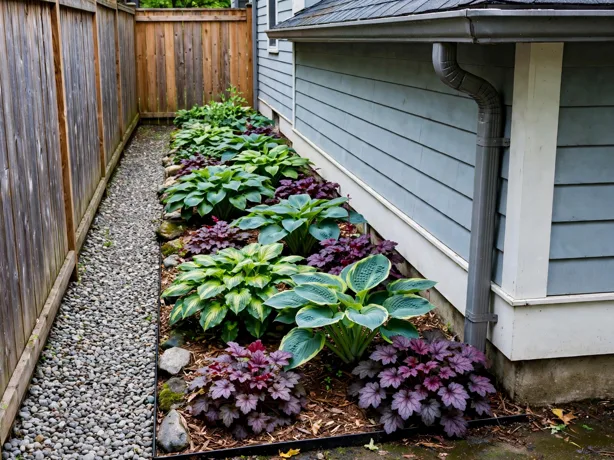
Texture note: Big quilted hosta leaves over the heuchera’s fine, ruffled foliage give the ribbon two clear layers, so even a flowerless band looks planted, never filler.
14. Night-Light Low Planting Strip
The side strip you cross after dark needs light at ankle height, not a floodlight on the wall. Set low stake lights every 6 feet along the house side, angled across the pads, and plant the gaps between them with low, pale-leafed plants that catch the beam: silver lamium, variegated liriope, and white-edged hostas. Nothing here grows above knee height, so the light stays clear, the edges of the route read plainly, and the strip feels guided rather than lit like a runway. Anyone taking the bins out at night will thank you for this one.
Best for: side strips used as the evening route to the bins, the bikes, or the back door.
15. Fruit Hedge Edible Screen
A fruit hedge turns the fence line into the most productive foot of the whole yard. Plant thornless blackberries, or a row of currant bushes, 24 inches apart against the fence and train the fruiting wood flat to horizontal wires. The hedge finishes about 18 inches deep, leafs out into a full privacy screen from May to October, and puts bowls of fruit within arm’s reach of the walk line. Prune once after fruiting, taking the old canes out at the base.
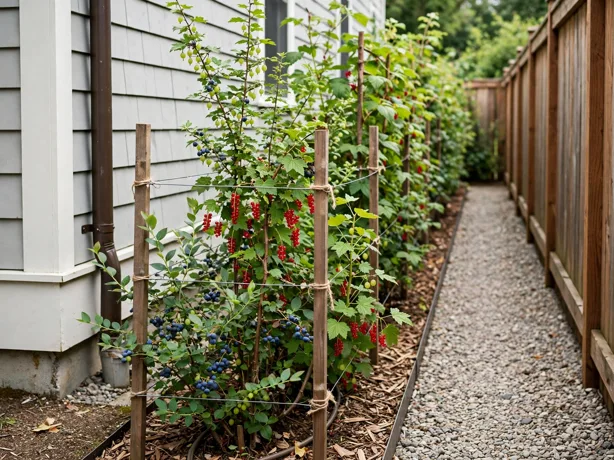
Space note: Budget the strip honestly: 18 inches for the flat-trained hedge, 32 inches of clear route, and whatever remains becomes a plain gravel margin against the house wall.
16. Rain Barrel Hidden Planting Corner
The corner under the downpipe is wet, splashy, and bare, which is what a rain barrel wants. Set a slimline barrel tight to the wall on a level paver, divert the downpipe into its top, and ring the base with a crescent bed of moisture lovers: sweet flag, blue flag iris, and one cardinal flower. Fix a trellis panel behind the barrel and plant a clematis at its foot; within a season the plastic disappears behind leaves. Send overflow out through a short gravel channel, never across the pads.
Fit check: Before a storm, run a hose into the barrel for five minutes: the overflow should leave by the gravel channel without touching the walk line.
17. Firewood Stack Green Wall Bed
A firewood stack against the house wall is honest storage, but a green frame turns it into a feature. Build the stack between two short posts so it stands only 12 inches deep with its log ends flush, and plant a narrow bed along its front edge with evergreen ferns and one winter-flowering hellebore. Above the stack, fix a shallow shelf under the eaves for a row of small pots of trailing rosemary.
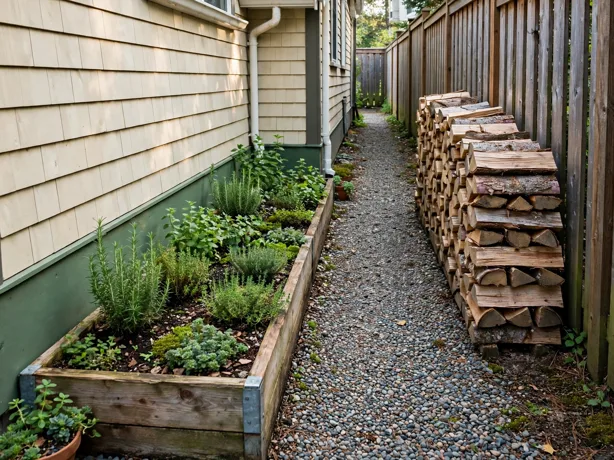
Style note: Keeping the log ends dead flush and the pot row in a single color is what makes storage read as a green wall instead of a woodpile.