Modern backyards usually fail at the extremes. One version is a hard gray slab of paving that feels like a car park with better furniture; the other is an ordinary garden with a few angular planters dropped in, where nothing lines up and nothing reads as designed.
The versions that work hold geometry and softness in balance. Strong straight lines and a short list of materials give the structure, and every hard edge is answered by loose green planting, so the yard feels calm and sharp at the same time instead of cold.
These 23 modern backyard landscaping ideas give you the exact materials, shapes and plants behind that balance — grids, panels, rills and clipped green forms — most of them buildable in stages with standard pavers, gravel, steel and nursery plants.
The Modern Garden Formula That Keeps Clean Lines Looking Warm
- Geometry does the talking: straight lines, grids and rectangles give the modern look; curves and clutter undo it.
- Three materials maximum: pick one paving, one gravel or stone and one metal or timber, and repeat them everywhere.
- Answer hard with soft: every hard line gets loose planting against it — grass drifts, soft shrubs — so clean never turns cold.
- Plants with architecture: choose plants that hold a shape — grasses, yucca, clipped green — and skip anything that flops or litters.
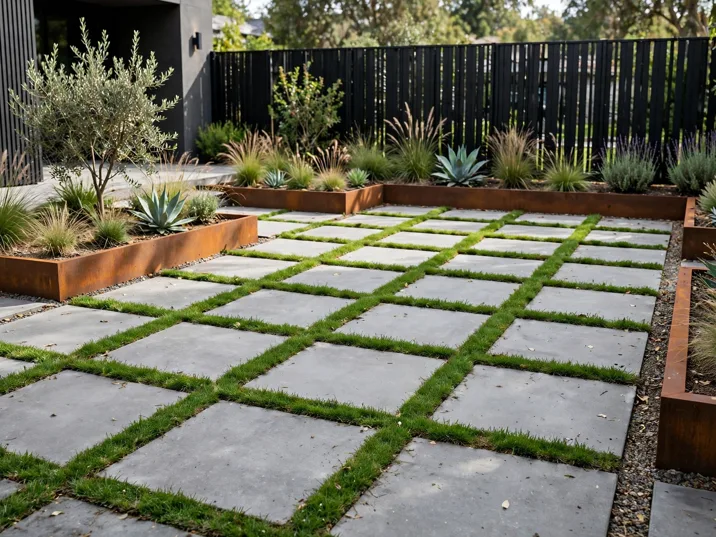
For example, a grid of large grey pavers and lawn panels, corten-edged beds of green grasses and one multi-stem tree, all against a black-stained fence, looks sharp from the kitchen window and still feels like a garden.
| # | Idea | Best For | Budget/Effort |
|---|---|---|---|
| 1 | Linear Paver and Grass Grid | Flat yards needing structure | Higher cost / staged build |
| 2 | Corten Steel Edge Beds | Beds needing a sharp line | Medium cost / one weekend |
| 3 | Gravel Court with Grass Drifts | Low-water modern yards | Medium cost / staged build |
| 4 | Black Fence Backdrop Planting | Fences that glare white | Low cost / one weekend |
| 5 | Architectural Agave and Yucca Bed | Hot modern sun traps | Medium cost / one afternoon |
| 6 | Minimalist Lawn Panel | Lawns as design pieces | Medium cost / one afternoon |
| 7 | Concrete Stepping Pad Run | Routes across lawn | Medium cost / one weekend |
| 8 | Raised Concrete Planter Rows | Level-change yards | Higher cost / staged build |
| 9 | Ornamental Grass Wave Planting | Softening hard edges | Medium cost / one afternoon |
| 10 | Hedge Wall Green Room | Modern privacy seekers | Medium cost / staged build |
| 11 | Narrow Water Rill Line | Long straight yards | Higher cost / staged build |
| 12 | Monochrome Green Modern Bed | Calm colour-free tastes | Medium cost / one afternoon |
| 13 | Sculptural Tree Spotlight Planting | One-tree statements | Medium cost / one afternoon |
| 14 | Steel and Stone Stair Slope | Modern sloped yards | Higher cost / staged build |
| 15 | Grid of Small Trees Layout | Orchards, modern style | Higher cost / staged build |
| 16 | Modern Prairie Grid Planting | Naturalistic modern fans | Medium cost / one weekend |
| 17 | Charcoal Gravel and Silver Plant Bed | Dark modern palettes | Medium cost / one afternoon |
| 18 | Block Hedge Cube Design | Geometric green shapes | Medium cost / one season |
| 19 | Bamboo Screen Modern Border | Tall narrow screening | Medium cost / one afternoon |
| 20 | Modern Cottage Mix Bed | Softening strict layouts | Low cost / one afternoon |
| 21 | Night Lighting Line Design | Evening-focused yards | Medium cost / one weekend |
| 22 | Asymmetric Balance Layout | Off-centre modern houses | Medium cost / staged build |
| 23 | Evergreen Cloud Pruning Bed | Sculptural green art | Higher cost / one season |
1. Linear Paver and Grass Grid
Lay a strict grid across the flat yard: 60-by-60-centimeter charcoal concrete pavers in straight rows, every other square left as a lawn panel of the same size. Keep the joints tight and run the grid wall to wall, so the pattern sets the rhythm. Edge the whole court with a flush steel strip so mower wheels run clean along the boundary.
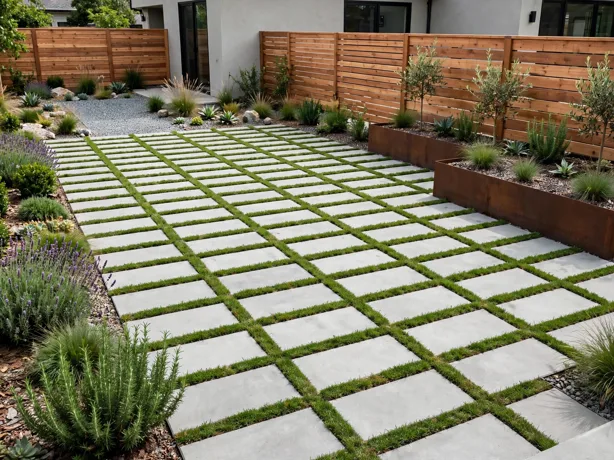
Style note: the grid reads modern only while every line stays true, so set the first row with a string line and check each square with a builder’s square before laying on. If your yard is a plain rectangle, this one grid can organize everything else you ever add.
2. Corten Steel Edge Beds
Frame each bed with corten steel edging 15 centimeters tall, set so just 10 centimeters shows above the soil as a clean rust-orange line. Run it in dead-straight lengths with squared corners, never curved, and plant behind it in single blocks: one bed of green liriope, the next of clipped boxwood balls. The steel weathers to its final color within a few months and then needs nothing for years.
Easy swap: swap corten for black powder-coated steel edging if your palette runs cooler; the line stays just as sharp against the soil.
3. Gravel Court with Grass Drifts
Replace the lawn with a court of pale gray 10-millimeter gravel, raked flat over a compacted base and held by steel edging on all four sides. Through it, plant three long drifts of ornamental grass — feather reed grass and fountain grass in ribbons about a meter wide — so the green moves through the stone like slow water. One of the cleanest routes into the look is borrowing layouts from modern garden aesthetic ideas and stripping them back to this gravel-and-grass pairing.
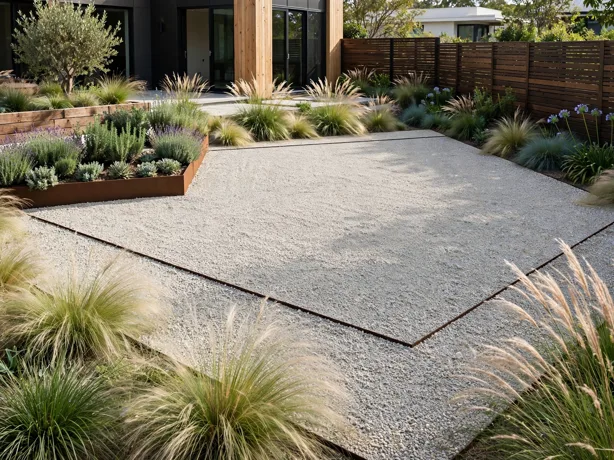
Seasonal swap: in fall the grasses turn straw-gold and carry the court; cut them to 10 centimeters in late winter and fresh green returns by spring.
4. Black Fence Backdrop Planting
Stain every fence panel a flat black or near-black, then plant against it in pale and green blocks so the foliage glows against the dark ground. Use silver artemisia and white gaura in one run, bright green hakonechloa in the next, and a back row of white-flowering hydrangea for height. The dark backdrop also hides panel joins, fixings and weathering completely, which makes a standard fence look twice as tall.
Why it works:
- Black absorbs light, so green and silver foliage reads brighter against it.
- One dark ground unifies beds planted in separate blocks.
- The fence itself disappears, which makes the yard feel deeper.
5. Architectural Agave and Yucca Bed
Give the sunniest, driest bed to plants that are sculpture first: one large blue agave as the center specimen, flanked by two stiff yucca rosettes and a front row of smaller blue fescue mounds. Set them in gritty, free-draining soil topped with pale decomposed granite, spaced wide — at least 60 centimeters apart — so each silhouette stands alone against the stone. Nothing here flops, litters or needs staking, even through a heatwave.
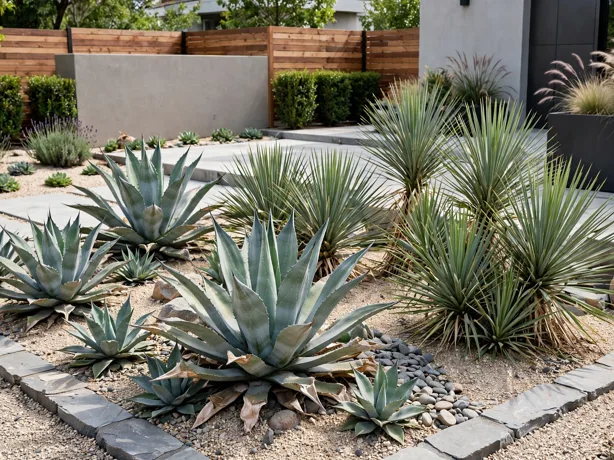
Budget note: the specimen agave costs the most; buy it small, at about 20 centimeters across, and let two seasons grow it to full drama for a third of the large-plant price.
6. Minimalist Lawn Panel
Treat the lawn as one designed panel, not the leftover space: a single rectangle of fine turf, cut crisply on all four sides by a flush steel or stone edge, with no beds biting into it. Keep it small enough to mow in straight passes — 4 by 6 meters is plenty — and feed and overseed so the green reads as one flat color. Around it, deep beds of ornamental grasses and clipped shrubs supply the softness, keeping the panel purely graphic.
The formula: one perfect lawn rectangle + flush steel edging + deep soft beds on all sides. From the house, it reads like a green rug on the plan.
7. Concrete Stepping Pad Run
Cross the lawn on a run of cast-concrete pads, each 90 by 45 centimeters, laid in a dead-straight line with a 15-centimeter grass joint between them. Set each pad flush with the turf on compacted sand, so the mower passes over and no pad rocks underfoot. Keep the run on the exact axis of the back door, and let one tall grass clump mark the far end.
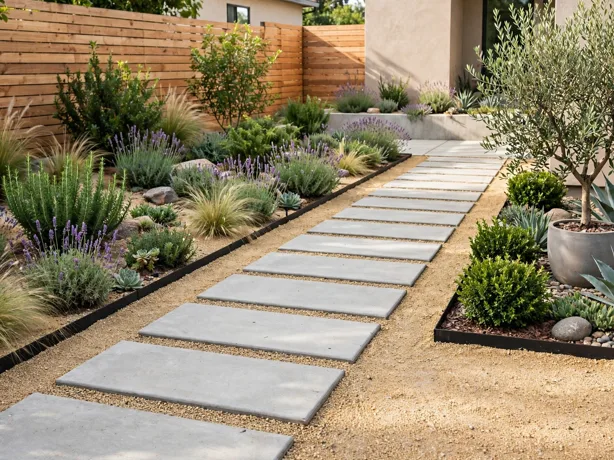
Get the look:
- Main piece: five 90-by-45-centimeter cast-concrete pads in one straight run
- Supporting piece: grass joints kept trimmed level with the pads
- Texture or material: smooth trowelled concrete against fine green turf
- Finishing touch: one tall feather reed grass clump at the run’s end
8. Raised Concrete Planter Rows
Where the yard changes level, build two or three planter rows in cast concrete or block, each 45 centimeters tall and 60 centimeters deep, running parallel across the slope. Cap them with smooth pale coping that doubles as seating, and plant each row as one block — green lavender in one, blue fescue in the next — so the tiers read as stripes. Matching concrete steps tie the rows into one piece of architecture.
Color note: raw gray concrete, one green and one blue-gray planting block keep the palette to three tones, which is what lets strong shapes stay calm. Built once, they give a sloped yard the order of a flat one.
9. Ornamental Grass Wave Planting
Soften the longest hard edge — a wall, a fence run or a paving boundary — with one continuous wave of ornamental grasses planted shoulder to shoulder. Use a single variety, such as Miscanthus ‘Morning Light’, set 45 centimeters apart in a band about a meter deep, so the whole drift sways as one surface. Underplant nothing; a dark bark mulch floor keeps the line clean and lets the pale plumes carry the effect from midsummer on.
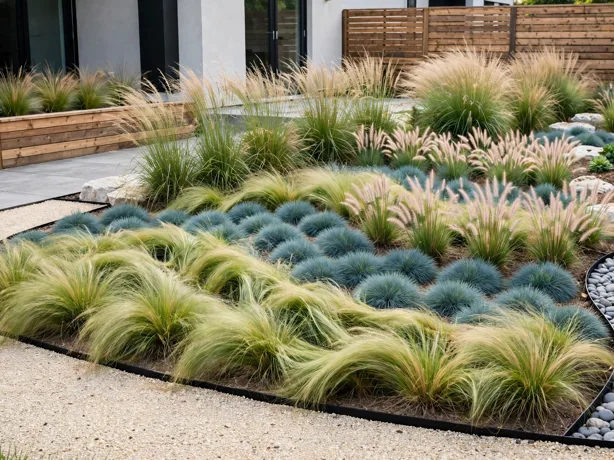
Texture note: fine, arching grass blades against flat render or smooth paving give the contrast modern planting runs on — all the softness comes from texture, not color.
10. Hedge Wall Green Room
Build one true room outdoors with hedge walls: plant dense evergreen hedging — yew or privet — on two or three sides of a seating terrace, clipped to 1.8 meters with flat tops and square corners. Inside, keep everything rectilinear: a gravel or paver floor, one steel bench line, one cube-clipped shrub in each corner. It is the clearest example of how modern garden layout trends borrow the plan of a house and simply roof it with sky.
Best for: overlooked yards where a tall, living wall gives real privacy without a fence permit or a hard structure.
11. Narrow Water Rill Line
Run a narrow water rill down the yard’s center line or along one edge: a channel just 20 centimeters wide and 15 deep, lined in black steel or dark stone, with a pump recirculating water from a hidden reservoir at the low end. Edge both sides with a single row of dark pavers so the water reads as a drawn line. Plant one side with a straight run of horsetail reed for a vertical echo.
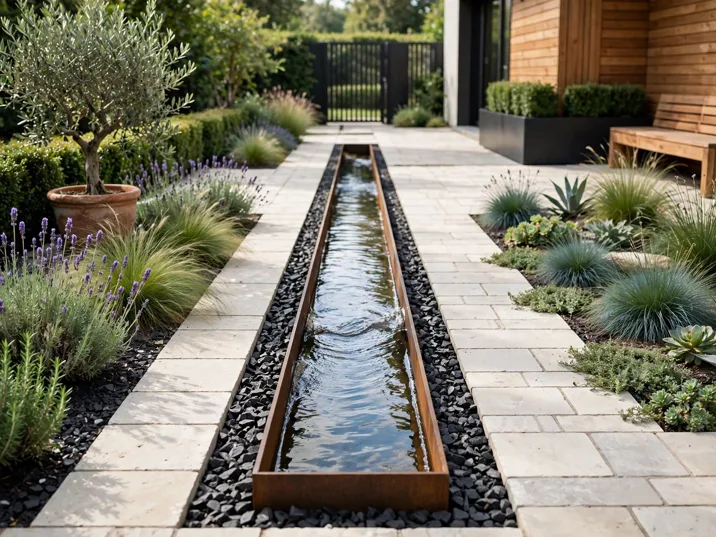
Space note: a rill needs only 20 centimeters of width, so it fits between a terrace and a bed where a pond never could; keep the run straight and level within a centimeter end to end.
12. Monochrome Green Modern Bed
Plant one deep bed in greens only — no flower color at all. Layer a back row of dark yew, a middle drift of bright green hakonechloa, clipped boxwood spheres at the center and a front line of green liriope, all finished with dark bark mulch. Interest comes from tone and shape alone: dark against bright, clipped against loose, sphere against mound.
Fit check: stand at the door and squint — if you still see three green tones and two clear shapes, the layering works; if it blurs into one mass, add a clipped sphere. For anyone tired of color decisions, this is the calmest bed you will ever plant.
13. Sculptural Tree Spotlight Planting
Choose one tree with real architecture — a multi-stem amelanchier, a twisted olive or a Japanese maple with a clear trunk — and give it a stage: a perfect circle or square of pale gravel, 2 meters across, set into the lawn or court. Plant nothing inside the ring except one low green groundcover disc at the trunk, and light the tree from one side with a single ground spike so its shadow draws across the gravel after dark.
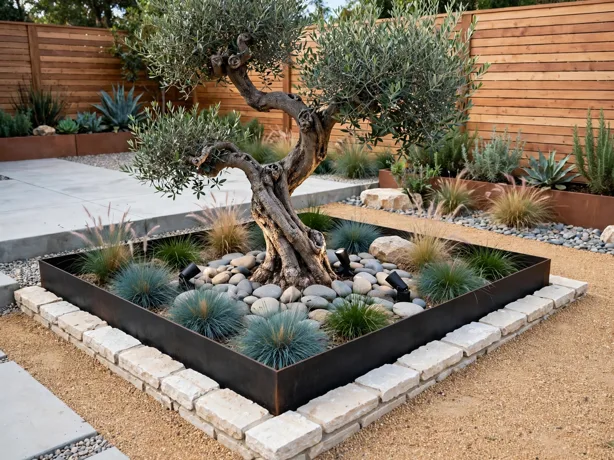
Style note: the empty ring is the design — resist filling it, because the bare gravel is what turns a nice tree into a sculpture.
14. Steel and Stone Stair Slope
Take a modern slope in straight flights: build wide steps from large gray stone treads, each 40 centimeters deep with a 15-centimeter rise, held between corten steel risers and side walls. Between flights, land on flat gravel terraces planted with single square blocks of blue fescue or green sedge, kept true to the stair line. A single flat-bar steel handrail, painted black, runs the full flight without a break.
Easy swap: swap the stone treads for precast concrete slabs in the same gray to cut the stair cost while keeping every line identical. Climbing the yard becomes a sequence of level rooms instead of a scramble.
15. Grid of Small Trees Layout
Plant small trees on a strict grid — nine or twelve of one variety, such as multi-stem amelanchier or columnar hornbeam, set 3 meters apart each way in straight rows across the yard. Underplant the whole grid with one green groundcover or a simple lawn, so the trunks stand in a single green floor. The layout borrows its order from the same geometry that organizes classic backyard landscaping designs, but here the repetition of one tree does all the work.
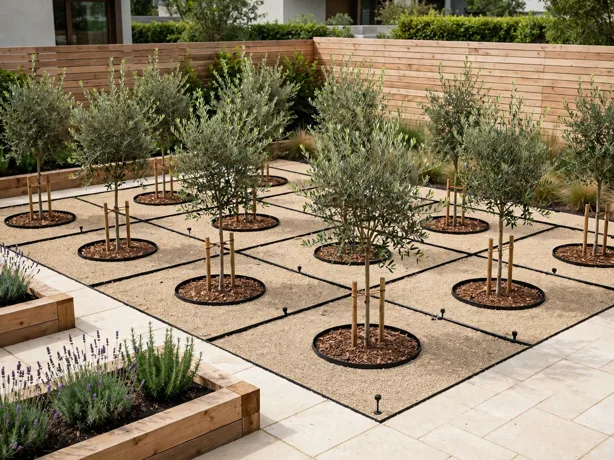
Seasonal swap: spring blossom and fall color arrive on every tree at once, so the grid changes its whole mood twice a year with zero replanting.
16. Modern Prairie Grid Planting
Lay the relaxed prairie palette over a strict grid: divide a sunny bed into meter squares with steel edging, then plant each square as one block — purple coneflower here, switchgrass there, black-eyed Susan in the next. The plants stay loose and natural inside their squares, flowering from June to October, but the grid underneath keeps the bed reading as design rather than meadow. Repeat three species only, so the blocks rhyme across the bed.
Why it works:
- The steel grid supplies the order, so informal plants never look messy.
- Block planting gives each species the mass to read from the house.
- Grasses hold the squares’ shapes through winter, after the flowers fade.
17. Charcoal Gravel and Silver Plant Bed
Build the dark version of the gravel bed: a floor of charcoal-black gravel, 10-millimeter grade, edged in black steel and planted only with silver and gray foliage. Set one white-flowering lavender variety in a straight run, artemisia mounds between, and a front line of lamb’s ear rosettes, each group spaced to stand clear of its neighbors. In evening light, the silver planting lifts off the black ground like print on a page.
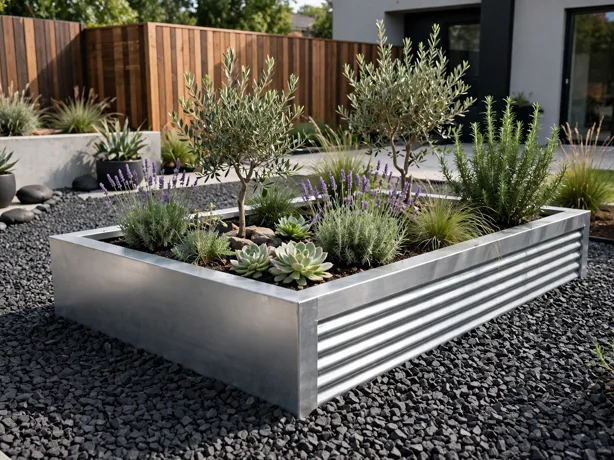
Budget note: gravel, steel edging and five plants per group cover a 3-by-2-meter bed for the price of one large shrub — the darkness does the expensive-looking work.
18. Block Hedge Cube Design
Clip hedging into pure geometry: plant a row of boxwood or yew and shear it into separate cubes, each about 60 centimeters square, spaced 30 centimeters apart along a gravel or paving line. Keep every face flat and every top dead level with its neighbors, and set the row against a plain fence or wall so the green blocks read as objects, not shrubs. One cube can carry a small standard tree rising from its center for a single vertical accent.
The formula: one repeated hedge cube + exact 30-centimeter gaps + a plain backdrop line. It is the greenest way to get sculpture into a yard without buying any.
19. Bamboo Screen Modern Border
Screen a boundary with clumping bamboo planted in a straight line: set plants of a non-running variety 60 centimeters apart inside a steel planter trough, 45 centimeters deep, so the roots stay where you put them. The culms rise 3 to 4 meters into a green wall that rustles above the planter line. Keep the floor a single pale gravel strip, so nothing competes with the verticals.
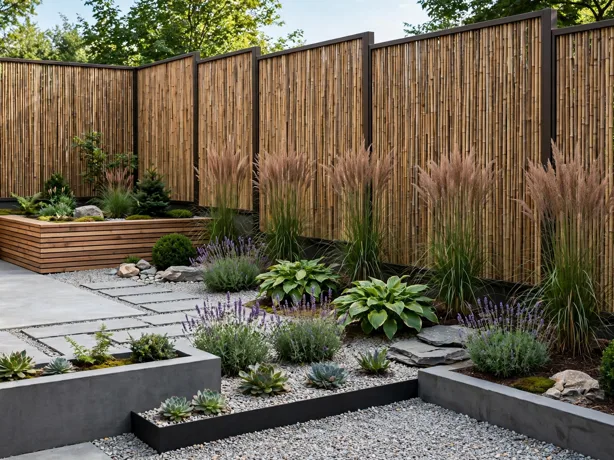
Get the look:
- Main piece: clumping bamboo at 60-centimeter spacing, one straight row
- Supporting piece: a 45-centimeter-deep steel planter trough containing the roots
- Texture or material: smooth green culms and fine leaves over pale gravel
- Finishing touch: one steel uplight washing the culms after dark
20. Modern Cottage Mix Bed
Soften a strict grid from inside its own lines: keep the steel-edged beds and the same three materials, but plant two blocks with freer perennials — white gaura, purple salvia and soft fountain grass — inside the same meter-square blocks as the clipped planting around them. The flowers loosen the geometry without breaking it, since every plant sits inside a drawn square. Keep the flower color to white and one purple, so the mix stays disciplined.
Color note: white plus one purple against green is the whole palette; a third flower color would tip this from a modern mix into a cottage jumble. Handled this way, soft planting keeps the clean lines intact.
21. Night Lighting Line Design
Draw the garden again in light after dark: run one straight line of low LED bollards or recessed strip lights along the main path edge, spaced 2 meters apart, all in a warm 2700K tone. Add one uplight at the base of the key tree and one wash inside the hedge wall, and leave everything else dark. By day the fittings are thin black lines that match the steel edging; by night, the yard’s geometry glows as a plan.
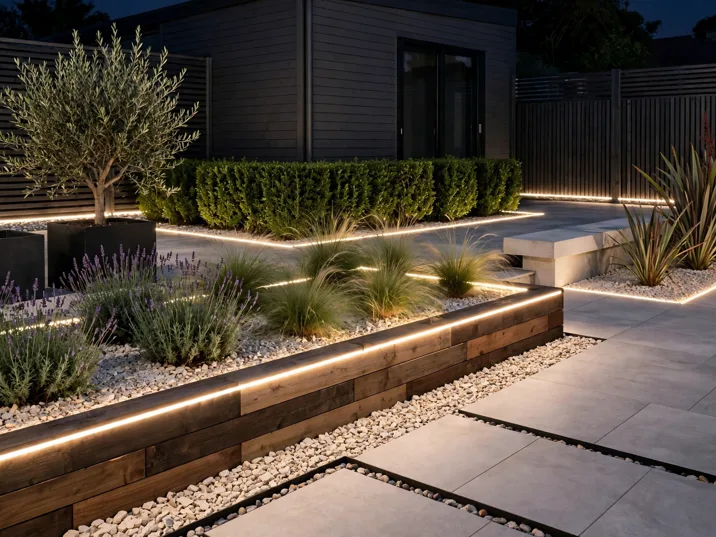
Texture note: light raking across gravel, grass plumes and clipped hedge faces reveals their surfaces after dark, so texture — not brightness — does the decorating.
22. Asymmetric Balance Layout
For a house whose door and windows sit off-center, balance the yard by weight instead of symmetry: place one element — a gravel court with a specimen tree — on the quiet side, and answer it with three elements on the busy side — two hedge cubes and a steel bench. Keep every shape rectangular and every line parallel to the house, repeating the paving and gravel across both halves, so both sides belong to one plan.
Best for: modern houses with off-center doors and windows, where a mirrored layout fights the building instead of settling it. From the back fence the yard still feels level, even though nothing matches side to side.
23. Evergreen Cloud Pruning Bed
Finish with living sculpture: plant a bed of one evergreen — yew, pine or privet — and prune each shrub into cloud pads at staggered heights, the largest about a meter wide, floating on bare stems. Set them 1.2 meters apart in dark gravel with no underplanting, so every cloud hangs over its own shadow. Against a plain fence, it reads as green balloons tethered to the ground.
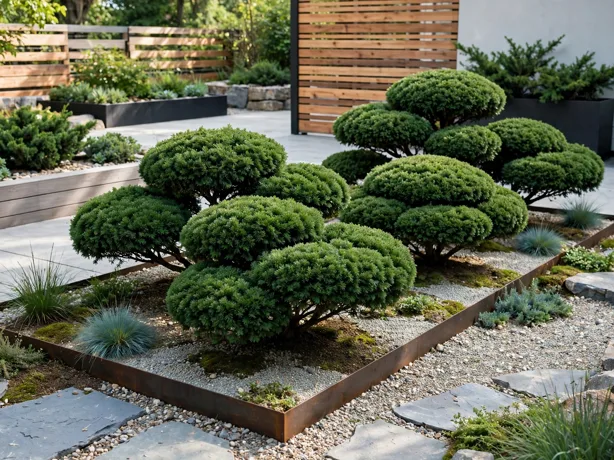
Space note: clouds need air around them — keep at least 60 centimeters of bare gravel between pads, or the sculptures merge into an ordinary lumpy hedge. Twenty minutes with shears twice a year is all the upkeep this piece of garden art asks.