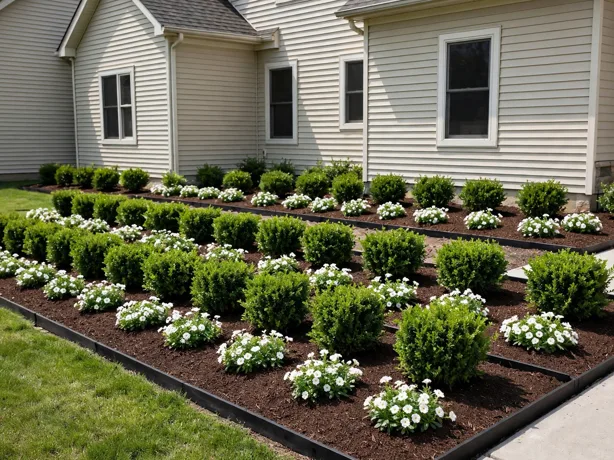
Most front yards do not fail all at once — they fade by accumulation. One random shrub lands by the steps, a bare patch spreads under the window, and the bed edges blur into the lawn until the whole front looks tired even on the day you mow. Nothing is exactly wrong, but nothing looks deliberate either, and every spring the fix seems to mean starting over.
Simple landscaping works the opposite way: repetition plus a clean finish. Pick one or two easy plants and repeat them in rows or drifts, cut a crisp edge around every bed, and close each gap of bare soil with mulch or ground cover. The front reads tidy because the eye sees a pattern, not a collection.
The 30 ideas below are built on those three moves — repeats, tidy edges and easy-care plants. Nearly all of them finish in a weekend with basics from one garden center trip: a few matching shrubs, bags of mulch, bulbs and ground cover you probably half own already.
The Front Yard Formula That Keeps Simple Beds Looking Tidy
- Edge first, plants second: cut or line a crisp bed edge before planting, because a sharp border makes even plain planting look deliberate.
- Repeat, do not collect: pick two or three plants and repeat them in drifts or rows instead of one of everything.
- Close every gap: finish beds with mulch, bark or living ground cover so no bare soil shows and weeds stay down.
- Keep one swap piece: one element — a bulb strip, a pair of pots — changes with the season so the front never needs a full redo.
For example, a straight foundation bed with a repeated row of green boxwood balls, white-flowering hydrangeas between them, a dark bark mulch finish and one bulb strip under the windows reads tidy in every season.
| # | Idea | Best For | Budget/Effort |
|---|---|---|---|
| 1 | One Shrub Repeated in a Row Bed | Plain straight fronts | Low cost / one afternoon |
| 2 | Mulch-First Bare Bed Makeover | Tired existing beds | Very low / one afternoon |
| 3 | Two-Plant Front Border Formula | Beginners who overbuy | Low cost / one bed at a time |
| 4 | Evergreen Anchor Corners | Beds that vanish in winter | Medium cost / one afternoon |
| 5 | Lawn Edge Clean Line Border | Beds blurring into grass | Very low / one hour |
| 6 | Gravel and Grass Strip Bed | Narrow awkward strips | Low cost / one afternoon |
| 7 | Boxwood Ball Trio by the Door | Bare entry corners | Low cost / one hour |
| 8 | No-Dig Cardboard Bed Start | New beds on lawn | Very low / one afternoon |
| 9 | Single Tree Ring Bed | Lone front trees | Low cost / one hour |
| 10 | Straight-Line Foundation Bed | Long house walls | Medium cost / one weekend |
| 11 | Mailbox Mini Bed | Forgotten mailbox spots | Very low / one hour |
| 12 | Porch Step Flanking Planters | Steps with no green | Low cost / one hour |
| 13 | Ground Cover Carpet Patch | Bare shady patches | Low cost / one afternoon |
| 14 | Low Hedge Line Instead of a Fence | Open front boundaries | Medium cost / one weekend |
| 15 | Seasonal Bulb Strip Under Windows | Spring colour lovers | Low cost / one hour |
| 16 | Driveway Edge Ribbon Bed | Long plain driveways | Medium cost / one weekend |
| 17 | Corner Bed Triangle Planting | Empty plot corners | Low cost / one afternoon |
| 18 | Repeat Drift Planting in Threes | Scattered single plants | Medium cost / one afternoon |
| 19 | Bark Mulch Island Bed | Flat lawns needing shape | Medium cost / one afternoon |
| 20 | Timber Edge Raised Front Bed | Sloping or thin soil | Medium cost / one weekend |
| 21 | Shade Bed Under the Front Tree | Dry shade under canopies | Low cost / one afternoon |
| 22 | White and Green Only Palette Bed | Calm classic fronts | Medium cost / one afternoon |
| 23 | Front Slope Ground Cover Blanket | Mowing-hating slopes | Medium cost / one weekend |
| 24 | Window Box Planting Line | Bare window walls | Low cost / one hour |
| 25 | Berm Bump Bed for Flat Yards | Dead-flat front lawns | Medium cost / one weekend |
| 26 | Easy Curve Bed with Set Plants | Stiff rectangular yards | Medium cost / one afternoon |
| 27 | Two-Tone Mulch Contrast Bed | Beds that look flat | Low cost / one afternoon |
| 28 | Divider Edging Bed Refresh | Old beds, new fronts | Very low / one afternoon |
| 29 | Evergreen and Grass Two-Tier Bed | Modern simple fronts | Medium cost / one afternoon |
| 30 | Ornamental Grass Front Cluster | Soft movement lovers | Low cost / one hour |
1. One Shrub Repeated in a Row Bed
Choose one tough, medium-sized shrub — dwarf inkberry holly or ‘Green Velvet’ boxwood — and plant seven to nine of them in a single straight row, spaced 2 feet apart, along the front bed. That is the whole design. The repetition does the work: from the street the row reads as one calm green ribbon instead of a jumble of single plants, and the bed looks planted on purpose even in winter, when nothing is flowering at all.
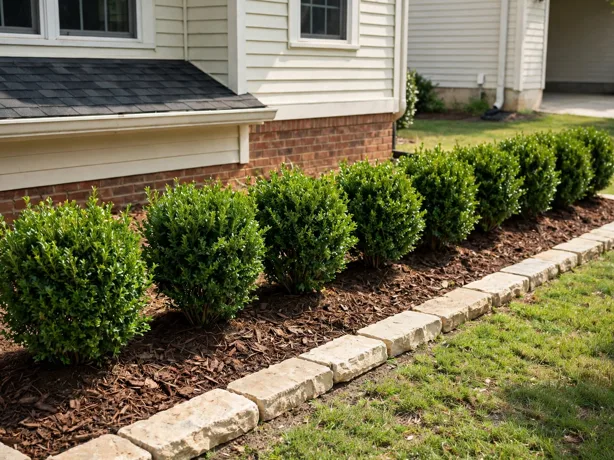
Behind the row, keep everything plain: a 3-inch layer of dark shredded bark mulch, no extra perennials, no edging clutter.
The formula: repeated dwarf inkberry row + dark bark mulch + crisp lawn edge
2. Mulch-First Bare Bed Makeover
Start with the bed you already have. Pull the weeds, cut a fresh edge, and spread 3 inches of bark mulch over all bare soil before you buy a single plant. Bare ground is what makes front beds look neglected, and mulch alone fixes it in an afternoon — the same trick behind low-maintenance front yard landscaping ideas that actually stay tidy.
Then set three matching shrubs in a triangle at the center and stop — the mulch field is the design.
Get the look:
- Main piece: three matching dwarf shrubs in a triangle
- Supporting piece: fresh-cut edge, 4 inches deep
- Texture or material: dark shredded bark mulch, 3 inches deep
- Finishing touch: mulch swept off the lawn edge
3. Two-Plant Front Border Formula
Limit the whole front border to exactly two plants: a low evergreen for structure, like dwarf boxwood, and one flowering perennial, like ‘May Night’ salvia. Plant the boxwood as a broken line along the edge, 18 inches apart, then fill behind it with salvia in groups of five. Two plants, repeated the full length of the bed, look designed; ten plants, one each, look like a shopping trip.
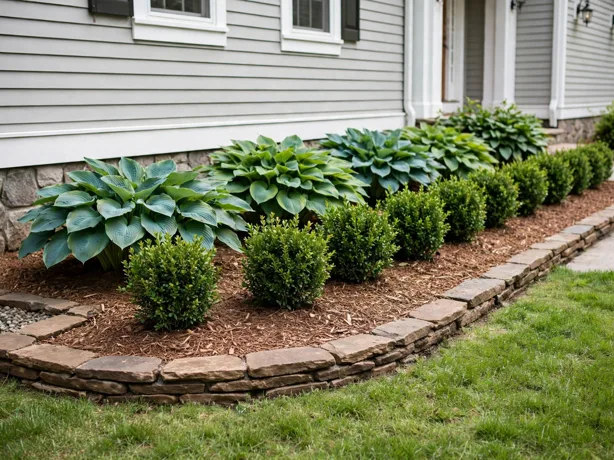
Buy in odd numbers and resist nursery extras — if it is not one of the two plants, it stays at the store.
Color note: The deep green boxwood and violet-blue salvia flowers repeat all season, and the pairing stays calm against any house color because nothing else competes with it.
4. Evergreen Anchor Corners
Beds that look fine in June often vanish by January because everything in them dies back. Fix it by anchoring both front corners of the bed — and the corner by the steps — with one evergreen each: a 3-foot ‘Green Mountain’ boxwood cone or a compact holly. Set them with tops just below window height. The rest of the bed can change with the seasons; the corners hold the shape all year.
Keep a plain mulch collar around each anchor so the shapes read clearly from the street.
Texture note: The fine, dense leaves of boxwood and holly contrast with the coarse bark mulch at their feet, and that contrast keeps the corners interesting even with zero flowers.
5. Lawn Edge Clean Line Border
The cheapest front-yard upgrade is a line. Run a half-moon edging tool along the bed and cut a clean, shallow trench, 4 inches wide and 3 inches deep, between bed and lawn. Refill nothing; the shadow line of the cut is the border. Behind it, keep the bed simple — one row of low plants and fresh mulch — and the whole front suddenly looks maintained.
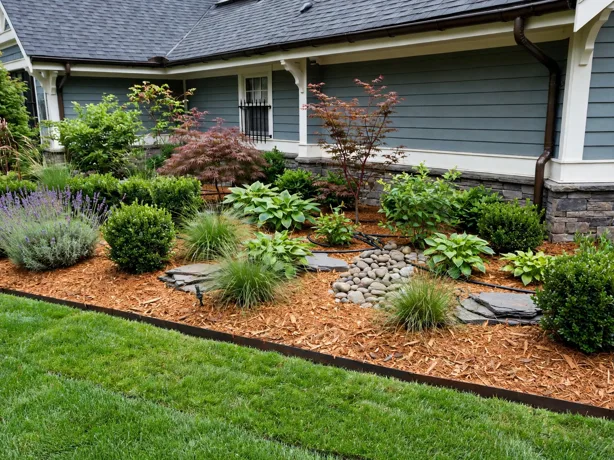
Re-cut the edge twice a year, in spring and early fall; each pass takes under an hour on an average front.
Best for: fronts where beds bleed into the lawn and the whole yard looks untidy a week after mowing.
6. Gravel and Grass Strip Bed
That awkward strip between the driveway and the house wall — too narrow for shrubs, too visible to ignore — solves neatly with two materials. Lay landscape fabric, spread 2 inches of pea gravel over the full strip, then plant tufts of blue fescue grass straight through it in a single line, one every 18 inches. The gravel stays clean, the grass softens it, and nothing needs mowing in a space the mower never fit anyway.
Keep the strip to one grass type so it reads as a ribbon, not a rockery.
Space note: This pattern works in strips as narrow as 12 inches; below that, skip the grass and run gravel alone so the line stays clean.
7. Boxwood Ball Trio by the Door
Three boxwood balls in matching pots turn a bare patch beside the front steps into a finished planting without digging a bed. Use three identical 16-inch pots in charcoal or terracotta, each with a boxwood clipped to a ball about 18 inches across. Set two flanking the bottom step and one at the top landing, all in the same line of sight.
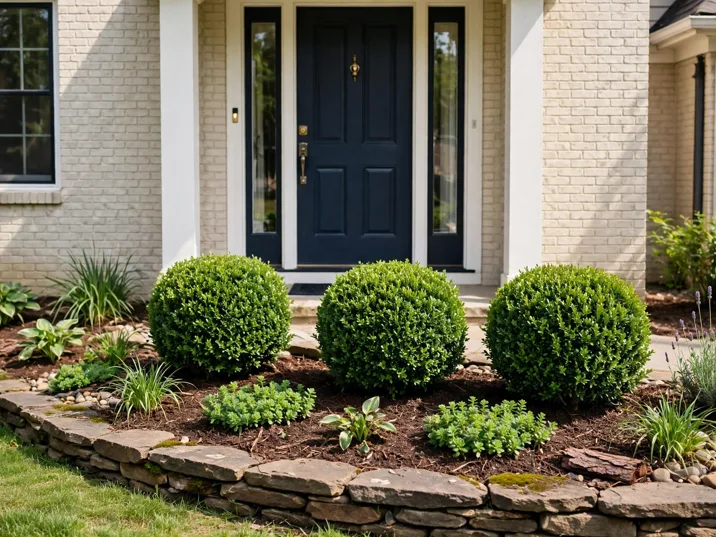
Water the pots twice a week in summer — potted boxwood dries faster than bedded plants — and clip lightly in June to keep the balls round.
Fit check: Leave at least 30 inches of clear step width beside each pot, and test with the storm door open — the balls should clear its swing completely.
8. No-Dig Cardboard Bed Start
A new bed does not need turf stripping. Mow the patch as short as possible, lay overlapping sheets of plain cardboard straight over the grass, wet them thoroughly, then cover with 4 inches of bark mulch. Plant through small slits in the cardboard the same day — a row of hostas or daylilies settles in while the grass underneath dies and feeds the soil.
By the following spring the cardboard is gone, the grass with it, and the bed behaves like it was always there.
Style note: Cut the cardboard edge in one clean curve or straight line before mulching — the bed’s shape is set now, and a tidy outline makes the no-dig shortcut invisible.
9. Single Tree Ring Bed
A lone front tree mowing ring becomes a real bed with one afternoon’s work. Cut a circle 5 to 6 feet across around the trunk, remove the grass inside it, and plant a single ground cover — pachysandra or liriope — in a full ring, spaced 8 inches apart. Finish with 2 inches of mulch between the plants until they knit together.
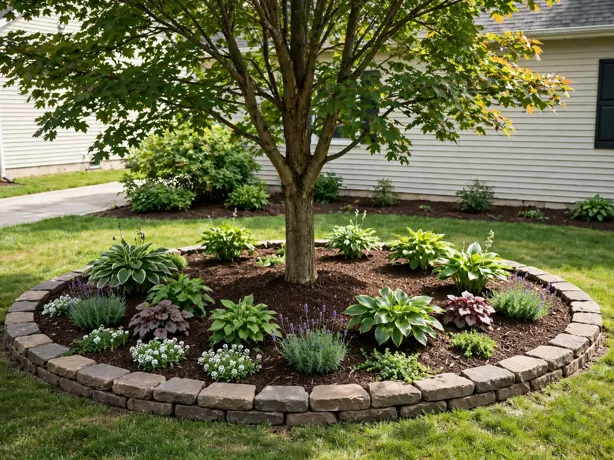
It is one of the classic front yard garden design ideas because the tree finally looks planted on purpose instead of stranded in lawn.
Easy swap: Trade the green ground cover for a ring of spring bulbs under a deciduous tree — the bulbs flower before the canopy leafs out.
10. Straight-Line Foundation Bed
For a long house wall, resist curves: one straight bed, 3 feet deep, running the full length of the facade is the simplest design there is. Plant a single row of compact evergreen shrubs — ‘Soft Touch’ holly or dwarf yew — spaced 3 feet apart, centered 18 inches out from the wall. In front of them, one straight strip of mulch, then lawn. The geometry of the house does the styling.
Keep every plant the same variety so the line reads as one hedge, not a row of individuals.
Seasonal swap: Underplant the front edge with a strip of daffodils in fall — they bloom along the line in spring, then their leaves hide under the shrubs.
11. Mailbox Mini Bed
Give the mailbox its own mini bed: cut a rectangle 3 feet wide and 2 feet deep around the post, edge it cleanly, plant one dwarf shrub behind the post and a low cushion of catmint in front, then mulch 3 inches deep.
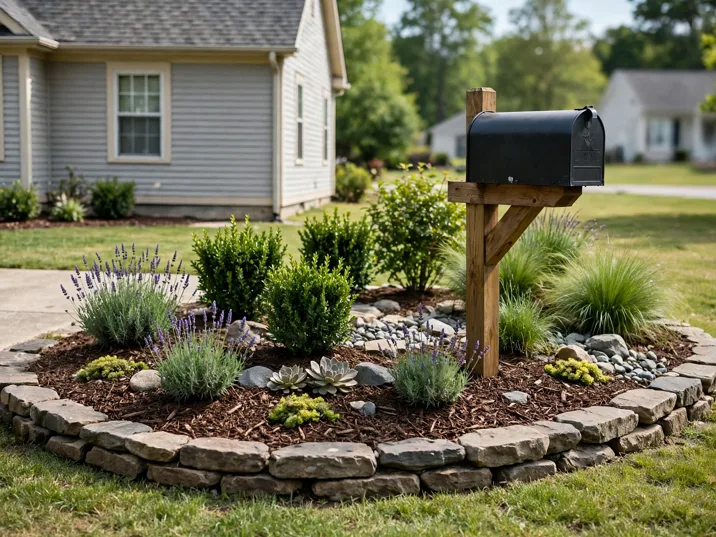
Keep plants under 18 inches tall so the box door swings clear of the growth.
Why it works:
- It turns the first thing visitors see into a deliberate welcome instead of an afterthought.
- Small beds stay weed-free because the mulch layer is thick relative to the area.
- One shrub plus one perennial keeps the repeat rule even at mailbox scale.
12. Porch Step Flanking Planters
Two matching planters flank the porch steps with nothing but plants: one evergreen ball or small grass per pot, repeated exactly on both sides. Use two 18-inch fiber-clay pots in the same finish, each holding a single ‘Winter Gem’ boxwood or a fountain of ornamental grass. Symmetry is the whole trick — the pair frames the steps the way lamps frame a door, but it is purely planting.
Set the pots on small feet so drainage clears the step surface and no rings stain the concrete.
Budget note: Two matched pots and two plants cost less than most single specimen shrubs, and the pots move with you or rotate to the back door in winter.
13. Ground Cover Carpet Patch
Bare shady patches where grass quits — under a hedge, beside the steps — look best carpeted in one living ground cover. Plant creeping Jenny, pachysandra or sweet woodruff in a solid block, plugs spaced 8 inches apart, and mulch lightly between them for the first season. One species only: a single green carpet reads calm, while three mixed covers read as weeds.
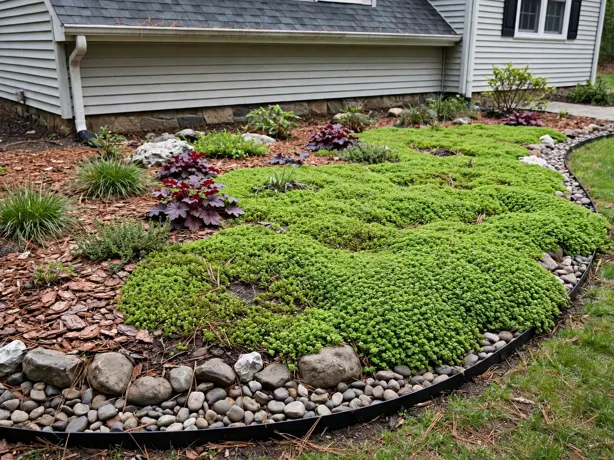
By the second summer the plants knit shut, and the patch needs no mulch, no mowing and almost no weeding.
The formula: one creeping ground cover block + light starter mulch + clean cut edge
14. Low Hedge Line Instead of a Fence
Along an open front boundary, a low hedge does a fence’s job with none of the hardness. Plant a single row of dwarf boxwood, inkberry or ‘Helleri’ holly, spaced 18 inches apart, along the property line and keep it clipped at 2 feet tall. In two seasons it knits into a green line that marks the yard and never needs painting or repairing.
Start the row 1 foot inside your line so the mature hedge stays on your side as it thickens.
Get the look:
- Main piece: single row of dwarf boxwood at 18-inch spacing
- Supporting piece: straight string line to plant against
- Texture or material: fine evergreen leaves over dark mulch
- Finishing touch: flat clipped top at 2 feet
15. Seasonal Bulb Strip Under Windows
Under the front windows, plant one narrow strip — 12 inches wide, the full width of the bed — with a single bulb type: 40 ‘Thalia’ daffodils or a drift of purple crocus. In spring the strip flowers as one bright line; by June the foliage folds away under the shrubs behind it and the bed returns to plain green and mulch.
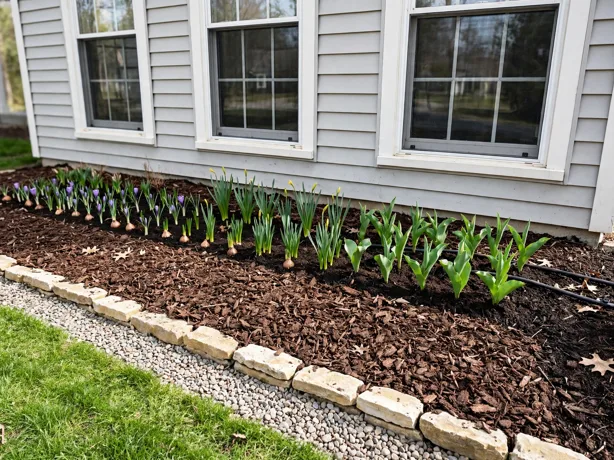
Plant bulbs in fall, 6 inches deep and a hand’s width apart, and mark the strip’s ends so spring cleanup never digs into it.
Color note: One bulb color in one line — all white daffodils or all purple crocus — reads as design; mixed bags scattered through the bed read as accidents.
16. Driveway Edge Ribbon Bed
A long plain driveway softens with a ribbon bed down one side: 18 inches wide, edged straight, planted with a single repeated grass — ‘Hameln’ fountain grass every 2 feet — and mulched dark between the tufts. The ribbon follows the drive’s own line, so it costs almost no yard and asks almost nothing: one cut-back each spring.
On the street end, stop the ribbon 3 feet short of the sidewalk so car doors and snow piles never crush the planting.
Texture note: The fountain grass throws soft, arching seed heads against the hard flat drive, and that one contrast — soft on hard — carries the whole border.
17. Corner Bed Triangle Planting
An empty lot corner takes a simple triangle bed: cut two straight edges along the sidewalk and drive, join them with one long diagonal, and plant in threes — one small evergreen at the back point, three mid shrubs along the middle, a drift of low perennials at the front edge. The triangle echoes the corner’s own shape, so it never looks arbitrary.
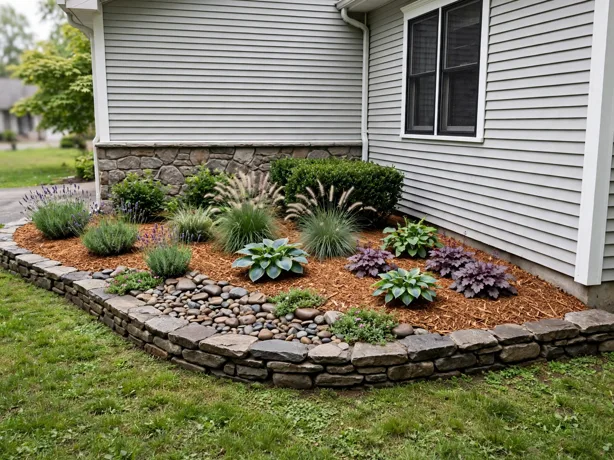
It also frames the turn where paths meet, the spot where front walkway landscaping ideas usually start — but here the planting alone does the framing.
Best for: corner lots where two streets meet and the front needs one clear, low planting that blocks nothing.
18. Repeat Drift Planting in Threes
If your front bed is full of single plants — one rose, one iris, one lonely daylily — the fix is not more plants, it is repeats. Choose the two plants you like most, buy two more of each, and regroup everything into drifts of three at 18-inch spacing. Same plants, same bed: the drifts suddenly read as a design instead of an inventory.
Move plants in early spring or fall, water the regrouped drifts weekly for the first season, and mulch the gaps they leave.
Space note: A drift of three perennials needs about 3 square feet; measure your bed and count the drifts it truly fits before buying extras.
19. Bark Mulch Island Bed
A flat front lawn gains shape from one island bed: an oval about 10 by 6 feet, set off-center in the lawn, filled almost entirely with dark bark mulch. Plant just three things in it — one small ornamental tree or large shrub at the back, and two drifts of ornamental grass at the front corners. The wide mulch field is the point; it makes three plants look like a composition.
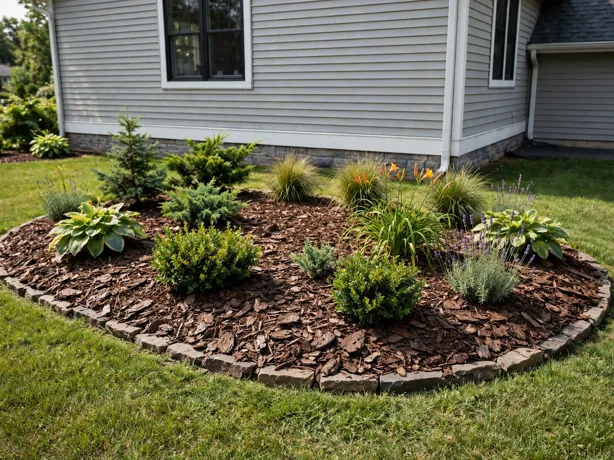
Cut the edge deep, 4 inches, so the island’s outline stays crisp against the grass all season.
Fit check: Walk the mower around the island before planting — you need a clean 2-foot turning pass on every side or the edge will get chewed weekly.
20. Timber Edge Raised Front Bed
On a sloping front or where soil is thin, raise one bed behind a single row of landscape timbers. Lay 6-inch timbers along the bed’s front line, level and pinned, then backfill with good soil to a depth of about 8 inches. Plant a simple repeated row — lavender or dwarf spirea — along the top edge so the planting, not the timber, stays the focus.
The raised soil warms faster in spring, drains better after storms and saves your back at planting time.
Style note: Stain or weather the timbers to a soft grey-brown so they recede — fresh orange timber shouts, aged timber lets the green row speak.
21. Shade Bed Under the Front Tree
The dry shade under a front tree defeats lawn and most flowers, but a shade bed of three plants handles it: hostas in drifts of three, ferns between them, and a ground cover of epimedium at the edge. Mulch with shredded leaf mulch or fine bark, 3 inches deep, and water deeply once a week the first summer while roots settle under the canopy’s competition.
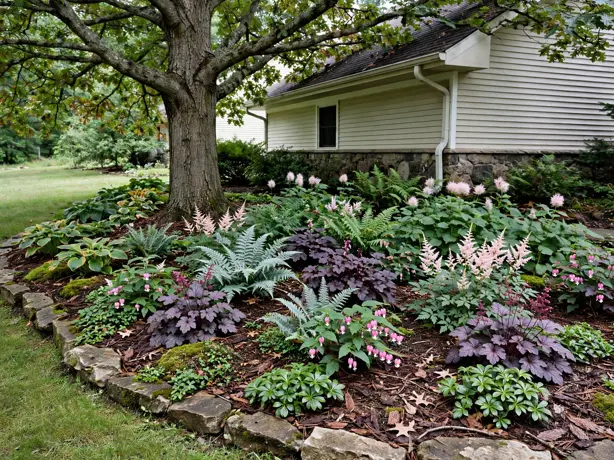
Keep every plant in the shade-tolerant family and the bed will fill rather than fight the tree.
Easy swap: Trade the hostas for astilbe if deer browse your front — the feathery plumes give the same full effect untouched.
22. White and Green Only Palette Bed
Restrict one front bed to white flowers and green foliage only, and it will look calm against any house color. Use white hydrangea as the anchor, white salvia or white roses in the middle row, and boxwood or hosta for the green frame. Every nursery trip gets simpler too — if it is not white or green, it is not for this bed.
The palette holds from spring bulbs to fall asters, and the bed never clashes with a painted door or brick.
Seasonal swap: Come winter, let the evergreen frame carry the bed and tuck in white hellebores — they flower in the cold months and keep the palette unbroken.
23. Front Slope Ground Cover Blanket
A front slope too steep to mow safely plants better as a blanket: one ground cover over the whole bank — creeping juniper or cotoneaster — in a staggered grid at 2-foot spacing, mulched heavily between plants for the first two years. Once it knits, the slope holds itself and needs no mowing.
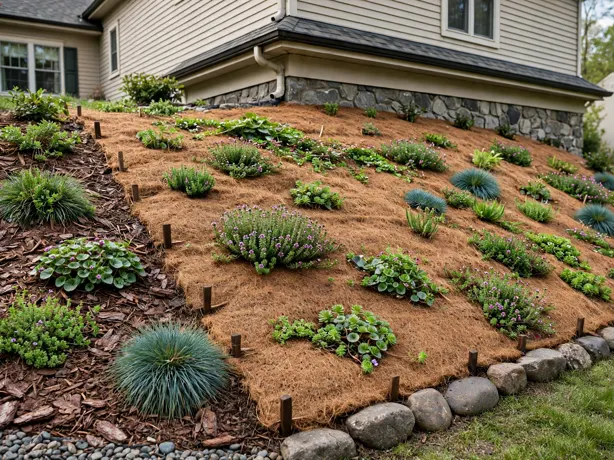
Plant from the top down so loose soil never buries the rows below.
Why it works:
- The roots net the soil together, so rain stops washing the bank onto the sidewalk.
- One species at one spacing grows evenly — no patchwork of fast and slow plants.
- Evergreen covers keep the slope dressed in winter, when bare banks look worst.
24. Window Box Planting Line
A bare window wall greens up with a line of identical window boxes, one under each front window, planted the same way: a small trailing ivy or creeping Jenny at the ends, one compact flowering plant — white geraniums or begonias — repeated in the middle. Same box, same plants, same spacing: the repetition across the facade does all the design work.
Water boxes on a drip line or with one can each morning in summer; shallow soil dries fast in sun.
Budget note: Boxes and a flat of bedding plants cost less than one foundation shrub per window, and replanting each spring takes an hour for the whole line.
25. Berm Bump Bed for Flat Yards
Dead-flat front yards lack any change of level, so build one bump: a berm about 8 feet long, 4 feet wide and 12 to 18 inches high, mounded off-center in the lawn. Plant its crest with one small shrub or ornamental grass cluster, its slopes with a single ground cover, and mulch the rest. The low hill gives the front a horizon and a reason for the planting to exist.
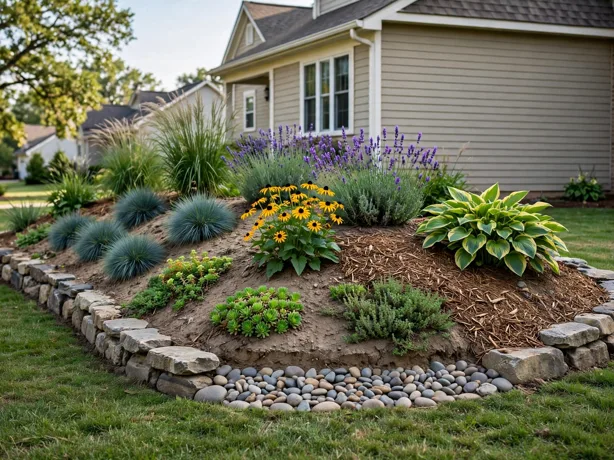
Build the berm from topsoil stripped from the bed edges elsewhere in the yard — the bump often costs nothing but labor.
The formula: one low soil berm + single crest shrub + ground cover slopes
26. Easy Curve Bed with Set Plants
Soften a stiff rectangular yard with one easy curve: lay a hose along the front bed, ease it into a single lazy S, and cut the edge along it. Plant a set kit twice along the curve — one evergreen, three perennials, one grass — so the shape still follows the repeat rule.
One curve only; competing curves make a front busier, not softer.
Get the look:
- Main piece: one S-curve bed edge cut along a hose line
- Supporting piece: plant kit of evergreen, perennial, grass repeated twice
- Texture or material: fine bark mulch over the whole curve
- Finishing touch: deepest point of the curve left as plain mulch
27. Two-Tone Mulch Contrast Bed
When a planted bed still looks flat, change the mulch, not the plants. Spread dark bark mulch around the shrubs in the back half and a pale gravel or light pine mulch in a clean band along the front edge, with a sharp straight line where the two meet. The contrast draws a border inside the border and makes plain green planting look layered.
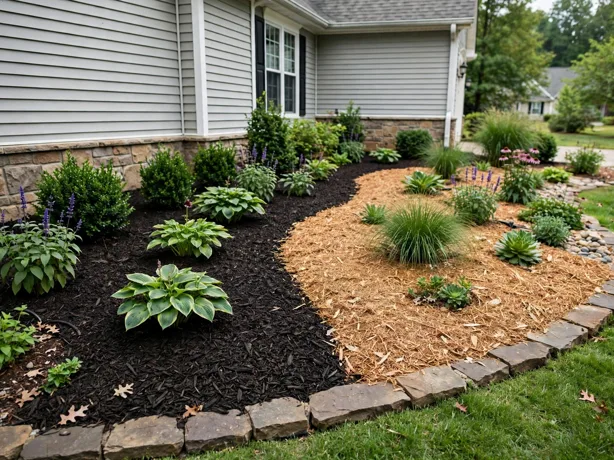
Keep the light band 12 inches wide — narrower reads as a spill, wider starts to compete with the plants.
Color note: The dark back mulch throws green foliage forward visually, while the pale front band reflects light up into the plants and brightens the whole bed.
28. Divider Edging Bed Refresh
Old front beds often hold decent plants in a tired frame. Refresh the frame instead of replanting: pull out the crumbling plastic or brick divider edging, cut a fresh soil edge, and reset one clean line of steel or aluminum edging flush with the lawn. Top up the mulch to a full 3 inches. The same shrubs, reframed, look newly planted.
Work in sections of 6 feet so the bed never sits open and unfinished overnight.
Texture note: A thin metal line disappears visually, leaving the contrast where it belongs — rough bark mulch against smooth clipped lawn, with no chunky border stealing attention.
29. Evergreen and Grass Two-Tier Bed
A modern simple front needs only two tiers: a back row of upright evergreens — columnar yew or ‘Sky Pencil’ holly every 3 feet — and a front row of one ornamental grass, tufted hair grass or fountain grass, at 18-inch spacing. Mulch the base dark and leave the geometry alone. The bed has height, movement and almost no decisions left in it.
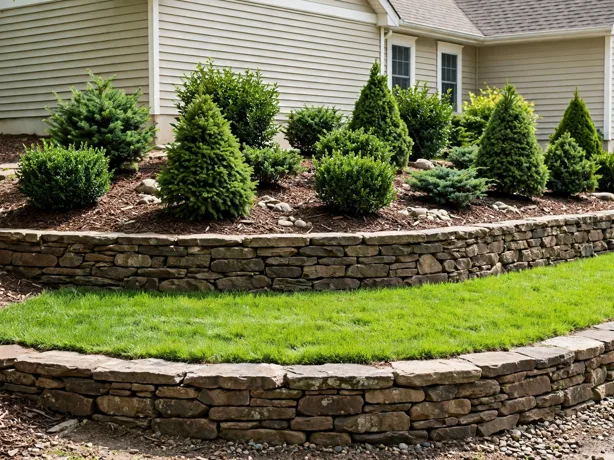
Cut the grass row down in late winter and the evergreens need one light trim a year — that is the whole calendar.
Best for: newer houses with clean lines, where flowery cottage planting would fight the architecture.
30. Ornamental Grass Front Cluster
Finish a simple front with one cluster of ornamental grasses instead of a mixed bed: five to seven plants of a single variety — ‘Karl Foerster’ feather reed grass for height, or blue fescue for a low cluster — grouped in a loose triangle on open mulch near the street corner of the bed. The cluster sways, catches evening light and asks for one cut-back a year.
One variety only: two grass types side by side read as a nursery row, not a planting.
Space note: Give a tall grass cluster a 4-foot circle of open mulch — the air around it is what makes the shape read from the street.