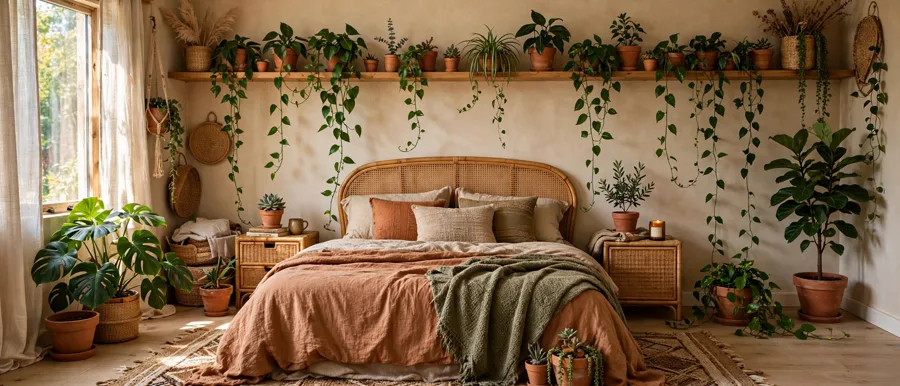
You brought home three plants on Saturday, set them in a row on the dresser, and stepped back expecting the room to feel calmer. Instead it looks like a checkout counter. The pots clash, the leaves point every direction, and the bedroom somehow feels busier than it did with no plants at all. That gap between “I added plants” and “this feels like a retreat” is exactly where boho styling earns its keep, because boho never treats plants as accessories. The plants lead, and everything else in the room quietly supports them.
Guides to boho bedroom plants usually start with the plant list itself, and the classics earn their place: golden pothos, monstera, calathea, a sturdy yucca. But the plants are only half the look. The other half is what they sit in and what they sit against — woven rattan, raw terracotta, bamboo, macramé cotton, and textiles in clay, sand, and rust. When those materials repeat around the room, even a handful of plants reads as one calm, deliberate scheme instead of a collection of separate purchases.
The 17 ideas below are all plant-led and deliberately unhurried. Boho greenery is curated and airy, not a dense jungle: a few groupings with room to breathe, natural materials doing the framing, and green as the strongest color in the room. Start with the formula, then take the ideas in whatever order suits your walls, your light, and the plants already waiting on your dresser.
The Boho Greenery Formula That Keeps Layered Plants Looking Airy
- Anchor first, accents second: one tall plant in a natural-material basket gives the room a focal point, and every smaller plant relates to it instead of competing with it.
- Repeat materials, not matching pots: rattan, terracotta, bamboo, and woven cotton echo each other across the room, so different pots still read as one family.
- Let green be the boldest color: keep textiles in clay, sand, cream, and rust tones so the foliage supplies the saturation and everything else stays quiet.
- Leave air between groupings: cluster plants in two or three spots and leave the remaining surfaces empty, because the gaps are what make the greenery feel calm rather than crowded.
Put together, that looks like a bird of paradise in a rattan basket anchoring one corner, a single pothos trailing from a macramé hanger by the window, and three small terracotta pots sharing the dresser — plenty of green, and still plenty of air.
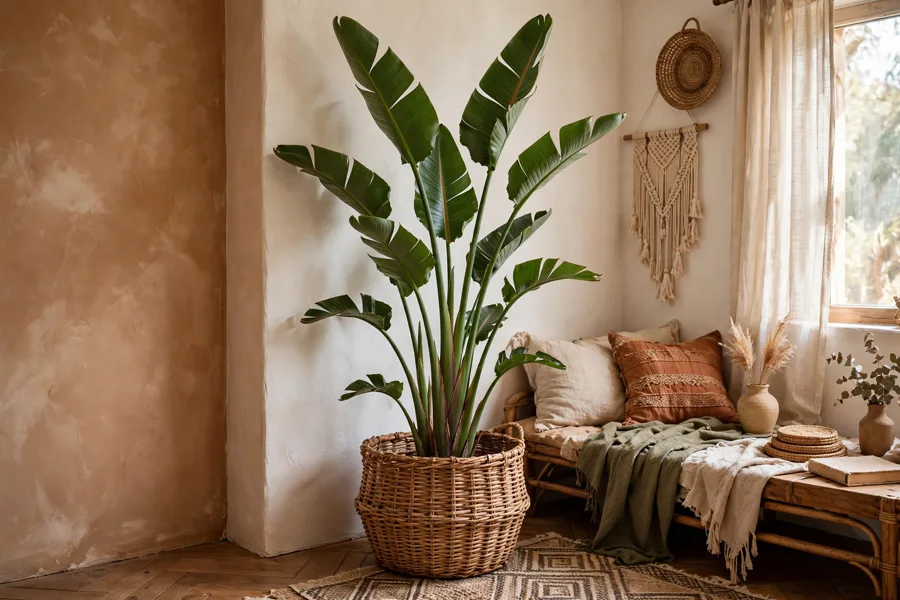
1. A Tall Plant in a Rattan Basket Anchors the Corner
Give the emptiest bedroom corner the biggest job. A tall, upright plant — a bird of paradise, a dracaena, or a young monstera — slipped into a wide woven rattan basket instantly becomes the room’s focal point, and every other plant takes its cue from it. Keep the nursery pot inside the basket so watering stays tidy. The honest trade-off: rattan is not waterproof, so the basket needs a liner or a hidden saucer, and a plant this size wants a quarter turn every week or two so it does not lean hard toward the window.
Get the look: basket opening 2 to 4 inches wider than the nursery pot, plant height roughly one third of the wall height, and nothing else on the floor within a foot of it.
2. A Terracotta Trio Warms Up the Dresser
Three unglazed terracotta pots in staggered heights turn a plain dresser top into the room’s warmest surface. Try a fern in the tallest pot, a peperomia in the middle one, and a small trailing ivy in the shortest, so the shapes step down like a skyline. Terracotta’s dusty orange is practically boho’s signature accent color, and it flatters every shade of green leaf. The trade-off is real, though: clay breathes, so soil dries out faster than in glazed pots, and white mineral marks build up on the outside over time. Most plant people end up calling those marks patina, but check moisture a day earlier than usual.
Color note: terracotta, rust, and clay sit in one warm family — if your bedding already carries rust tones, this trio will look planned rather than collected.
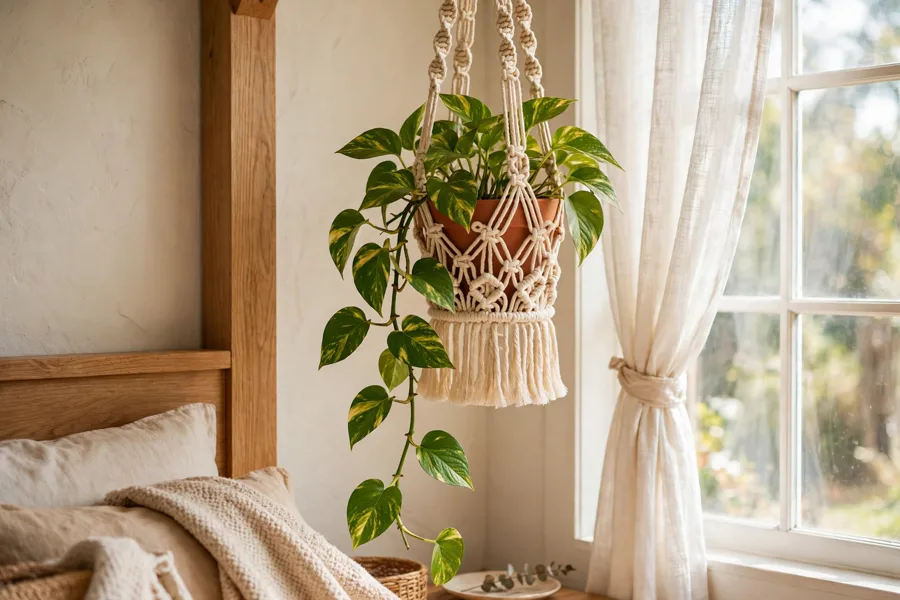
3. One Macramé Hanger Beside the Window
A single macramé hanger holding a golden pothos beside the window gives you the woven texture boho is known for, without turning the ceiling into a system of hooks and pulleys. One hanger, well placed, reads as a styling choice; the long trailers soften the window frame and catch evening light beautifully. Choose a spot where the longest stems clear both pillow and curtain. The trade-off is watering day: a hanging plant has to come down, get watered at the sink, drain, and go back up, so pick a hanger with a simple loop you can lift off its hook one-handed.
Texture note: unbleached cotton cord against green leaves is the pairing to repeat — echo it once more in a cushion cover or a throw and the corner feels finished.
If the knotwork appeals to you beyond the plants, the same hand-tied texture anchors the bed styling in these bohemian bed ideas.
4. Trailing Vines Soften a Woven Wall Hanging
A flat woven wall hanging — macramé, a simple tapestry weave, or a cane web panel — can look stiff on its own. Thread the top few inches of a pothos or heartleaf philodendron vine loosely along its upper edge and let two or three stems spill down one side, and the whole piece relaxes. The vine should look draped, never pinned into a pattern; gravity does the styling. Use removable clear hooks on the wall rather than pushing pins through the weave. The trade-off: a growing vine gains weight and length, so this is a pairing to re-drape every couple of months, not a set-and-forget arrangement.
Style note: let the stems fall on one side only — asymmetry is what keeps the look boho instead of formal.
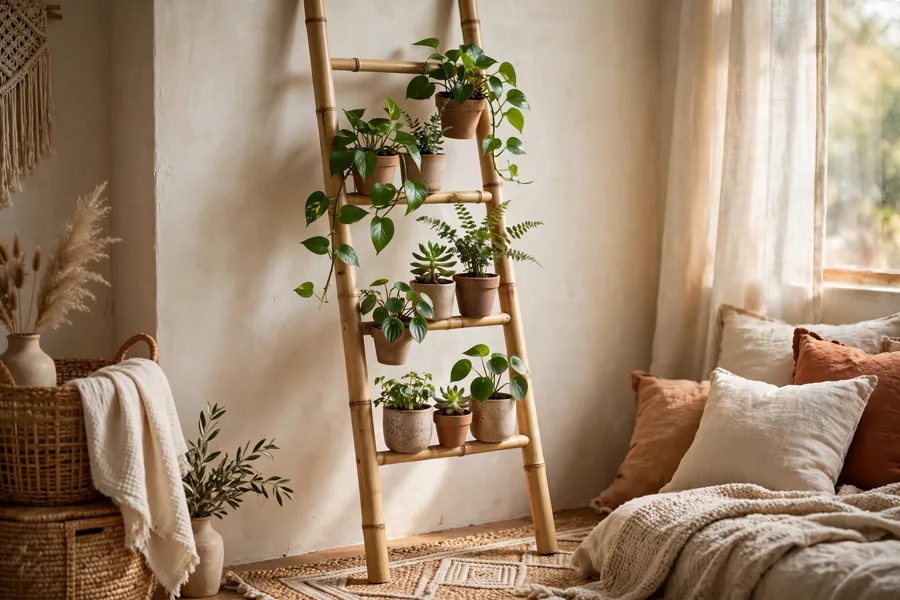
5. A Bamboo Ladder Stand Builds a Plant Cluster
A leaning bamboo ladder stand gives five or six small plants one shared address, which is the difference between a collection and a cluster. Set the largest pot on the bottom rung, mid-size plants in the middle, and your smallest trailing pot on top so its stems can wander down through the others. Bamboo’s pale, jointed poles sit comfortably next to rattan and clay, and the open frame keeps the grouping light. The trade-off: ladder stands are not the steadiest furniture on thick carpet, so stand this one against a wall on a hard floor, out of the walkway.
Best for: plant collectors with lots of small pots and one bare wall — the stand turns the sprawl into a single deliberate feature.
| Plant | Boho Pot Pairing | Why the Pairing Works |
|---|---|---|
| Bird of paradise | Wide rattan basket | The weave softens the plant’s bold, upright leaves |
| Golden pothos | Macramé hanger | Cotton cord and trailing stems share the same relaxed drape |
| Calathea | Matte terracotta pot | Earthy clay keeps patterned leaves as the only busy element |
| Cactus cluster | Unglazed clay, mixed sizes | Dry-clay texture matches the plants’ desert character |
| Monstera | Bamboo stand, basket below | Pale bamboo lifts the plant so its leaves clear the floor |
6. The Nightstand Pairing: Clay Pot Beside a Rattan Lamp
The nightstand is where boho greenery meets your actual bedtime routine, so style it as a pair rather than a plant plus leftovers. One small, soft-leaved plant — a peperomia or a young prayer plant — in a matte clay pot, set beside a lamp with a rattan or cane base, repeats the room’s two key materials at the exact spot your eye lands last at night. Keep the plant compact; a 4- to 6-inch pot is plenty. The trade-off is space: on a small nightstand the plant competes with a water glass and a book, so if something has to move to the dresser, move the book stack, not the plant.
The formula:
- Main piece: a compact leafy plant in a matte clay pot
- Supporting piece: a lamp with a rattan or cane base
- Texture or material: a linen shade against the pot’s raw clay
- Finishing touch: one short stem tipped over the pot’s edge toward the bed
7. Earthy Textiles That Let the Green Lead
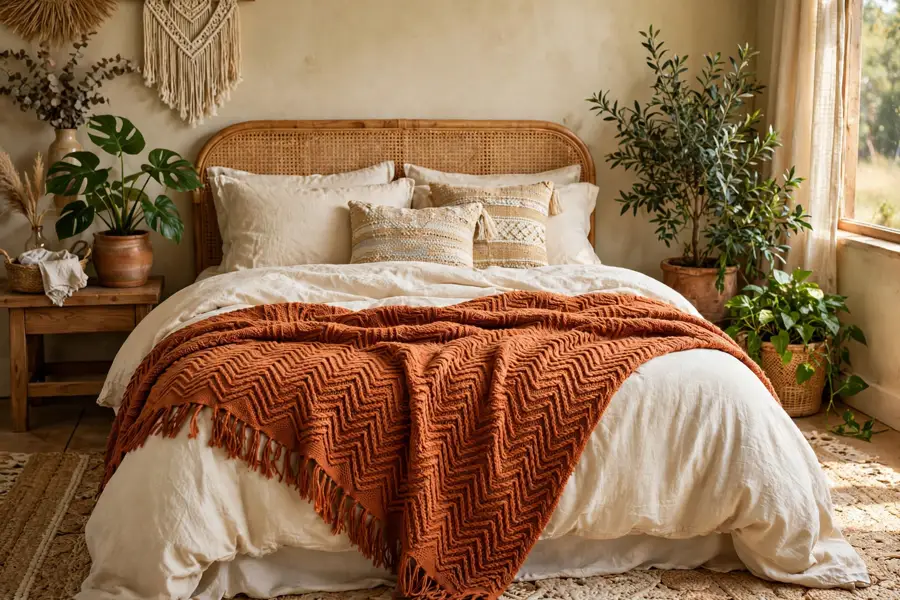
Boho bedrooms earn their calm by keeping every textile in a narrow, sun-baked range — clay, sand, oatmeal, rust, faded terracotta — and letting the plants supply the only vivid color. A rust throw across the bed, oatmeal linen curtains, and a sand-colored cushion or two will make even ordinary foliage look rich by contrast. This is also the cheapest styling move in the whole article, because it mostly involves editing: move the one bright blue or purple textile out, and the plants suddenly look intentional. The trade-off is discipline at the shops, since a colorful bargain cushion can quietly undo the whole scheme.
Easy swap: if a full textile edit is too much at once, swap only the cushion covers — two covers in clay and sand change what the eye reads first.
8. A Plant Grouping Makes the Chair Corner the Focal Point
Most bedrooms have one chair that collects clothes. Clear it, set a woven floor cushion beside it, and build a plant grouping at its shoulder: a medium plant on a low bamboo stool, a basket plant on the floor, and one small pot on the chair’s side table if it has one. The grouping gives the room a second destination besides the bed, and the plants get a dedicated stage instead of filling gaps. It works because the eye reads clustered plants around a seat as a place, not as storage.
Why it works:
- Three heights — floor, stool, trailing — make one corner feel layered without filling it
- A seat inside the grouping invites you to actually sit among the plants, which sells the retreat feeling
- Grouping care in one spot means watering rounds take minutes, not a tour of the whole room
9. Small Clay Pots Line the Windowsill
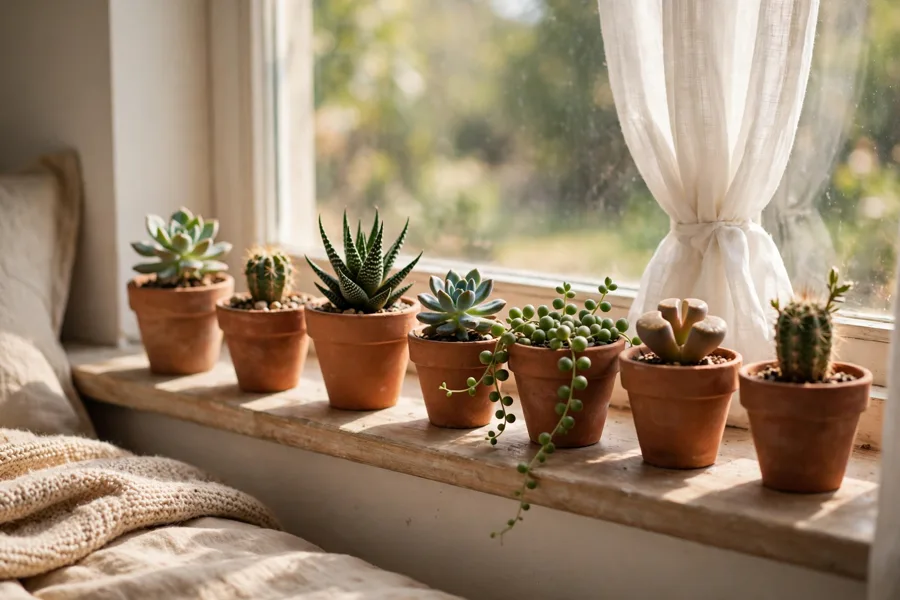
A row of small clay pots on the windowsill is the oldest boho move there is, and it still works: three to five mini cacti and succulents in mismatched unglazed pots, close enough to read as a set, different enough to stay interesting. The sill’s strong light suits them, and their small scale suits the narrow ledge. Keep a slim tray under the row so watering does not spot the paintwork. The trade-off is that sill plants live in the room’s harshest light and driest air, so this row belongs to genuinely sun-loving plants — a fern will scorch and sulk here within weeks.
Space note: a standard sill fits 4-inch pots in a single row; if your sill is shallower than the pot is wide, the row belongs on a slim shelf board fixed just below it instead.
10. The Height Rule: One Tall, One Wide, One Trailing
When a plant grouping looks wrong and you cannot say why, it is usually the heights: three plants of identical size in a row read as products on a shelf. Fix any grouping by composing it as one tall plant, one wide or bushy plant, and one trailing plant, whatever the spot. Tall gives the eye a starting point, wide fills the middle, and trailing breaks the bottom edge so the group melts into the room. The trade-off is that this rule sometimes retires a plant you love from a grouping that has no slot for its shape — move it to start a new group rather than forcing it in.
Fit check: stand back at the doorway and squint — if the three plants blur into one green shape with a clear top, middle, and spill, the heights are right.
11. Swap One Layer With the Season, Not the Whole Room
A boho greenery scheme should flex with the year without being rebuilt. Keep the anchor plants and pots fixed, and rotate one soft layer: lighter linen and a fresh green fern front and center in spring, deeper rust textiles and a olive-toned cushion as evenings cool. The plants themselves stay put, which they prefer, and the room still feels newly dressed. The same freshen-up logic drives most spring bedroom decor, just translated here into a palette swap instead of a theme. The trade-off is storage: one bin of off-season textiles is the price of a room that changes four times a year.
Seasonal swap: spring asks for one pale throw and the fern collection forward; autumn asks for the rust throw back and a bowl of pinecones beside the terracotta trio.
12. One Basket Style Unifies Every Pot You Own
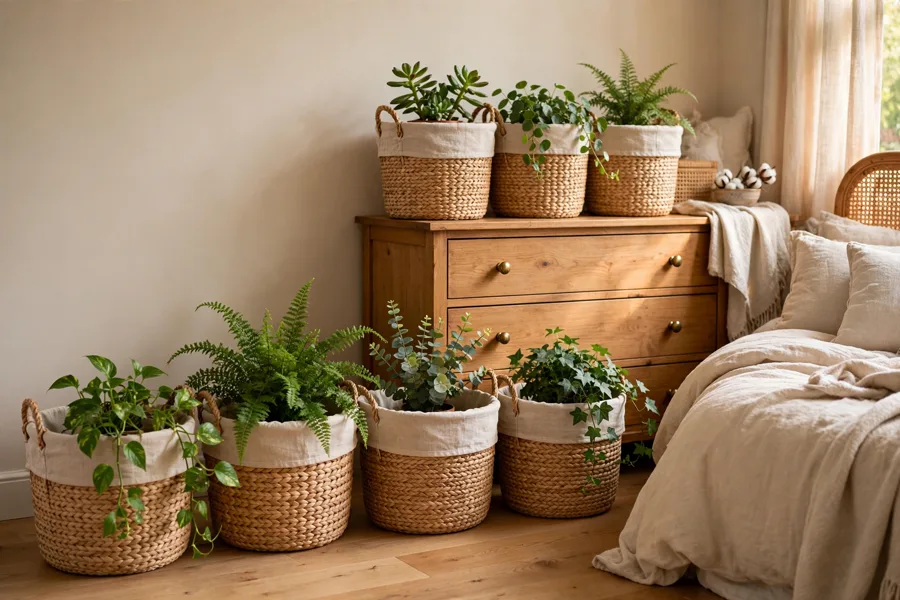
If your plant pots are a jumble of nursery plastic, gift-shop ceramics, and one cracked clay pot, do not replace them — dress them. Dropping every pot into the same style of woven basket makes the collection read as one scheme while the plants keep their familiar homes. A lined basket does the hiding neatly: the Sprout Home seagrass basket is $24 and swallows a standard 6-inch nursery pot whole. Buy the basket size for your largest everyday pot and repeat it. The trade-off: baskets hide drainage saucers too, so lift pots out monthly and tip away any water sitting in the liner.
Budget note: unifying with baskets costs a fraction of re-potting everything into new ceramics, and the plants never suffer transplant shock for the sake of looks.
| Layer | Material | Where It Belongs |
|---|---|---|
| Base layer | Jute or woven wool rug | Under and around plant groupings |
| Soft layer | Linen and cotton in clay, sand, rust | Bedding, curtains, cushion covers |
| Hard texture | Rattan, cane, and bamboo | Baskets, stands, lamp bases |
| Handmade layer | Macramé cotton cord | One hanger, one wall piece — not everywhere |
| Living layer | Foliage in mixed shapes | Clustered at two or three spots only |
13. Patterned Leaves Against Plain Weaves
Calatheas, marantas, and other prayer plants carry enough pattern for a whole corner — stripes, painterly edges, purple undersides. They look their best against deliberately plain surroundings: an unpatterned rattan screen, a natural linen curtain, a bare clay pot. Set one patterned plant where its backdrop is quietest and let the foliage do all the talking. Pairing patterned leaves with a busy woven textile is the one combination that reliably fails, because the eye cannot decide what to look at. The trade-off is that prayer plants are the divas of this list, curling their leaves if the air runs dry, so this star wants the humid spot near other plants.
Get the look: one patterned plant, one plain weave behind it, one plain clay pot under it — pattern appears exactly once in the arrangement.
14. Three Weaves Are Enough: Rattan, Jute, Macramé Cotton
Texture is boho’s second language, but it has a vocabulary limit. Three woven materials repeated around the room — rattan in the baskets and stands, jute underfoot in the rug and pot wraps, macramé cotton in one hanger and perhaps one cushion — gives you depth without static. Add a fourth and fifth weave and the room starts to feel like a craft fair. If you are deciding where a new woven piece belongs, put it where an existing weave is missing rather than beside its twin. The trade-off: restraint means the beautiful extra basket you found may have to live in another room.
Texture note: vary the scale of the weaves as well as the material — chunky jute, medium rattan, fine cotton cord — so the layers separate visually instead of blending into one beige blur.
15. Green Is the Room’s Only Bold Color
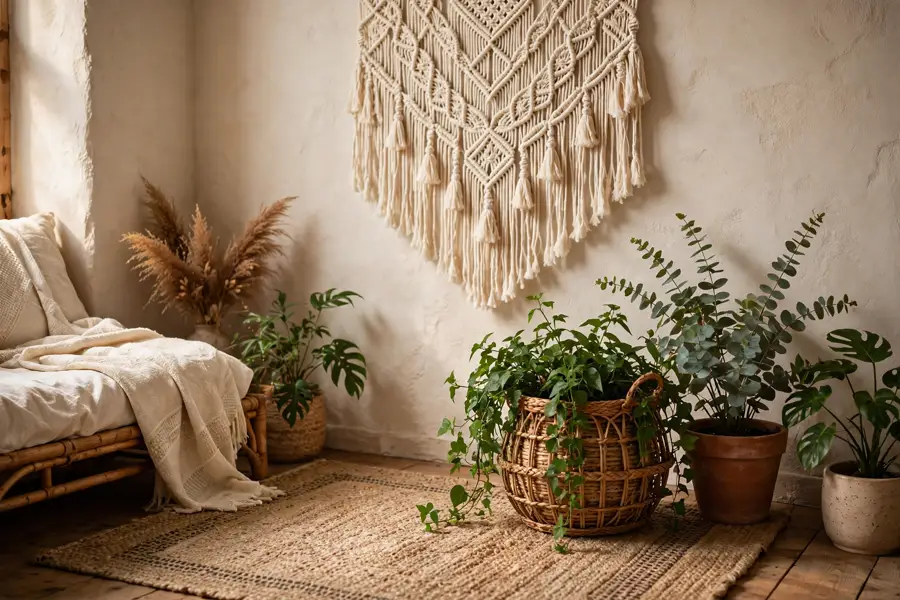
This is the discipline underneath everything else in the article: in a boho greenery bedroom, foliage green is the single saturated color, and paint, textiles, and furniture all stay in the warm neutral family. It sounds strict, but it is what lets you own plants of wildly different greens — blue-green eucalyptus tones, deep monstera green, pale new pothos growth — without any of them clashing. The room reads colorful because the greens vary, yet calm because nothing competes with them.
Why it works:
- One bold color family gives the eye a single story, so the room feels designed rather than accumulated
- Warm neutrals make green look richer, the same way a frame flatters a painting
- New plants always match the scheme automatically, which removes the usual styling hesitation
16. Let One Vine Grow a Little Wild
After all this composing, loosen one thing on purpose. Choose a single vine — a philodendron trailing off the dresser or across the top of a bookshelf — and let it grow unevenly, longer on one side, stems crossing where they like. That small amount of disorder is what keeps a boho room from looking staged, and it costs nothing. Guide it loosely with a couple of removable hooks so it does not reach the floor or the bedding. The trade-off is housekeeping: a wild vine collects dust along its stems and tangles when you move the pot, so shake it out gently outdoors every month or so.
Style note: wild works when everything around the vine is tidy — one unruly plant in an ordered room reads as relaxed; three read as neglected.
| Spot | Plant Pick | Pot or Partner |
|---|---|---|
| Empty corner | Bird of paradise | Wide rattan basket |
| Nightstand | Peperomia | Matte clay pot, rattan lamp |
| Dresser top | Fern and ivy trio | Staggered terracotta pots |
| Windowsill | Mini cacti and succulents | Mismatched small clay pots |
| Chair corner | Monstera | Bamboo stool plus floor basket |
| Beside the window | Golden pothos | Single macramé hanger |
17. A Dressing Corner Framed in Green
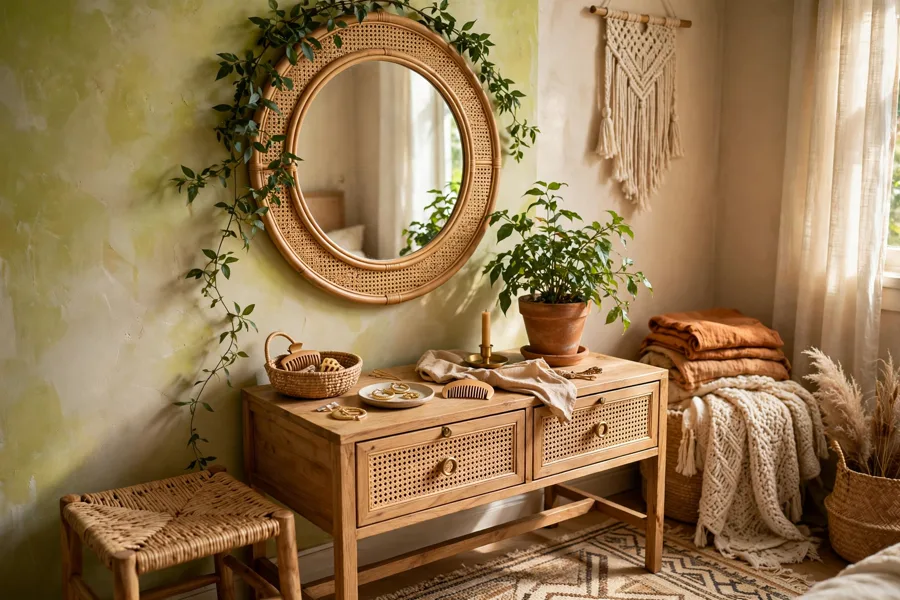
The stretch of wall by a mirror or dressing table is usually wasted on a chair and good intentions. Frame it with plants instead: a trailing pothos on a small wall shelf at the mirror’s top corner, a medium plant in a clay pot on the floor below, and the mirror itself bouncing their green back into the room. Getting ready surrounded by leaves sounds minor, but it changes the first minutes of the day. The trade-off is light competition — keep the vine trimmed off the mirror’s edge and glass, or the reflection you actually need shrinks month by month.
Space note: this vignette needs about 2 feet of wall and no furniture beyond what is already there, which makes it the easiest grouping in the article to add last.
Begin With the Corner, Then Stop
A boho greenery bedroom is not built in one shopping trip; it settles in, one grouping at a time, the way the style itself prefers. If the whole set of ideas feels like a lot, remember that the room also gains from the softer habits in these cozy bedroom ideas — warm light, layered bedding, unhurried corners — with the plants simply taking the lead role. Add the anchor, dress the pots you own, and live with it for a week before deciding what the next corner needs.
Your one next step: pick the emptiest corner of your bedroom, measure its floor space, and choose the single tall plant that will anchor it — that one decision makes every idea in this article easier.