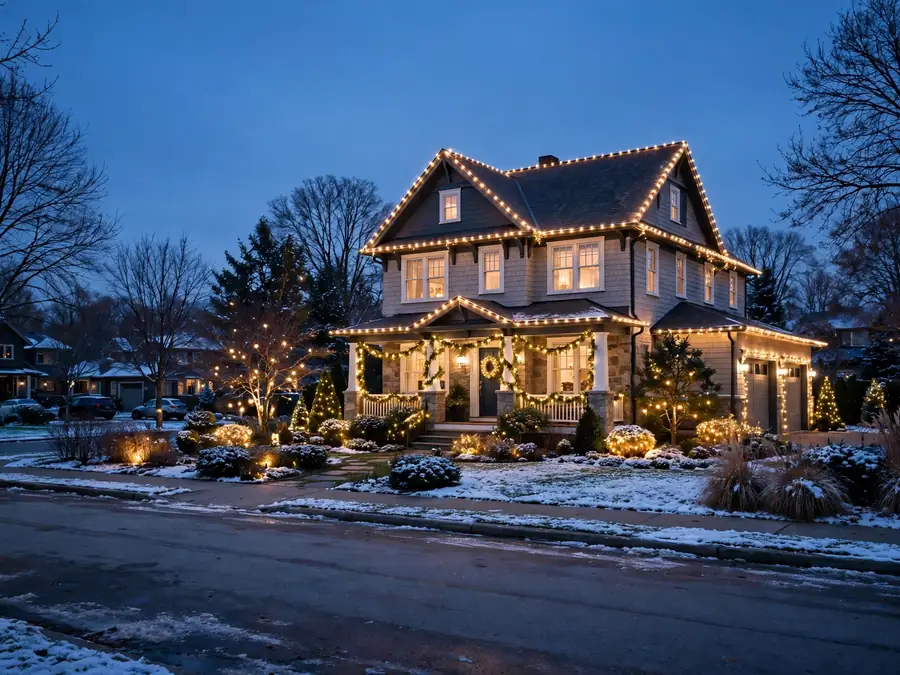
It is the first week of December, the houses on both sides are already glowing, and your home still looks dark by six in the evening. Last year you fixed that by lighting everything at once, and the January bill made you regret it for a month. This year the goal is different: a house that shines from the street, lit in a way that never runs all night or all at once.
The discipline is simple. Every idea below is LED, and every idea has an off switch that works by itself: a timer, a solar panel, or a battery pack. Nothing plugs in and stays on until morning, and nothing needs the whole facade lit to look finished. For more outdoor Christmas light ideas that layer a whole facade, that gallery is a good browse before you buy anything.
Here are 14 outdoor Christmas light ideas, each built around one lit zone: the roofline, the shrubs, one tree, the windows, the path. Pick the zones your house actually shows to the street, light them one at a time, and let the timers do the saving for you.
The Outdoor Lighting Formula That Keeps the House Looking Bright
- One hero zone first: light the strongest line your house already has, usually the roofline, before adding anything else.
- Warm white LED only: every bulb in every zone matches one warm colour temperature, so separate purchases still read as one display.
- Every run gets a clock: timers, solar panels, or battery packs switch each zone off by ten, with nothing left glowing overnight.
- Add a zone, not a watt: grow the display one area per weekend instead of brightening everything you already own.
For example: a clipped warm-white roofline on a timer, net lights over the two front shrubs on the same schedule, and one solar spotlight on the entry gives a finished-looking house that is never fully lit for more than a few evening hours.
| # | Idea | Where It Goes | How It Stays Cheap to Run |
|---|---|---|---|
| 1 | C9-Style LED Roofline | Front gutter | Timer, off by 10 p.m. |
| 2 | Icicle Strands, Front Eaves Only | Front eaves | One short run, on a timer |
| 3 | Net Lights Over Front Shrubs | Front shrubs | One net per shrub, timer |
| 4 | Trunk-and-First-Branches Tree Wrap | One front tree | LED string on a timer |
| 5 | Hanging LED Spheres | Tree branches | Battery, built-in timer |
| 6 | One Projector, One Blank Wall | Garage door or blank wall | Single unit on a timer |
| 7 | Window Frames Outlined From Outside | Front windows | Mini LEDs on a timer |
| 8 | Battery Window Candles | Every front window | Battery, timer mode |
| 9 | Candy-Cane Path Markers | Front walk | Low-voltage set on a timer |
| 10 | Solar Spotlights, Two Only | Entry and one evergreen | Solar, no socket at all |
| 11 | Porch Columns Spiral-Wrapped | Porch columns | Mini LEDs on a timer |
| 12 | Pre-Lit Garland Swags | Fence top rail | Battery, no outlet needed |
| 13 | Rope-Light Star at the Gable | Gable peak | One rope light on a timer |
| 14 | Rope Light Along the Driveway | One driveway edge | One run on a timer |
1. C9-Style LED Roofline on Gutter Clips
Run one straight line of warm white C9-style LED bulbs along the front gutter, each bulb seated point-down in a plastic gutter clip. The oversized bulbs read classic from the street and pull the eye along the roof edge instead of scattering it. Put the whole run on a single outdoor timer, dusk to 10 p.m. Trade-off: clips go on one by one from a ladder, so the first afternoon is slow. After that, this single line does more for the house than any other idea here.
The formula: One straight roofline, warm white only, and a hard timer stop is the backbone every other zone in this list hangs off.
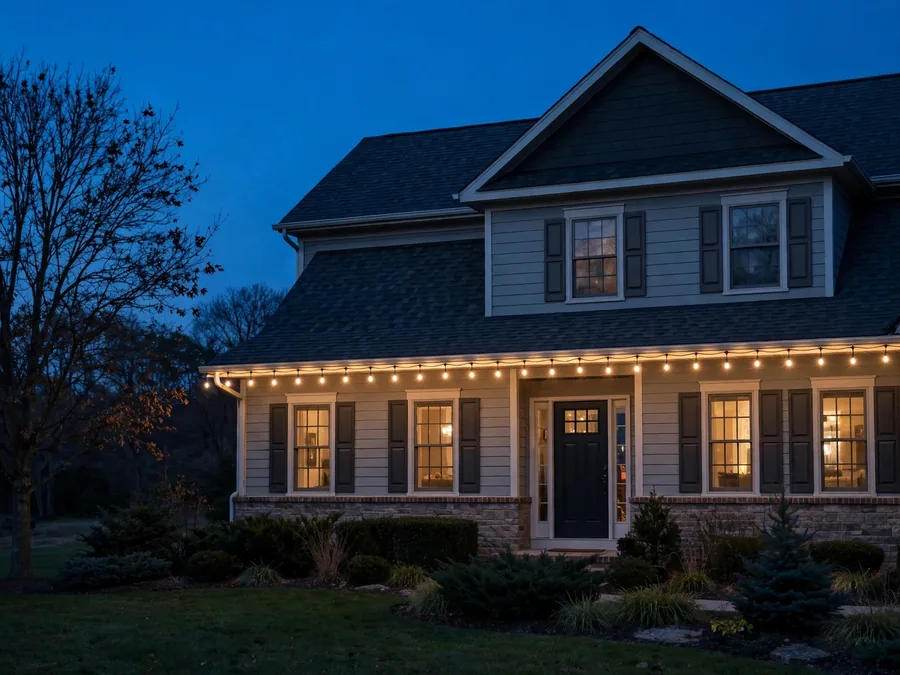
2. Icicle Strands on the Front Eaves Only
Hang warm white LED icicle strands along the front eaves and stop there: no sides, no back, no second storey wrap. Limiting the strands to the face the street actually sees keeps the run short, the ladder work simple, and the nightly draw small. Choose drops of mixed lengths so the line looks like real icicles instead of a fringe curtain. Trade-off: from side streets the house looks half finished, which matters on corner lots. On a mid-block house, front-only is the cheapest full look there is.
Budget note: One front-length strand set costs far less than a whole-house kit, and any leftover budget buys the timer that makes it cheap to run.
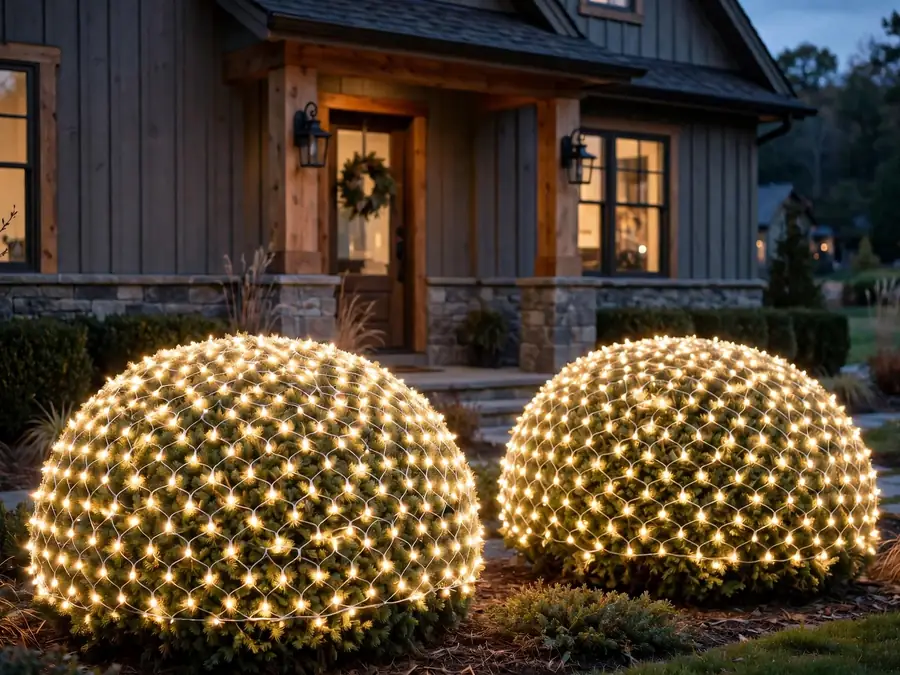
3. Net Lights Over the Front Shrubs
Drape one warm white LED net over each of the two or three shrubs beside your door or under the front windows. Nets settle evenly in seconds, no wrapping, no bare patches, and each shrub becomes a soft mound of light. If those shrubs line the boundary, match their glow to your Christmas fence decor so the whole frontage reads as one calm scene. Trade-off: nets fit rounded shrubs well but fight you on tall, pointy shapes.
Get the look:
- Main piece: one LED net light per shrub
- Supporting piece: short outdoor extension lead to the timer
- Texture or material: fine mesh net over dense evergreen foliage
- Finishing touch: tuck the net edges under the lowest branches
4. Trunk-and-First-Branches Tree Wrap
Wrap one front-yard tree properly instead of three trees thinly: warm white mini LEDs spiralled up the trunk, then out along the first three or four main branches only. The lit skeleton of the tree shows against the night sky, and the untouched upper branches keep it elegant instead of fizzy. One tree, one string set, one timer. Trade-off: wrapping is the slowest job on this list, roughly an hour for a mid-sized tree, and it comes down just as slowly in January.
Color note: Warm white against dark bark reads golden and calm; cool white on a pale trunk can look stark and blue from the road.
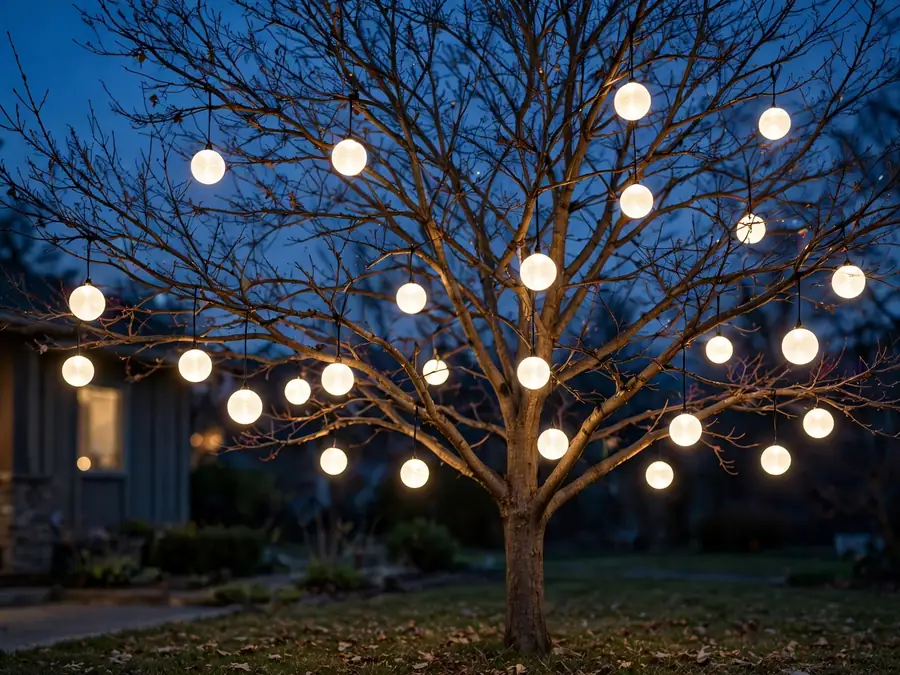
5. Hanging LED Spheres in Bare Branches
Hang five to seven battery LED spheres, each about the size of a grapefruit, at uneven heights in the bare branches of a deciduous front tree. From the street they float like low moons, and because each sphere runs on its own battery pack with a built-in timer, there is no cord to hide and no socket involved at all. Trade-off: batteries fade over the season, so keep a spare set ready for the last week of December.
Space note: Spheres earn their keep on small frontages where there is no lawn for displays: the tree canopy becomes the whole decoration.
6. One Projector on One Blank Wall
Set a single LED projector on a lawn stake and aim it at one blank surface only: the garage door, a flat gable end, or an empty stretch of wall. Slow-drifting snowflakes or stars cover a big area from one low-draw unit, which is why this is the cheapest way to fill a wide, empty facade. Run it on a timer for the evening hours only. Trade-off: projectors wash out under bright streetlights and look faint on dark brick, so test your wall before relying on it.
Best for: Wide, pale garage doors and gable ends with nothing else on them.
7. Window Frames Outlined From Outside
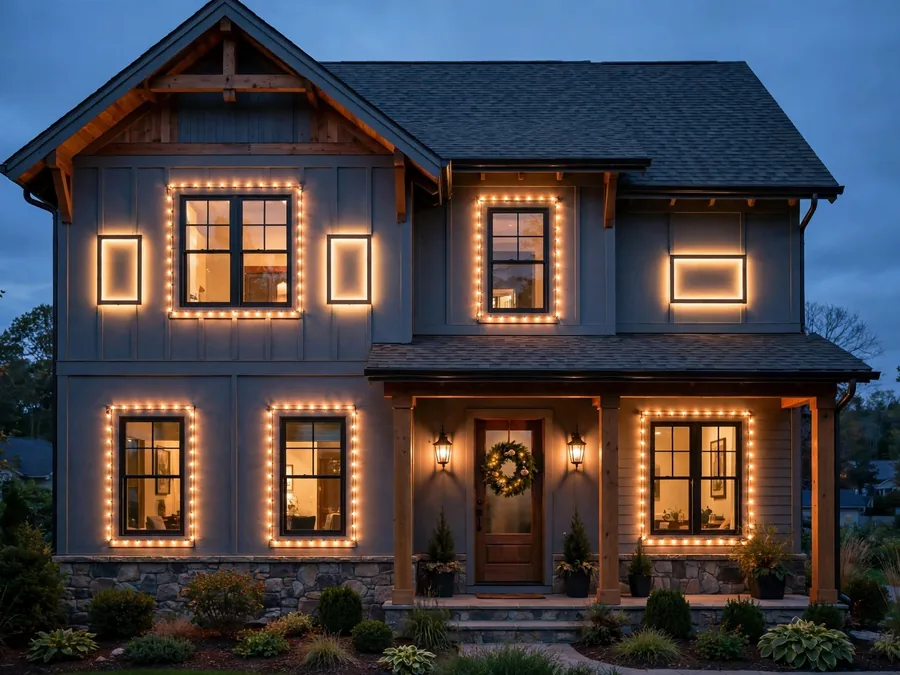
Trace the outside edge of each front window with a warm white mini LED string fixed on small adhesive clips, so the house shows a row of calm glowing rectangles. Outlining from outside keeps cords outdoors, frames the glass like a picture, and lights only the front elevation. Two or three windows are plenty; skip any window the street cannot see. Trade-off: clips on painted frames need a gentle hand at takedown, or a few may take paint with them in January.
Fit check: Measure each frame’s perimeter before buying; a standard front window takes roughly 12 to 15 feet of string, and one string per window keeps joins invisible.
| Power Style | Best For | Keep in Mind |
|---|---|---|
| Timer plug | Rooflines, icicles, window outlines | Set it once; check after any power cut |
| Solar | Spotlights far from a socket | Needs a panel spot that gets winter sun |
| Battery with timer | Spheres, window candles, garlands | Budget for one spare battery set |
| Plug-in LED, no timer | Nothing on this list | This is the combination that inflates bills |
8. Battery Window Candles on Timer Mode
Stand one battery candle with a warm flickering LED flame on the inside sill of each front window, and let the street read them as a quiet row of lights. Set every candle to its timer mode on the same evening hour so they come on together and switch off together. Paired with simple Christmas door decor, the entry reads finished without a single cord outside. Trade-off: candles give a gentle glow, not real brightness, so they complement a lit zone rather than replacing one.
Why it works:
- Identical flames in every window make the whole facade look deliberate
- Timer mode removes the nightly walk from window to window
- Batteries sip power compared with anything plugged in
9. Candy-Cane Path Markers on One Timer
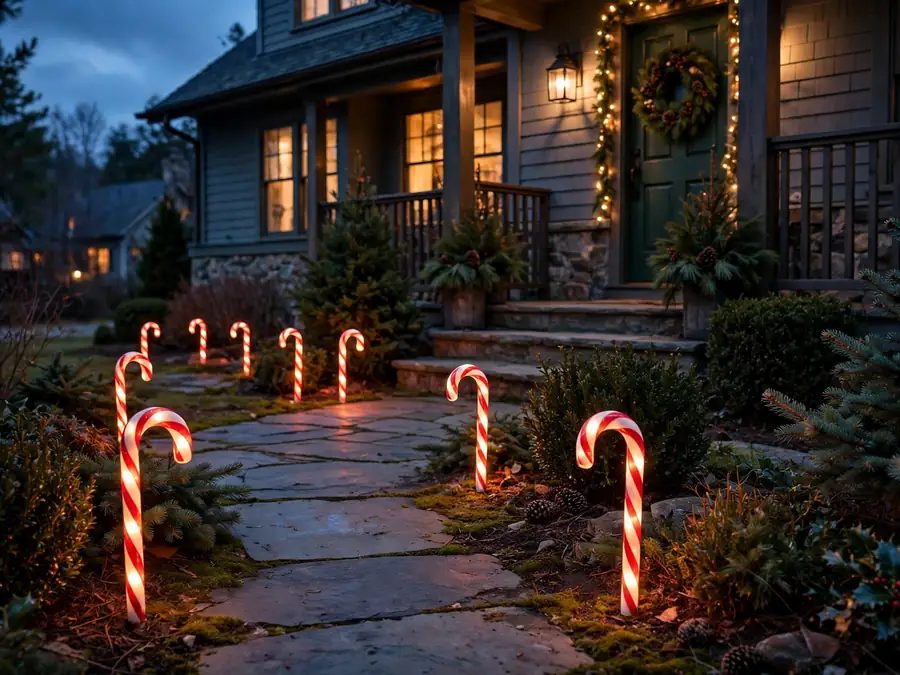
Line the front walk with plug-in LED candy-cane markers, red and white stripes glowing at knee height, spaced evenly from the pavement to the porch step. The path becomes the welcome, and guests get light exactly where feet need it. Connect the row to the same timer as the roofline so the two zones live and die together. Trade-off: markers are the first thing a snow shovel or a delivery driver’s boot finds, so expect to straighten a few each week.
Texture note: The striped plastic canes add the one playful, glossy note in an otherwise calm warm-white scheme, which is why they suit the path and nowhere else.
10. Solar Spotlights on the Entry and One Evergreen
Use exactly two solar spotlights and nothing more: one staked at the base of the entry, aimed up at the door surround, and one under the single best evergreen in the front bed, aimed into its branches. Each charges all day and runs all evening with no socket, no cable, and no timer to set. Trade-off: after two or three heavily overcast days the charge runs short and the light fades early, so treat these as accents rather than your main display.
Easy swap: In a grey week, slide both spots to whichever of your shrubs catches the most winter sun instead of adding a third light.
11. Porch Columns Spiral-Wrapped in Mini Lights
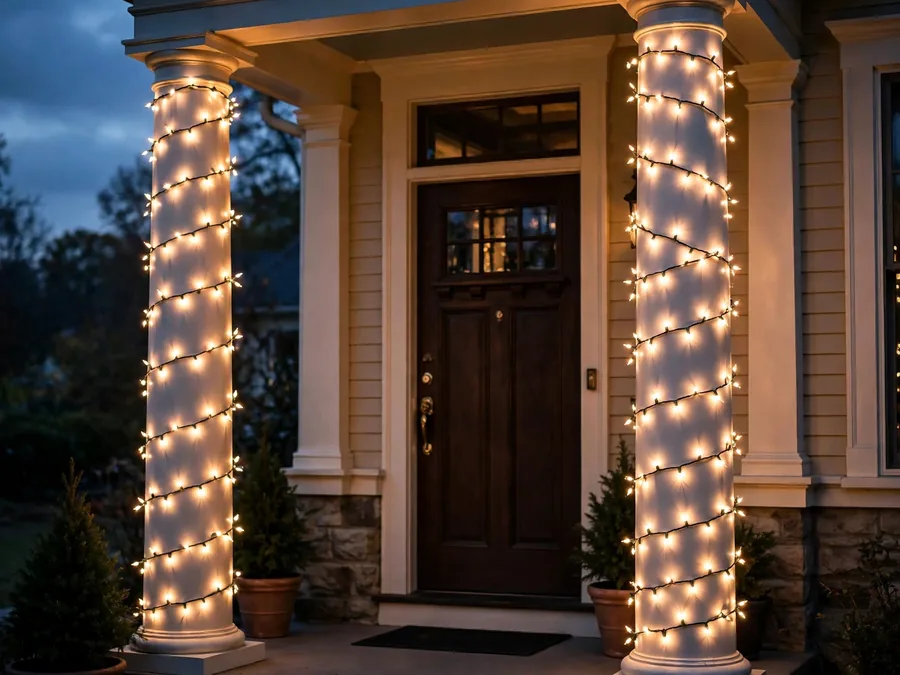
Spiral warm white mini LEDs up both porch columns, spacing the turns a hand’s width apart, then let the pair frame the front door like two lit pillars. One string per column and one shared timer keep the porch on the same schedule as the roofline. It pairs naturally with the rest of your front porch ideas, because the columns do the glowing and everything else can stay unlit. Trade-off: thin columns need the string taped or tied at the top, or the spiral slowly slides down.
Style note: Even spacing is everything here: rushed, uneven spirals read untidy from the street, while measured turns look like professional work.
12. Pre-Lit Garland Swags on the Fence Rail
Swag a pre-lit garland in loose scallops along the front fence’s top rail, letting each dip hang about a foot deep. The shortcut here is the UTSUND LED string light with 12 lights from IKEA, $19.99: thread it through a plain faux garland before you hang it, and the scallops glow with no cord in sight, because the string is battery operated and rated for outdoor use. Trade-off: one string lights only a short stretch of garland, so this suits a gate section or the panels nearest the house best.
Budget note: Dress just the two panels flanking the gate with one garland each instead of the full fence run; the lit entrance is what the street remembers.
13. Rope-Light Star at the Gable Peak
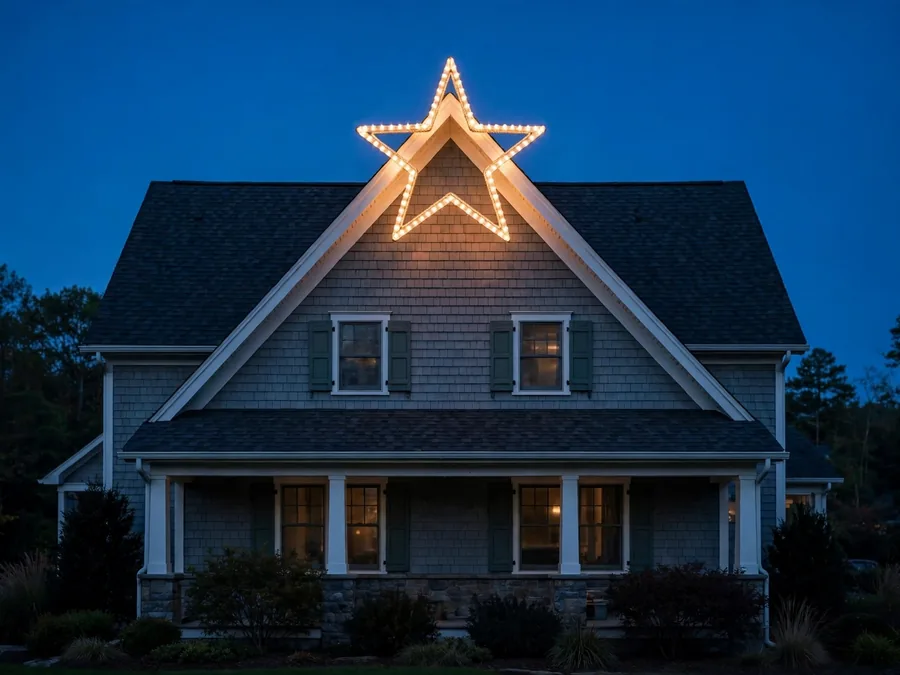
Bend a warm white LED rope light into a five-point star, fix it to a simple wooden frame, and mount it at the gable peak above everything else. One silhouette, one short run of rope, one timer: from the street it looks like the house’s own tree topper. Rope light holds its shape outdoors and shrugs off weather that would tangle a string. Trade-off: the star needs a ladder and a second pair of hands to mount safely, so it is a weekend job, not a dusk job.
Seasonal swap: In January the frame comes down but the rope light stays useful, coiled along a fence or step edge as plain winter light.
14. Rope Light Along One Driveway Edge
Stake a single warm white LED rope light along the driveway edge that borders the lawn, running it straight from the pavement to the garage. The low line of light outlines the parking bay, helps drivers judge the turn-in after dark, and echoes the roofline’s straight run at ground level. Keep it to one edge: both sides looks like a runway and doubles the draw. Trade-off: rope light near tyres and shovelled snow takes knocks, so check the stakes after every storm.
The formula: Ground line plus roofline, both warm white and both on timers, bookend the house and make every unlit space between them look intentional.
| Stage | Add This | Why It Comes at This Point |
|---|---|---|
| Stage 1: this weekend | Roofline C9 LEDs and one timer | The single biggest change, and the timer habit starts here |
| Stage 2: next weekend | Shrub nets and path markers | Fast jobs that fill the middle and ground levels |
| Stage 3: when ready | Tree wrap or the gable star | One silhouette is enough; pick the one your house shows best |
Light One Zone Well, Then Stop
A bright house is not a fully lit house. It is a house with a clear roofline, one or two calm pools of light at ground level, and a timer quietly ending the show at ten. The 14 ideas above all follow that pattern, and any three of them, done neatly, will outshine a yard where everything is plugged in at once.
Your one next step: this weekend, hang only the roofline run from idea 1, plug it into a timer set from dusk to 10 p.m., and look at the house from across the street before you buy a single thing more.