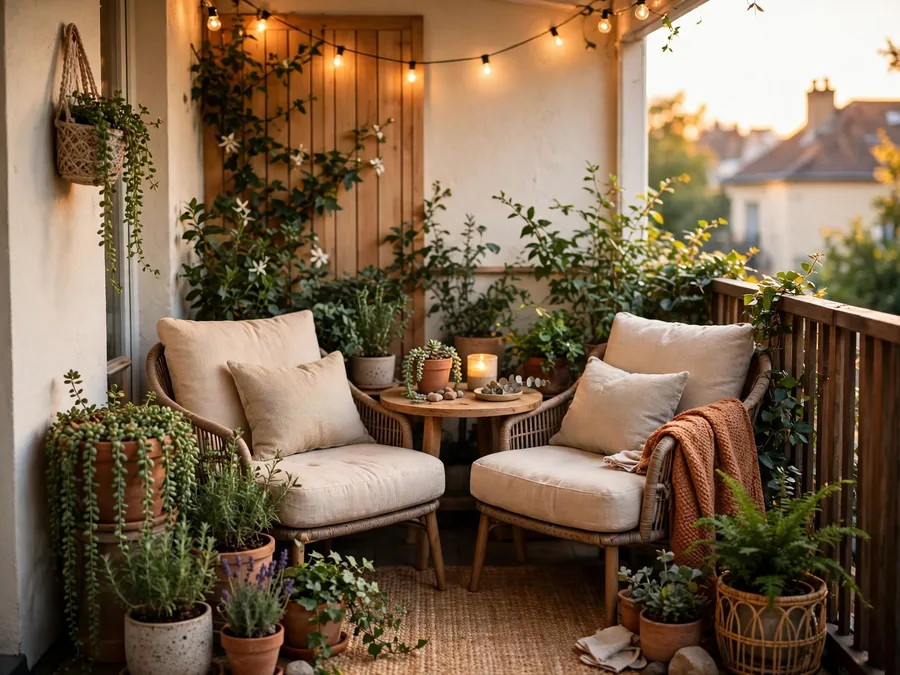
A small patio rarely fails as a hangout because it is small. It fails because it becomes the place where the bike leans, the hose coils, and the spare chairs stack — so every attempt to sit outside starts with moving storage out of the way. By the time a seat is clear, the coffee is cold and the moment has passed, and the slab goes back to being overflow space instead of the retreat it was supposed to be.
The patios that escape that fate all follow the same order: furniture hugs the edges and corners, every piece is light enough to move with one hand, and anything green grows up or outward instead of across the floor. Roundups of small patio ideas keep landing on the same truth — snug comes from fit, not from square footage.
These 12 ideas are built for patios and balconies where every inch is already spoken for. Each one comes with real measurements, a clear place to put things, and an honest downside, and most of them start with basics you probably already own: two chairs, a few pots, a tape measure, and a free afternoon.
The Small Patio Formula That Keeps Tiny Spaces Looking Snug, Not Stuffed
- Claim the edges first: push every seat and surface against a wall, rail, or corner so the middle of the floor stays open and the space reads as a room, not a corridor.
- Repeat one warm palette: terracotta, warm white, and natural wood tones carried across cushions, pots, and furniture make separate small pieces read as one planned set.
- Measure before you buy: a piece that fits on paper can still block the door swing or the walk to the rail, so tape every footprint on the floor before money changes hands.
- Keep one piece that folds or rolls: a single folding chair, drop-leaf table, or pot on casters lets the layout change for guests instead of being frozen all season.
Picture a 5-by-8-foot balcony done this way: a honey-toned corner bench along the short wall with rust cushions, two cream railing boxes of trailing rosemary hanging outside the rail, and a 24-inch folding table that comes off its wall hooks only when dinner does.
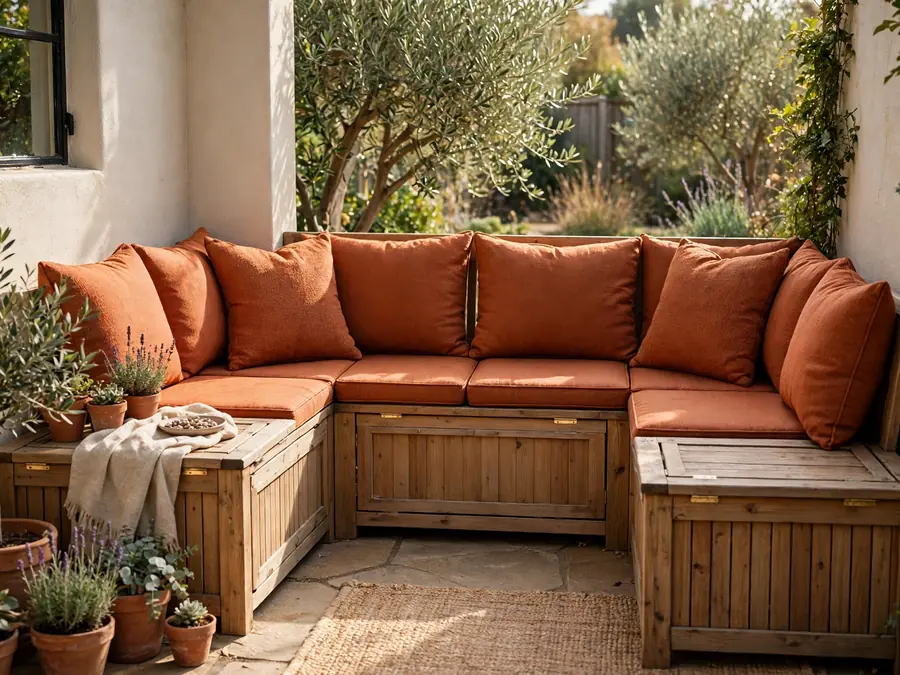
1. A Corner Bench Measured-Built to the Inch
Corners are the only square footage a small patio truly wastes, so give yours a job. An L-shaped bench built or bought to your corner’s exact measure — say 48 inches along the wall and 36 inches along the rail — turns a dead angle into seating for three. Choose a seat height of 17 to 18 inches, hinged lids over both runs for storing cushions and throws, and outdoor canvas cushions in rust or olive cut exactly as deep as the bench, with no overhang. The honest cost: a fitted bench can never move when you want a new layout. If your corner catches afternoon sun, you will feel every degree of it by 4 p.m.
Fit check: Before ordering, tape the bench outline on the floor and live with it for a full day — you need a clear 24 inches between the bench edge and the opposite rail to walk past carrying a mug in each hand.
2. Folding Chairs That Hang Flat on the Wall
Seating that stores on the wall is seating that never crowds the floor. Two folding chairs and a 24-inch folding table live on three sturdy hooks screwed into the wall or fence at shoulder height; when it is just you and a book, the whole set hangs flat and the patio is all open floor. The SUNDSÖ folding chair from IKEA is $50, powder-coated steel that arrives already assembled and folds down to a few inches thick. The trade-off is ceremony: every sit-down starts with unhooking and unfolding, which on some evenings will talk you out of going outside at all.
The formula: two folding chairs + one 24-inch folding table + three wall hooks at shoulder height.
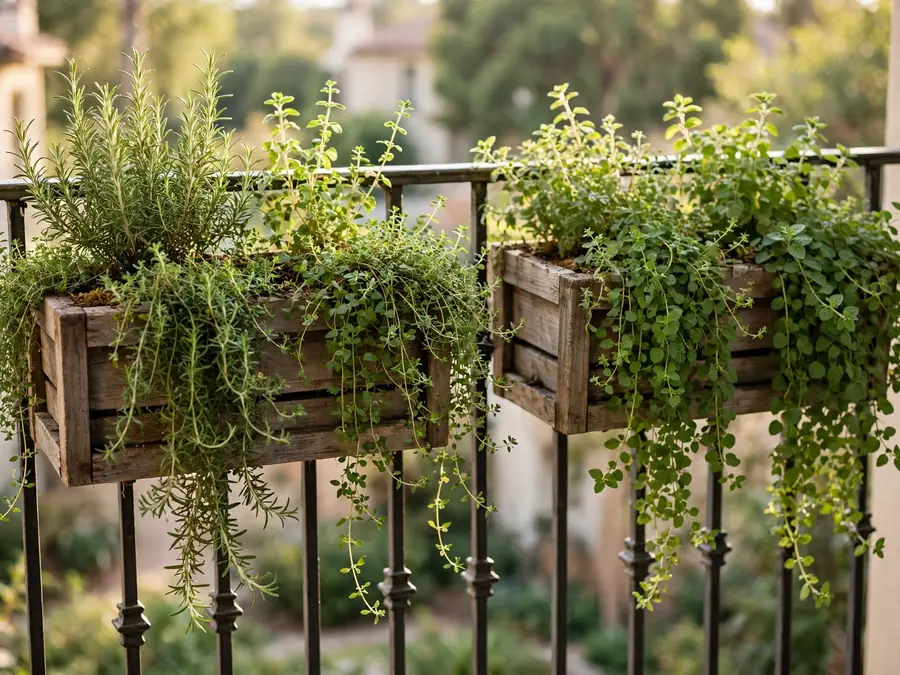
3. Railing Planters That Borrow Space From the Air
A planter that hangs outside the railing grows in space you were never going to use. Clip two 24-inch railing boxes over the top rail so the pots sit on the outer side, filled with trailing rosemary, thyme, and one tumbling tomato if the rail gets six hours of sun. The floor stays completely clear, the green sits at eye level while you are seated, and watering happens from your chair. It is the same borrow-the-edges logic behind good patio garden decor, shrunk to rail scale. Heavy boxes are the catch: a soaked 24-inch planter is a real load, so check your rail’s fasteners first.
Space note: Each outside-the-rail box frees roughly 2 square feet of floor — on a 30-square-foot balcony, two boxes hand back the footprint of a whole extra chair.
4. A Wall Ledge Standing In for a Side Table
Every side table is four legs hunting for floor you do not have. A wall-mounted ledge — a 36-by-6-inch acacia shelf on two brackets, mounted at arm height beside your chair — holds a mug, a book, and a phone while taking up zero floor. Keep the finish oiled rather than painted, because cups will ring it within a month and oil hides rings far better. The limitation is reach: a fixed ledge serves exactly one seat, so mount it beside the chair you actually use every day, not the one guests get.
Get the look:
- Main piece: a 36-by-6-inch wall ledge at arm height
- Supporting piece: one deep chair angled toward it
- Texture or material: oiled acacia against painted brick or siding
- Finishing touch: a small battery candle at the ledge’s far end
| Small-space stand-in | Footprint | Full-size piece it replaces |
|---|---|---|
| Wall ledge, 36 by 6 inches | 0 square feet of floor | A four-legged side table |
| Railing planter, 24 inches | 0 square feet of floor | Two floor pots |
| Folding chair, stored | Hangs flat on the wall | A fixed armchair |
| Corner bench, 48 by 36 inches | Uses the dead corner | Two chairs and a table |
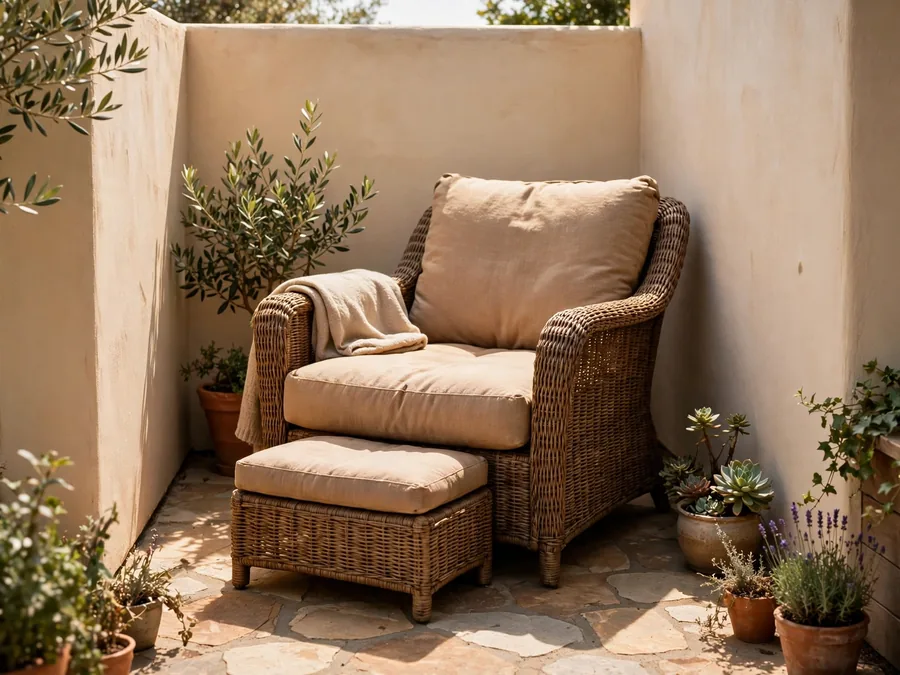
5. One Deep Chair Instead of Two Shallow Ones
Two skimpy chairs make two people politely uncomfortable; one deep chair makes one person completely at home. Pick a single lounge chair with a seat at least 24 inches deep and 26 inches wide, add a small ottoman that slides fully underneath it, and give the pair the patio’s best corner. In warm white canvas with a single terracotta lumbar pillow, it works as a reading chair, a nap chair, and a morning-coffee chair in one. The honest downside: when a friend visits, somebody ends up sitting on the ottoman — which, at 16 inches high, works better than it sounds.
Best for: solo morning coffee and evening reading on balconies under 40 square feet, where one great seat beats two cramped ones.
If the patio is mostly yours alone, furnish it for the life you actually live out there.
6. Two-Tone Deck Tiles That Draw a Bigger Floor
Bare concrete makes a small patio read as one gray smear, and the eye stops at the walls. Interlocking deck tiles in two tones — warm acacia-look slats in the middle, a charcoal border one tile wide — give the floor a finished center and an edge, which tricks the eye into reading the space as planned rather than leftover. A 6-by-8-foot area takes roughly an hour of snapping tiles together, with no tools beyond a tape measure. The tiles do trap leaves and grit underneath, so lift and sweep below them twice a season or the corners will start to smell like it.
Color note: Hold the palette to the warm wood tone and one dark neutral; a third tile color turns the border trick into visual noise, and the floor shrinks again.
7. A Folding Privacy Screen That Earns Its Keep
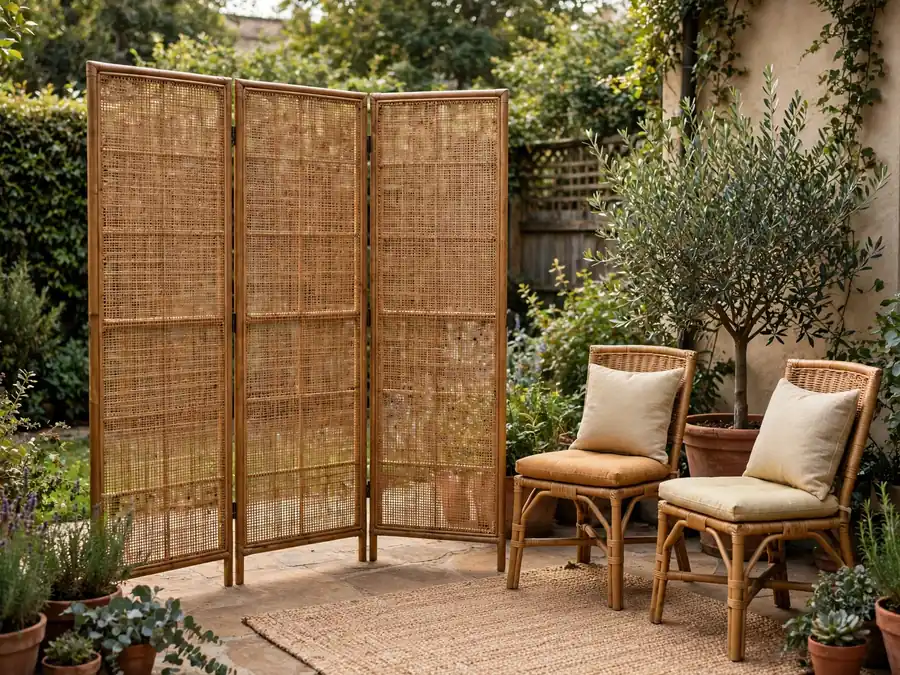
Feeling watched is the fastest way to stop using a small patio altogether. A three-panel folding screen, each panel 16 inches wide and 5 feet tall, stands in the corner nearest the neighbor’s window and folds flat against the wall on days when you want the view instead. Woven willow or slatted acacia both let air through while breaking sightlines, and neither needs a single screw — it is the same layered-privacy thinking behind a cozy garden aesthetic, scaled down to one folding panel. Screens are sails, though: in a gusty gap between buildings, an unsecured panel will walk across the patio and take a pot with it.
Why it works:
- It blocks the one sightline that matters instead of fencing off the whole patio
- It folds to 16 inches wide, so privacy stays optional rather than permanent
- Slatted panels keep air moving, so the corner never turns stuffy
8. Stacking Stools That Work Three Jobs
A stool is the hardest-working shape in a small space: seat, side table, footrest, and plant stand in a 14-inch circle. Buy two or three stackable stools and stack them in a corner when the floor needs to be completely clear; unstacked, one holds your drink, one holds your feet, and the third lifts a fern to knee height. Mixed materials keep the stack from looking like classroom furniture. Stacked stools do clang and wobble on uneven pavers, though, so felt pads under the feet are not optional — they are the difference between clever and annoying.
Texture note: Pair one matte sage metal stool with one warm acacia-topped stool; the contrast stops a stack of identical shapes from reading as spare cafeteria seating.
Three stools take less floor than one armchair and, on the nights that matter, seat more people.
| Gap to measure | Leave at least | Why it matters |
|---|---|---|
| Bench edge to opposite rail | 24 inches | Room to pass with a mug in each hand |
| Chair back to wall | 6 inches | Space for cushion loft and a slight recline |
| Table edge to seated knees | 12 inches | Slide in and out without shuffling the chair |
| Walkway past planters | 24 inches | A clear route for the watering can |
9. A Drop-Leaf Table That Changes Size With the Guest List
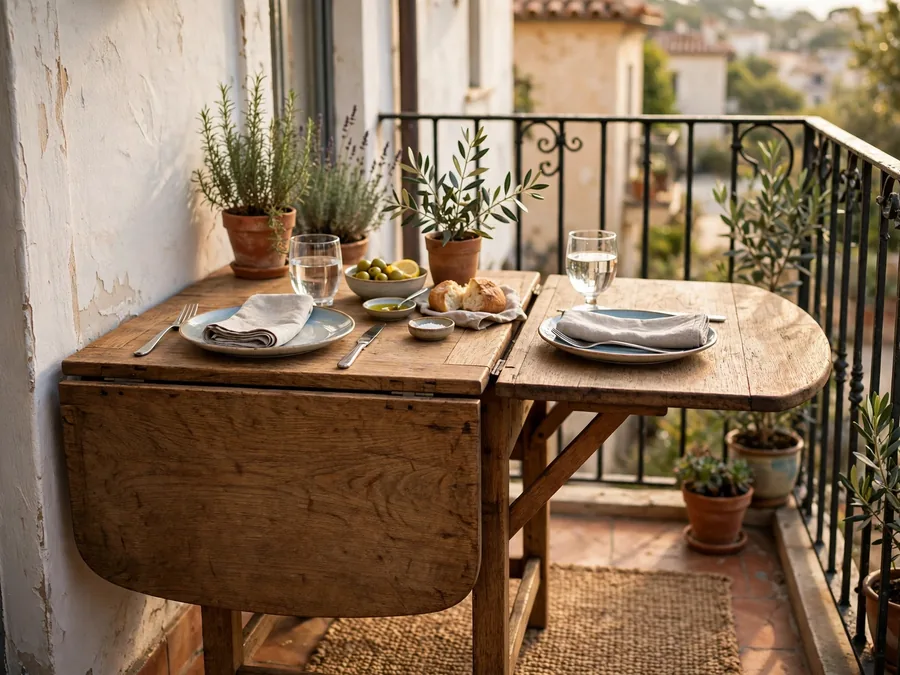
A fixed table is sized for the biggest dinner you host twice a year. A drop-leaf table — 32 inches across with both leaves up, only 16 inches deep with one leaf down — lives slim against the wall as a solo coffee ledge and opens into dinner for two in about ten seconds. Choose a top in oiled teak or whitewashed pine and keep two folding chairs as its permanent partners. Against the wall, the folded leaf doubles as a narrow display strip for a single pot and a candle. The hinge side is the weak point: rest a heavy casserole in the middle of the table, never out on the open leaf.
Easy swap: Trade the dinner setup for a work setup by dropping the leaf, sliding the table flat to the wall, and putting the laptop where the plates were.
10. A Storage Ottoman That Swallows the Mess
Small patios look crowded mostly because of the small stuff: spare cushion covers, a watering can, the citronella candle, yesterday’s book. A storage ottoman roughly 18 inches square, with a hinged weatherproof lid, swallows all of it and still works as a footrest, a tray table, and a third seat. Upholster it in the same canvas family as your chair cushions so it disappears into the scheme instead of announcing itself. Check the lid seal before you buy — a cheap ottoman that lets rain creep in becomes a mildew box by midsummer, and you will smell it before you see it.
Style note: A flat, firm lid in your cushion fabric reads as furniture; a puffy vinyl top reads as storage, and the whole patio feels tidier for the difference.
11. Plants on Casters That Shuffle for Company
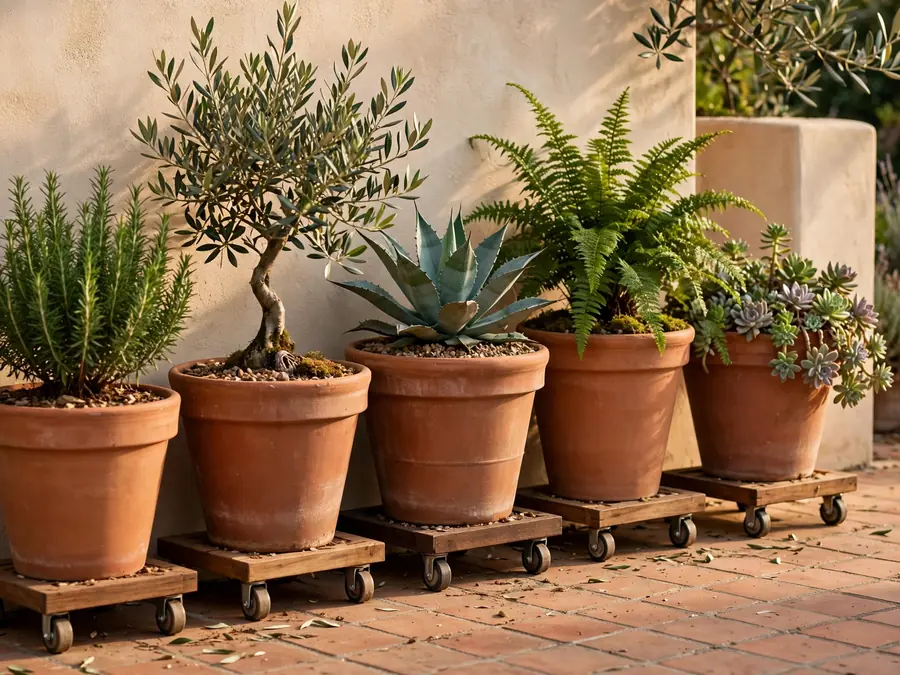
Pots that cannot move end up dictating the whole layout, and on 30 square feet that is too much power to hand a fern. Put your three biggest pots on low rolling plant caddies — 12-inch rounds with locking casters — and the greenery becomes furniture you can rearrange: clustered tight into a green backdrop on quiet nights, rolled apart to open floor when two friends come over. Unglazed terracotta on dark steel caddies keeps the look grounded rather than gadgety. Caddies raise each pot about 3 inches, so check your sightlines from the chair again after the lift.
Budget note: Basic rolling caddies cost only a few dollars each at garden centers, so the whole movable-garden trick runs less than one new planter — it works with the pots you already own.
Your layout stops being a decision you made once in spring and becomes one you can remake in under a minute.
12. A 44-Inch Loveseat Sized for Real Balconies
Most loveseats run 60 inches wide and will eat a small patio whole. Balcony-scale versions at 44 to 48 inches seat two honestly — shoulders touching, which is rather the point — and still leave room for a slim stool at each end. Frame it in anthracite aluminum with warm white cushions, set it along the long wall, and it becomes nap headquarters from the first warm weekend to the last. The trade-off is the naps themselves: at 44 inches, anyone over 6 feet sleeps diagonally or not at all, and replacement cushions in this size take longer to find.
Seasonal swap: In fall, trade the warm white cushion covers for rust plaid, add one chunky throw, and angle the loveseat toward the low sun; in spring, swap back and shift it six inches toward the shade.
| Season | Swap this | Keep this |
|---|---|---|
| Spring | Fresh cushion covers; first herbs into the railing boxes | The measured layout you taped out |
| Summer | Shade aimed at the sitting corner; a lighter throw | The folding set, out every evening |
| Fall | Rust plaid covers and one chunky throw | The screen, for wind as much as privacy |
| Winter | Covers stored inside the ottoman; screen folded flat | The bench and tiles, swept and ready |
Begin With One Corner and Sit Down
None of these twelve ideas asks for a renovation, a permit, or even a free weekend — the most expensive move on the list is a loveseat, and the cheapest is a tape measure. Start where your patio already wants to work: one corner, measured honestly, furnished at the right scale. If a full garden retreat is the long-term dream, these same fit-first rules are exactly how backyard oasis ideas scale up when the space finally allows it.
Your one next step: take a tape measure outside tonight and tape the outline of either the corner bench or the 44-inch loveseat on your floor, then sit inside the empty outline with tomorrow morning’s coffee. If the taped version already feels snug instead of squeezed, buy for that corner first and let the rest of the patio wait its turn.