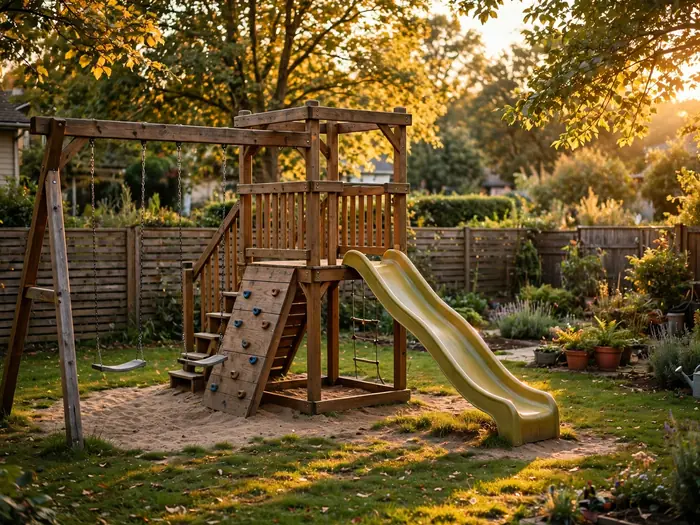
A trip to the park sounds simple until you count the drive, the wait for a free swing and the drive home again. Meanwhile the lone swing frame many families buy instead stands in the yard looking lonely, and within a season the children walk straight past it.
The yards children actually use borrow the park’s real secret: several kinds of motion in one place. Swinging, sliding, climbing, bouncing and spinning share one safe surface, the whole zone stays visible from the house, and the equipment leaves room for children to grow into it.
These 23 equipment-led ideas run from a single bold slide to complete park-style sets, each with the anchoring, surfacing and layout thinking real parks use, scaled down for an ordinary backyard.
The Backyard Playground Formula That Keeps Big Fun Looking Neat
- Mix the motions: one swing, one slide, one climb and one bounce is a park; four swings is a queue.
- One surface decision for the whole zone: mulch, mats or turf under everything keeps the area safe and mowable around.
- Anchor and check like a park does: every frame staked or set firm, bolts and ropes inspected each season.
- Leave a growth margin: children outgrow heights fast, so choose pieces that adjust, extend or resell well.
For example: a swing frame with two belts and a glider (swing), a slide off a small deck (slide), a climbing dome beside it (climb) and a ground-level trampoline (bounce), all on one bark-mulch rectangle you can see from the kitchen window (one surface, clear sight lines).
| # | Idea | Best For | Budget/Effort |
|---|---|---|---|
| 1 | Wooden Swing Set with a Slide and Climbing Wall | The complete starter park | High |
| 2 | Freestanding Slide Landing in a Mulch Pit | One bold piece, done well | Mid to high |
| 3 | Geodesic Climbing Dome on the Grass | Climbers aged five to twelve | Mid |
| 4 | Monkey Bars Frame Over Soft Ground | Strength and daring | Mid to high |
| 5 | In-Ground Trampoline with a Safety Net | Bouncing without the eyesore | High |
| 6 | Playhouse with a Porch and Flower Boxes | Pretend play headquarters | High |
| 7 | Zip Line Run with a Seat and a Stop Block | The thrill ride | Mid to high |
| 8 | Ninja Line Course Strung Between Two Trees | Obstacle training at home | Mid |
| 9 | Basketball Hoop Zone on a Paved Pad | Kids who shoot daily | Mid |
| 10 | Mini Soccer Pitch with Two Small Goals | A lawn with a purpose | Low to mid |
| 11 | Fence-Mounted Panel of Climbing Holds | Vertical play, tiny footprint | Mid |
| 12 | Platform Deck Reached by a Rope Ladder | A fort without walls | Mid to high |
| 13 | Tire Swing Hung from a Steel Frame | Spinning and swinging in one | Low to mid |
| 14 | Wobble Bridge Linking the Deck and the Dome | Balance with a bounce | Mid |
| 15 | Spring Rider Seesaw Built for Two | Partners in rhythm | Mid |
| 16 | Covered Sandbox Kit with Corner Seats | Sand play, cat-free | Mid |
| 17 | Water Play Tower with Chutes and Wheels | Summer’s main attraction | Mid to high |
| 18 | Tetherball Pole in Its Own Circle | One-on-one battles | Low to mid |
| 19 | Volleyball and Badminton Net Across the Lawn | Teens and parents join in | Low to mid |
| 20 | Fort Tower with a Flag and a Telescope | Lookouts and storytellers | High |
| 21 | Bike and Scooter Ramp Set on the Drive | Wheels, airborne briefly | Low to mid |
| 22 | Spinner Merry-Go-Round Seat for One or Two | Dizzy delight | Mid |
| 23 | Adjustable Gymnastics Bar Set on Posts | Future gymnasts | Mid |
1. Wooden Swing Set with a Slide and Climbing Wall
Buy the set as one coordinated frame: a cedar A-frame holding two belt swings and a glider, a 1.5-meter deck with a wave slide, and a climbing wall with molded holds up the back. Set the footprint at roughly 5 by 4 meters on level ground, anchor every leg with steel ground stakes, and spread bark mulch 8 centimeters deep across the fall zone. Confirm the deck height suits your youngest child now, not the one they will be at ten; 1.2 to 1.5 meters suits ages three to eight best.
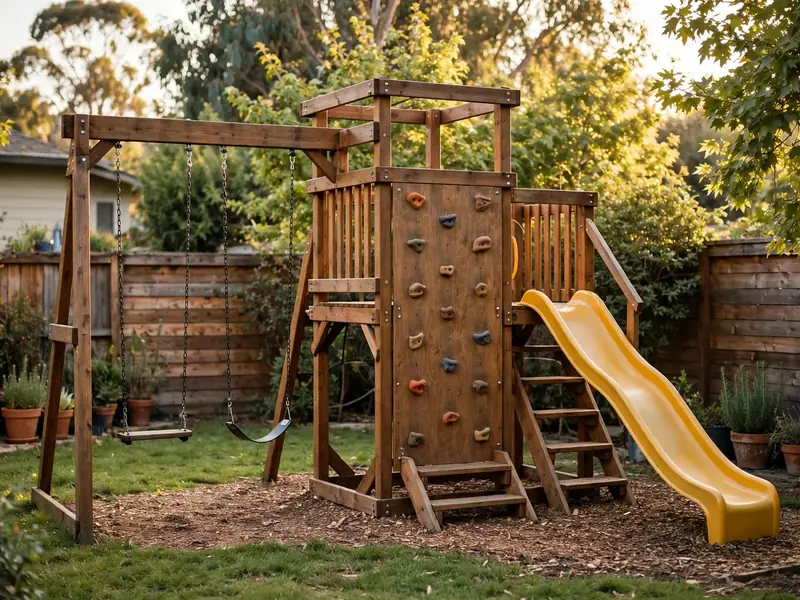
Fit check: Measure your gate and the flat area before ordering; the mulch zone needs a full 1.8 meters of clear space beyond the swings’ arc at both ends.
2. Freestanding Slide Landing in a Mulch Pit
Treat the landing as part of the equipment and one bold slide can carry a whole yard. Choose a 1.8 to 2.4 meter slide with wide steps, high side rails and a frame that bolts to ground anchors. Dig the landing pit 25 centimeters deep, edge it with landscape timbers, and fill it with play-grade bark mulch. Face the run-out toward open lawn, never a fence or path, with 2 meters clear past the pit. Stainless chutes stay cooler than plastic in full sun.
Style note: Pick the chute in a color that matches your fence stain or house trim, and the timber-edged pit reads as landscaping rather than clutter.
3. Geodesic Climbing Dome on the Grass
A steel climbing dome, 2 to 3 meters wide and about 1.5 meters high, anchors with the stakes in its kit and asks for nothing but a meter of clear space all around. Set it on grass or deep mulch, never concrete. The galvanized bars give small hands a true grip, and children use the same dome as fort, spaceship and lookout. Inspect connectors each season and replace any missing caps. Keep it for confident climbers of five and up; toddlers belong on the lowest ring only, with you within arm’s reach.
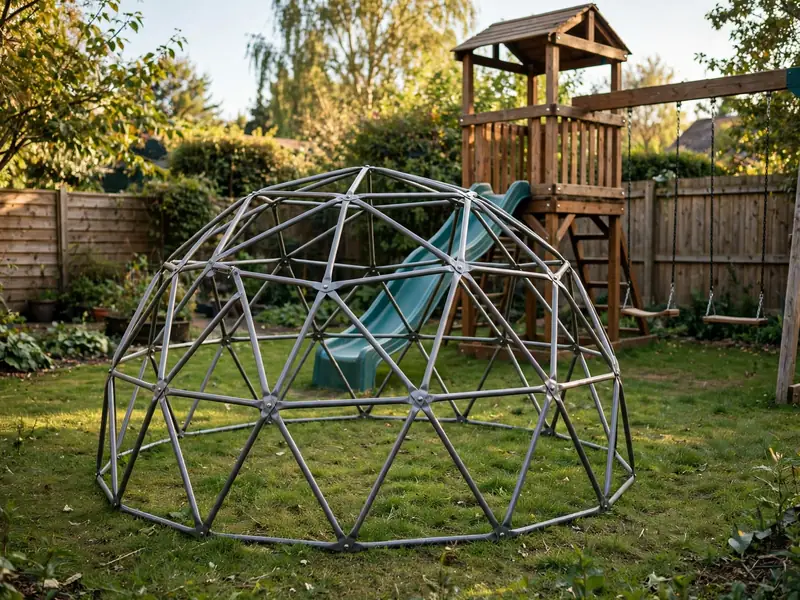
Easy swap: Worried about height? Start with the 90-centimeter junior dome and move up to the full size when grips and confidence grow.
4. Monkey Bars Frame Over Soft Ground
A freestanding monkey bar frame, about 2.2 meters high with rungs spaced 30 centimeters apart, builds the upper-body strength parks are famous for. Set the posts in concrete footings or use the manufacturer’s ground anchors, and lay rubber mats or 10 centimeters of mulch beneath the whole ladder run, since every drop here lands straight down. Start younger children on a shorter span with a spotting adult; the full frame suits ages six to twelve. Tighten rung bolts each spring, because loose rungs are the one failure this piece cannot afford.
Seasonal swap: In winter, hang a porch swing from the frame’s end bay and the structure earns its footprint all year round.
5. In-Ground Trampoline with a Safety Net
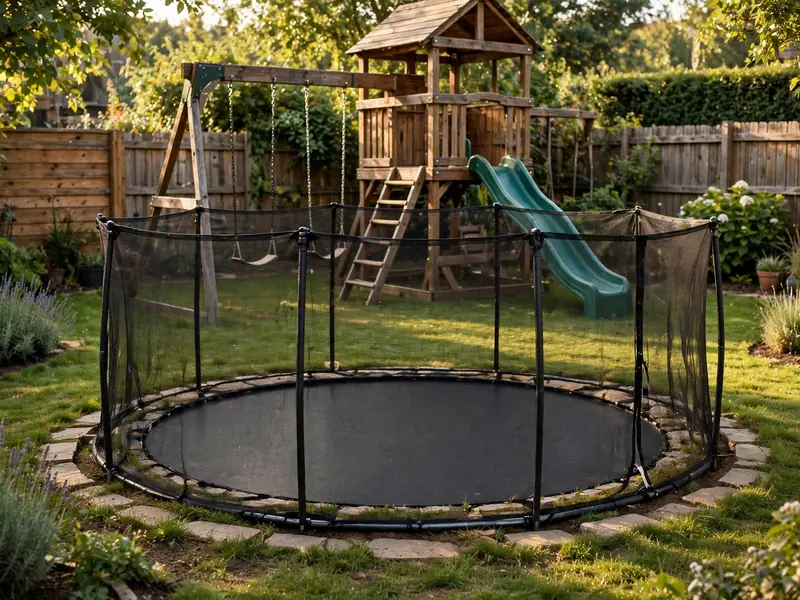
Sinking a trampoline removes the ladder, the fall height and most of the visual bulk. Dig the pit to the kit’s depth, line it with the supplied retaining wall, and set the frame so the mat sits flush with the lawn. A low-profile safety net still matters; pick one that opens at ground level. Sitting this quietly in the grass, it reads more like one of those modern backyard landscaping ideas than gym equipment. Good airflow underneath keeps the bounce lively.
Why it works:
- No ladder means younger children climb on and off safely alone.
- Nothing towers over the fence, so sight lines from the house stay clear.
- Flush edges let the mower roll straight across the surround.
6. Playhouse with a Porch and Flower Boxes
A wooden playhouse works hardest when it is real architecture in miniature: a 1.5 by 1.8 meter cabin, a railed porch across the front, a Dutch door children can open top and bottom, and two window boxes planted with real marigolds. Set it on a level paver or deck base so the floor stays dry, screw the frame to the base against storm lift, and keep the door swing clear of paths. Inside, a fold-down table and two stools turn it from house to shop to school as the week demands.
Budget note: Kits cost the most in spring; the same house bought in autumn sales, then assembled over winter weekends, often lands at nearly half price.
7. Zip Line Run with a Seat and a Stop Block
A zip line lives or dies on its anchors. Run 20 to 30 meters of galvanized cable between two mature trees at least 30 centimeters thick, or between posts set deep in concrete, with the start about 2 meters high and a gentle downhill slope. Fit a handled trolley, a real seat rather than a bar alone, and a spring or bungee stop block a full meter before the far anchor. Clear the whole corridor of branches and fences, land riders over mulch or grass, and test the line yourself before any child rides.
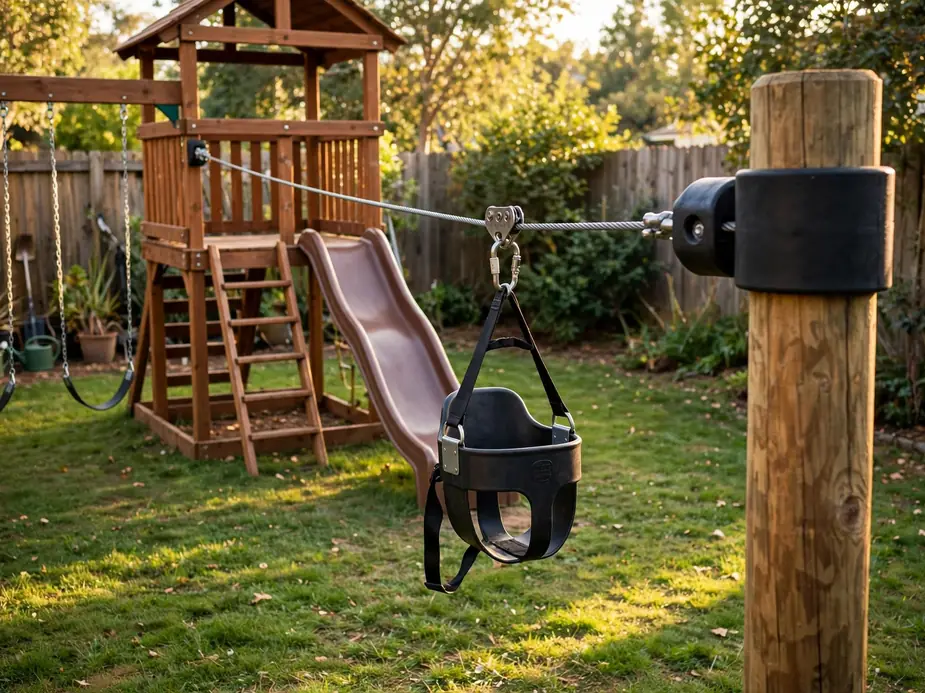
The formula: strong anchors + a seated trolley + a stop block set well clear of the tree
8. Ninja Line Course Strung Between Two Trees
A ninja line turns two strong trees into a hanging obstacle course: a ratchet strap strung at about 2.2 meters carrying monkey rings, a trapeze bar, grips and a rope ladder. Ratchet it drum-tight, pad both trunks, and keep the ground beneath soft and empty. Hang obstacles easiest-first from the start tree. Beside a trampoline, it gives older children a circuit that changes monthly, and every piece slides off into its bag in minutes.
Get the look:
- Main piece: a 10-meter line kit with seven clip-on obstacles
- Supporting piece: two thick trunk protector pads with straps
- Texture or material: grippy rubber-coated rings and bars
- Finishing touch: a storage bag hung on the start tree
9. Basketball Hoop Zone on a Paved Pad
A hoop gets used daily when the pad beneath it is honest: a level paved area at least 3.5 by 4 meters, an adjustable hoop set between 2.3 and 3 meters, and a painted key and free-throw line to make games feel official. In-ground posts wobble least; if you choose a portable base, fill it with sand rather than water for stability through winter freezes. Angle the backboard so misses roll back onto the pad, not into planting beds or the street.
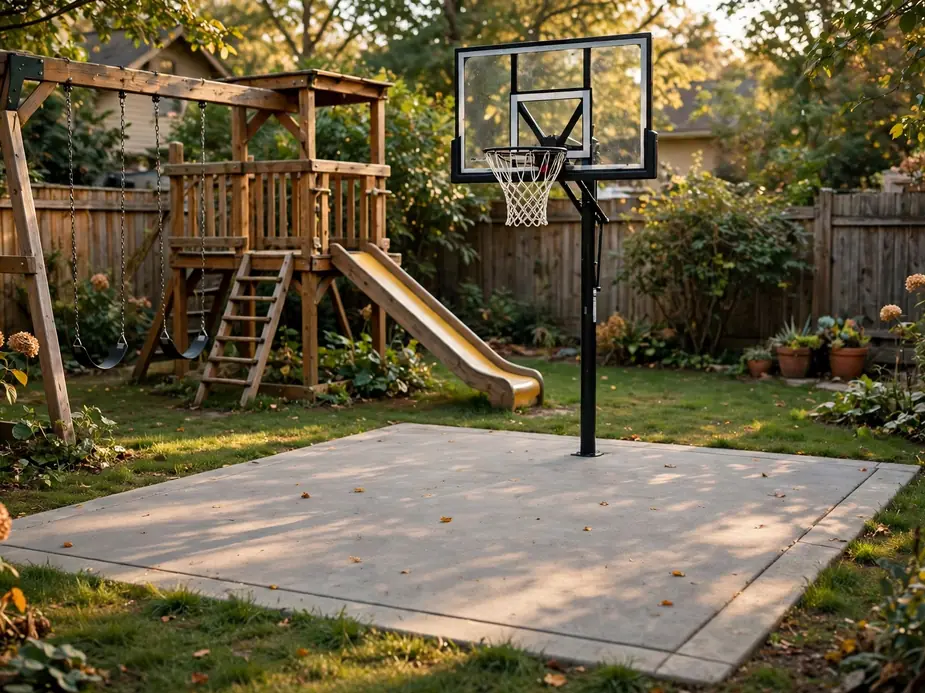
Color note: Paint the key in the same brick or charcoal as your paving and mark the lines in soft white, and the court looks planned, not sprayed on.
10. Mini Soccer Pitch with Two Small Goals
Two pop-up or PVC goals, 1.8 meters wide, turn a plain rectangle of lawn into a pitch. Mark the boundaries with flat rubber spot markers or a washable line spray, lay a center line and two small penalty boxes, and keep the goals weighted with sandbags so they never tip onto a celebrating striker. Rotate the pitch a meter sideways every few weeks to spare the grass in the goal mouths. A full-size ball wears young knees and lawns out faster; a size 3 or 4 ball keeps games close and control tight.
Texture note: Short, dense grass plays truest; if your lawn is patchy, a strip of artificial turf in each goal mouth ends the mud season.
11. Fence-Mounted Panel of Climbing Holds
Where no tree or frame fits, the fence becomes the climbing wall. Bolt two sheets of exterior plywood, each 1.2 by 2.4 meters, through the fence posts, never just the boards, and fix 25 to 30 screw-on holds in mixed sizes, set in routes by color. Keep the top holds under 1.8 meters, lay interlocking rubber mats across the landing strip, and check hold bolts monthly because outdoor timber breathes and loosens them. Routes reset in an afternoon with an Allen key, which is exactly how this small wall stays interesting for years.
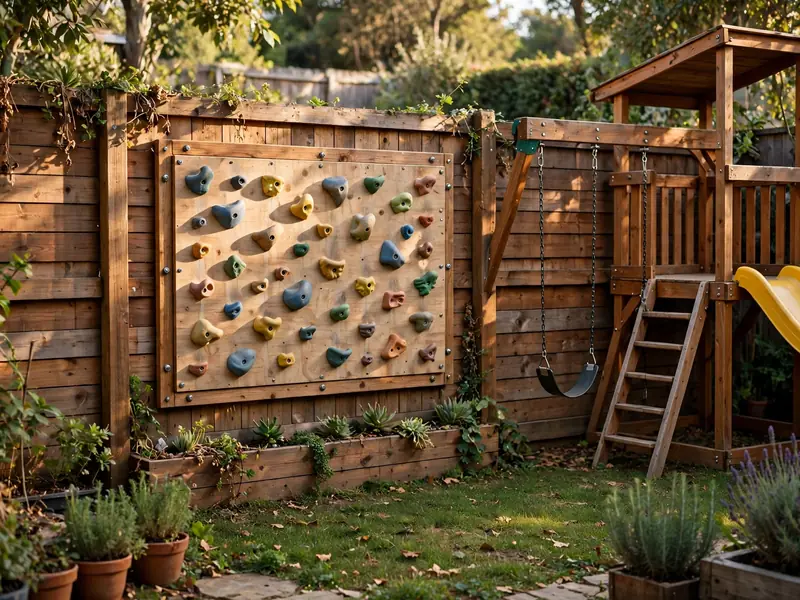
Best for: Garden walls and side fences where floor space is tighter than wall space.
12. Platform Deck Reached by a Rope Ladder
A wall-less platform is the fort children never finish redesigning. Build a 1.8 by 1.8 meter deck at 1.4 meters high on four posts concreted into the ground, reached by a rope ladder with wooden rungs and guarded on three sides by rails at two heights. The fourth side stays open for a future slide or fireman’s pole. Underneath becomes shaded storage for bikes and ride-ons. Its footprint is barely bigger than a shed’s, which is why it earns its place among small garden ideas that still deliver serious play.
Space note: Place the deck in a corner and two of its guard sides come free from the fences, saving rails and opening the middle of the yard.
13. Tire Swing Hung from a Steel Frame
A tire swing on its own steel A-frame can live where no suitable tree exists. Hang a clean, drained tire from galvanized chain or marine rope on a swivel fitting, so it can spin as well as swing, and set the seat 40 to 60 centimeters off the ground. Anchor each leg and keep a 2-meter clear circle around the swing’s whole travel, since a spinning tire wanders sideways more than parents expect. Use a real tire with no exposed steel belt, and drill drainage holes so it never becomes a mosquito nursery.
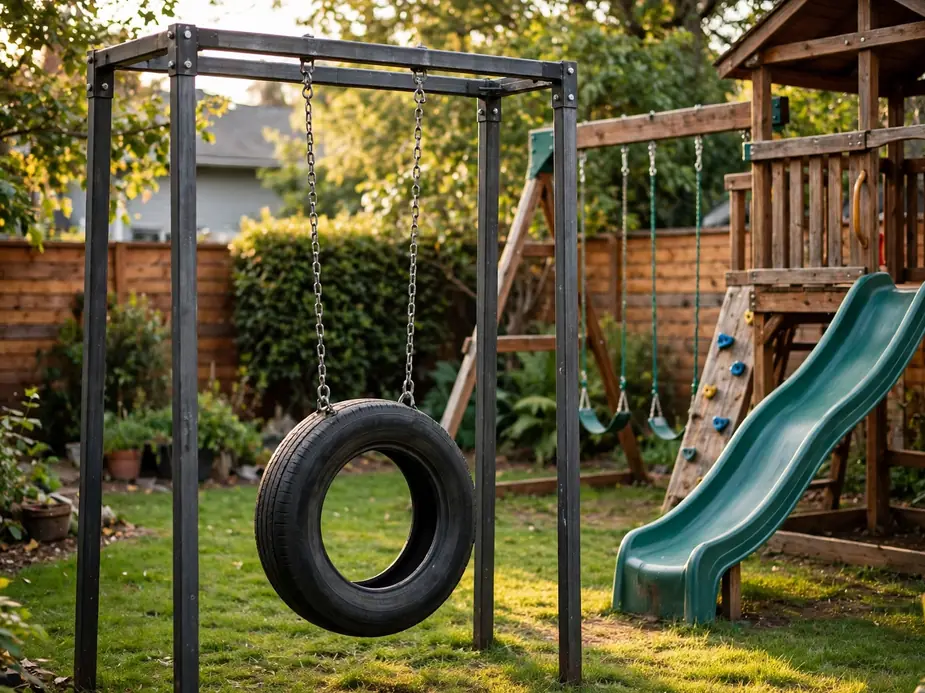
Fit check: One rider at a time under age five; two can share only when their feet both reach the ground to brake.
14. Wobble Bridge Linking the Deck and the Dome
A wobble bridge links two pieces you already own into one traveling course. Run chain-supported planks, about 2.5 meters long and 30 centimeters wide with side hand ropes, between the play deck and the climbing dome at matching heights. The chains fix with locking links at both ends, the planks get anti-slip strips, and the ground below keeps its deep mulch, because wobbling is the point and stepping off is the game. Children who will not cross a still bridge will queue for this one, and their balance improves without a single lesson.
Style note: Stain the planks to match the deck boards and use black chain, and the bridge reads as part of the set, not a repair.
15. Spring Rider Seesaw Built for Two
A spring-mounted seesaw replaces the old fulcrum plank with a heavy steel coil that softens every landing. Choose a two-seat model with handles in front of each saddle and a spring rated for the combined weight of your biggest pair of riders, and bolt the base plate to a concrete pad or ground frame hidden under mulch. The motion stays gentle, no slammed ends and no trapped fingers at a pivot. It is the rare piece toddlers and eight-year-olds negotiate over peacefully, taking turns by weight rather than by argument.
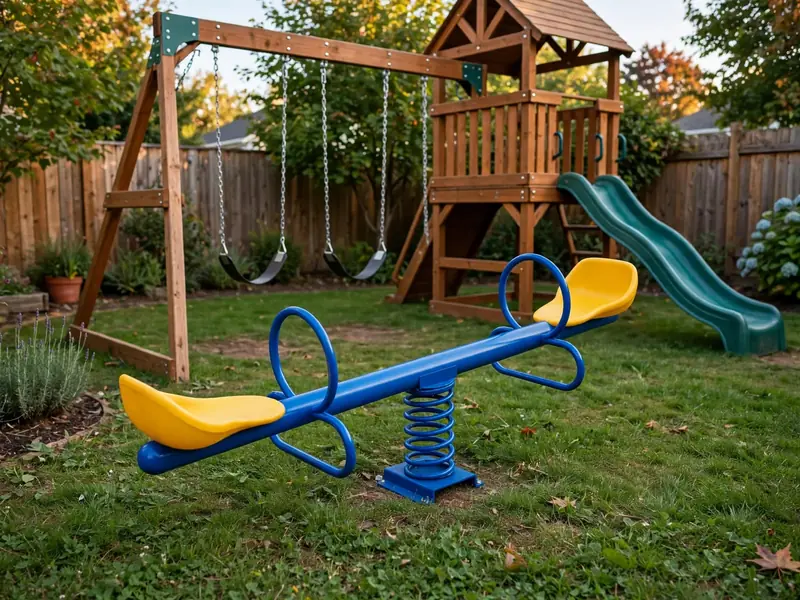
Easy swap: No room for the concrete pad? Choose the ground-frame version that pins into firm soil and lifts out when the lawn needs reseeding.
16. Covered Sandbox Kit with Corner Seats
A sandbox kit earns its place when the cover is built in, not dragged over. Look for a 1.5 meter square timber frame with corner seats, a hinged cover that folds back into two benches, and a mesh base that drains rain while blocking weeds. Fill it with washed play sand to a depth of 15 centimeters, about ten bags, and site it where you can see it from the house but midday sun cannot turn it into an oven. The folding cover keeps cats out and the sand play-ready every single morning.
Seasonal swap: In winter, empty and bag the sand, and the covered box becomes storage for outdoor cushions and the frost-tender pots.
17. Water Play Tower with Chutes and Wheels
A water play tower stacks the fun vertically: a raised tank, hand pumps, spiraling chutes, wheels and tip buckets over two or three levels on a sealed resin frame. Feed it from the garden hose through a pressure regulator, and stand it on paving or gravel with a drain, never on lawn it will churn to swamp. Each chute should empty into the level below, so one bucket works five times before it leaves the tower.
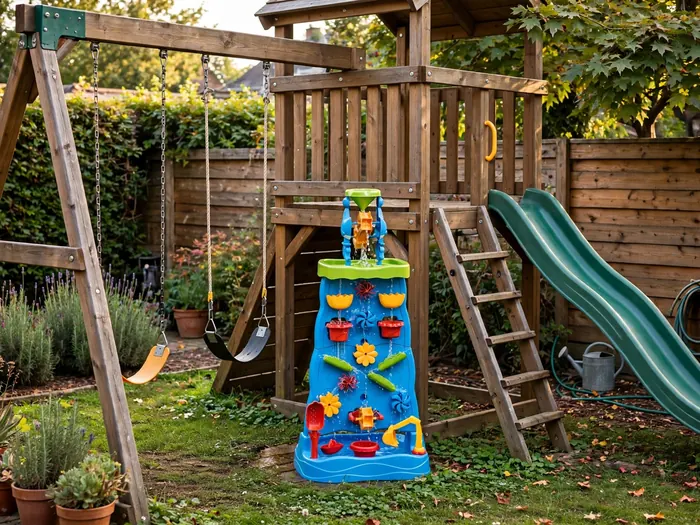
Why it works:
- Gravity does the work, so no batteries or motors ever need drying out.
- Small hands control the flow themselves with pumps, dams and gates.
- On a drained hard surface the play stays soaked and the yard does not.
18. Tetherball Pole in Its Own Circle
A tetherball pole is the smallest full game you can install: a galvanized steel pole set in a concrete footing or a heavy tire base, standing about 3 meters tall, with the ball on its cord hanging to the 2-meter mark. Paint or chalk a 3-meter circle around it and keep that ring clear of everything, including other play gear. In yards styled around natural outdoor playground ideas, a timber-clad pole and rope cord blend the game in surprisingly well. Two players, one ball, endless rematches, and no lost equipment ever.
Budget note: The tire-base version costs the least and moves house with you; the concreted pole is cheaper over ten years of wobble-free play.
19. Volleyball and Badminton Net Across the Lawn
A net across the lawn is the piece teenagers and parents actually share. Choose a set with two steel or fiberglass poles on ground sleeves or weighted bases, a net adjustable between badminton and volleyball height, and boundary lines on straps you can roll out in minutes. Tension the net until the center sags no more than 8 centimeters, and mow a slightly wider strip under it so ankles never turn in hidden tufts. Everything packs into one bag, so the lawn returns to garden the moment the match ends.
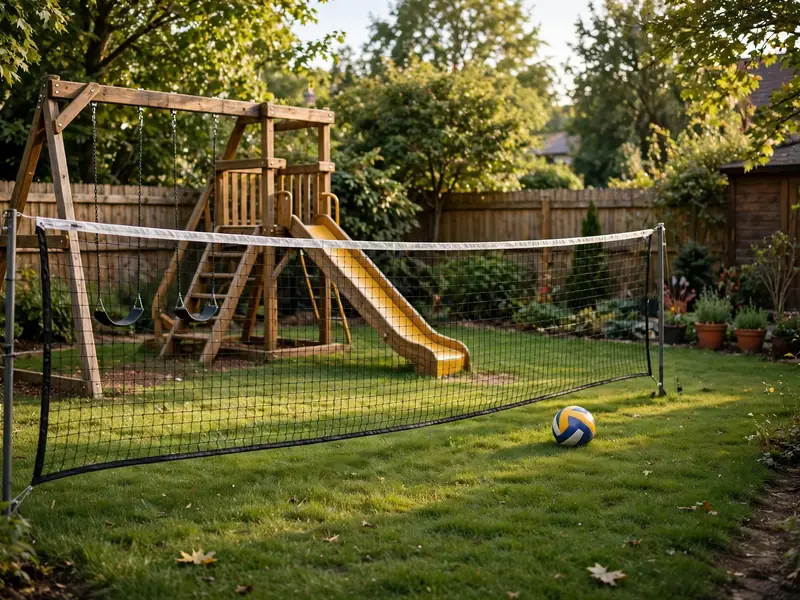
The formula: adjustable-height poles + a tensioned net + roll-out boundary lines
20. Fort Tower with a Flag and a Telescope
A fort tower gives pretend play a permanent address: a raised open tower at about 1.8 meters, reached by steps, with a flagpole on the roof peak and a swivel telescope at the rail. Guard every open side, slope the roof away from the ladder, and anchor the frame like a swing set’s. A rope pulley with a bucket hauls up snacks, messages and the occasional teddy on official business.
Get the look:
- Main piece: a cedar tower frame with a pitched roof
- Supporting piece: a climbing net or ladder on the shaded side
- Texture or material: galvanized hardware and rough-sawn timber
- Finishing touch: a family flag the kids design themselves
21. Bike and Scooter Ramp Set on the Drive
Ramp sets turn the driveway into a skills park: two or three interlocking plastic or plywood ramps, a low launch ramp, a table top and a landing wedge, with rubber feet that grip the paving. Keep heights under 45 centimeters for home use, line ramps up on the flattest stretch of drive, and set a strict rule that the drive closes to cars while ramps are out. Helmets are part of the kit, hung on the same hook as the ramp bag, so the habit never depends on memory or mood.
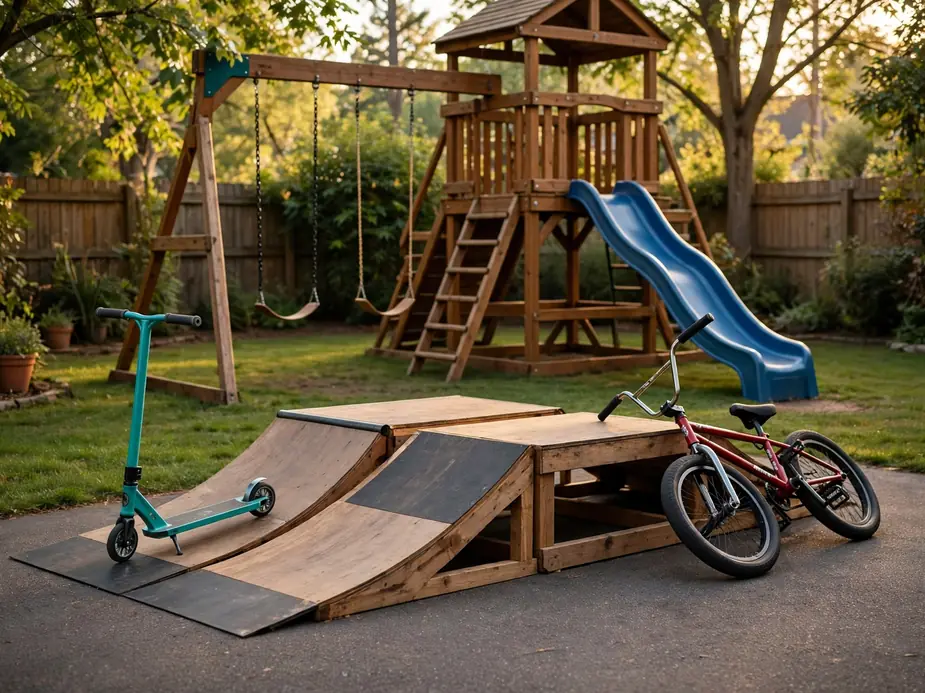
Color note: Charcoal and graphite ramps disappear against asphalt; bright colors are the safer choice if your drive doubles as a play space after dark.
22. Spinner Merry-Go-Round Seat for One or Two
A home spinner borrows the park merry-go-round and scales it to one or two riders: a heavy steel disc on a sealed bearing base, with a central hand wheel or surrounding grab rails, turning at a speed children’s own pushing controls. Bolt or stake the base dead level; a tilted spinner drifts and strains its bearing. The disc should sit low, no more than 30 centimeters up, over your softest surface. Because riders power it themselves, the spinning stays as gentle or as wild as the smallest passenger can enjoy, and it tires them out beautifully.
Texture note: A ribbed, powder-coated disc grips shoes in wet weather far better than smooth steel, and it never gets slippery with sunscreen.
23. Adjustable Gymnastics Bar Set on Posts
A gymnastics bar set on two posts brings the training hall home: a steel bar adjustable between 1 and 1.6 meters, locked with pins at each height, over a pair of proper landing mats. Set the posts in concrete, check the locking pins before every session, and teach the rule that the bar is for supported skills only until a coach says otherwise. Kip, cast and chin-up practice that once needed a gym membership now happens before breakfast, and the bar lowers as smaller siblings take their turn at hanging like bats.
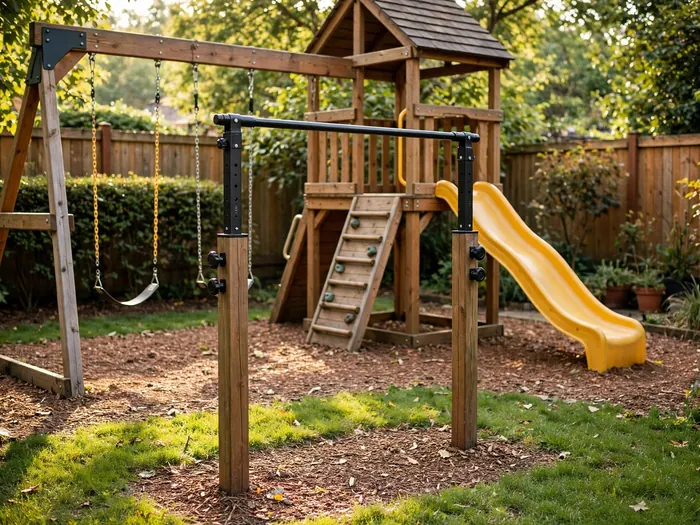
Best for: Children already in gymnastics classes who practice daily and outgrow door-frame bars in a month.