Plastic playsets promise adventure, but within a couple of summers the colors fade, the plastic cracks, and the whole thing glares in the middle of the yard. Meanwhile, the children have wandered off to climb the one real tree, splash in a puddle, or build something out of the stick pile in the corner.
A natural playground takes that hint and builds the play out of the landscape itself. Logs, stone, sand, water and plants become the equipment, arranged in loose zones with soft landings underneath, so the yard stays beautiful for adults and endlessly interesting for kids.
These 30 ideas run from a single log beam you can set in an afternoon to a full nature-play corner built over a season. Nearly all of them use found, grown or inexpensive natural materials, so you can start small and let the playground grow with your family.
The Natural Playground Formula That Keeps Wild Looking Safe
- Build from what the yard already grows: fallen branches, stumps, stones and slopes become the equipment, so nothing looks imported.
- Soft landings under every climb: mulch, sand or grass beneath anything a child can fall from, at least a hand’s depth.
- Loose parts are the toys: sticks, cones, stones and water that children can move, stack and flood keep play new every week.
- Zones, not sprawl: group wild play into two or three corners with paths between, so the garden still reads as a garden.
For example: a log beam and stump trail in one shaded corner (found materials), deep bark mulch under both (soft landing), a basket of cones and sticks beside them (loose parts), and a mown path leading to a sand pit in the second corner (zones) make a playground that looks like the garden grew it.
| # | Idea | Best For | Budget/Effort |
|---|---|---|---|
| 1 | Log Balance Beam Set Low Over Mulch | First climbing confidence | Very low |
| 2 | Tree Stump Stepping Stone Trail | A path that is a game | Low |
| 3 | Boulder Scramble Cluster in a Corner | Big-kid climbing | Mid |
| 4 | Sand Pit Edged with Sawn Logs | Hours of digging and building | Low to mid |
| 5 | Mud Kitchen Built from Pallets and Old Bowls | Messy play, contained | Low |
| 6 | Stick Teepee Wrapped with Climbing Beans | A den that grows | Very low |
| 7 | Sensory Garden Path of Scented Herbs | Toddlers who touch everything | Low |
| 8 | Grass Mound with a Slide Down Its Side | A hill of their own | Mid to high |
| 9 | Rope and Plank Swing from a Strong Branch | The classic, done safely | Low |
| 10 | Digging Patch with Buried Treasure Stones | Archaeologists aged four | Very low |
| 11 | Shallow Water Rill Lined with Pebbles | Dams, boats and floods | Mid |
| 12 | Log Slice Hopscotch Pads Set in the Lawn | Art you can jump on | Low |
| 13 | Woven Willow Hut in a Shady Spot | A secret house | Low to mid |
| 14 | Bug Hotel Stacked from Logs and Bricks | Science on the fence line | Very low |
| 15 | Sunflower House Grown in a Ring | A room that blooms | Very low |
| 16 | Pinecone and Stick Play Shop Counter | Imagination retail | Very low |
| 17 | Rock Painting Station on a Flat Stone | Quiet creative time | Very low |
| 18 | Branch Weaving Loom Between Two Posts | Big weaving, outdoors | Low |
| 19 | Weather Station Post with a Rain Gauge and Thermometer | Little weather watchers | Low |
| 20 | Fairy Garden Tucked Under a Shrub | Small worlds | Low |
| 21 | Log Seesaw on a Stump Fulcrum | Physics by feel | Low |
| 22 | Low Climbing Tree Dressed with a Rope Ladder | The tree everyone remembers | Low |
| 23 | Barefoot Texture Path of Bark, Stone and Sand | Sensory play underfoot | Low |
| 24 | Rain Chain and Puddle Play Corner | Wet days, welcomed | Low |
| 25 | Stump Table and Toadstool Seat Circle | Tea parties and board games | Low to mid |
| 26 | Den Building Kit of Branches and Tarps | Engineering Saturdays | Low |
| 27 | Hammock Slung Between Two Trees | Reading and resting | Low to mid |
| 28 | Clover and Moss Soft Play Lawn Patch | Bare feet all summer | Low |
| 29 | Listening Corner with Wind Chimes in a Tree | Calm sensory play | Low |
| 30 | Children’s Vegetable Patch with Kid-Size Beds | Growing their own snacks | Low to mid |
1. Log Balance Beam Set Low Over Mulch
Start with one straight hardwood log, about 12 feet long and 10 inches across, bark stripped and laid flat-side down so small shoes grip instead of slide. Keep the top of the beam no higher than 12 inches above a bed of bark mulch spread 4 inches deep and raked level. Sink both ends a few inches into the soil so the beam can never roll mid-step, and top up the mulch each spring where feet have kicked it thin. Paint a pair of small footprints at the low end to show beginners exactly where to climb up.
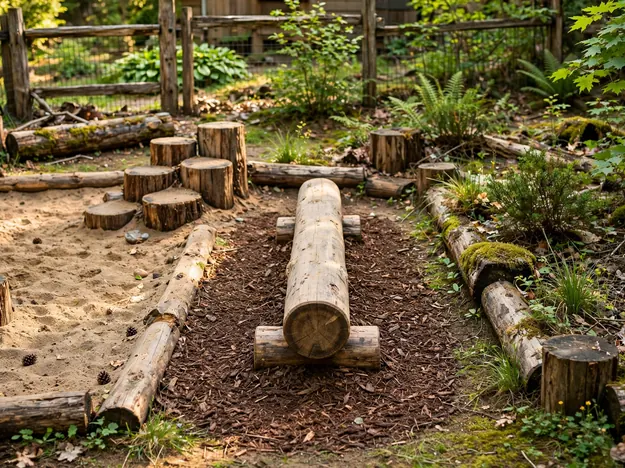
The formula: debarked hardwood log + deep bark mulch bed + buried steady ends
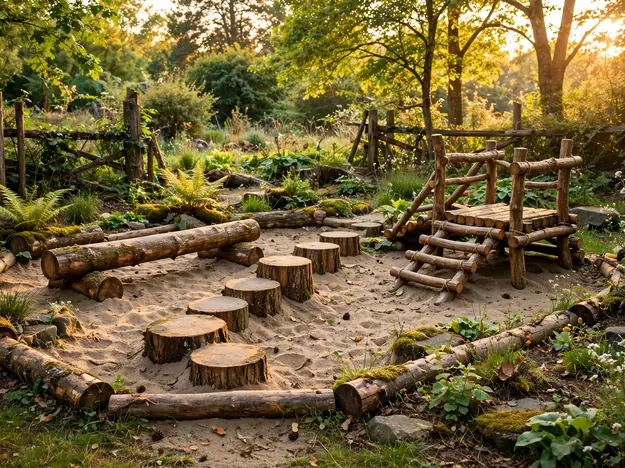
2. Tree Stump Stepping Stone Trail
Slice a fallen trunk into rounds 12 to 18 inches across, or ask a tree surgeon for offcuts, and set them in a loose, wandering line through one corner. Vary the heights between 6 and 14 inches and space the tops one child-stride apart, closer for toddlers. Bury each round a third deep over a gravel base so nothing rocks underfoot, and let grass or mulch, never paving, fill the gaps between.
Get the look:
- Main piece: a wandering row of buried stump rounds
- Supporting piece: gravel bases packed under each stump
- Texture or material: rough bark edges against smooth sawn tops
- Finishing touch: a small pile of pebbles marking the trail’s start
3. Boulder Scramble Cluster in a Corner
Choose five to seven granite or sandstone boulders, 18 to 36 inches across, and cluster them in a quiet corner with the tallest at the back. Half-bury each stone so it cannot shift, stepping the heights up like a rough staircase children can scramble hands-and-feet style. Fill the ground between and around them with pea gravel or deep mulch, and leave one clear approach from the lawn so the scramble reads as a destination, not an obstacle. Older kids will test themselves on it long after the younger ones have moved on.
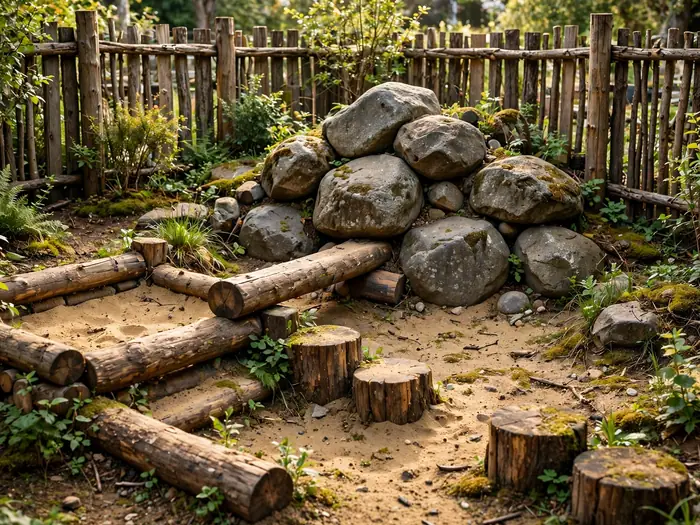
Color note: Cool gray stone warms up beautifully against honey-toned cedar mulch, and a few mossy patches in the shady gaps soften the whole cluster.
4. Sand Pit Edged with Sawn Logs
Mark out a rectangle about 6 by 8 feet, dig down 10 inches, and line the edge with sawn log rounds stood upright like a low palisade. Line the base with landscape fabric, fill with washed play sand to within 2 inches of the rim, and sink one wide log flat at the corner as a sitting and pouring ledge. A fitted tarp or a sheet of plywood laid over the top at night keeps the sand clean and dry.
Texture note: Fine, pale sand against the rough bark of the log edging gives toddlers two textures to pat, pour and compare in one small square.
5. Mud Kitchen Built from Pallets and Old Bowls
Stand two pallets upright against a fence or wall and fix a third pallet plank across the top ends as a counter, about 20 inches high for preschoolers. Screw on a row of hooks for ladles and sieves, set two old mixing bowls into cut holes as sinks, and add a bucket of water beside the counter rather than a running tap. A crate underneath holds muffin tins, old saucepans and wooden spoons, and a patch of bare soil in front gives the chefs their main ingredient. Expect the mud pie menu to change with every season’s ingredients.
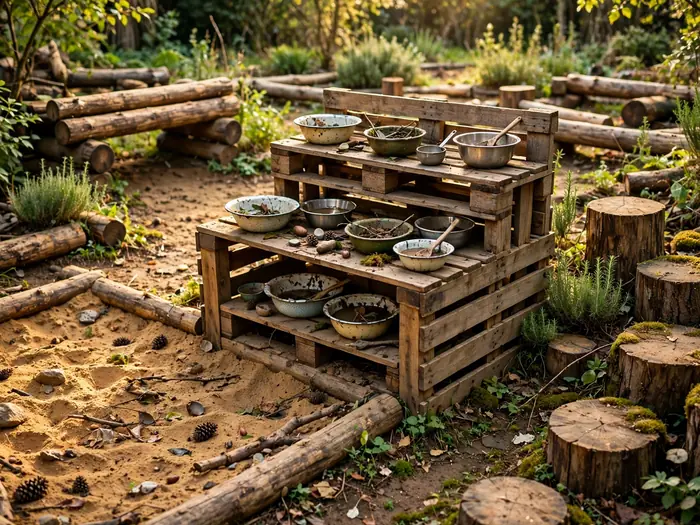
Best for: preschool chefs who love real tools, real water and gloriously messy imaginary cooking.
6. Stick Teepee Wrapped with Climbing Beans
Push six to eight long, straight branches, each 6 to 7 feet, into the soil in a circle about 5 feet across, lean the tops together and lash them with garden twine. Leave one gap wider than the rest as the doorway, and wind extra twine around the frame at knee height to give climbing plants a grip. In spring, plant runner beans or sweet peas at the base of every second pole and train them upward as they sprout.
Space note: The 5-foot circle fits a shady corner neatly, and the whole teepee comes down in minutes once the beans finish.
7. Sensory Garden Path of Scented Herbs
Set a curving line of flat stepping stones through a sunny border, and plant something sniffable or squeezable within reach of every stone. Lavender, lemon thyme, chamomile and soft lamb’s ear are the classic team; brush past them and the path scents itself. Keep everything low and gentle, nothing spiky or brittle, and tuck creeping thyme between the stones so bare feet land on a fragrant cushion. If the beds themselves need fresh thinking, these backyard garden ideas keep planting lush without constant upkeep.
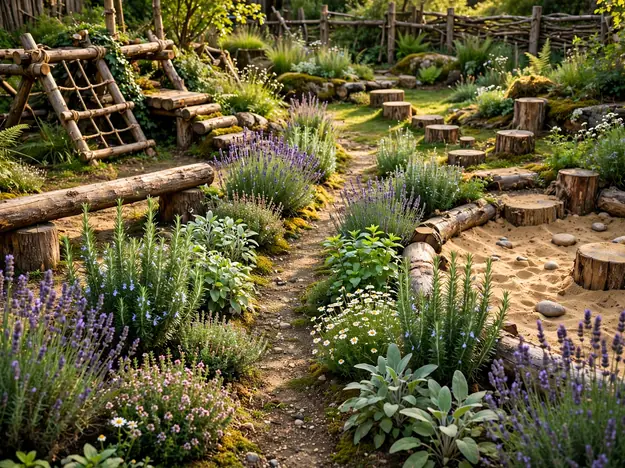
Fit check: Stones should sit dead level and no more than a toddler’s stride apart, or little legs will skip the planting and wade straight through it.
8. Grass Mound with a Slide Down Its Side
Build the mound from clean topsoil piled about 3 feet high and 10 feet across, compact it in layers, then turf or seed the whole dome and let roots knit for a full season before heavy play. Set a wide slide down the gentlest slope with its foot landing on mulch, and keep the other slopes slide-free for rolling, sitting and winter sledding. A couple of flat boulders part-buried at the base give climbers a start and stop the soil edge crumbling.
Style note: A smooth green dome reads as garden sculpture from the patio, especially with one ornamental grass clump planted at its crown.
9. Rope and Plank Swing from a Strong Branch
Pick a live, healthy branch at least 8 inches thick and 8 to 10 feet up, and have it checked if you are unsure of its strength. Hang two lengths of weatherproof rope over the branch on wide straps that protect the bark, and tie them to a smooth sanded plank seat about 20 inches wide with a hole at each corner. Leave at least 6 feet of clear, mulched swing space front and back, and check the knots and rope for fraying every spring.
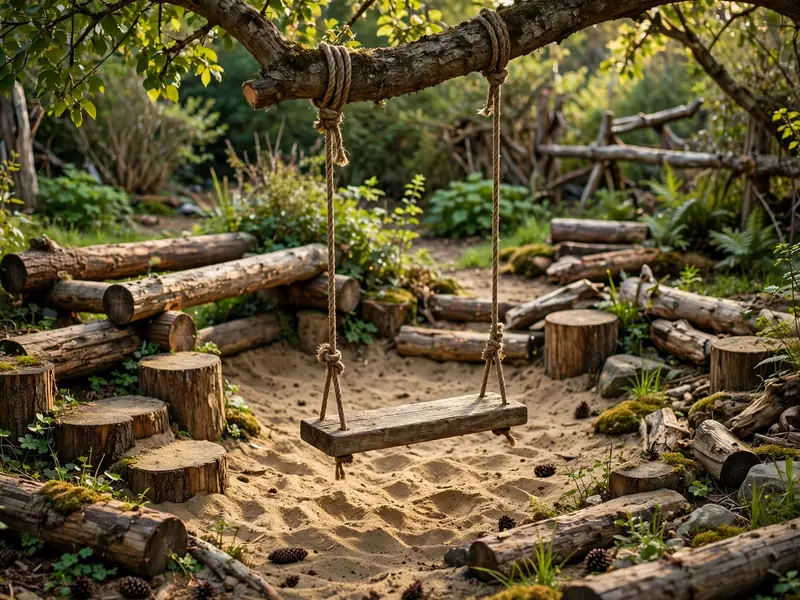
Easy swap: Trade the plank for a round disc seat on a single rope when the children are ready for spinning as well as swinging.
10. Digging Patch with Buried Treasure Stones
Choose a corner the lawn will not miss, about 4 feet square, and dig it over deeply, picking out sharp stones and roots. Edge it with logs or bricks so the patch reads as a deliberate digging zone, not a worn-out lawn, and refill it each spring with a barrow of fresh soil and sand mixed half and half. Bury a dozen polished treasure stones, a few big shells and one waterproof capsule just under the surface, and rebury them quietly whenever they have all been found.
Seasonal swap: In autumn, swap buried stones for conkers and acorns, and let winter rain pack the patch ready for spring digging.
11. Shallow Water Rill Lined with Pebbles
Dig a shallow channel, no more than 4 inches deep, winding 10 to 15 feet down the gentlest slope in the yard, and line it with smooth river pebbles set in a sand bed. Feed it with a slow hose trickle, a rain barrel tap, or buckets carried by the children themselves, and finish it in a wide pebble basin where the water spreads and soaks away. This is the playground feature that changes every single visit, dammed, bridged and flooded with sticks and leaves.
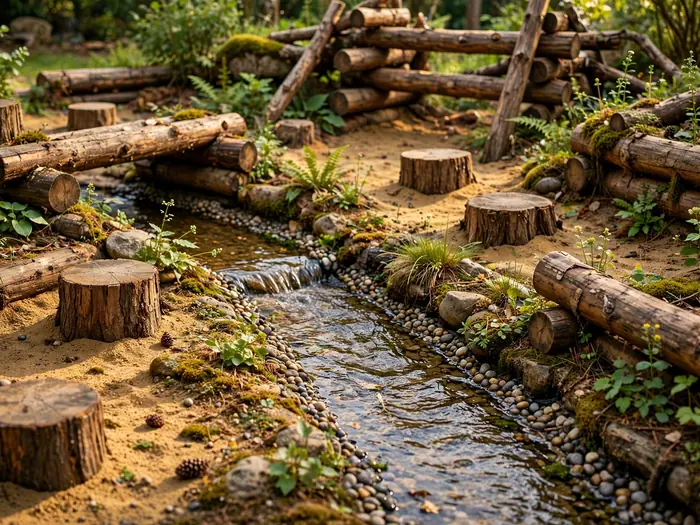
Why it works:
- Moving water invites experimenting, not just splashing
- Pebbles and dams turn one channel into endless games
- The shallow depth keeps the whole thing safely self-run
12. Log Slice Hopscotch Pads Set in the Lawn
Cut or buy ten log slices, 12 to 14 inches across and 2 inches thick, sand the tops smooth, and paint or burn a number onto each one. Set them in the classic hopscotch pattern sunk flush with the lawn so the mower passes straight over, each pad bedded on a little gravel so it drains instead of rotting. Seal the painted tops with outdoor varnish once a year, and the course quietly doubles as a stepping route across wet grass in winter.
Budget note: A tree surgeon will often give slices away free; your only real cost is a small tin of outdoor varnish.
13. Woven Willow Hut in a Shady Spot
Push ten to twelve living willow rods, each about 8 feet long, a foot into the ground in a circle 6 feet across, spacing them a hand’s width apart. Bend the tops inward, weave them together and tie the dome with twine, then weave thinner willow whips horizontally through the uprights in and out, like a basket. Leave a low doorway gap facing the house, water the rods deeply through their first summer, and by the second year the hut leafs out into a green, whispering room.
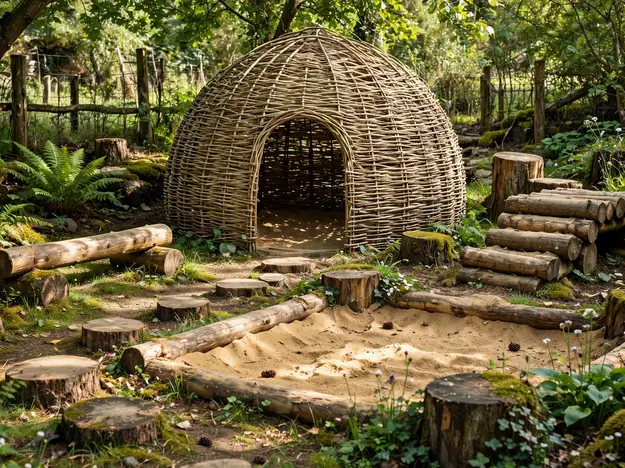
The formula: living willow rods + woven willow whips + one low doorway gap
14. Bug Hotel Stacked from Logs and Bricks
Stack the hotel on a dry, sunny fence line: two bricks as feet, then layers of log sections drilled with holes, bundles of hollow stems and pinecones packed into an old crate or between planks. Angle a slate over the top so rain runs off, and let the layers look slightly uneven; the insects are not judging. It earns its keep in any corner planned around small garden ideas that make tiny spaces work harder.
Get the look:
- Main piece: a crate of drilled log sections
- Supporting piece: brick feet lifting it off damp ground
- Texture or material: hollow stems, cones and bark layers
- Finishing touch: a slate roof tilted against the rain
15. Sunflower House Grown in a Ring
Sow two staggered rings of giant sunflower seeds, or plant one ring 5 feet across and leave a gap for the door. Mix in a few runner bean or morning glory plants at the base of the tallest stems and train them across string stretched between the tops to start a living roof. Inside, lay a circle of bark mulch and one flat stone as a floor, and the house is ready when the flower heads open above head height, usually by midsummer.
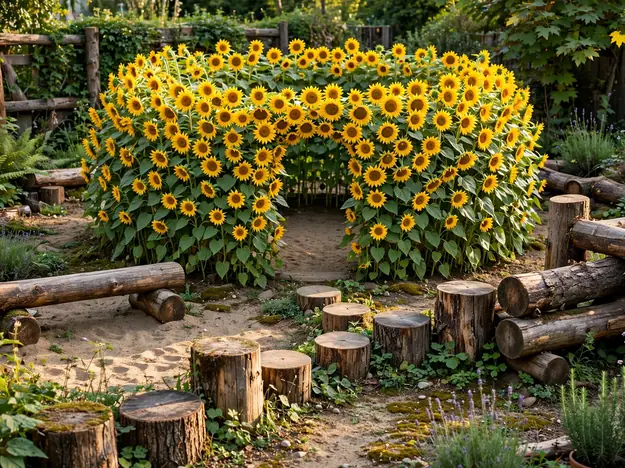
Color note: All that gold and green needs one calm contrast, so keep the inside floor plain brown mulch and skip extra planting inside.
16. Pinecone and Stick Play Shop Counter
Build the counter from a wide plank laid across two stumps at child waist height, with a lower plank shelf beneath for stock. On top, arrange the shop’s whole inventory by texture: a basket of pinecones, a bowl of smooth pebbles, a pile of stick bundles tied with twine and a jar of acorns. A flat piece of bark propped up makes the price board, chalked fresh each morning, and a small log round beside the counter serves as the till stool for the shopkeeper on duty.
Texture note: Spiky cones, silky pebbles and rough bark side by side are the whole curriculum here; hands learn more than eyes do.
17. Rock Painting Station on a Flat Stone
Choose one big, flat-topped boulder or lay a wide paving stone at knee height in a shady corner, and brush it clean as the studio table. Set a basket beside it holding smooth river pebbles gathered on walks, a jar of water, two or three brushes and a small set of acrylic paint pens that will not spill. Finished rocks go to dry along the stone’s edge, then migrate to the garden as markers, gifts and hidden surprises for visitors to find among the plants.
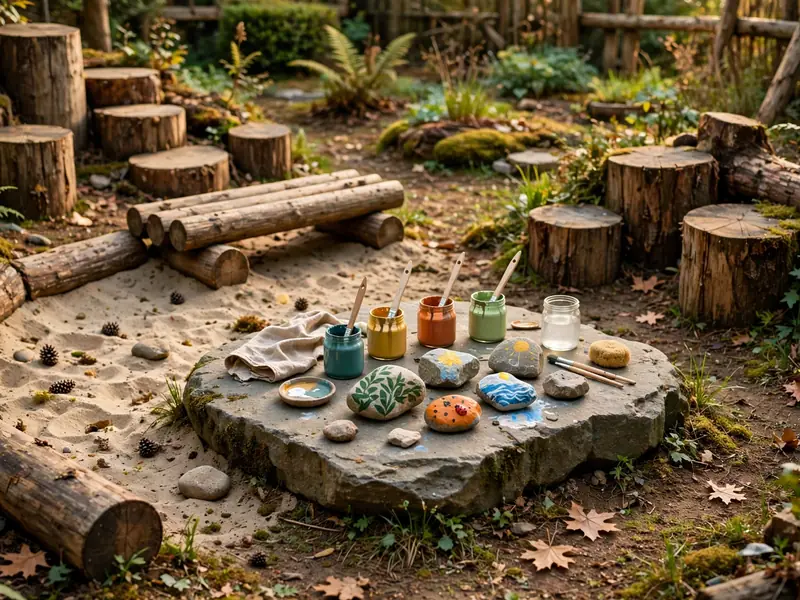
Best for: the child who prefers a quiet corner and a small, finished thing to take home.
18. Branch Weaving Loom Between Two Posts
Set two sturdy posts 4 feet apart and a full stride from any path, with a top and bottom crossbar of straight branches lashed or screwed between them. Tie vertical warp strings, garden twine or thin rope, from bar to bar every 3 inches, pulled firm but not drum-tight. Weavers pass long grasses, fern fronds, wool scraps and flexible willow through the strings over-under style, working upward from the bottom bar, and the finished weaving can stay as garden art or be unpicked and started again.
Space note: The loom needs only a 4-foot gap between posts, so it tucks neatly along a fence line or the side of a shed.
19. Weather Station Post with a Rain Gauge and Thermometer
Sink a straight, peeled post about 4 feet tall in the sunniest open patch, away from walls and overhanging branches that would skew the readings. Fix a rain gauge to the top where small hands can lift it out to read, a simple thermometer on the shaded north face, and a ribbon windsock or a string of small flags below to show the wind. A clipboard in a plastic sleeve hangs on a hook for the daily log, turning weather watching into a small, serious ritual.
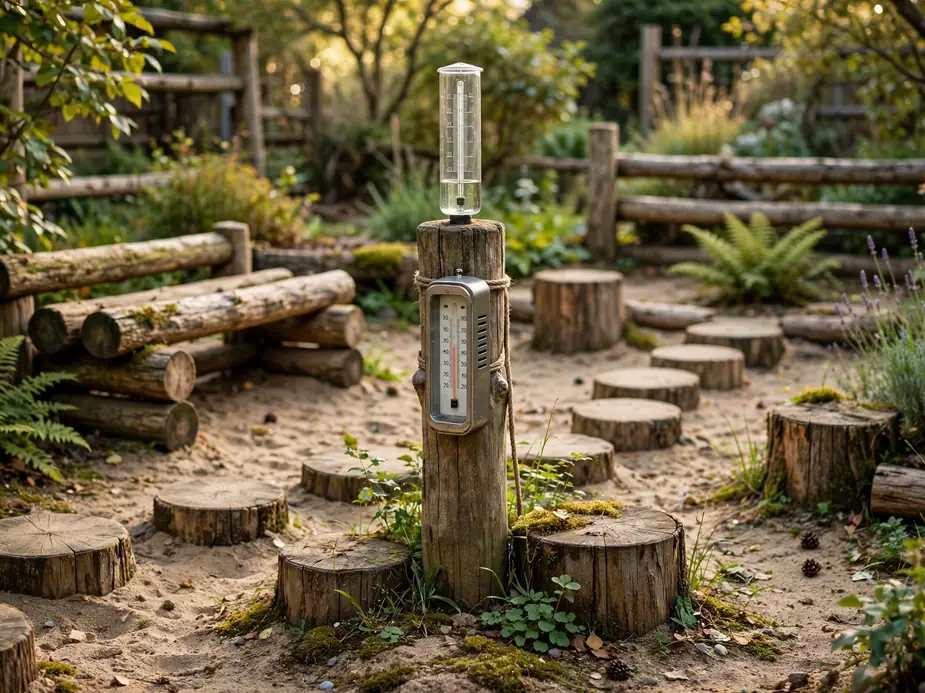
Fit check: Set the gauge at a height the youngest watcher can read without climbing; the post can grow with them via a taller replacement later.
20. Fairy Garden Tucked Under a Shrub
Pick the sheltered hollow under a shrub where the light is dappled and the soil stays cool, and clear a patch about 2 feet across. Build the world from what the garden offers: a bark-roofed house against the trunk, a pebble path, an acorn-cap bowl, tiny stick fences and a moss lawn pressed gently into place. Add one small bought or handmade door against the trunk if you like, but let found materials do the rest, and refresh the scene after storms as part of the game.
Style note: Keeping everything one natural palette, bark brown, stone gray, moss green, is what makes it read as a hidden world, not a toy spill.
21. Log Seesaw on a Stump Fulcrum
Choose a wide, solid stump about 18 inches high as the fulcrum and set it dead level on firm, mulched ground. Lay a strong, smooth plank, 8 to 10 feet long, across the top so it tips freely both ways, and fix a shallow notch or two battens underneath to stop it sliding sideways off the stump. Sand the ends smooth as handholds and keep the landing zone clear of stones and roots. Families comparing setups often pair a seesaw like this with other backyard playground ideas built the same low-tech way.
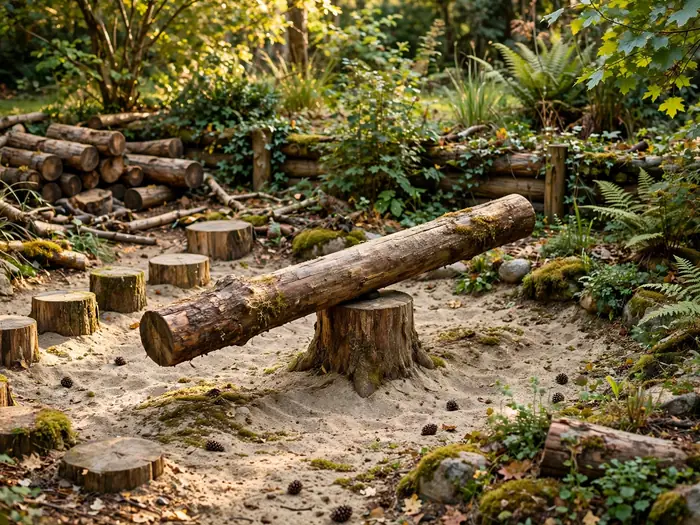
Easy swap: Rest the plank on a fat log laid sideways instead of a stump for a gentler, slower tip.
22. Low Climbing Tree Dressed with a Rope Ladder
Choose a mature tree with a first branch no higher than 4 to 5 feet and limbs thick enough to hold an adult without flexing. Hang a rope ladder from that first strong branch, tied so it cannot slip sideways, and let its bottom rung hang just above a deep mulch bed. Teach the house rules early: one climber at a time, dry bark only, and no higher than the ribbon you tie at the agreed ceiling until next year. For many families, this becomes the tree every childhood story starts from.
Seasonal swap: In autumn, hang a small basket on a lower branch for collecting the tree’s own seeds and fallen treasures.
23. Barefoot Texture Path of Bark, Stone and Sand
Lay a gently curving path, about 18 inches wide, divided into short sections like stepping chapters: smooth river pebbles first, then soft bark mulch, then cool sand, then a stretch of flat flagstones, finishing on springy moss or clover. Separate each section with a half-buried log edging so the materials stay in their lanes, and keep every surface no more than a couple of inches deep so small feet feel the change, not a trip hazard.
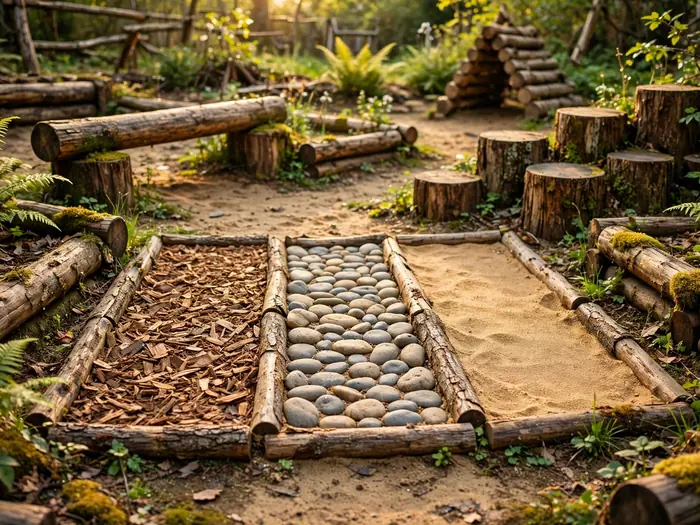
Why it works:
- Each texture wakes up balance and foot strength differently
- Short sections let toddlers choose and repeat favorites
- Natural materials make the path free to refresh
24. Rain Chain and Puddle Play Corner
Hang a simple rain chain from the gutter corner nearest the play area, guiding roof water down into a shallow pebble basin instead of a hidden drain. Around the basin, lay a ring of flat stones as splashing territory and add a couple of sturdy buckets, a watering can and guttering offcuts for channeling the flow. On dry weeks the corner still works as a stone-and-bucket station, but after rain it becomes the yard’s busiest address, so site it where wet feet on the path will not matter.
Budget note: A basic chain and a barrow of pebbles cost very little, and the water itself is delivered free by the weather.
25. Stump Table and Toadstool Seat Circle
Set one broad stump, 24 to 30 inches across and about 18 inches high, as the table, sawn level and sanded smooth on top. Around it, place four to six smaller stump seats, 10 to 12 inches high, in a loose circle on a mulch or gravel pad so chairs never wobble on wet grass. Angle the whole circle into dappled shade, close enough to the kitchen door for tray-carrying, and the set seats tea parties, board games, homework and grown-up coffee with equal ease, and it quickly becomes the spot everyone drifts to while dinner cooks.
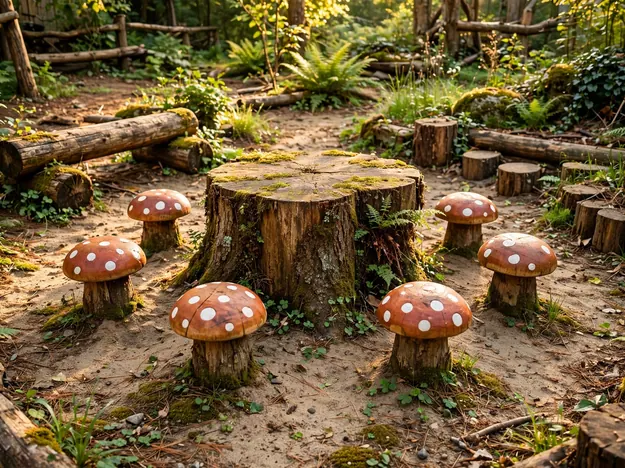
The formula: one broad stump table + ring of stump seats + dappled shade overhead
26. Den Building Kit of Branches and Tarps
Store the kit in a lidded crate by the back door: eight to ten long, forked branches, two tarps, a bundle of ropes and bungee cords, and a fistful of clothespins. The forked branches lean against a tree, fence or each other as the frame, tarps throw over as roof and walls, and ropes lash the joints where engineers insist on doors. Everything packs into the one crate, which is the secret of its popularity with parents.
Get the look:
- Main piece: forked branches for the frame
- Supporting piece: two tarps as roof and walls
- Texture or material: rough bark against smooth tarp canvas
- Finishing touch: clothespins clipping the doorway tarp open
27. Hammock Slung Between Two Trees
Choose two sturdy trees 10 to 12 feet apart, or one tree and a sunk post, and fit wide tree straps at about 5 feet high so the bark is never cut by rope. Hang a plain woven hammock with a gentle sag, its lowest point about 18 inches off a soft grass or mulch landing, and test it with an adult’s weight before any child climbs in. Keep its swing path clear of planters, and unclip it in storms so it lasts for years. It quickly becomes the most argued-over seat in the garden.
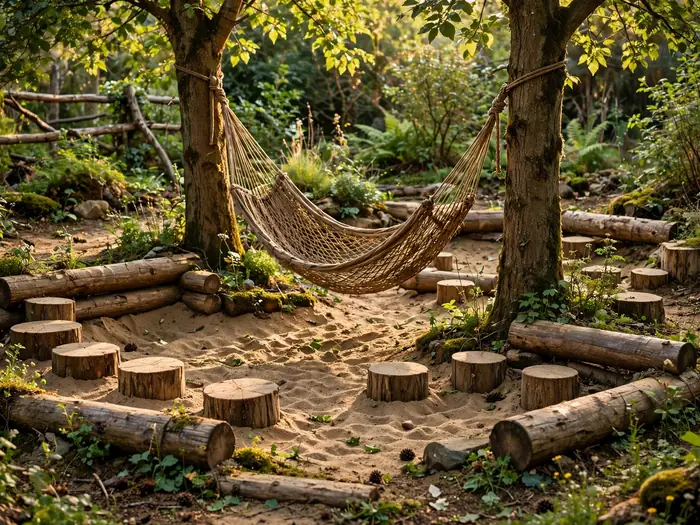
Color note: Undyed cream or sage canvas disappears into the greenery, while a striped one turns the corner into a cheerful focal point.
28. Clover and Moss Soft Play Lawn Patch
Retire the most worn, shady corner of lawn and overseed it thickly with white clover, which stays green in drought, feeds the bees and feels cool and springy under bare feet. In the dampest edges, encourage moss instead of fighting it, pressing transplanted moss pads into bare soil and misting them through dry spells. Keep the patch unmown or mow it high and rarely, edge it with a clean log border so it reads as chosen, and let it become the default spot for picnics, babies and cloud-watching.
Texture note: Clover’s soft leaf mat over moss’s velvet makes the gentlest landing in the whole garden for crawlers and tumblers.
29. Listening Corner with Wind Chimes in a Tree
Hang two or three chimes of different voices, bamboo for a soft knock, metal tubes for a clear ring, in the branches of one tree at the quiet end of the yard. Underneath, arrange a semicircle of stump seats on mulch facing into the garden rather than the fence, and plant rustling grasses and a lavender bush nearby so scent and sound arrive together. Keep every other play zone at the far end of the yard; the corner only works if the loud games happen somewhere else. Many children claim it as their thinking spot within the first week.
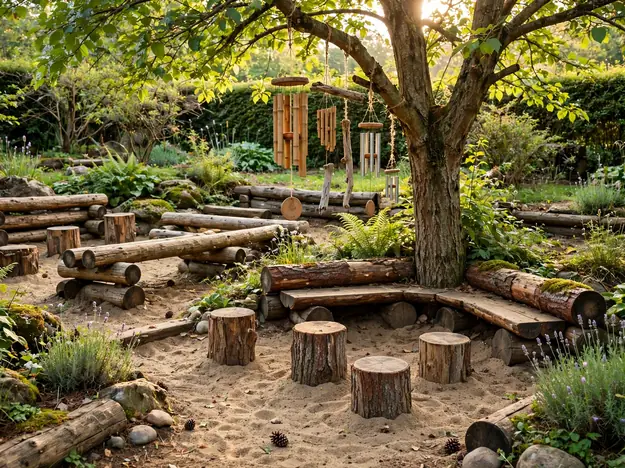
Best for: overwhelmed little ones who need a calm reset without going indoors.
30. Children’s Vegetable Patch with Kid-Size Beds
Build two or three raised beds at child scale, no more than 3 feet wide and 12 inches high, from untreated boards or stacked logs, with paths wide enough for a small wheelbarrow. Fill with good topsoil and compost, and give each child one bed or one end as truly theirs to plan. Fast, forgiving crops teach the patience: radishes in a month, beans up a stick teepee, pumpkins that take over by September, and strawberries that reward anyone who remembers to look under the leaves.
Space note: Three small beds plus paths fit a 10-by-10-foot sunny patch, and one bed alone still works on a patio edge.