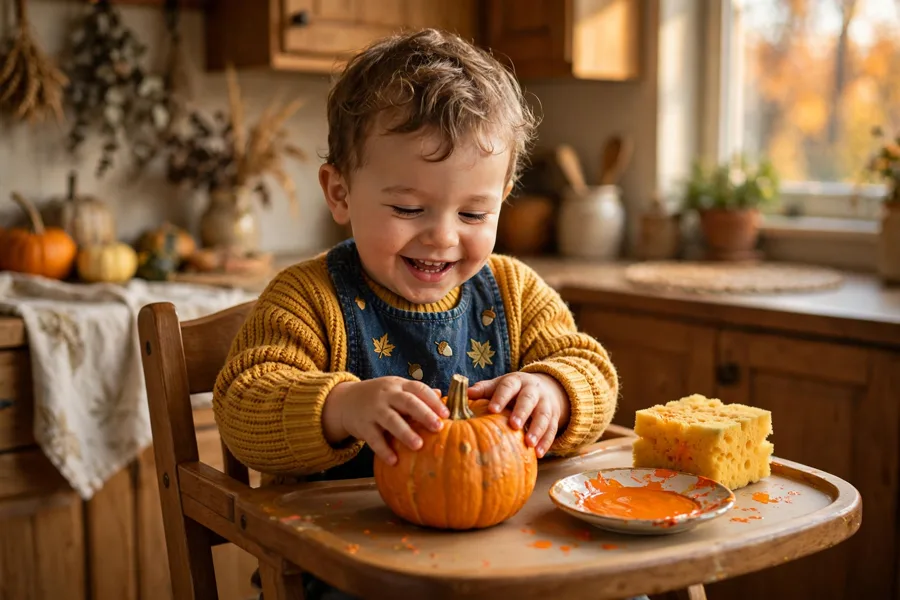
Most pumpkin crafts fall apart with a toddler in the first two minutes. The stickers are too small to peel, the glue bottle becomes a drink, and the “easy” painted pumpkin ends up decorating the couch instead. At this age, a craft has to survive being grabbed, mouthed, squeezed, and abandoned mid-step — and almost everything in a standard craft kit fails that test.
The versions that work flip the setup. An adult quietly handles anything sharp, tiny, or permanent beforehand, and the toddler only ever touches pieces bigger than their own fist, paints that rinse off with water, and steps that show a result in under a minute. If it can be squished, stacked, rolled, washed, or pressed, a one-to-three-year-old can genuinely do it themselves.
Here are 12 pumpkin crafts built exactly that way: taste-safe where it counts, washable everywhere, and finished before attention runs out. Most need one real mini pumpkin plus basics from your kitchen. For more seasonal inspiration in the same gentle style, this roundup of pumpkin crafts for toddlers shows the approach working beautifully.
The Toddler Pumpkin Formula That Keeps Craft Time Looking Sweet Without Sticky Chaos
- Start on a tray: every activity lives on one rimmed tray or baking sheet, so paint, water, and pieces have a visible border and you can carry the whole thing away in one trip.
- Choose washable and taste-safe: stick to finger paints and food-based doughs in just two or three colors — orange, green, and white tell the whole pumpkin story.
- Size every piece up: if a piece is smaller than your toddler’s fist, an adult handles it; toddlers get whole pumpkins, chunky sponges, and foam shapes they can hold in a whole palm.
- Keep one part resettable: a pumpkin that can be wiped clean, restacked, or re-rolled lets the same activity run three times in a row, which is exactly how toddlers prefer to play.
Put together, that looks like one mini pumpkin on a grey tray, a saucer of orange washable paint, a chunky sponge, and a towel underneath — two minutes to set up and one rinse to clear away.
| Safety Check | Why It Matters | Quick Fix |
|---|---|---|
| Every piece bigger than a toddler fist | Anything smaller will be mouthed and tested | Swap small parts for palm-sized foam, felt, or fabric |
| Washable or food-based materials only | Paint will reach skin, clothes, and probably a sleeve | Use washable paint and edible dough; skip glitter entirely |
| Adult preps cuts, lids, and adhesives | Toddlers should never hold scissors, knives, or glue | Do every prep step before your toddler sits down |
| Sessions of 5 to 10 minutes | Longer steps lose a one-to-three-year-old completely | One pumpkin, one material, one clear action per session |
1. Pumpkin Washing Station
Fill a shallow tub with warm water and one drop of gentle soap, set a real mini pumpkin inside, and hand your toddler a big sponge and a soft brush. They scrub the pumpkin’s ribs, dunk it, lift it out, and pat it dry with a small towel, then most will immediately put it back in and start again. It is part bath time, part car wash, and entirely at their pace. The honest trade-off is wet sleeves: roll them up past the elbow first, and keep a dry towel within your reach, not theirs.
Best for: warm afternoons on a porch, patio, or kitchen floor with a towel underneath.
2. Paint-in-a-Bag Pumpkin Picture
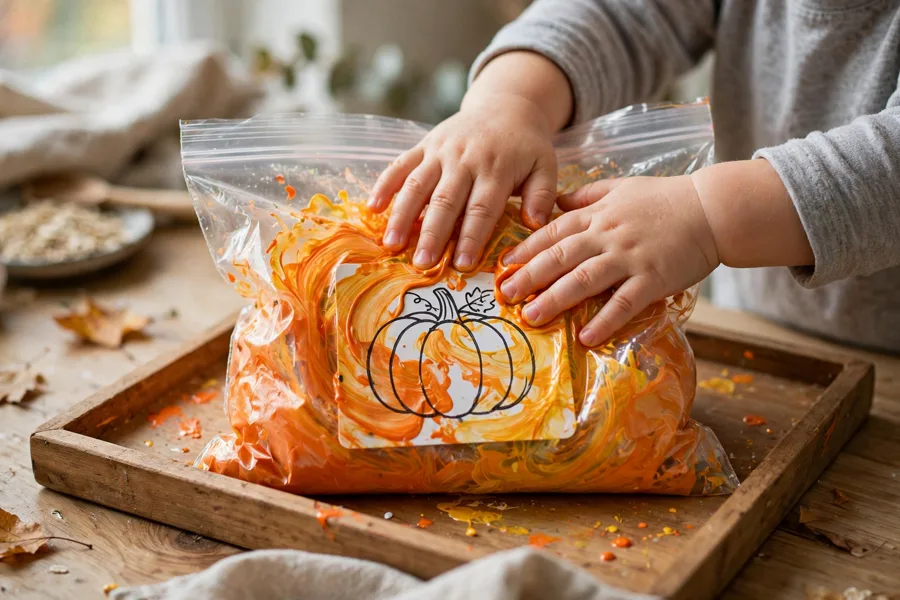
Draw a fat pumpkin outline on thick white card and slide it into a large zip-top freezer bag. Squeeze in three blobs of washable paint — orange, yellow, and a little green near the stem end — using a paint adults control, like the Melissa & Doug Washable Poster Paint Set, $13.99, whose flip-cap bottles make dispensing tidy. Seal the bag, tape the seal down, and let your toddler press, pat, and drag the colors around through the plastic. The picture fills in with zero paint on hands, clothes, or floor, and when your toddler naps, older siblings can move on to these kindergarten fall activities.
The formula: card pumpkin inside a sealed bag + three blobs of washable paint + small hands squishing from outside.
3. Jumbo Dot Dabbing
Pour a shallow puddle of orange washable paint into a saucer, clip a cotton ball into a spring clothespin for a chunky handle, and set a real mini pumpkin on the tray. Show one dab — press, lift, dot — and hand it over. Your toddler covers the pumpkin in big soft dots, then usually graduates to joyful smearing, which is fine. Work on green dots last, near the stem, so the pumpkin still reads as a pumpkin. Expect the dots to merge into patches; at this age the dabbing itself is the achievement, not the pattern.
Fit check: choose a pumpkin your toddler can steady with one whole hand — about 4 inches across — big enough to grip, light enough to be safe if it tips off the tray.
4. Handprint Pumpkin Keepsake
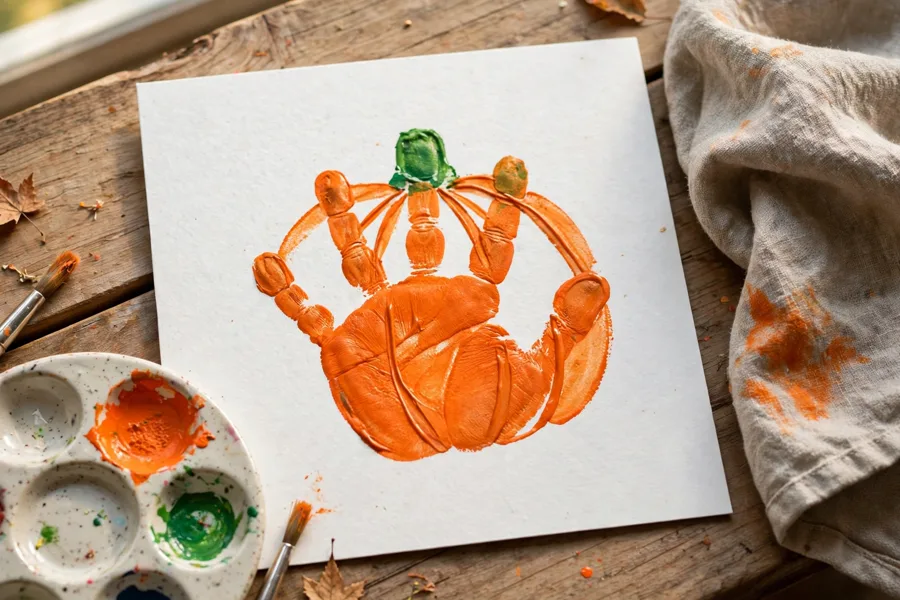
An adult paints the toddler’s palm and four fingers with orange washable paint, leaving the thumb clean, then presses the hand flat onto thick white card. Lift straight up, and the spread fingers become pumpkin ridges. Once dry, the adult adds a green thumbprint stem at the top and writes the name and year underneath. Make two prints: toddlers move, and the second attempt is nearly always the keeper. This is the one craft from the list that grandparents will actually frame, so it earns its small extra effort on a quiet morning.
Why it works:
- The toddler’s whole job is one press, which matches a two-year-old attention span
- Washable paint means the hand is clean before the print is even dry
- It turns a fleeting stage — that tiny hand — into a dated autumn keepsake
5. Feed-the-Pumpkin Posting Box
Cut a wide slot, about 5 inches long, in the lid of a big cardboard box and draw a pumpkin face around it, so the slot becomes the pumpkin’s open mouth. Set out five or six palm-sized pumpkins cut from thick foam, each at least 4 inches across so nothing fits whole into a small mouth. Your toddler feeds them through the slot one by one, listening for the soft thud, then lifts the lid to fish them all out and start again. The trade-off: foam pumpkins get chewed and grubby fast, so choose washable foam, and tape the slot edges so the raw cardboard cannot scratch little hands.
Budget note: the box is free from any delivery, and a single sheet of craft foam makes the whole set of pumpkins for about a dollar.
6. Soft Pumpkin Bowling
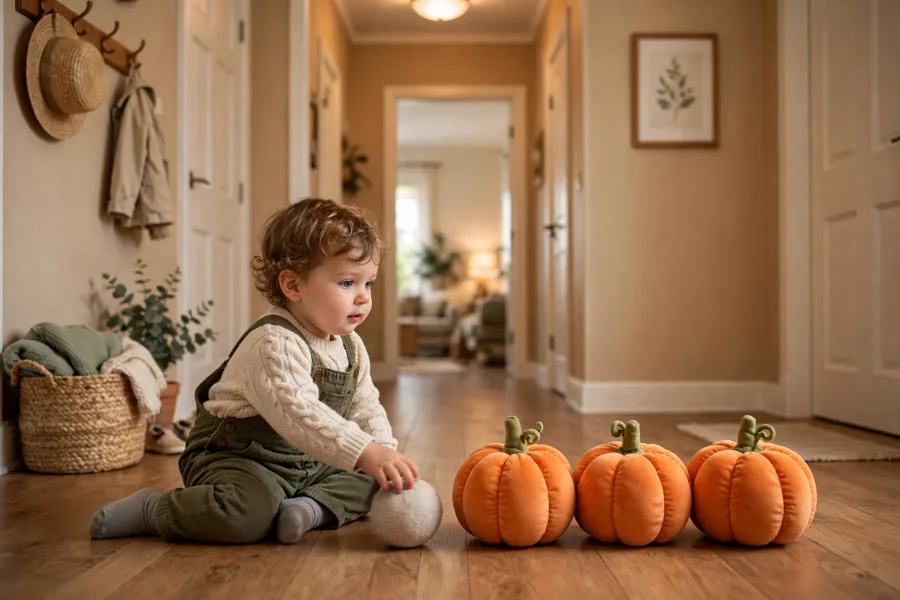
Line up three plush pumpkins as pins at the end of a short hallway or against the sofa, sit your toddler about four feet away with a soft fabric ball, and let them roll. Every knockdown gets a reset from you and an immediate retry from them. Use the same soft pumpkins from the stacking tower so there is nothing new to buy and nothing hard to be thrown — and at this age, something will eventually be thrown. Shorten the lane whenever success dips; a toddler who knocks pins down every second roll will happily play for ten minutes.
Texture note: fleece pumpkins and a squishy ball keep every surface soft, so the whole game is safe on bare feet, wooden floors, and crawling younger siblings.
| Activity Type | Likely Mess | Contain It With |
|---|---|---|
| Water play (washing, rinsing) | Splashed sleeves and a wet patch of floor | Rolled sleeves, a towel mat, and a shallow tub |
| Paint (bag, dots, handprints) | Paint on hands and tray edges | A rimmed tray and washable paint only |
| Dough play | Crumbs and one sticky tabletop | The tray again, plus a five-second sweep after |
| Scooping a real pumpkin | Stringy pulp everywhere it lands | Do the whole activity inside an empty storage tub |
7. Taste-Safe Pumpkin Dough
An adult mixes this before craft time: about 1 cup of canned pumpkin puree stirred into roughly 2 cups of cornstarch with a pinch of pumpkin spice, kneaded until it holds together like soft clay. It smells like pie and is made entirely of food, so the inevitable taste-test is a non-event. Your toddler pokes it, squeezes it through their fingers, flattens it with a palm, and presses the bottom of a cup into it to make “pumpkins.” The dough dries out within a day or two; keep it in the fridge and revive it with a spoonful of puree.
Easy swap: swap the pumpkin spice for a drop of vanilla and the same dough becomes a plain scented dough for any season’s shapes.
8. Big-Piece Foam Pumpkin Faces
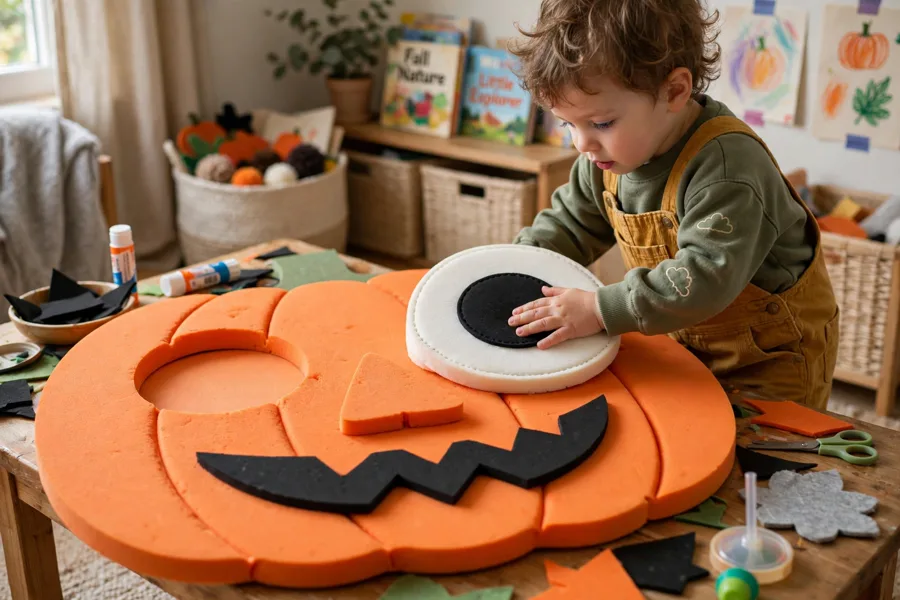
Start with a large flat foam pumpkin, about 10 inches tall, in bright orange. The face pieces are oversized foam shapes — two round eyes, a triangle nose, and a wide smiling mouth, each 3 to 4 inches across — with hook-and-loop dots an adult has stuck to their backs beforehand. Your toddler presses a face on, peels it off, and builds a sillier one, all with pieces far too big to be a hazard and no glue anywhere near their hands. It is the big-piece toddler version of the shape play in this kindergarten fall learning guide, scaled down to palm size and patience size.
Space note: the flat pumpkin stores in a folder or leans in a bookcase between sessions, so the face game lives at toddler height, ready to restart.
9. Scoop-and-Pour Pumpkin
An adult cuts the top off a medium pumpkin and removes every loose seed beforehand, since seeds are a choking hazard at this age. What stays is the stringy pulp, and that is your toddler’s material: they scoop it out with a big spoon and their hands, drop it into a bowl, then pour and spoon it back in again. Do the whole thing with the pumpkin sitting inside an empty storage tub so the strings land in one washable place. It is the messiest craft on this list by a distance — and for many toddlers, the absolute favorite.
Get the look:
- Main piece: one opened pumpkin with seeds removed by an adult
- Supporting piece: a big spoon and a toddler-sized bowl
- Texture or material: cool, stringy, slippery real pumpkin pulp
- Finishing touch: the pumpkin lid placed back on top like a hat at the end
10. Frozen Pumpkin Rescue
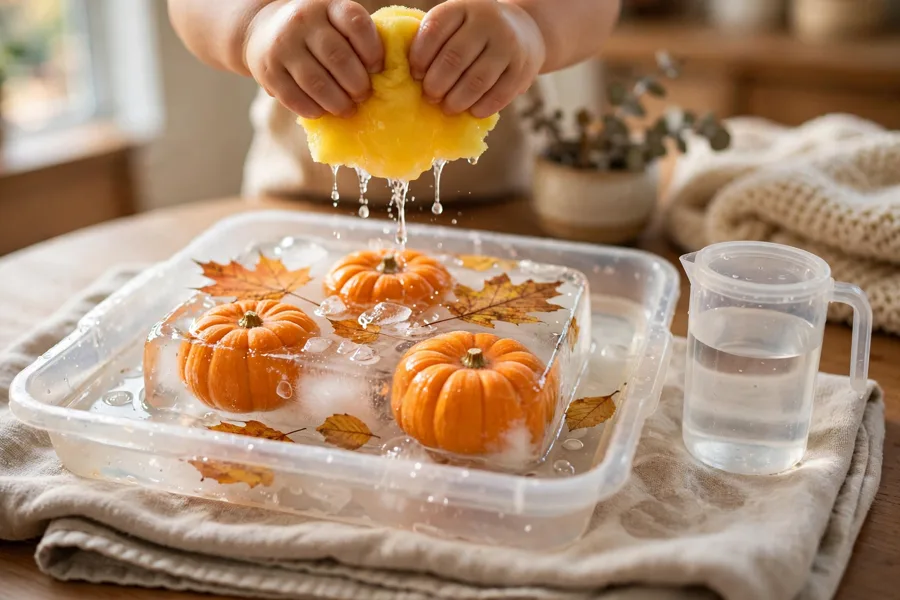
The night before, freeze three or four mini pumpkins and a few big autumn leaves in a shallow tub of water. At play time, tip the ice block into a washing-up bowl set on a folded towel, and hand your toddler a big unbreakable jug of warm — never hot — water and a chunky sponge. They pour and squeeze over the ice, watching the pumpkins slowly appear and finally wobble free, then lift each one out like a rescued prize. The honest trade-off: this one needs that overnight freeze, and sleeves will get wet, so push them up and keep a dry top nearby. Fish the last pumpkin out for a photo, and keep these kindergarten fall crafts in mind for when those same hands are ready for scissors in a couple of years.
Why it works:
- Warm water on cold ice is a contrast toddlers can feel, see, and control themselves
- Pouring and squeezing build the wrist strength later used for cups and crayons
- The pumpkin frees itself a little with every squeeze, so the reward keeps arriving
11. Pumpkin Rolling Ramp
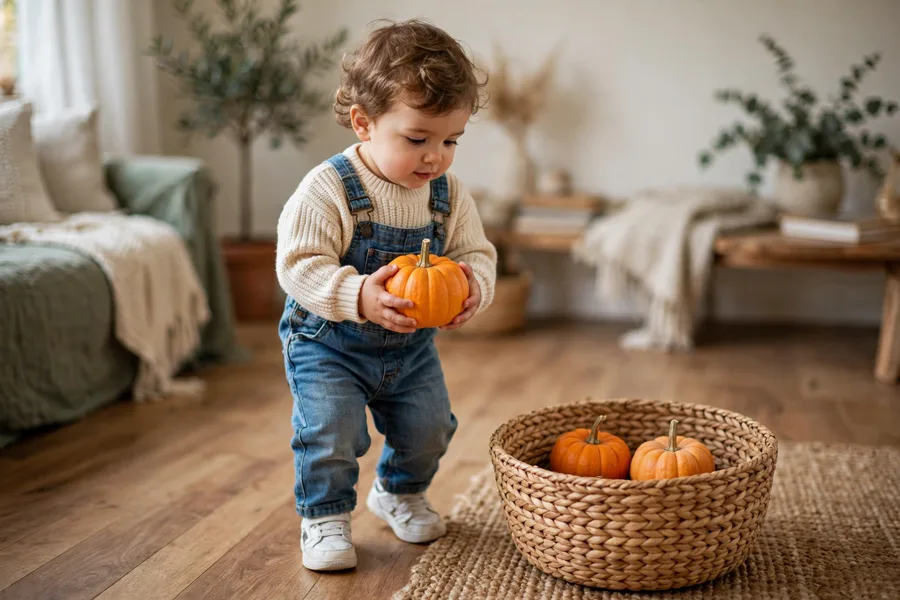
Prop one end of a sturdy cardboard sheet or wooden board on a stack of books to make a gentle ramp, ending in a laundry basket. Your toddler sets a light mini pumpkin at the top, lets go, and watches it roll, wobble, and land — then trots down, retrieves it, and climbs back for another turn. Choose pumpkins around 3 to 4 inches so little arms can carry them safely, and stay close: rolling is thrilling, throwing is the sequel nobody ordered. After a dozen drops the pumpkins bruise, so plan to cook the most battered one the same day.
Seasonal swap: in winter, roll soft plush snowballs down the same ramp into the same basket and the gross-motor game survives the season change.
12. Mini Pumpkin Treasure Hunt
While your toddler is in another room, an adult hides four mini pumpkins in plain sight at toddler height around one room: one on a chair seat, one beside the sofa leg, one on a low shelf, one half-tucked behind a cushion with the orange showing. Hand over a small basket and walk the room together, pointing and celebrating each find as it gets carried and dropped in. Nothing is small, breakable, or hidden anywhere that invites climbing. Repeat rounds take thirty seconds to reset, and the finding never gets old at this age.
Best for: burning off energy on a rainy afternoon when paint and water both feel like too much.
| Already at Home | Worth Buying | Skip for Toddlers |
|---|---|---|
| Trays, tubs, towels, big spoons | One washable paint set in fall colors | Tiny stickers and googly eyes |
| Card, zip bags, sponges, clothespins | A few real mini pumpkins each October | Glue bottles in toddler hands |
| Canned pumpkin puree and cornstarch | Soft plush pumpkins in three sizes | Glitter, which never truly washes out |
| Laundry basket and cardboard for ramps | One large foam pumpkin board with big pieces | Anything with parts smaller than a fist |
Short, Safe, and Ready to Repeat
None of these crafts ask a toddler to be careful, patient, or precise — three things no one-to-three-year-old has ever been. They ask only for big pieces, washable materials, and an adult who did the fiddly prep before the fun started. Set up on a tray, keep sessions short, and let the same pumpkin be washed, dotted, stacked, and rolled all month long.
Your one next step: buy two mini pumpkins and one tray on your next grocery run, and start tomorrow morning with the washing station — it needs nothing else, takes five minutes, and shows you exactly how much mess your toddler makes before you commit to paint.