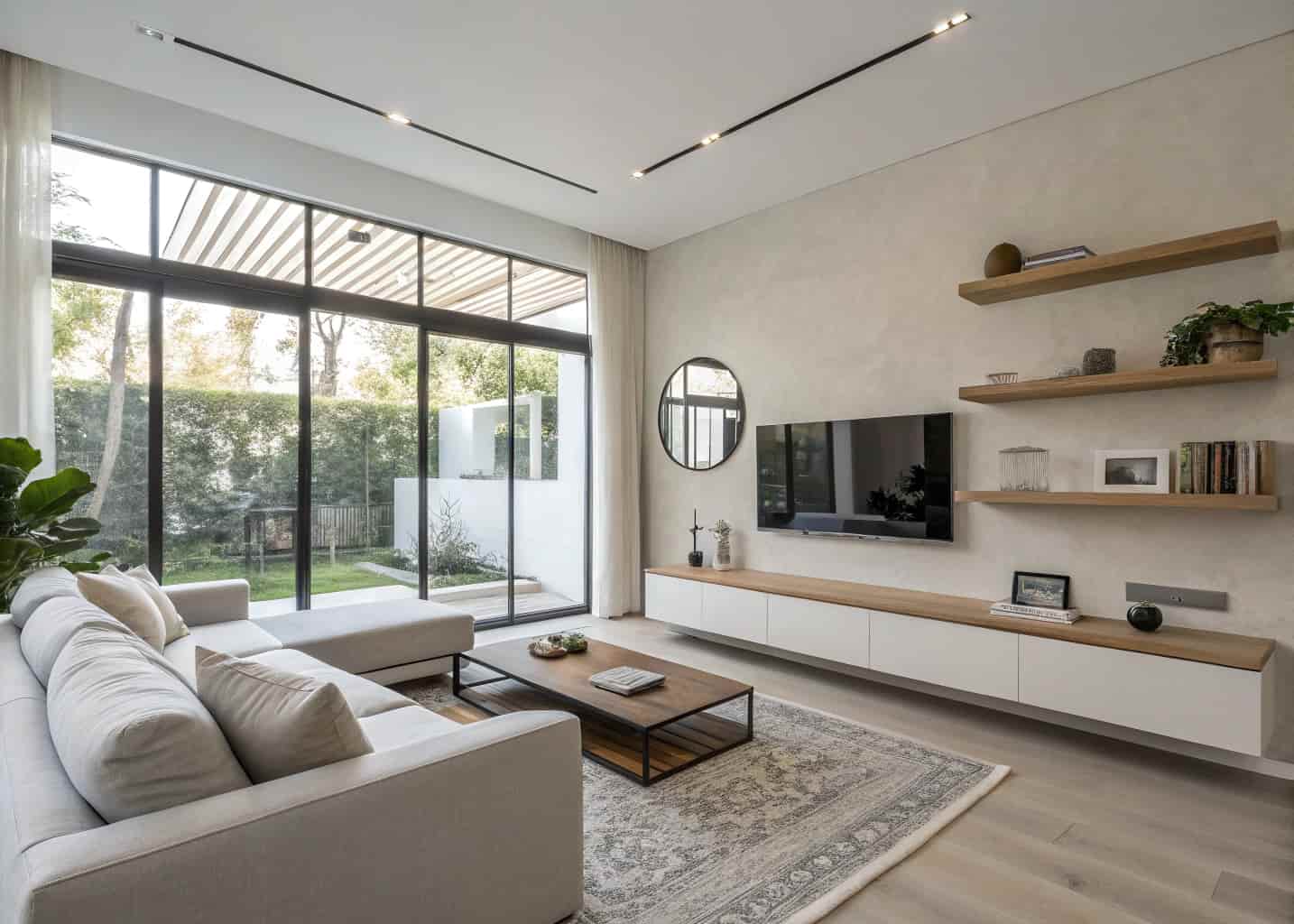
Living in a Minimalist Living Room Small Spaces doesn’t mean you have to feel cramped. With the right approach, even the tightest living room can feel open, calm, and honestly — really beautiful.
1. Start with a Neutral Color Palette
When I moved into my first apartment, the walls were a dark olive green. It felt like living inside a cave. The moment I painted everything a soft warm white, the room doubled in feel — not in size, but in how it breathed. Neutral tones like ivory, warm beige, and light gray are the foundation of every great minimalist small living room. These shades reflect natural light, making walls feel further away than they actually are. You don’t have to go boring. Layer different textures like linen cushions, a jute rug, or a cotton throw in the same neutral family. The result is a space that feels curated and calm without being cold or empty.

2. Choose Furniture with Legs
This one tip changed everything for me. Furniture that sits directly on the floor — chunky sofas, heavy coffee tables, boxy ottomans — visually weighs a small room down. But the moment you bring in a sofa with thin wooden legs or a raised accent chair, the floor becomes visible and the room starts to feel lighter. You can see more of the floor, which tricks your brain into thinking there’s more space than there is. Scandinavian-style furniture is great for this. Look for sofas, coffee tables, and side chairs with slender tapered legs in natural wood. It’s a small detail, but the visual effect it creates is massive in a tight room.

3. Use a Large Area Rug
Most people make the mistake of buying a rug that’s too small. A tiny rug floating in the middle of the room actually makes the space look more cluttered and smaller. Go bigger. A large area rug that anchors all your furniture — sofa, chairs, coffee table — creates a sense of boundary that actually expands the room visually. Think of the rug as defining the living area, almost like drawing a room within a room. For a minimalist look, stick to solid colors or simple geometric patterns. A soft cream, dusty sage, or warm terracotta in a flatweave or low pile works perfectly. It adds warmth without overwhelming the space with too much pattern.

4. Go Vertical with Shelving
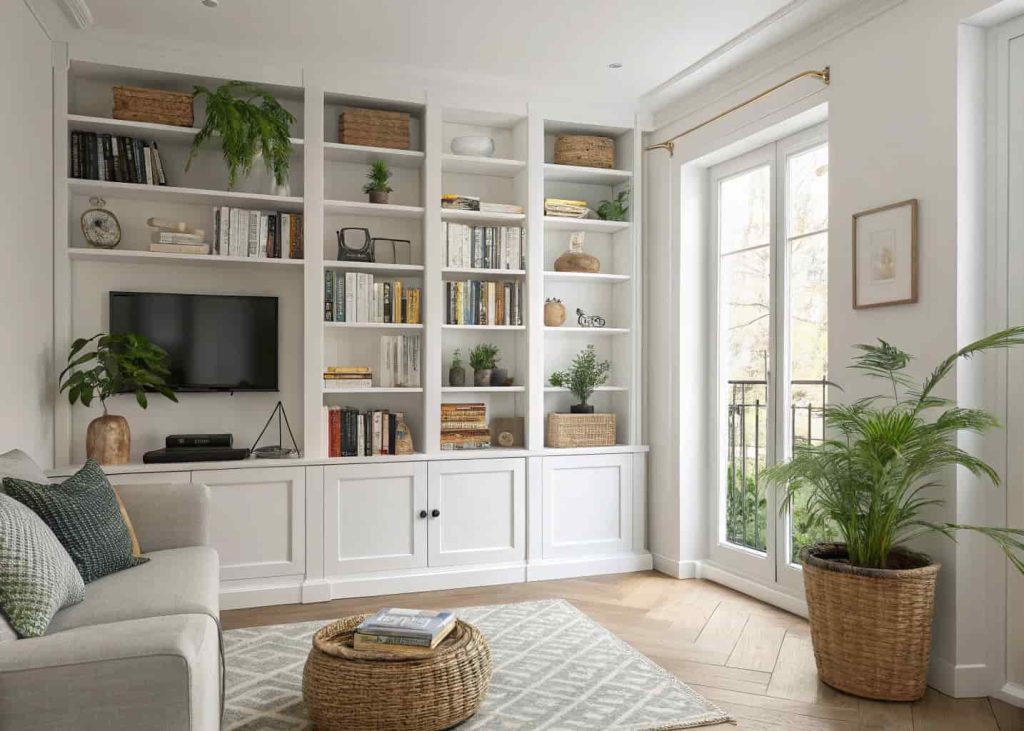
When you can’t go wide, go tall. Vertical shelving is one of the smartest moves in a small living room. Floor-to-ceiling shelves draw the eye upward, which immediately makes the ceiling feel higher and the room feel bigger. I’ve seen apartments where vertical shelves on just one wall completely transformed how spacious the living area felt. The key is to keep things minimal on those shelves — a few books, one or two plants, a candle, a small sculpture. Don’t pack them full. Negative space on shelves is just as important as what you put on them. Use your shelves as a display of your personality, not a storage dump for everything you own.
5. Choose a Sofa That Fits — Not One That Fills
I get it. The big sectional sofa looks amazing in the showroom. But in a small living room, it becomes a wall. The right sofa for a tight space is one that leaves breathing room on all sides. A compact two-seater or a modest three-seater in a light-colored fabric will do far more for a small room than an oversized sectional ever could. Consider a sofa without arms, or with very low, slim arms. It creates a sleeker profile that doesn’t eat into your floor space visually. If you love the look of a sectional, there are small-space versions now that are designed specifically for apartments — they have the comfort without the bulk. Measure your room before you buy. Always.

6. Use Mirrors Strategically
Mirrors are basically magic in small spaces. One large mirror placed opposite a window can double the natural light in a room and make it look almost twice the size. This isn’t a design trick — it’s just how light works. The mirror reflects the outdoor view and the brightness, and your eye reads it as more space. A full-length leaning mirror in a corner, or a large round mirror above a console table, works beautifully in a minimalist living room. Don’t go overboard with multiple mirrors on every wall — one statement mirror is enough. Choose a simple frame in gold, black, or natural wood to keep it in line with your overall aesthetic.

7. Embrace Multifunctional Furniture
In a small space, every single piece of furniture needs to earn its spot. If it only does one thing, think hard about whether it belongs. A coffee table with hidden storage lets you hide throws, remotes, and books when you don’t need them. An ottoman that opens up gives you a footrest, extra seating, and storage all in one. A sleek console table behind your sofa can act as a desk, a bar cart, or a display surface. I once saw a living room in a 400 square foot apartment where the sofa had a pull-out bed, the coffee table lifted to desk height, and the side table had drawers. The room looked completely normal — until it didn’t need to.

8. Keep the Color Count Low
One of the fastest ways to make a small room feel chaotic is to use too many colors. Five different accent colors — a red cushion here, a blue vase there, a yellow throw somewhere else — creates visual noise. Your eye doesn’t know where to rest, and the room ends up feeling busier and smaller than it is. Stick to two or three colors max. A soft base like white or cream, one warm neutral like sand or tan, and one accent color — maybe a dusty green or terracotta — is all you need. When you limit your palette, everything feels intentional. The room looks bigger because there’s less competing for your attention. Less really is more here.

9. Let in as Much Natural Light as Possible
Natural light is the single most powerful tool you have in a small room. It costs nothing and it changes everything. Ditch the heavy curtains. If privacy isn’t an issue, take the curtains off entirely. If you do need window treatments, go for sheer linen panels in white or off-white that let light diffuse through. Keep furniture away from windows so they’re not blocking light from traveling across the room. If your windows are small, hang curtains from ceiling to floor — it makes the windows look bigger and brings more light into the room visually. A well-lit small room always feels larger than a dim large one. Don’t underestimate this.

10. Add a Single Statement Plant
Plants add life to a minimalist room without adding clutter — but only if you use them right. One large statement plant in a beautiful pot is far better than ten small plants scattered everywhere. A fiddle leaf fig, a snake plant, or a large monstera in a simple terracotta or white pot can anchor a corner and bring in the kind of warmth that no piece of furniture can replicate. I keep a large snake plant in the corner of my living room. It takes up almost no floor space, it requires very little care, and it adds this soft organic presence that makes the whole room feel alive. One plant, done well, is all you need.

11. Mount Your TV on the Wall
A TV on a bulky stand or a wide media console takes up a lot of valuable floor space in a small living room. Mounting it on the wall eliminates that entirely. You free up the floor, the room feels cleaner, and the whole wall becomes part of the design rather than just a spot where the TV lives. Run cables through the wall or use a slim cable management cover for a clean look. Below the TV, you can add one slim floating shelf for your essentials instead of a wide console. This combination — wall-mounted TV plus floating shelf — gives you function without the bulk. It’s one of the simplest changes you can make that delivers an immediate visual upgrade.

12. Declutter Ruthlessly and Often
Minimalism isn’t just a design style — it’s a habit. You can set up the most beautiful small living room with perfect furniture and neutral colors, but if you let clutter creep back in, none of it matters. Remote controls, charging cables, mail, kids’ toys, random stuff you put down and forgot about — these things accumulate fast and a small room has no room to hide them. Make it a weekly habit to reset the space. Everything gets a home. If something doesn’t have a home, it either needs one or it needs to go. A small living room that’s tidy feels genuinely spacious. The same room with clutter feels suffocating. The furniture doesn’t change — the habits do.

13. Use Lighting Layers — Not Just Overhead Lights
Most small apartments rely entirely on one overhead light. It’s harsh, it’s flat, and it makes every room look like a waiting area. The solution is layered lighting — different light sources at different heights working together to create warmth and depth. A floor lamp in a corner. A table lamp on a side table. Warm LED candles or string lights along a shelf. When you use multiple light sources at lower levels, the room feels cozier, more intimate, and honestly more expensive than it is. Warm bulbs (2700K) are your best friend here. Cool white bulbs in a small living room feel clinical. Warm light makes everything glow, makes people look better, and makes the space feel intentionally designed.

Final Thoughts
A small living room is not a problem. It’s a design challenge — and an exciting one. The best minimalist spaces I’ve ever seen weren’t large. They were thoughtful. Every piece of furniture had a reason to be there. Every color was chosen on purpose. The lighting was warm. The clutter was gone. And the whole room breathed. You don’t need more square footage to have a living room you love. You need the right ideas, a little patience, and the willingness to let go of what doesn’t serve the space. Start with one or two tips from this list and see what changes. Small moves make a big difference.