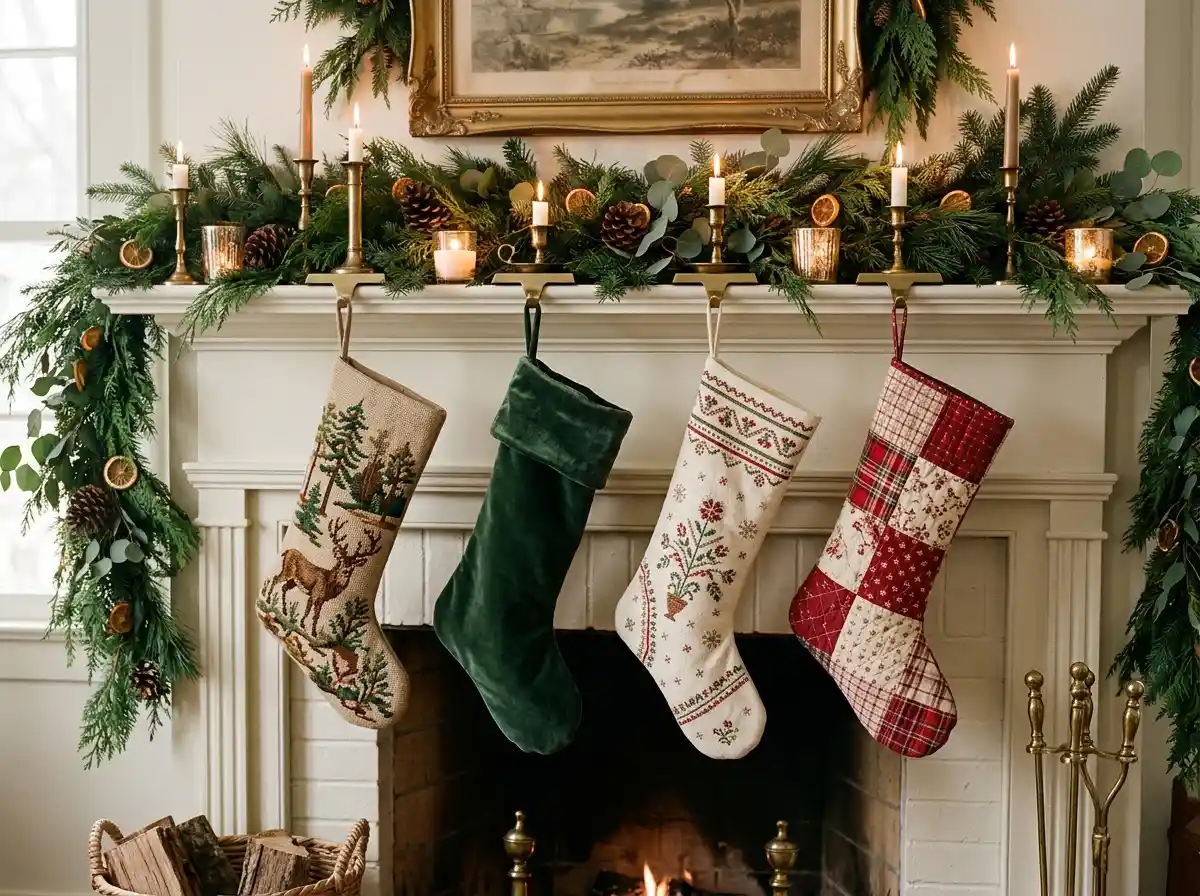
You bought the perfect stocking three years in a row, and none of them match. One is embroidered from a craft fair, one is plush velvet, one was a gift — and hung side by side, the row looks less like a family tradition and more like a lost-and-found bin.
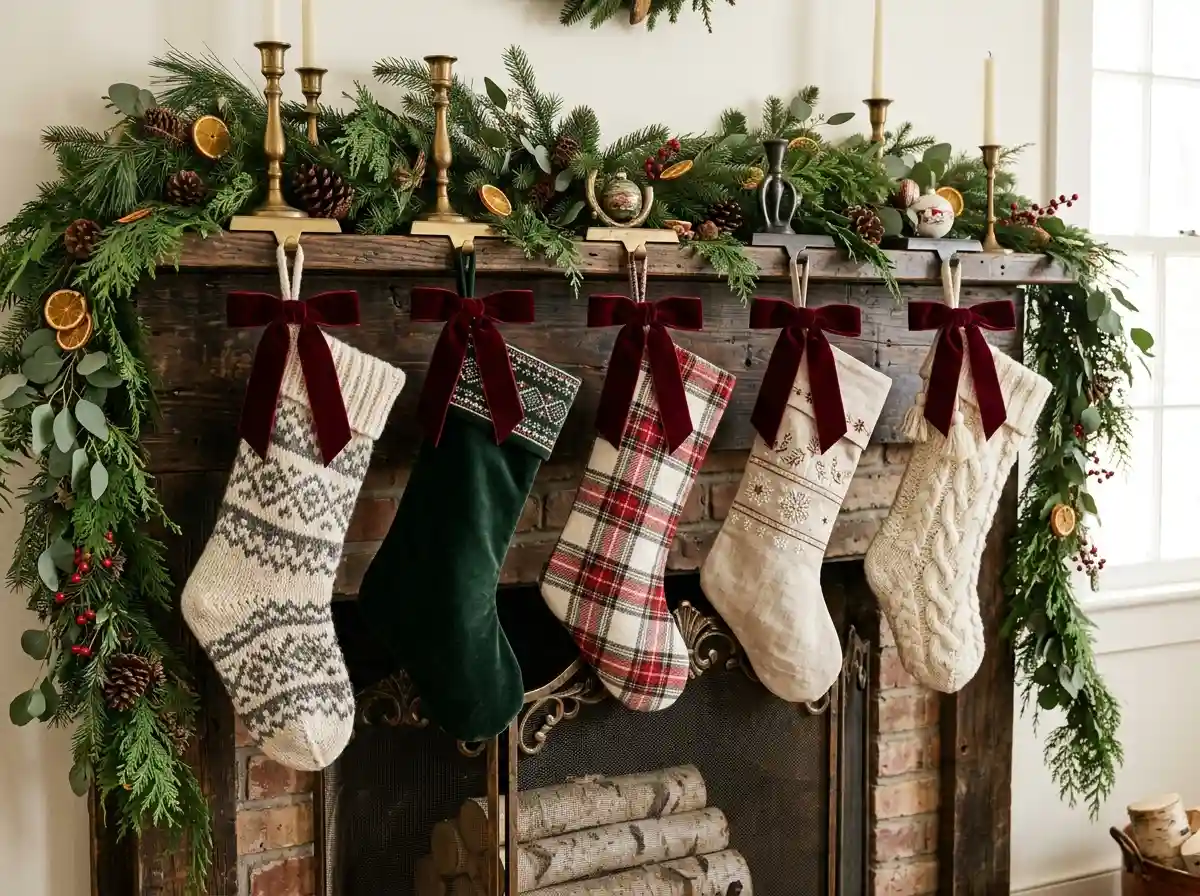
The fix is not buying a matching set. Mixed stockings look intentional when they share one thing: a repeated color, the same cuff fabric, or the same ribbon on every loop. Pick your one shared thread, and suddenly folk, velvet and patchwork read as a collected family set instead of a jumble.
Below are 13 Christmas stocking ideas that mix those fabrics on purpose, plus hanging options for homes without a mantel. Most use ribbon, hooks and craft supplies you likely already own, and if your home has no fireplace at all, these Christmas stocking ideas prove a mantel is optional — ladders, railings and shelves all work.
The Stocking Formula That Keeps Mixed Fabrics Looking Like a Family, Not a Jumble Sale
- Anchor with one base fabric: Let one material carry at least half the row, such as quilted cotton or plain linen, so the prints and velvets read as accents instead of rivals.
- Repeat one thread color: Choose a single accent shade like cranberry red or deep green and make sure it appears on every stocking, even if only in the stitching, trim or cuff.
- Size for real gifts: Pick stockings around 18 to 20 inches long for anyone expecting actual presents, and save the small decorative sizes for pets and display only.
- Leave one hook spare: Hang an empty hook at the end of the row so a new partner, baby or guest stocking can join next year without breaking the pattern.
Picture this: three cream patchwork stockings stitched from the same red-and-sage fabric scraps, one deep green velvet stocking with a cream cuff at the center, all hung from brass holders on a walnut mantel and tied with the same cranberry ribbon.
| Style | Fabric to look for | Pairs well with | Good to know |
|---|---|---|---|
| Folk embroidered | Cotton or linen with stitched motifs | Patchwork, plain quilted cotton | The shared background color does the unifying |
| Needlepoint | Wool yarn design on a cotton ground | Velvet, plain linen | Reads heirloom; keep motifs in one color family |
| Velvet | Cotton velvet with a contrasting cuff | Needlepoint, embroidered linen | One or two per row is plenty of richness |
| Patchwork | Mixed quilting cottons from one fabric set | Folk embroidered, solid quilted | Use the same 4 to 5 fabrics in every stocking |
| Quilted | Solid cotton with diamond stitching | Everything — it is the quiet anchor | Batting keeps the shape when empty |
1. Folk-Embroidered Stockings on a Shared Cream Ground
Choose embroidered stockings where every motif — a cross-stitch reindeer, a crewel heart, a geometric folk border — sits on the same cream or ivory cotton background. The motifs can be completely different from one stocking to the next, because the pale shared ground is doing the unifying work. Hang them in a row with the busiest design in the middle and plainer ones toward the ends. The trade-off is time or money: hand-stitched versions take hours to make and cost more to buy than printed ones. If a grandparent’s embroidered stocking started your collection, this is the easiest way to build a whole row around it.
Get the look:
- Main piece: Cream-ground embroidered stockings with mixed folk motifs
- Supporting piece: One plain cream linen stocking at each end of the row
- Texture or material: Matte cotton and linen against the stitched wool thread
- Finishing touch: The same narrow red ribbon tied on every hanging loop
2. Classic Needlepoint Stockings With Heirloom Motifs
Needlepoint stockings carry the row when everything else is soft and simple. Look for dense wool-yarn stitching — a nutcracker, a Christmas tree, a Santa — on a cotton ground, and keep all the motifs inside one color family so a red-heavy design is not fighting a pastel one. The L.L.Bean Christmas Needlepoint Stocking, at $32.95, is a good benchmark: cotton, about 18 inches long, with the kind of traditional motif that mixes calmly with plainer neighbors. Style the rest of the mantel quietly around them with plain greenery, using these Christmas mantel decor ideas to keep the shelf from competing with the stitching.
Budget note: Needlepoint is the splurge of the stocking world, so buy one a year in the same color family and let the row grow into an heirloom set instead of replacing cheaper stockings all at once.

3. Deep Green Velvet Stockings With a Wide Cream Cuff
Velvet earns its place when the color is fresh. Skip the expected red and choose deep forest or emerald green velvet, finished with a wide cream linen or faux-fur cuff about 4 inches deep. The pale cuff is the bridge: it echoes the cream in embroidered and needlepoint neighbors, so the dark velvet does not sit like a stranger. One or two velvet stockings per row is enough — a full row of velvet goes heavy and funereal fast. Be aware that velvet shows dust and lint more than any other fabric here, and a crushed pile mark does not always brush out.
Texture note: Velvet reads richest next to something matte and nubby, like quilted cotton or raw linen. Keep shiny satin out of the same row, or the mix tips from cozy into costume.
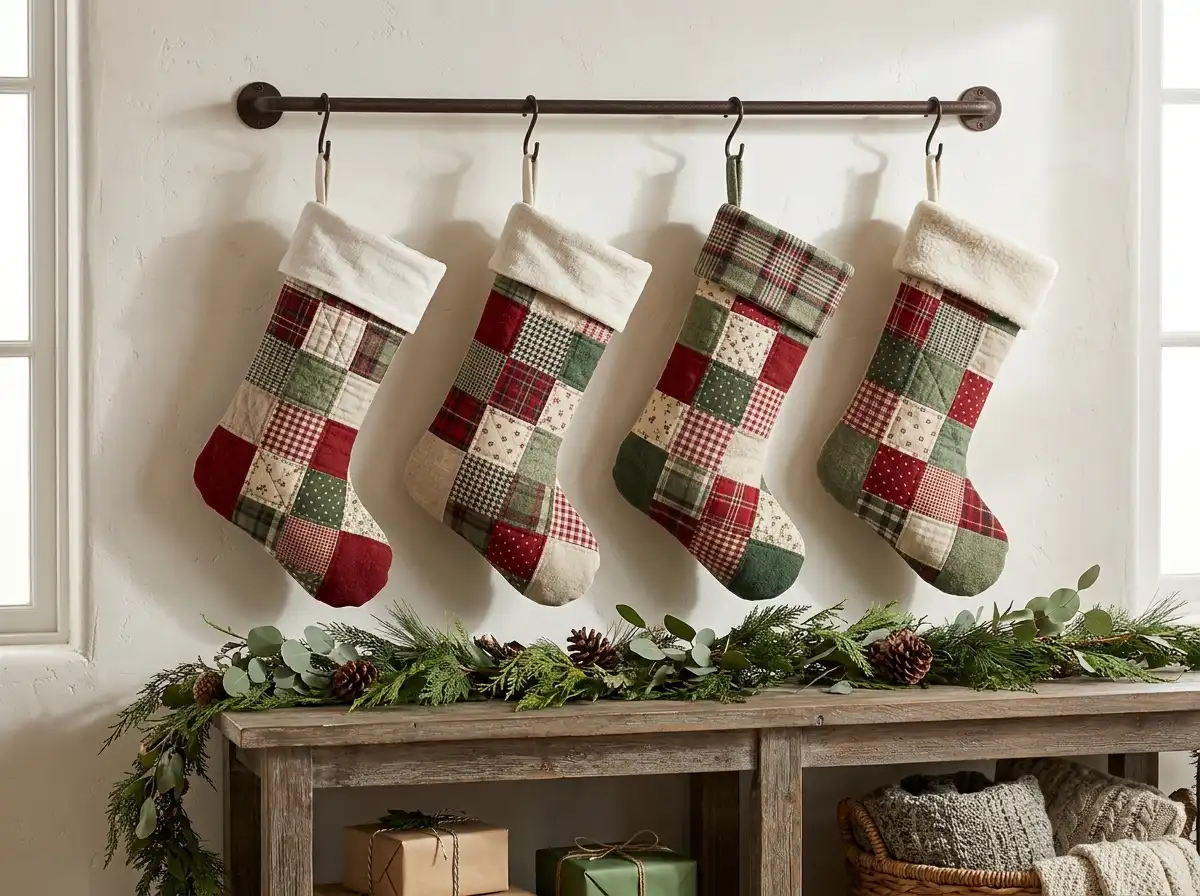
4. Scrap-Patch Patchwork Stockings From One Fabric Set
Patchwork solves the matching problem by making every stocking different on purpose. Cut squares from the same four or five quilting cottons — say a cranberry solid, a sage print, a cream dot and a tiny red check — then arrange them in a new order for each family member. Every stocking is unique, yet the repeated fabric set keeps the row obviously related. Add a solid cuff in the cranberry to calm the pattern down. Honestly, the piecing takes an evening per stocking, so start with the two most visible ones. If your fabric stash is already overflowing, this row costs almost nothing to make.
Color note: Lock the set to one warm palette — cream, cranberry and sage — and leave any cool blue or gray scraps for another project. One stray fabric in a different temperature is what makes patchwork look random instead of related.
5. Diamond-Quilted Stockings as the Quiet Anchor
Every mixed row needs a few stockings that are not trying to be the star. Solid cotton stockings with diamond quilting — cream, cranberry or soft sage — fill gaps between the embroidered and patterned pieces and give the eye a place to rest. The light batting also holds the stocking’s shape on the hook, so the row looks full and tidy even before anything goes inside. Match the quilting color to your tree skirt below and the whole corner reads as one plan; these Christmas tree toppers and tree skirts show how the tree’s base and top can share the same palette. Quilted stockings are also the most forgiving for beginners to sew, since the stitching hides small cutting mistakes.
Why it works:
- The stitched diamonds add pattern without adding a competing print
- The padded shape hangs neatly next to floppier fabrics
- A solid color repeated twice becomes the row’s anchor shade
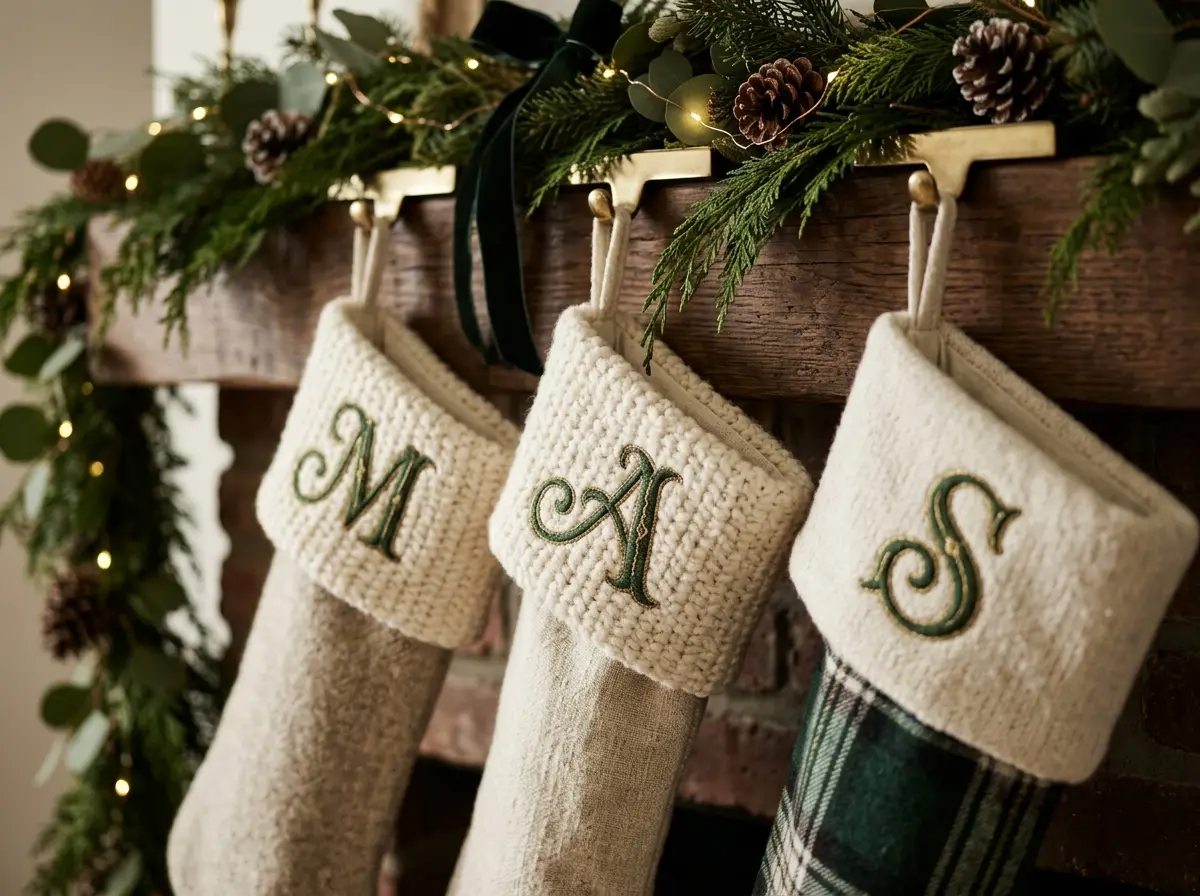
6. Embroidered Initials on the Cuff Instead of Name Tags
Personalization holds a mixed set together when it is done the same way on every stocking. Stitch one initial — or a small monogram — onto each cuff in the identical thread color and letter style, whether the body below is folk embroidery, velvet or patchwork. The repeated lettering reads like a family crest rather than a label. Choose a cranberry or deep green floss that already appears in your palette. The downside is permanence: an embroidered initial cannot be re-gifted, and a childhood nickname may not age well, so stick to first initials only. For kids whose stockings get outgrown, initials also make handing down much simpler.
Fit check: The cuff needs to be at least 3 inches deep to fit a stitched initial with breathing room. Measure before you buy plain stockings to customize, because slim fashion cuffs leave the letter cramped against the seam.
7. A Staircase Railing Row Tied With One Ribbon
No mantel is no problem when the staircase does the hanging. Tie each stocking to a banister spindle with the same ribbon — a 1-inch cranberry velvet ribbon works across every fabric in this article — spacing them one spindle apart down the rail. Weave a plain greenery garland along the top of the rail above them, and the descending line of mixed stockings looks deliberate and festive. One caution: keep filled stockings off the stairs themselves on Christmas morning, because a heavy stocking on a step edge is a trip hazard in the dark. If your entry is the first thing guests see, this row is your welcome.
Space note: Count your spindles before you shop. A standard rail gives you room for five to seven stockings at one-per-spindle spacing; a big family should plan every second spindle for the fuller years.
| Hanging spot | What you need | Weight tip |
|---|---|---|
| Staircase railing | Ribbon ties, one garland for the rail top | Tie to spindles, not the handrail, so hands can still grip |
| Blanket ladder | S-hooks or ribbon on each rung | Heaviest stockings on the lowest rung |
| Bookshelf or console edge | Weighted stocking holders | Check the holder rating; most hold 2 to 3 pounds comfortably |
| Wall hooks in a row | Adhesive hooks rated for the filled weight | Hang empty for display, fill on the floor Christmas Eve |
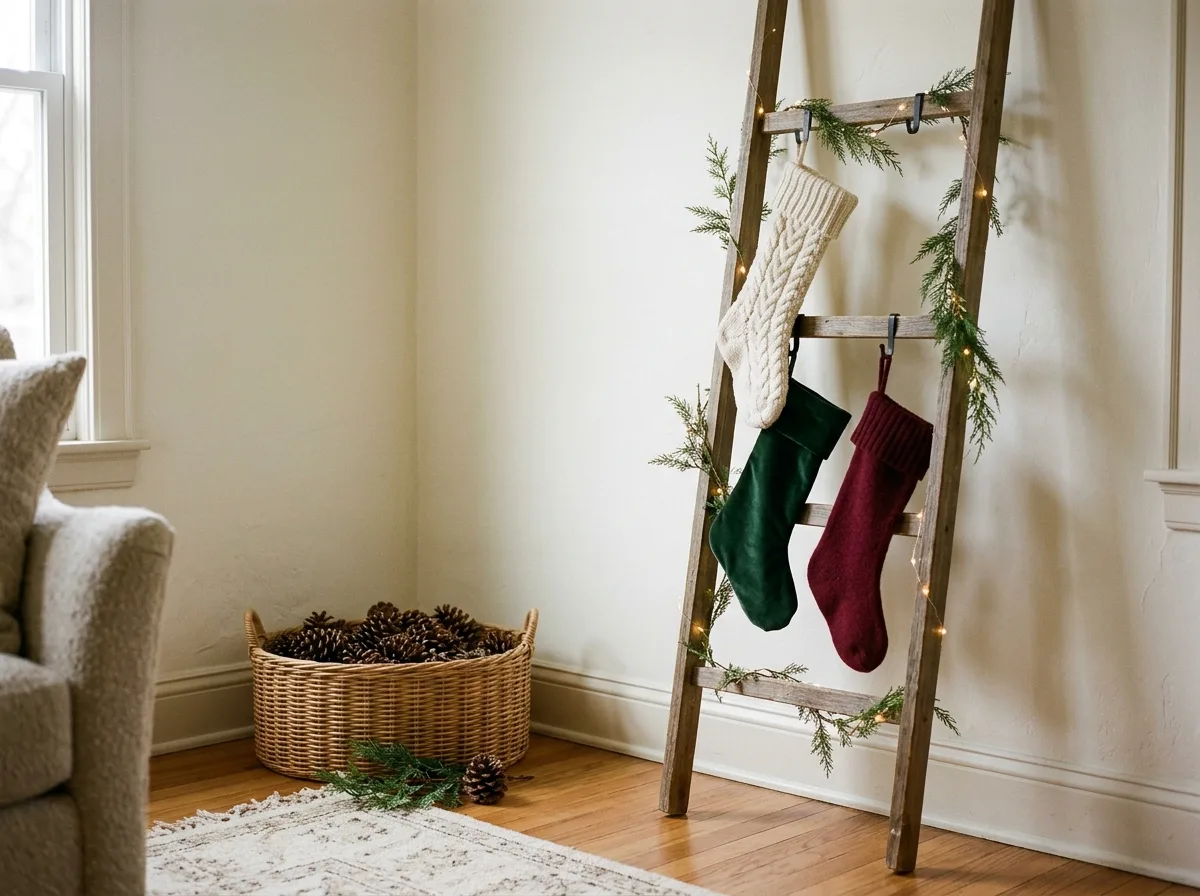
8. Blanket Ladder Display for Mantel-Free Rooms
A leaning wooden ladder turns a blank wall into a stocking station. Rest it against the wall near the tree, hang one stocking per rung from small hooks or ribbon ties, and drape a folded throw over an empty rung so the ladder reads as furniture, not scaffolding. Mix your fabrics freely here — folk on the top rung, velvet in the middle, patchwork at the bottom — because the ladder’s rungs give each stocking its own frame. The honest downside is footprint: a ladder needs about 2 feet of floor depth with the lean, which tight apartments may feel. In a rental where hooks in the wall are banned, this is often the only big display that works.
Best for: Renters and fireplace-free living rooms. The whole display lifts away in January with zero holes to fill and nothing to repair.
9. Weighted Stocking Holders on a Shelf or Console
Weighted holders let any flat edge behave like a mantel. Choose holders in one finish — all antique brass, all black iron — and let that shared metal be the thread that ties needlepoint, patchwork and velvet together on a bookcase or console table. Line a simple garland along the shelf behind them to hide the holder bases. Know the limit before Christmas Eve: most holders comfortably hold a stocking with 2 to 3 pounds of fill, and a stocking stuffed with oranges and books will slide the whole thing off the edge. Fill heavy stockings lightly for display and finish the job on the floor.
The formula: Same holder finish on every stocking, one garland behind them, and no more than two fabric patterns in between the solids — the metal and the greenery supply the repetition, so the fabrics can relax.
10. One Ribbon on Every Loop to Unify a Mismatched Set
If you already own a truly random set — a souvenir stocking, a knitted one, a sequined one — do not replace them. Tie a generous bow of the exact same ribbon onto every hanging loop and the row instantly shares a uniform. A 1.5-inch cranberry or deep green ribbon, cut to the same length for each, works on every style in this article and costs less than one new stocking. The bows also lift shorter stockings visually, evening out a row of mixed sizes. It will not fix a genuine color clash, like neon beside pastel, but for the normal family jumble it is the fastest fix there is.
Style note: Cut all the ribbon lengths on the same day with the same scissors angle — tails at slightly different lengths look like an accident, while identical tails look like a design decision.
11. Mini Stockings for Pets at the End of the Row
A small stocking, around 8 to 10 inches, gives the dog or cat a place in the lineup without shrinking the human display. Hang minis at the end of the row or on the lowest ladder rung, and let them be the playful ones — a paw-print folk motif, a tiny patchwork, a scrap of the green velvet. That playfulness fits right in with whimsical Christmas decor ideas elsewhere in the room. The limitation is real, though: a mini holds a few treats or a small toy, nothing more, so do not promise a pet a big gift in it. Kids tend to claim the pet stocking as their favorite job on Christmas Eve.
Easy swap: After the holidays, unhook the minis and use them as gift-card holders or silverware pockets at the table next year — the small size that limits presents is perfect for both.
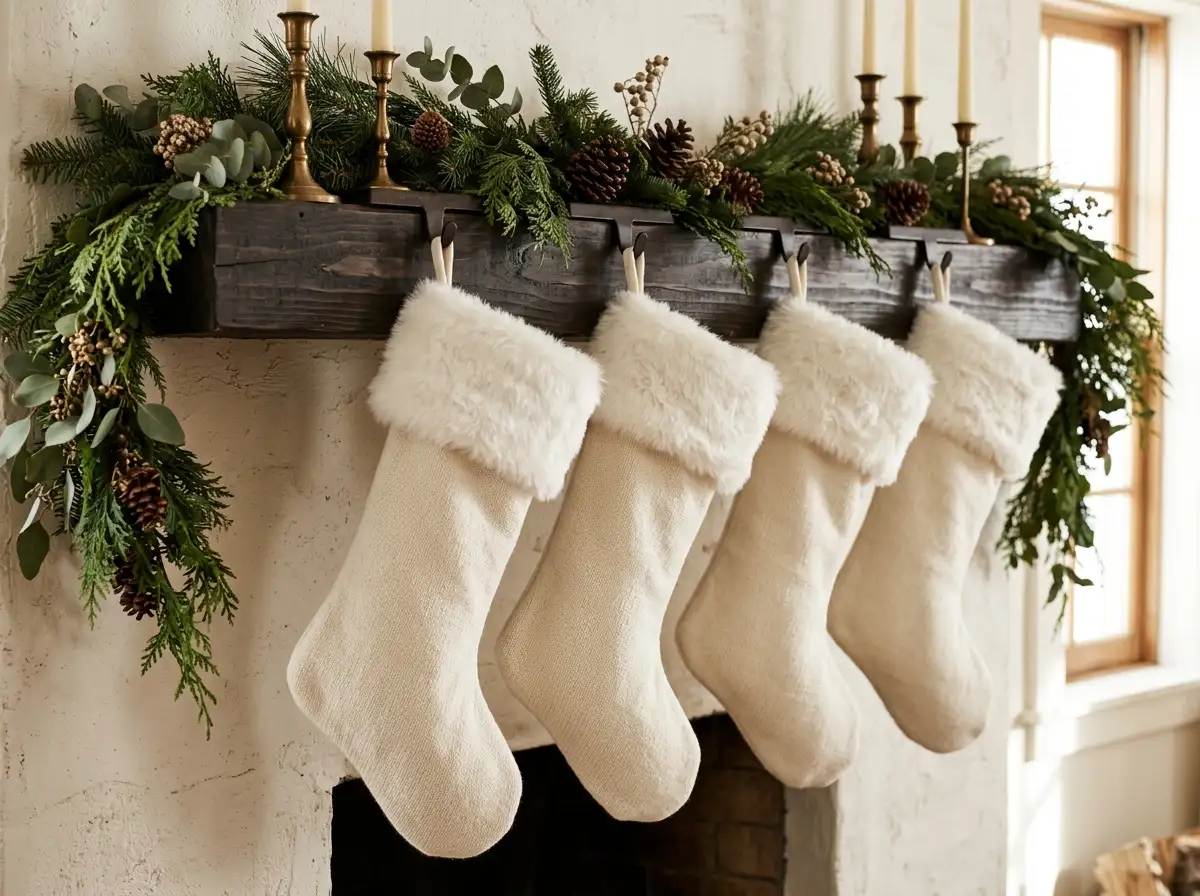
12. Plain Stockings, One Matching Faux-Fur Cuff
Buy the bodies plain and let the cuff do the matching. Simple cotton or linen stockings in assorted family colors — cranberry, forest green, cream — each get the same wide white faux-fur cuff folded over the top. The identical snowy cuff turns three unrelated colors into a set, and the look suits folk and patchwork neighbors too, since cream appears in both. Sew or safety-pin the cuffs on so they can come off for washing; faux fur and cotton want different care. Be honest about the fur: inexpensive versions shed a little at first, so shake them outside before hanging.
Seasonal swap: Keep the plain bodies and change only the cuffs next year — a plaid flannel cuff makes the same stockings feel rustic, while a linen cuff takes them calm and simple.
13. The One-Brave-Stocking Rule for Pattern Lovers
When one person in the family wants a loud stocking — a bold folk print, a bright patchwork, a novelty motif — let exactly one be brave and keep the rest quiet. One statement stocking in a row of solids and gentle textures looks curated; three statements look like an argument. Place the brave one off-center, at position two or three, rather than in the middle where it shouts. The rule also gives you a painless way to add a new stocking later: a newcomer can be the brave one while the established row stays calm. If your taste runs bold, this rule is what keeps it looking designed instead of chaotic.
Color note: The brave stocking still has to borrow at least one color from the family palette — a wild print with a cranberry cuff stays related, while a totally foreign color scheme never will.
| Quick check | Guideline |
|---|---|
| Loop strength | Tug each hanging loop once; a filled stocking can weigh 3 pounds or more |
| Spacing | Leave 6 to 8 inches between stockings so patterns do not crowd |
| Height | Bottoms should clear the floor by at least a foot and sit out of pet reach |
| Heat safety | Keep fabric at least 3 feet from open flame or a hot stove front |
| Shared thread | Stand back and confirm one color or cuff repeats on every single stocking |
Your one next step: lay all your stockings on the bed tonight, pick the one color that appears in most of them, and buy a single spool of ribbon in that shade — tying it on every loop will show you within ten minutes whether your mixed set already works.