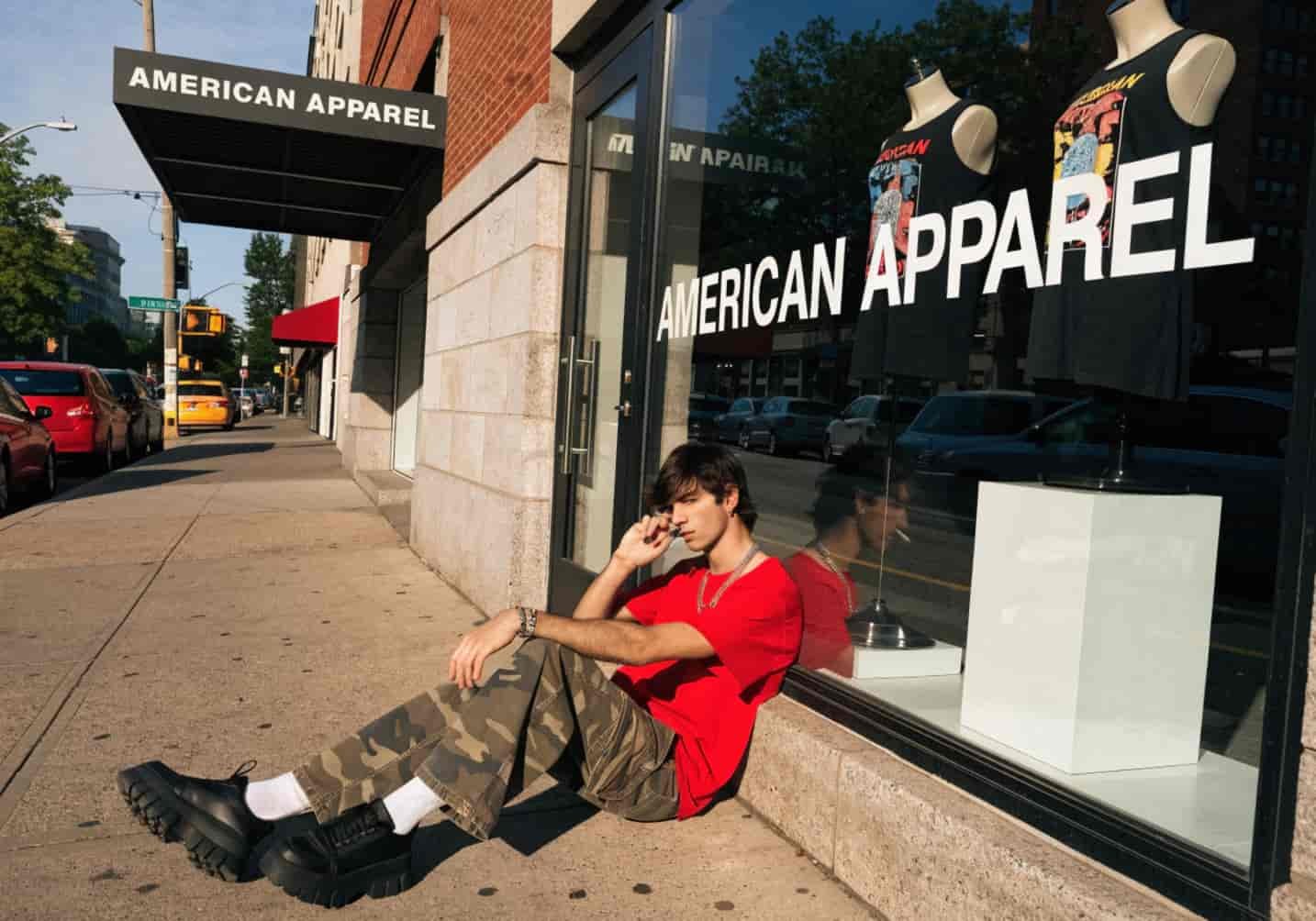
I still have a ringer tee I bought from American Apparel in 2011 — the kind with the contrast collar and sleeve trim. It’s been through a hundred washes and the fabric still hasn’t gone see-through, which is more than I can say for most $20 t-shirts I’ve bought since. That’s basically the whole pitch of this brand in one garment.
1. How a Dorm-Room T-Shirt Hustle Became a Brand
Dov Charney, a Canadian university dropout, started selling plain t-shirts out of his dorm room at Tufts in the late 1980s. The company that became American Apparel was formally founded in Los Angeles in 1998, and Charney built it around a very specific idea: keep manufacturing under one roof in downtown LA, pay factory workers above minimum wage, and skip the usual overseas supply chain entirely. At its peak in the mid-2000s, the company employed close to 10,000 people and ran one of the largest garment factories in the United States, a converted industrial building on Alameda Street in LA’s Fashion District.
The brand grew fast — and then it didn’t. Aggressive expansion, mounting debt, and a string of lawsuits against Charney (several involving sexual harassment claims) led to his ouster by the board in 2014. American Apparel filed for bankruptcy in October 2015, filed again in late 2016, and in January 2017 its intellectual property was sold at a bankruptcy auction to Canadian manufacturer Gildan Activewear for $88 million. Gildan didn’t buy the factories or the stores — just the name, the designs, and the trademark. The site relaunched as an e-commerce-only operation in the US in August 2017 and went global in April 2018.
![American Apparel retail storefront signage from the brand's original retail era"]](https://makecashly.com/wp-content/uploads/2026/09/image-37-16-1024x717.jpg)
2. Why This Brand Actually Changed the Industry
Before American Apparel, “basics” mostly meant Hanes and Fruit of the Loom — cheap, boxy, and not something you’d wear on purpose. American Apparel proved there was a market for a fitted, soft, slightly-too-casual-to-be-casual t-shirt that cost $18 instead of $6. That price point and fit reset expectations for an entire category, and you can draw a fairly direct line from it to brands like Everlane, Uniqlo’s basics lines, and Bella+Canvas — which was actually founded by former American Apparel executives and now dominates the wholesale blank-apparel market American Apparel used to hold.
The vertically integrated model — design, cut, sew, dye, and distribute all in one building — was also unusual for a mid-size apparel company at the time. Most competitors had already offshored production. American Apparel’s “Made in USA, sweatshop-free” labeling became a genuine point of differentiation, not just a marketing line, and it forced other basics brands to start disclosing more about where their clothes actually came from.
3. The Fabric Is the Whole Point
If you’ve worn the brand, you know the fabric before you know the name on the tag. The flagship is a 100% combed ring-spun cotton jersey, typically around 4.3 oz per square yard — noticeably lighter and softer than the 5.5–6 oz cotton used in most mass-market tees, which is why it drapes instead of standing stiff. The tri-blend (poly-cotton-rayon) fabric, used in styles like the Track Jacket and the Tri-Blend Tee, was one of the first widely available blends to nail that worn-in, vintage feel without actually being worn in.
The trade-off nobody tells you about: that lighter jersey pills faster under friction — think backpack straps or seatbelts — than heavier cotton does. If you want the softness without the pilling, spot-treat with a fabric shaver every few weeks rather than waiting until it looks bad. By the time you can see the pills, they’ve already worked into the weave and are harder to remove cleanly. Turning the garment inside out before washing also cuts pilling noticeably, since most of the abrasion happens against other fabric in the wash, not against the drum.
![Close-up of combed ring-spun cotton jersey fabric texture"]](https://makecashly.com/wp-content/uploads/2026/09/image-38-14-1024x717.jpg)
4. What “Made in USA” Actually Means Now vs. Then
This is the part that’s changed the most, and most people don’t realize it. Under Charney, “Made in USA” meant literally cut and sewn in the Alameda Street factory, which closed for good after the 2015 bankruptcy. Under Gildan, the company kept some domestic sewing contracts for select core styles but shifted a large share of production into Gildan’s existing global supply chain — factories in Central America and elsewhere that already make Gildan’s other lines. Gildan executives have said publicly that Made-in-the-USA styles still represent a meaningful share of sales, but it’s no longer a blanket brand-wide claim.
If domestic manufacturing matters to you specifically, don’t assume it based on the logo — check the individual product page and the garment’s country-of-origin tag, because it now varies style by style rather than applying across the whole catalog. As of late 2025, Gildan also moved exclusive US wholesale distribution of the brand to S&S Activewear, another sign the company is leaning further into a conventional wholesale-and-blanks model rather than the direct-to-consumer, LA-centric identity it had under Charney.
5. What People Actually Buy: Tees, Hoodies, Leggings
Three categories carry most of the catalog:
- T-shirts — the Fine Jersey crew and the 50/25/25 tri-blend are the two best-selling styles, usually priced $18–$28.
- Hoodies and fleece — the California Fleece line (garment-dyed, brushed-back fleece) runs heavier, around 14 oz, and sits in the $45–$65 range. It shrinks more than most fleece on first wash — expect 3–5% — so sizing up slightly or washing cold and hang-drying the first time helps.
- Leggings and bodysuits — the brand’s stretch cotton-spandex leggings (the “Disco Pant” being the most recognizable, a shiny spandex legging rather than a cotton one) were genuinely ahead of the athleisure trend, showing up in stores years before leggings-as-daywear went mainstream around 2012–2014.
![American Apparel style hoodies and leggings folded on a retail shelf"]](https://makecashly.com/wp-content/uploads/2026/09/image-39-12-1024x717.jpg)
6. Sustainability and Ethical Production, Then and Now
The original sustainability pitch was mostly about labor, not materials: sweatshop-free, living-wage manufacturing, on-site health clinics for factory workers, and no subcontracting to unknown overseas facilities. It wasn’t marketed as an eco-brand in the organic-cotton, low-water-dye sense — the “ethical” claim was specifically about how workers were treated, not the environmental footprint of the fabric itself.
Under Gildan, the ethical story shifted toward Gildan’s own corporate sustainability program, which focuses more on environmental metrics — water usage, energy use per garment, recycled polyester content in some blends — published in Gildan’s annual sustainability reports. That’s a genuinely different kind of ethical claim than the original one, and it’s worth knowing the difference if sourcing transparency is why you’re buying the brand in the first place.
7. Color Range and Customization
This is an underrated part of the original appeal. At its peak, some core styles were offered in 50+ colorways at once — a level of color depth almost no other basics brand matched, which made American Apparel a go-to source for bulk custom printing (bands, small businesses, event merch) long before print-on-demand made custom apparel easy. The color range today under Gildan is narrower than it was in the mid-2000s but still wider than most direct competitors, and the brand still sells heavily into the wholesale blank-apparel and screen-printing market rather than purely direct-to-consumer.
8. Popularity in Celebrity and Streetwear Culture
The brand’s cultural moment ran roughly 2005–2012, overlapping with the “indie sleaze” aesthetic — skinny jeans, ironic band tees, disco pants. It showed up on musicians, in music videos, and became shorthand for a specific LA-hipster look before “hipster” was even a fully settled term. Some of that visibility came from genuinely controversial advertising — American Apparel’s ad campaigns were repeatedly criticized and even banned in some markets for using explicit, often very young-looking models, which is a real part of the brand’s history, not just an aesthetic footnote. That controversy is tied directly to the harassment allegations against Charney and was a factor in the board’s decision to remove him.
9. Buying It Now: Sizing and Fit Notes
Sizing runs closer to true-to-size than most fast fashion, but fit varies a lot by style, which trips people up. The Fine Jersey tee fits close to the body — size up if you want a looser, boxier look rather than the original slim fit. The tri-blend tends to run slightly more relaxed than the Fine Jersey in the same labeled size. Leggings and bodysuits use their own size chart entirely (based on waist and hip measurements, not dress size), so check that specifically rather than assuming your normal size carries over. Size range on most core styles now runs from XXS up to 3XL or 4XL depending on the item, a real expansion from the narrower range the brand offered in its 2000s heyday.
10. American Apparel vs. Other Basics Brands
| Brand | Fabric Weight | Price Range (tee) | Best For |
|---|---|---|---|
| American Apparel | ~4.3 oz light jersey | $18–$28 | Soft drape, fitted look, deep color range |
| Everlane | ~5.5 oz mid jersey | $18–$30 | Supply-chain transparency, minimalist fit |
| Uniqlo | ~5–6 oz heavier jersey | $10–$15 | Durability, budget, wide sizing |
| Bella+Canvas | ~4.2 oz light jersey | $6–$12 wholesale | Bulk/custom printing, blanks |
The honest trade-off: if you want a tee that drapes and feels expensive out of the dryer, American Apparel and Bella+Canvas fabrics beat Uniqlo’s heavier jersey. But that lighter jersey pills and thins faster over 1–2 years of regular wear than Uniqlo’s heavier cotton does. For a daily-wear five-pack you’ll hammer in rotation, Uniqlo lasts longer. For a going-out tee you want to actually fit well and photograph nicely, American Apparel’s cut wins.
11. Styling Ideas With American Apparel Pieces
The fitted silhouette works best leaned into rather than layered away. A few combinations that actually hold up:
- Fine Jersey crew tee tucked into high-rise denim, with the California Fleece zip hoodie tied at the waist rather than worn buttoned — this was the signature 2008-era silhouette and it’s cycled back into rotation with the current indie-sleaze revival.
- The tri-blend raglan under an oversized denim or canvas jacket, which balances the fitted top with a boxier outer layer.
- Disco pants (the shiny leggings, not the cotton ones) under an oversized blazer for evening wear — the shine reads dressier than a matte legging would.
!["Casual outfit flat lay featuring a fitted basic tee, denim, and zip hoodie"]](https://makecashly.com/wp-content/uploads/2026/09/image-40-9-1024x717.jpg)
12. Where the Brand Is Headed in 2025–2026
The brand today is a fairly different animal from the one that built its reputation. Gildan’s late-2025 move to hand exclusive US wholesale distribution to S&S Activewear signals the company is doubling down on the blanks-and-wholesale side of the business — screen printers, promotional product distributors, bulk buyers — rather than trying to rebuild the direct-to-consumer retail presence it had before bankruptcy. Don’t expect a wave of new physical stores; the current model is e-commerce plus wholesale, and that’s likely to stay the shape of the business for the foreseeable future.
What’s stayed consistent is the product itself: the fabric, the fit, and the color range are still recognizably the same brand, even if the ownership, the manufacturing footprint, and the marketing tone around it have all changed since 2017. For anyone buying today, it’s worth separating the nostalgia for the 2000s-era brand from the company that currently makes the clothes — they share a name and a logo, but not much else about how the business runs.