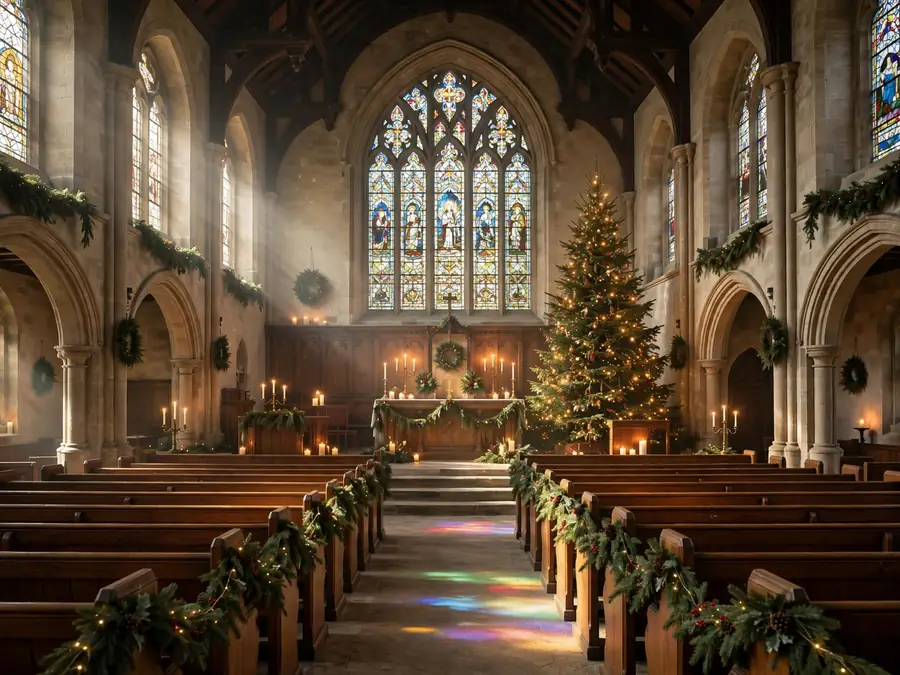
Every December, the same thing happens in churches everywhere: willing volunteers decorate with love, and the sanctuary still ends up crowded. One group adds tinsel, another adds coloured lights, a third tapes paper stars to wood that has stood for a hundred years — and somewhere behind it all, the altar and the cross quietly disappear.
The sanctuaries that feel heavenly instead follow one discipline: a single colour story of ivory, deep green, and antique gold, everything placed in calm symmetry, and decoration that frames the room rather than covering it. Nothing sits on the altar cloth, nothing hangs on the cross itself, and every seat keeps a clear view of the platform. The best church Christmas decoration ideas all share that restraint — greenery and candlelight with space left around them.
Below are 30 ideas for the sanctuary, pews, windows, narthex, children’s corner, fellowship hall, and front steps. Most use basics a church already owns — plain garlands, LED candles, ribbon, and poinsettias — and every single one lifts away in January without leaving a mark.
The Church Christmas Formula That Keeps the Sanctuary Looking Heavenly, Not Heavy
- Frame, don’t fill: Decorate the edges of the room — steps, rails, sills, and doors — and leave the centre, the altar, and the cross completely clear.
- Hold one colour story: Ivory, deep green, and antique gold with warm-white light only; any piece that doesn’t match stays in the cupboard this year.
- Keep every sight line open: Nothing in the congregation’s view rises above pew height except at the platform sides, so every seat still sees the cross and the reader.
- Make it all lift away: Every piece is tied, hooked, clipped, or freestanding — never taped, glued, or nailed — so the room returns to normal in one evening.
For example: two slim green trees with ivory ribbon flanking the platform, a plain garland tied along the communion rail, and LED hurricanes glowing on the window sills — the altar bare, the cross untouched, the whole room calm.
| # | Idea | Where It Goes | Key Piece |
|---|---|---|---|
| 1 | Twin Slim Trees Flanking the Platform | Sanctuary | Two slim trees, ivory ribbon |
| 2 | Ivory Poinsettias on the Platform Steps | Platform steps | Cream poinsettias, gold pot covers |
| 3 | A Nativity Table Beside the Platform | Sanctuary floor | Nativity set on a low table |
| 4 | A Plain Garland Along the Communion Rail | Communion rail | Plain garland, ribbon ties |
| 5 | Hurricane Candles on the Window Sills | Window sills | Glass hurricanes, LED pillars |
| 6 | Two Vertical Banners on Freestanding Stands | Platform walls | Ivory banners, metal stands |
| 7 | An Advent Wreath on Its Own Stand | Beside the platform | Wreath on an iron floor stand |
| 8 | A Chrismon Tree in the Sanctuary Corner | Sanctuary corner | White-and-gold symbol ornaments |
| 9 | White Amaryllis on Two Pedestals | Platform sides | Paired pedestals, white blooms |
| 10 | One Large Star High Above the Platform | Above the platform | Single large star |
| 11 | Pew-End Swags on Every Other Pew | Centre aisle pews | Small swags, ivory bows |
| 12 | Lantern Markers at the Aisle Ends | Aisle corners | Black lanterns, LED candles |
| 13 | Shepherd’s-Crook Candle Stands Down the Aisle | Centre aisle | Iron stands, hanging votives |
| 14 | Reserved Rows Marked With Ribbon and Greenery | Front pews | Ribbon loops, greenery sprigs |
| 15 | A Plain Wreath in Every Tall Window | Sanctuary windows | Matching plain wreaths |
| 16 | Paper Stars in the Side Windows | Side windows | Paper star lanterns |
| 17 | A Garland Line Along the Deep Window Ledges | Window ledges | Garland, fairy lights |
| 18 | A Welcome Table With One Small Tree | Narthex | Small tree, welcome book |
| 19 | Matching Wreaths on the Double Doors | Main doors | Pair of identical wreaths |
| 20 | Garland Tied Along the Narthex Handrail | Narthex rail | Garland, ribbon ties |
| 21 | A Giving Tree With Paper Tags | Narthex | Small tree, gift tags |
| 22 | A Felt Nativity Board in the Children’s Corner | Children’s corner | Felt figures on a low board |
| 23 | One-Colour Paper Chains in the Children’s Room | Children’s room | Cream and gold paper chains |
| 24 | A Garland Run Along the Fellowship Hall Windows | Fellowship hall | One continuous garland line |
| 25 | Identical Greenery Jars on Every Hall Table | Hall tables | Glass jars, LED tealights |
| 26 | A Garland Along the Choir Loft Rail | Choir loft | Garland, ivory bows |
| 27 | One Lit Tree Beside the Church Sign | Exterior | Outdoor tree, timer lights |
| 28 | Luminarias Along the Front Walk for Christmas Eve | Front walk | Paper bags, LED tealights |
| 29 | A Single Candle in Every Street-Facing Window | Exterior windows | Identical LED candles |
| 30 | Handrail Garlands on the Entrance Steps | Entrance steps | Garlands, bows at the posts |
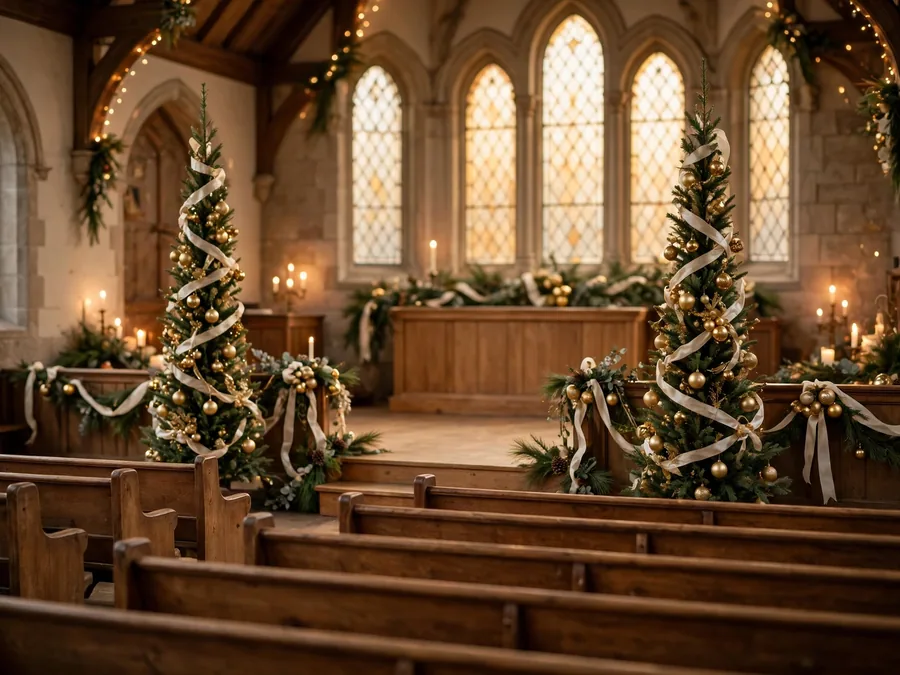
1. Twin Slim Trees Flanking the Platform
Place two slim trees, 6½ to 7 feet tall, at the two front corners of the platform, clear of the steps. Dress them identically: warm-white lights, wide ivory ribbon wound top to bottom, and matte gold baubles only. From the back pews the pair frames the platform like brackets.
The honest trade-off: slim trees look sparse up close, so judge them from the congregation’s seats, never from the platform. If the platform is narrow, use one tree rather than squeezing in a pair.
Why it works:
- Symmetry reads as reverence in a sanctuary
- All the height sits at the sides, so the cross stays tallest in view
- Two stored trees come out and go away in one trip
2. Ivory Poinsettias on the Platform Steps
Line the two side edges of the platform steps with ivory poinsettias — never the centre, where feet and the communion tray need to pass. Use the same size pot throughout, five or seven per side, slipped into plain gold-foil or basket covers so no plastic shows, each on a small saucer to protect carpet and wood. Real poinsettias drop leaves and need a drink before the weekend; water them on Friday and they look fresh through Sunday. The side-edge rule is what makes this workable on Monday morning.
Color note: Ivory blooms against deep green foliage carry the colour story alone, glowing softly under warm lighting where red would shout.
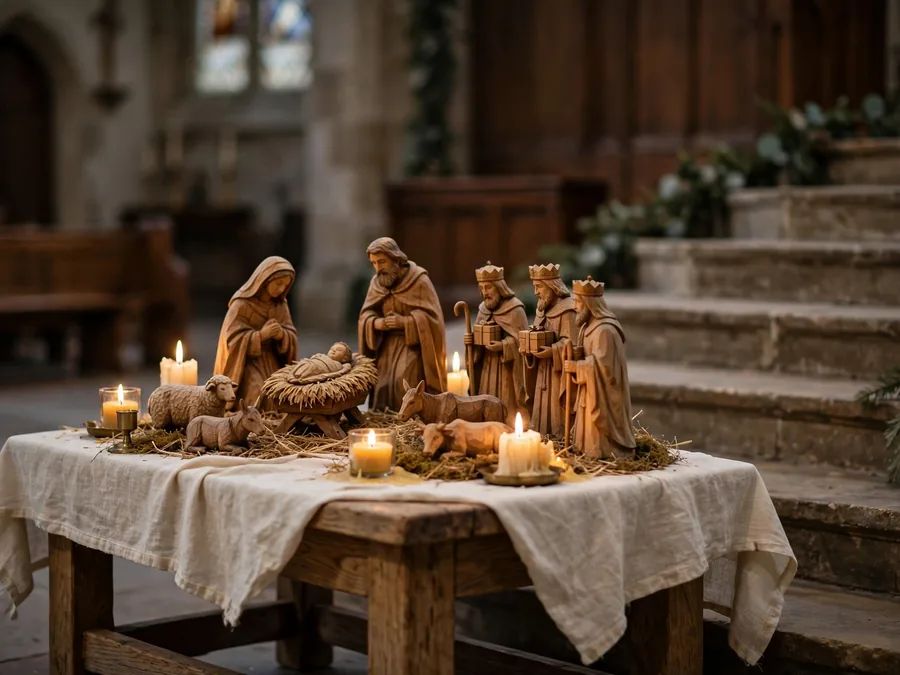
3. A Nativity Table Beside the Platform, Not on It
Set the nativity on a low table on the sanctuary floor, beside the platform steps — near enough central, low enough for children to see in at eye level. Lay a cream cloth, a scatter of straw, and figures 8 to 12 inches tall, with one LED candle in a holder behind the scene for a soft halo. The altar itself stays untouched. In a tight chancel, a console table against the side wall does the same job.
Get the look:
- Main piece: Nativity set, 8–12 inch figures, on a low table
- Supporting piece: Cream cloth, thin layer of straw
- Texture or material: Wood, linen, straw — nothing shiny
- Finishing touch: One LED candle in glass behind the stable
4. A Plain Garland Along the Communion Rail
Run plain green 9-foot garlands along the front of the communion or altar rail, joined end to end and tied on with ivory ribbon every 2 feet. Add nothing else — no baubles, no bows, no lights. The garland hangs below the rail’s top so hands, hymn books, and the communion tray pass freely, with ties around the uprights, never the polished top. Photographed, a bare garland can look stark; in the room, that plainness lets everything else breathe. Nearly every church can do this one exactly as written.
Fit check: Let the swag drop no more than 8 inches below the rail top, and kneel at the rail yourself to confirm nothing brushes knees or catches on clothing.
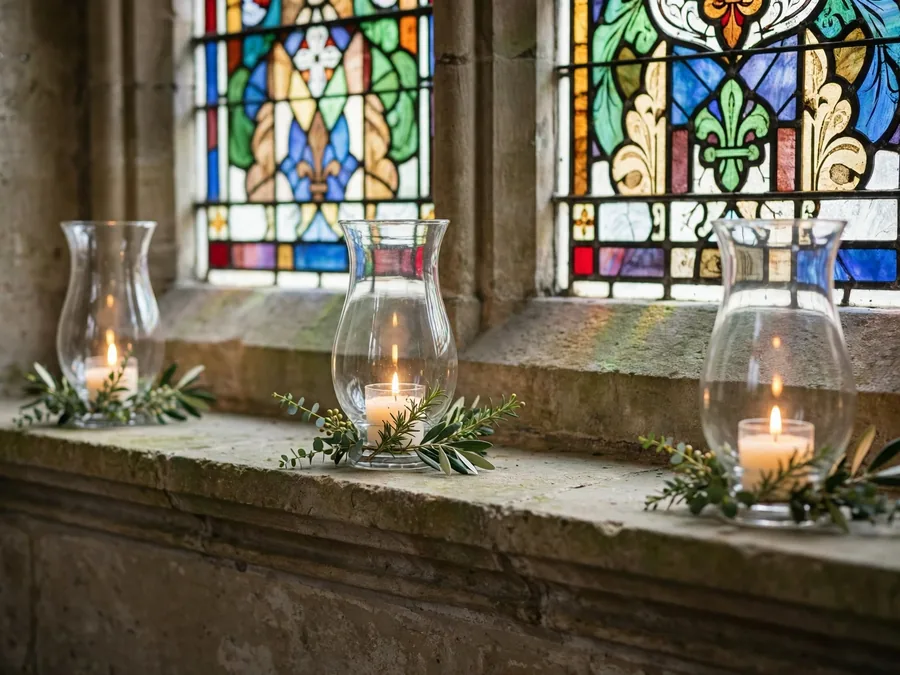
5. Hurricane Candles on the Window Sills
Centre one glass hurricane on each deep window sill, holding a warm-white LED pillar candle, with a single flat sprig of greenery laid beside it. Identical heights matter more than identical glassware, so measure the candles, not the holders. It is the same plain-greenery discipline that makes classic Christmas wreath ideas work: one green note, repeated calmly. Use LED without apology — sills sit close to curtains, banners, and dry garlands, and no glow is worth a fire risk. The trade-off is a slightly cooler light than real flame, softened by choosing the warmest LED tone available.
The formula: Glass hurricane + warm-white LED pillar + one flat greenery sprig
6. Two Vertical Banners on Freestanding Stands
Hang a matched pair of tall fabric banners on black metal stands, one against each side wall of the platform. Choose ivory cloth with a single gold star or dove motif — words date quickly and can slide into cheesy, while a simple symbol holds up for decades. Stands 7 feet tall keep the banners above head height without a single screw in the wall, and the pair can move to the narthex for the carol service. The honest downside: good banners cost real money, so this is a buy-once piece the church keeps, not a yearly craft project.
Best for: Tall sanctuaries with bare side walls that swallow smaller decorations whole.
7. An Advent Wreath on Its Own Stand
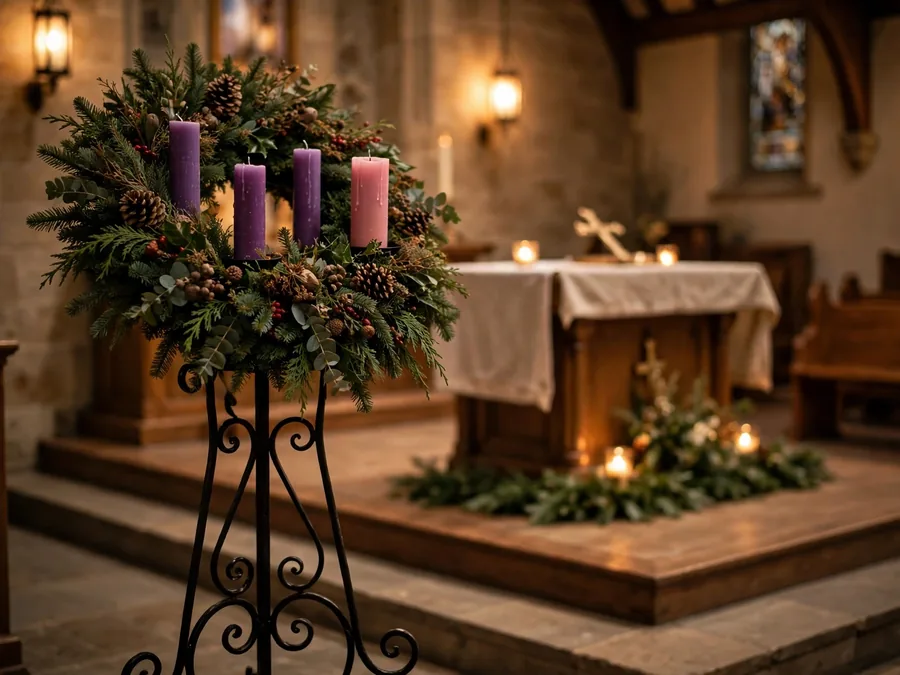
Give the Advent wreath a wrought-iron floor stand of its own, beside the platform where the candle-lighting family can reach it without climbing steps. Use a 24-inch greenery ring with three purple candles, one pink, and a white candle at the centre — or follow your church’s tradition exactly. Keep a lighter and snuffer in a small basket at the stand’s base. Real candles need a named person watching them every service; if your building’s rules say no open flame, good LED Advent candles exist and nobody minds.
Texture note: Black iron, soft wax, and rough greenery against smooth platform wood gives the corner depth without adding a single extra colour.
8. A Chrismon Tree in the Sanctuary Corner
Stand one tree in the sanctuary corner nearest the narthex door and cover it only in white-and-gold Chrismon ornaments — crosses, doves, stars, fish, and crowns — with warm-white lights. Nothing else: no red, no tinsel, no baubles. The tree becomes a quiet teaching point children study while they wait, and it explains itself to visitors better than any notice sheet. Because every ornament follows one rule, the tree can grow slowly over the years without ever looking random. Start with thirty ornaments and add a few each Advent.
Budget note: A craft group can make a full set from white foam, gold cord, and glitter over two or three evenings for the price of one shop-bought ornament box.
9. White Amaryllis on Two Pedestals
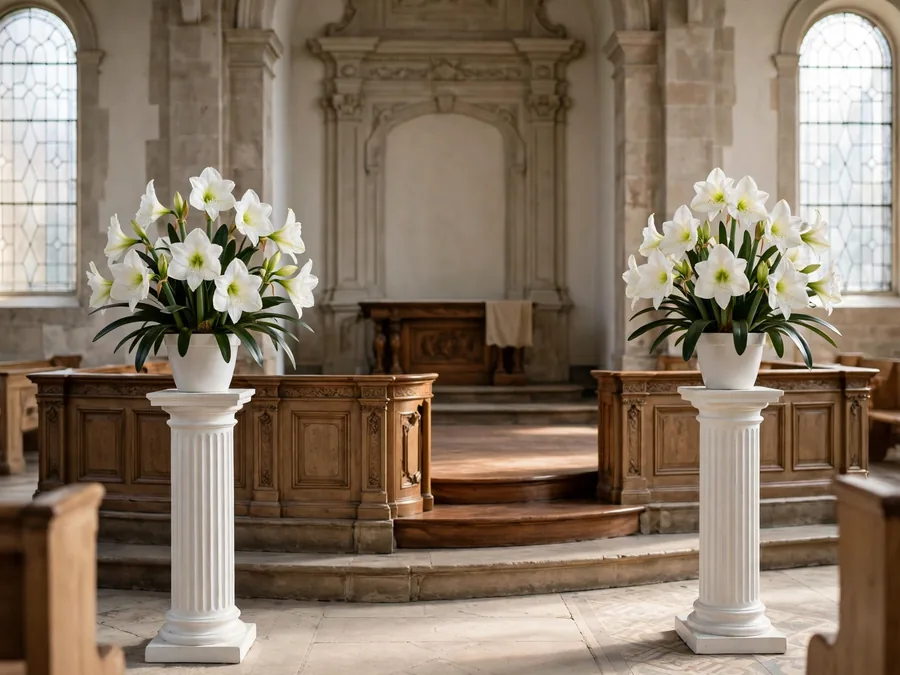
Set a white ceramic pot of amaryllis on each of two matching pedestals, one at either side of the platform, at the height of the top step. White blooms on long green stems give the platform living height without a single ornament, and the pair reads as one gesture from anywhere in the room. Forcing bulbs to flower at Christmas means potting them six to eight weeks ahead — the real cost here; a good faux amaryllis avoids the calendar entirely. Keep the pots plain: the flowers are the decoration.
Space note: Pedestals 30 to 36 inches tall put the blooms at step height, clear of the sight line to the lectern from every row behind the third.
10. One Large Star High Above the Platform
Hang a single large star — 24 to 36 inches across, warm-white LED outline or plain antique gold — high on the wall or beam above the platform, centred on the axis of the cross. Then stop. Nothing else goes up there: no swags, no second star, no lettering. The emptiness around it is the elegance, and it photographs beautifully over a candlelit congregation. This needs two people, a proper ladder, and a fixing into solid structure, so agree it with whoever looks after your building first.
Style note: One star alone says more than a ceiling full of decorations; restraint at height is what makes a sanctuary feel lofty instead of busy.
11. Pew-End Swags on Every Other Pew
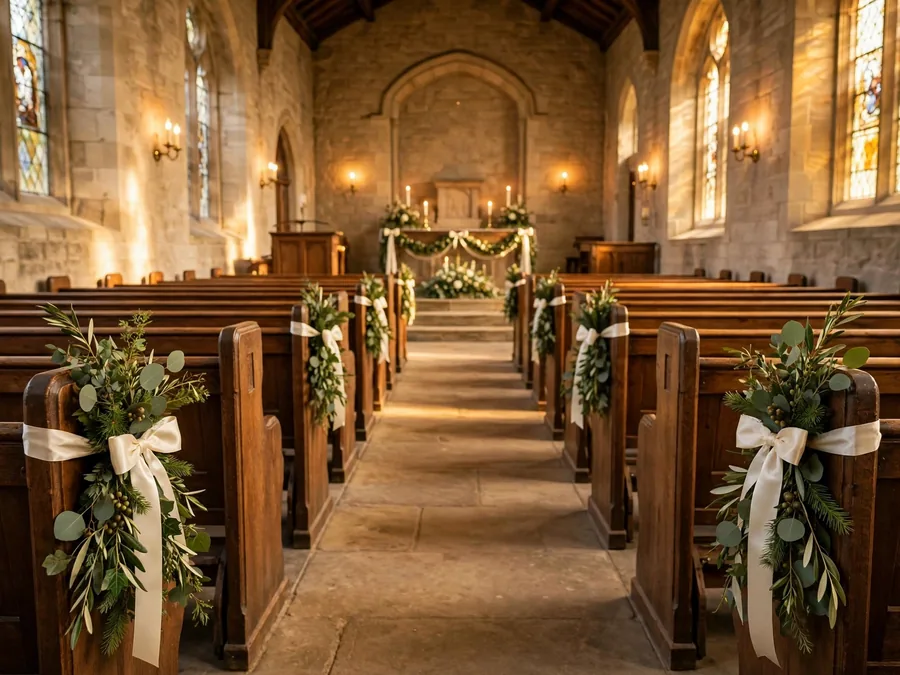
Clip a small greenery swag, about 12 inches long, to the aisle end of every other pew, each finished with one plain ivory bow at the same height. Decorating every pew doubles the cost and crowds the aisle; every other pew sets up a rhythm the eye reads as order. Use padded pew clips or ribbon ties — never tape or pins on polished ends. Keep each swag inside the pew’s outline so coats and shoulders pass without catching.
Easy swap: Change only the bow colour — deep gold next year, soft silver the year after — and the same swags look new for the price of one spool of ribbon.
12. Lantern Markers at the Aisle Ends
Stand four black metal lanterns with LED candles on the floor: two at the front corners of the centre aisle, two flanking the inside of the main doors. They sit in the dead space against the pew ends, glowing at ankle height where ushers need light during candlelight services. The trade-off is trip risk if they creep into the walkway, so mark each spot with a tiny chalk dot and reset them after every service. Keep the style plain — fancy lanterns at floor level just look lost.
Fit check: Walk the aisle carrying a hymn book at your side; a full 4 feet of clear passage should remain, with no lantern touching your path.
| Surface | Safe Fixing | Leave at Home |
|---|---|---|
| Polished pew ends | Padded pew clips, ribbon ties | Tape, pins, sticky hooks |
| Painted or stone walls | Freestanding stands, existing picture hooks | Nails, screws, adhesive strips |
| Wooden doors | Over-door hooks with felt backing | Wreath nails, pinched hangers |
| Window glass | Ribbon from the top frame, suction cups on glass only | Tape on frames or stone mullions |
| Floors and steps | Weighted bases, felt pads, chalk position dots | Loose items in walkways, trailing cords |
13. Shepherd’s-Crook Candle Stands Down the Aisle
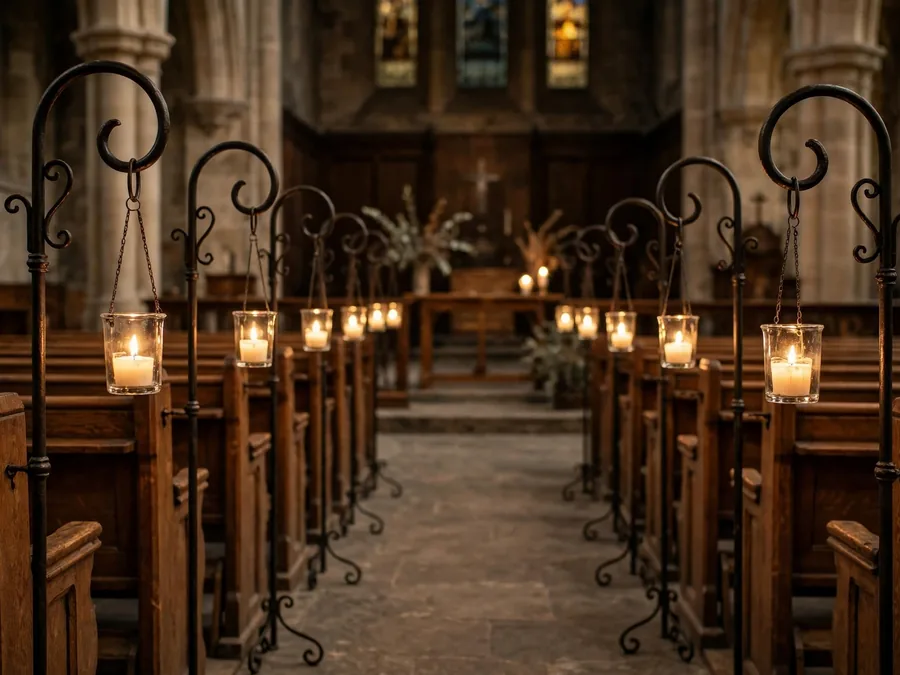
Line the centre aisle with freestanding iron shepherd’s-crook stands, one at every third pew, alternating sides so the glow zigzags gently down the room. Hang a small glass votive with an LED candle from each hook, and tie one short ivory ribbon under the hook. The stands need heavy, flat bases — a crowded Christmas Eve aisle means elbows, children, and long coats brushing past. Leave them unlit on ordinary Sundays if you prefer; on candlelight night, switch them on an hour early and the aisle becomes the best seat in the house.
Color note: Black iron and warm-white glass against ivory ribbon keeps the whole aisle inside the colour story, with the dark stands echoing the window frames.
14. Reserved Rows Marked With Ribbon and Greenery
For the carol service, mark rows reserved for family, choir, or readers with a simple ivory ribbon looped across each aisle-end pew, holding one small sprig of greenery. It does the ushers’ hardest job politely — nobody has to be moved. Make the markers generous and obviously temporary: a loose loop lifts off in one motion when the row is released. The trade-off: reserved rows can look unwelcoming in photographs, so keep the count honest and free them the moment the service starts.
Why it works:
- A ribbon reads as information, not decoration, so it never looks like clutter
- Ushers seat people faster, which calms the whole pre-service room
- Everything lifts away in seconds and stores in one small box
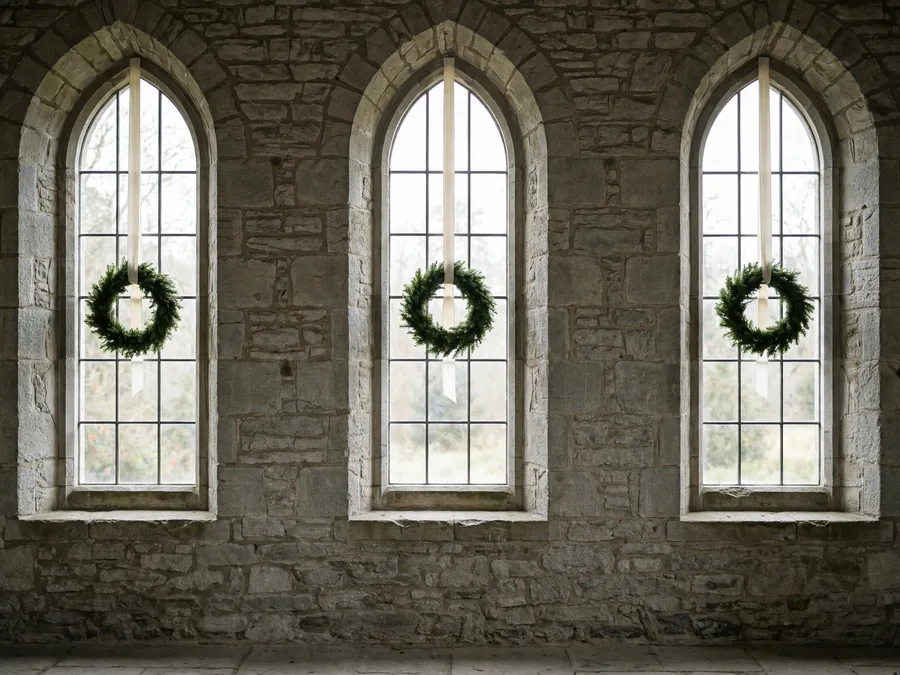
15. A Plain Wreath in Every Tall Window
Hang one plain green wreath, 20 to 24 inches across, in the centre of each tall sanctuary window, suspended from the top frame on wide ivory ribbon. No bows, no berries, no lights — daylight through the glass does the decorating, and at night the wreaths read as dark, calm silhouettes. Identical wreaths are the whole point, so buy them in one batch. Against stained glass, keep them completely plain so the colours never fight.
Get the look:
- Main piece: One plain wreath centred in each tall window
- Supporting piece: Wide ivory ribbon from the top frame
- Texture or material: Matte foliage against glass
- Finishing touch: Every wreath at exactly the same height
16. Paper Stars in the Side Windows
Hang white and cream paper star lanterns, fitted with battery LED bulbs, in the side aisle windows at paired heights — the same height on both sides, window by window. Paper stars fold flat in January and store in one box, the friendliest large decoration a church can own. Keep them clear of curtain fabric and use timer battery packs so nobody climbs to switch them off nightly. The honest weakness: paper tires after a few seasons of folding, so replace a star or two each year.
Seasonal swap: The same window hooks hold plain white paper lanterns at Easter, so the fixings earn their place twice a year.
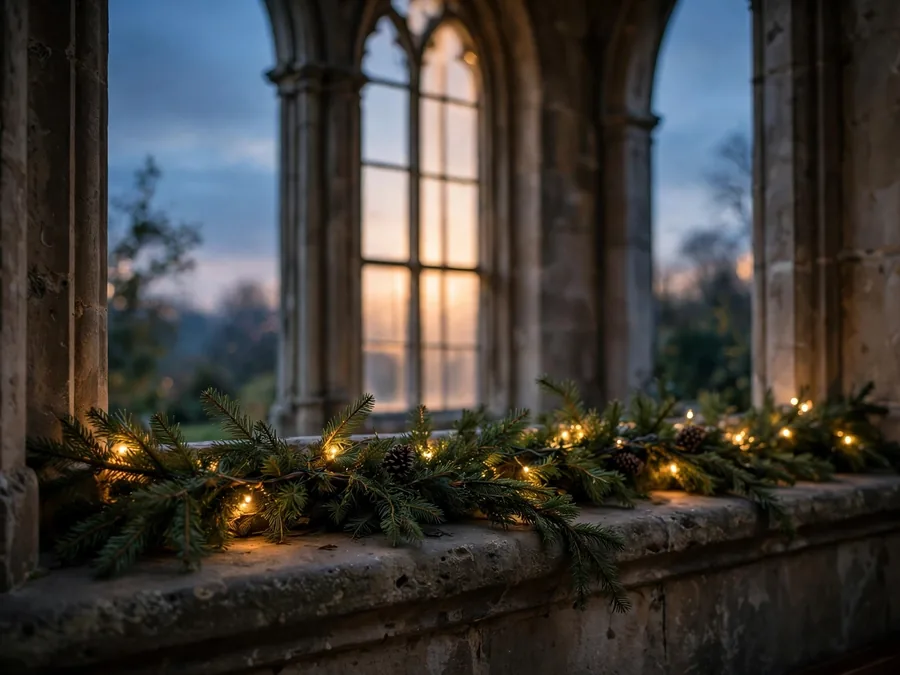
17. A Garland Line Along the Deep Window Ledges
Where your side windows have deep stone or wood ledges, run one plain garland flat along each ledge with warm-white fairy lights woven loosely through it, battery packs tucked behind the last fold. The line of green sits low and quiet, lighting the wall wash rather than the room. Nothing may hang over the edge into the seats below. Not every church has ledges deep enough — if a hymn book can’t sit flat on yours, use the sill hurricanes instead.
Space note: The ledge needs at least 4 clear inches of depth; the garland lies flat and still, with every light inside the ledge line, never dangling.
18. A Welcome Table With One Small Tree
In the narthex, set one small table against the wall with a 3-foot tree dressed in ivory and gold, the visitors’ book open beside it, one LED candle, and a neat stack of service sheets in a basket. One table, one tree, one candle — the welcome works because it is edited, not because it is big. The table must sit flat against the wall so the doorway keeps a full clear path at the busiest moment of the week. If your narthex doubles as a pram park or a coat stand, shrink the tree to a tabletop one and keep the same three-piece rule.
The formula: Small dressed tree + open visitors’ book + one LED candle in glass
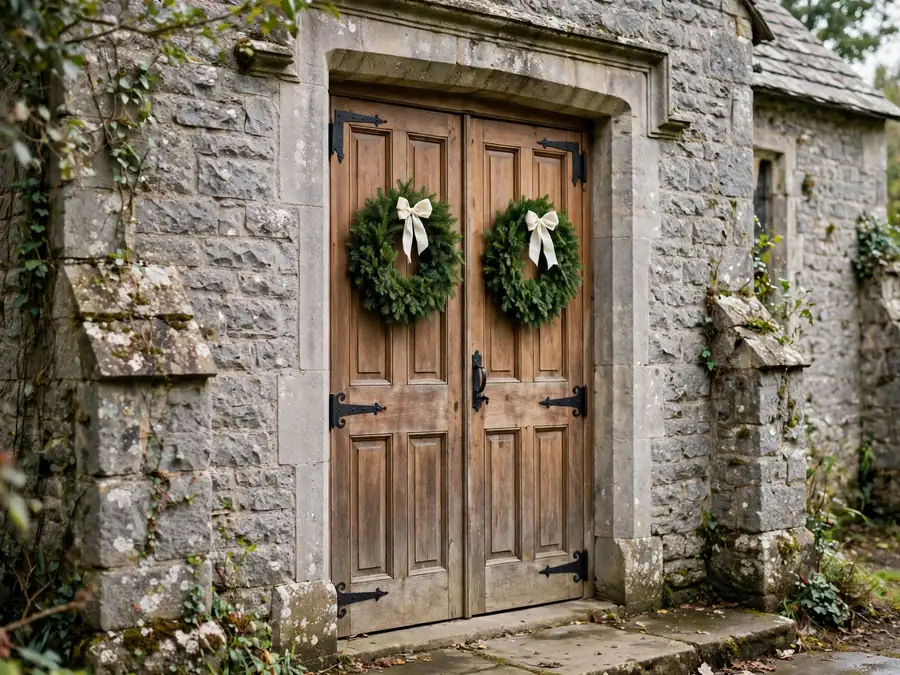
19. Matching Wreaths on the Double Doors
Hang one identical plain green wreath on each of the main double doors, on felt-backed over-door hooks, with a single ivory bow at the bottom of each. It is the same lesson behind good Christmas door decor: one strong piece, nothing competing with it. A matched pair is the secret, and a ready-made shortcut earns its keep here — the IKEA VINTERFINT artificial wreath, 23½ inches across, is $19.99, so both doors match without a florist’s bill. Faux foliage survives a month of weather that would strip greenery bare.
Budget note: Buy the plainest wreaths you can find and add bows from one spool of wired ivory ribbon; pre-decorated pairs cost twice as much for half the calm.
20. Garland Tied Along the Narthex Handrail
Run a plain garland along the outside face of the narthex stair or ramp handrail, tied on with ivory ribbon every 18 inches, with battery warm-white lights woven through if the narthex is dim. The top of the rail stays completely bare — hands of every age grip it, especially on wet December steps, and decoration never outranks a safe hold. Work from the bottom up so the swags fall evenly, tails tucked short. It is the first thing people touch, so it sets the tone before a word is spoken.
Texture note: Rough green foliage against a smooth varnished rail, with the ribbon ties as the only soft note, keeps the entry feeling tailored rather than fluffy.
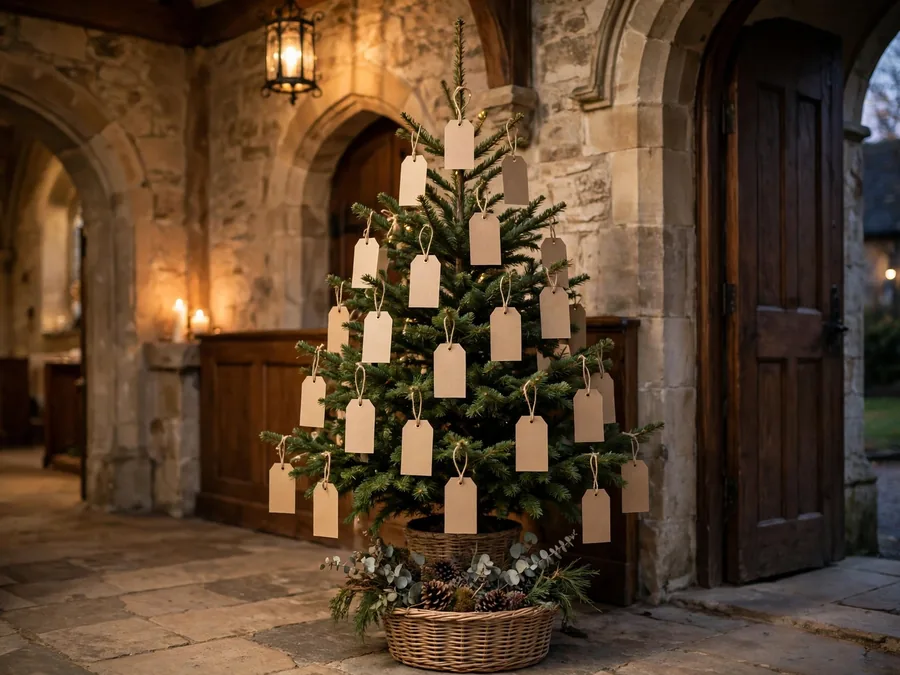
21. A Giving Tree With Paper Tags
Stand a plain 4-foot tree in the narthex dressed with nothing but paper tags, each one naming a single gift your Christmas appeal needs — a toy for a six-year-old, a pair of gloves, a tin for the food bank. Members take a tag and bring the gift back the next week. Keep a basket at the base with spare tags and a pen, because the tree empties fast in the first fortnight and a bare tree helps nobody. This is the one decoration in the building that is supposed to be stripped by Christmas — and it usually is, which is rather the point.
Best for: Churches running a food-bank, toy, or warm-clothing appeal through December.
22. A Felt Nativity Board in the Children’s Corner
Mount a low felt board in the children’s corner with large, soft nativity figures the children can move themselves — Mary, Joseph, the manger, a star, two animals, and no more. Keep the pieces big, few, and washable, in soft gold, cream, and sage rather than bright primary colours, so the corner belongs to the same calm building. A labelled box underneath catches the pieces at tidy-up. The honest trade-off: pieces will wander into pews and pockets, so count the set weekly and treat a missing sheep as the cost of children using it.
Style note: Few, large figures read as one clear story to a three-year-old; a crowded board is just visual noise at toddler height.
| Spot | Piece Size | Sight-Line Rule |
|---|---|---|
| Platform trees | 6½–7 ft, slim profile | Tops stay below the cross from the back pew |
| Platform steps | Pots 8–10 inches across | Side edges only; the centre stays clear for feet |
| Centre aisle | Swags within the pew’s own width | A full 4 ft of walkway remains open |
| Tall windows | Wreath 20–24 inches | No wider than a third of the window |
| Double doors | Wreath 22–26 inches | Top of the wreath below the door’s top rail |
| Hall tables | Jars under 8 inches tall | Conversation passes over the top, easily |
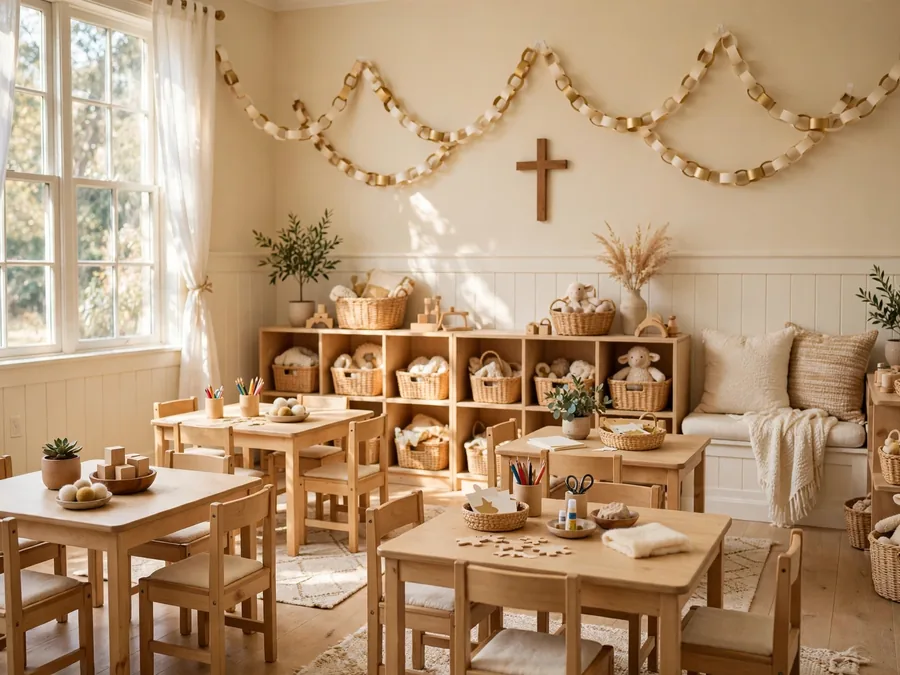
23. One-Colour Paper Chains in the Children’s Room
Let the children make the decoration for their own room: paper chains in cream and gold only, strung in gentle swags across the corners and pinned to the notice boards rather than the walls. Two colours keep a handmade project inside the building’s calm instead of turning into a rainbow explosion — and the children still made every link. Keep swags short, 6 feet at most, because long paper runs sag in warm December rooms. The chains rarely survive storage; honestly, remaking them is half the tradition.
Easy swap: Ivory and soft silver paper gives the same calm rhythm next year, so the room never looks like a repeat.
24. A Garland Run Along the Fellowship Hall Windows
In the fellowship hall, run one continuous line of plain garland along the window wall, joined at the window mullions so the seams hide, with warm-white lights woven through and battery packs at the two ends. Leave the tables, the serving hatch, and every other wall plain — one decorated wall is a backdrop; four is a grotto. Measure the whole run before buying: garlands come in 9-foot lengths, and guessing short leaves an obvious bald patch.
Fit check: Hold the garland line at least 12 inches above the back of a chair pushed against the wall, so seated guests never lean into foliage.
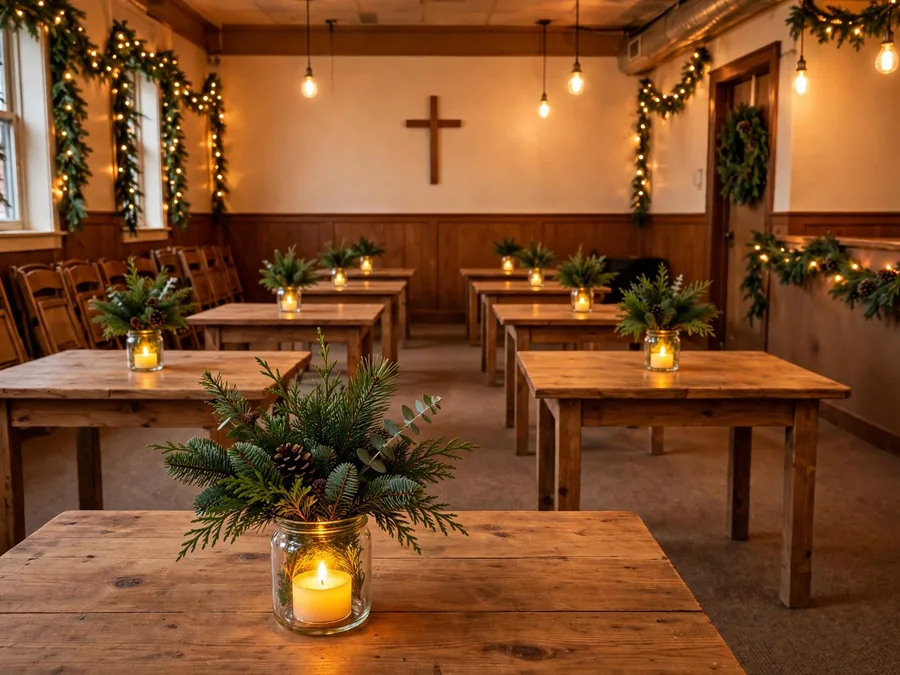
25. Identical Greenery Jars on Every Hall Table
For suppers and coffee after services, put one small glass jar on every fellowship hall table holding a single sprig of greenery in water, with one LED tealight beside it. Identical is the operative word — same jar, same sprig height, same central position — because repetition across ten tables reads as design, while ten different centrepieces read as leftovers. Keep everything under 8 inches so conversation passes over the top. Make them assembly-line style in one evening.
Color note: Deep green sprigs and warm tealight glow against plain white cloths repeat the sanctuary’s story in the room where people actually linger.
26. A Garland Along the Choir Loft Rail
Tie a garland along the front of the choir loft rail, with ivory bows at each tie point, the drape below the rail’s top edge so music folders and the conductor’s sight line stay clear.
The loft is the one high surface the congregation stares at for an hour, so the platform rule applies double: plain, level, symmetrical. Battery lights are optional — in a bright sanctuary the green line alone is enough. Check the view from the back pew before calling it finished.
Why it works:
- The loft rail is a frame the eye already rests on during hymns
- A single green line softens a hard architectural edge without hiding it
- Ribbon ties never touch the rail’s polished top
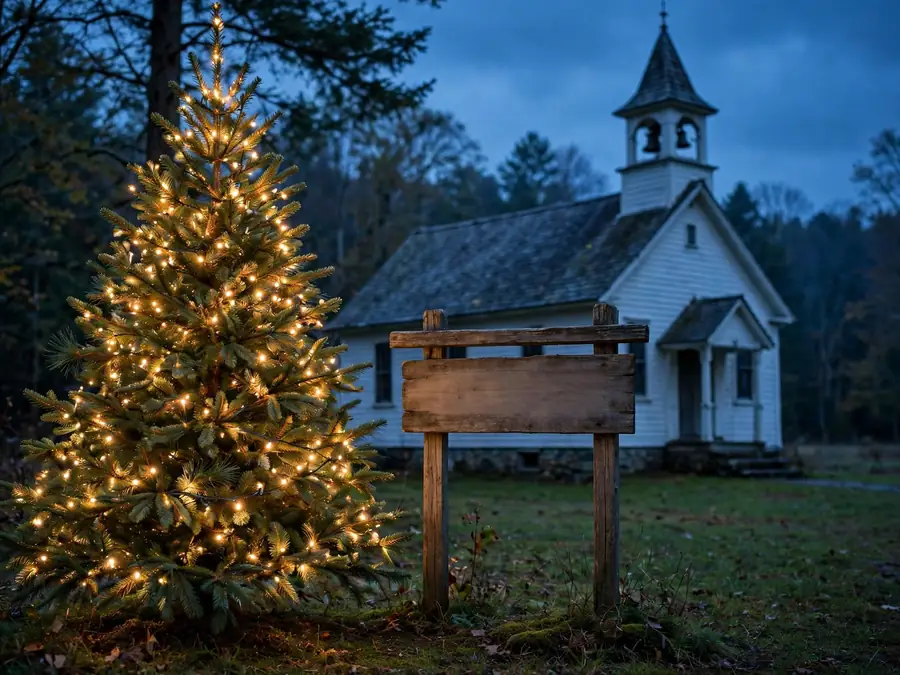
27. One Lit Tree Beside the Church Sign
Stand one outdoor tree, 5 to 6 feet tall, beside the church’s entrance sign or at the top of the drive, lit with warm-white lights only, on a timer from dusk until 10 p.m. One tree, one colour of light, doing the work of an invitation to everyone who passes. Use a weighted stand and a weatherproof socket cover — outdoor electrics are the one place this list refuses to improvise. A real tree outdoors lasts the season in December weather; a faux one needs its weight doubled in wind.
Space note: Set the tree behind the line of the pavement or drive entrance, never inside the sight triangle drivers need when pulling out.
28. Luminarias Along the Front Walk for Christmas Eve
For Christmas Eve and the carol service only, line both sides of the front walk with paper-bag luminarias: white or kraft bags folded down at the top, a cup of sand in the base, one LED tealight each, spaced about 2 feet apart. Set them out an hour before the service and take them in the same night. It is the most welcoming sight in this whole list — and the most labour-intensive per hour of display, so assign two named volunteers before you promise it. Wind is the honest enemy; the sand is not optional.
Seasonal swap: The same bags, sand, and lights line the walk again for an Easter sunrise service, looking entirely different at dawn.
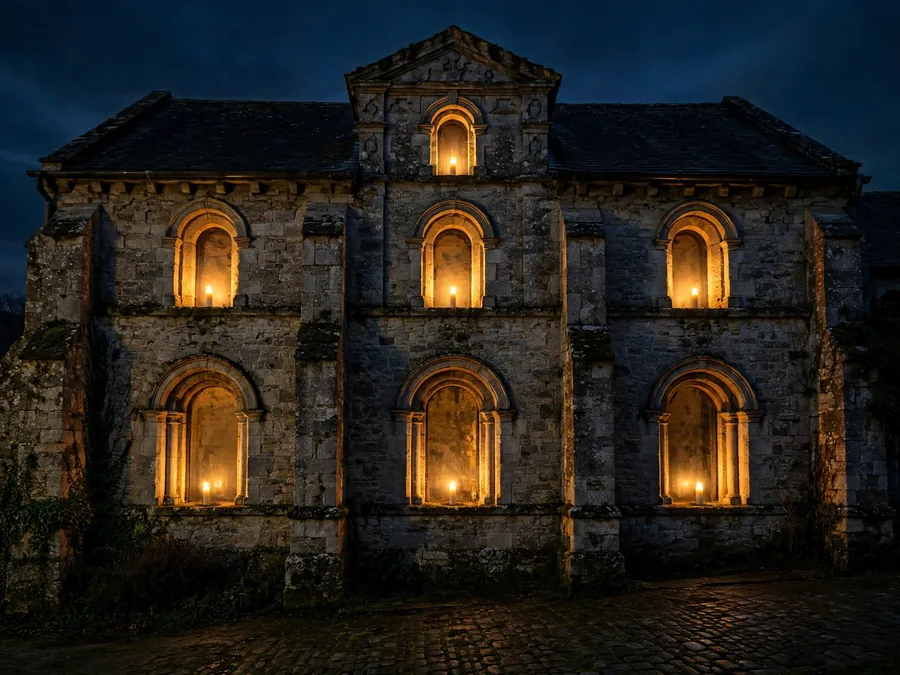
29. A Single Candle in Every Street-Facing Window
Place one identical LED candle, centred on the sill, in every window of the church that faces the street — sanctuary, hall, and office windows alike — all on timers set to light together at dusk. From outside, the whole building glows in one calm gesture that costs less than almost anything else here. Mixed window sizes actually help: the repeated candle becomes the rhythm that ties a rambling building together. Choose candles with a warm tone and check the timers once in mid-December, because one dark window in the row is more noticeable than none at all.
The formula: One identical candle + centred on every sill + all timers set to the same dusk hour
30. Handrail Garlands on the Entrance Steps
Finish where people arrive: plain garlands tied along both handrails of the outside entrance steps, one ivory bow at each newel post, battery warm-white lights woven through if the steps are used after dark. The pairing of garland and bows anchors most festive entryway ideas indoors; outside, it simply has to survive weather. The garland rides on the outer face and the rail top stays bare for hands — doubly important on frosty steps. Use outdoor-rated ribbon, because December fades indoor ribbon by New Year.
Budget note: Two 9-foot garlands and one spool of ribbon cover most entrances; buy them in the January sales and this whole idea costs almost nothing next year.
Start With the Doors, Then the Platform, Then Stop
A church does not need all 30 of these ideas — it needs a few of them, done calmly and in the same colours. The pairs do the heavy lifting: door wreaths, platform trees, window wreaths. Once those are placed, look at the room from the back pew and add only what the room still asks for. Most years, the honest answer will be: nothing.
Your one next step: This week, stand at the back of your sanctuary with one other person, agree the colour story out loud, and hang the pair of matching wreaths on the main doors. That single finished job will set the standard — and the restraint — for everything else your team adds this Christmas.