Last December your porch probably grew the way most do: a wreath in November, then a second strand of lights that did not quite match the first, a lantern by the steps, a sign from the craft store — until the welcome your guests got was less “come in” and more “we may have overdone it.” Add one extension cord stretched across the steps, and the porch was quietly working against you.
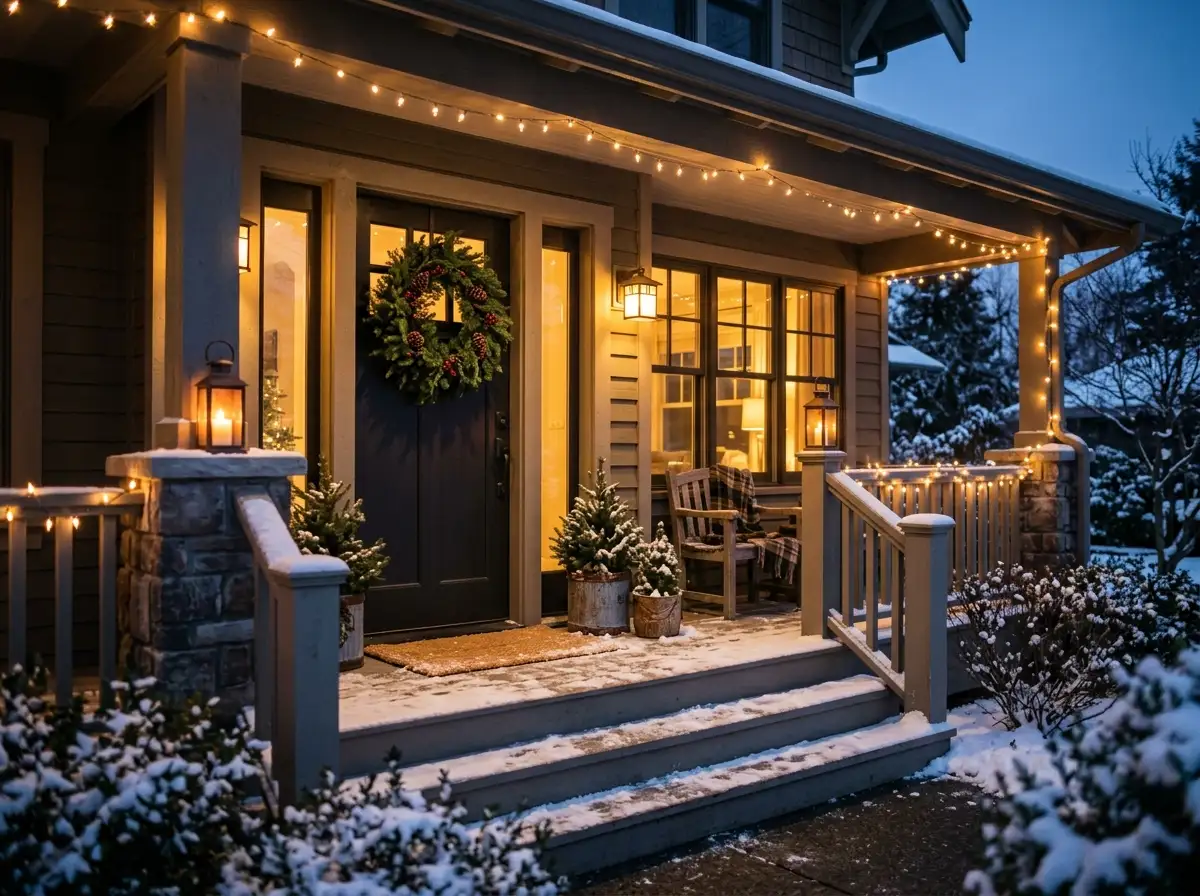
A porch that welcomes instead of shouts is built in layers around one focal point: the door. Greenery first, one clear color story, light that switches itself on at dusk — and everything tied down for real weather. You can see the same layered approach across these front porch Christmas decor ideas, where the strongest porches are rarely the fullest ones.
The 16 ideas below follow that order, from the door outward. Most use what a porch already has — urns, lanterns, a chair, a railing — plus a timer, a handful of zip ties, and lights in a single warm white.
The Porch Formula That Keeps the Welcome Bright Without Becoming a Billboard
- Anchor the door first: Hang the wreath or swag before anything else goes up, because every later choice should support that one focal point instead of competing with it.
- Repeat green, red, and warm white: Evergreen, one red accent, and warm white light are the whole color story — anything outside those three belongs in the yard, not on the porch.
- Build for weather, not for the photo: Weight the urns, zip-tie the garland, and route cords off wet ground, because the display has to survive December wind and rain, not just its first evening.
- Put it all on one timer: Every light on a single timer means the porch lights itself at dusk, goes dark at a set hour, and can slim down to winter mode in January without a rebuild.
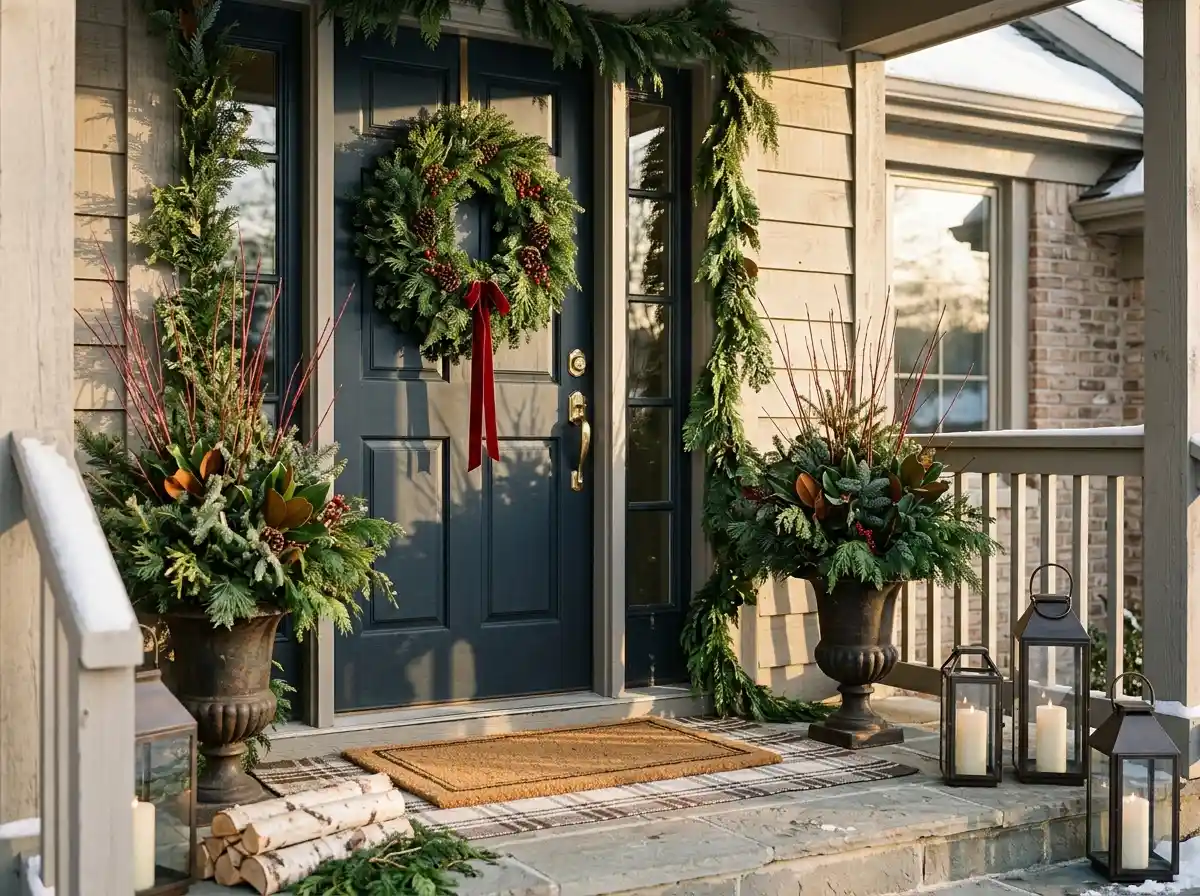
On a real porch that looks like this: a 24-inch evergreen wreath with a cranberry ribbon on the front door, an urn of pine and red twigs on each side, one strand of warm white lights around the door frame, and a plaid rug layered under the doormat.
| Order | Layer | Why it comes at that stage |
|---|---|---|
| 1 | Wreath or swag on the door | It is the focal point every other piece must match |
| 2 | Garland and lights on the frame | They draw the doorway’s outline after dark |
| 3 | Urns, lanterns, and a chair at the sides | They fill the edges without blocking the door swing |
| 4 | Mats and luminarias at ground level | They finish the path guests actually walk |
1. One Strong Wreath, Sized to the Door
Measure your door before you buy: on a standard 36-inch door, a 24-inch wreath fills the frame without crowding the edges, and it should hang at eye level — roughly 57 inches from the ground to its center. Choose fullness over decorations: a dense evergreen wreath with one ribbon reads clearly from the street, while a sparse wreath covered in ornaments reads as clutter. This is the one piece worth spending on: the Balsam Hill Grand Heritage Wreath, which starts at $139, is built on a sturdy frame that holds its shape through wind and years of hanging. A premium wreath costs more than the rest of the porch combined — the defense is that everything else here is cheap or already owned.
Fit check: Keep 5 to 6 inches of door visible on each side of the wreath; if you can see less than that, the wreath is a size too big.
2. A Door Swag When Every House Has a Wreath
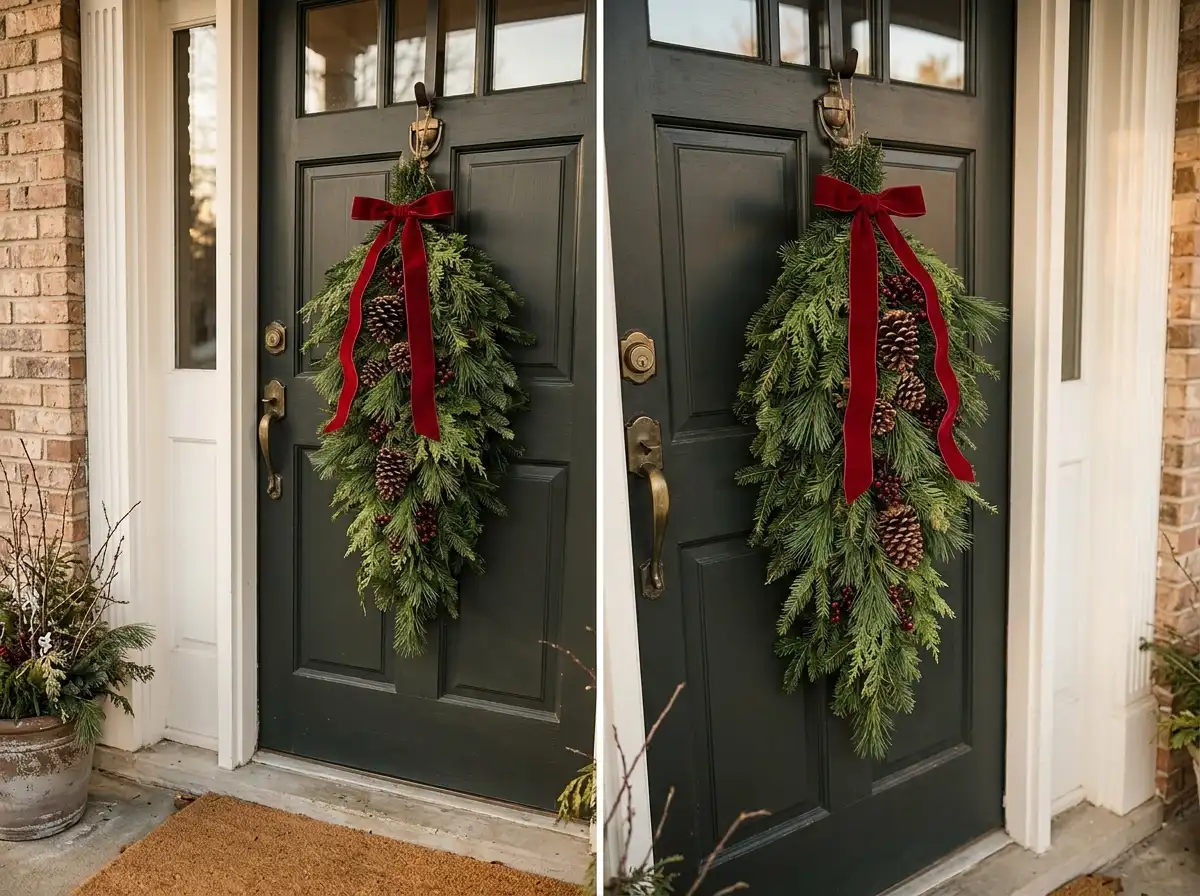
If every door on the street wears a wreath, hang a swag instead: a teardrop bunch of cedar and pine, about 24 inches long, tied at the top with wire and finished with two small brass bells and a short ribbon tail. It hangs from the same hook, points downward like an exclamation mark, and sways slightly when the door opens — movement no wreath gives you. A swag also suits doors with a large window or an awkward knocker, since it can sit higher and narrower. Swags do dry out faster than wreaths when they are real, because the stems are cut shorter, so faux is the safer buy here. Carry the same greens inside, and guests will feel the porch and your Christmas entryway decor as one welcome instead of two separate efforts.
Style note: On double doors, a swag looks best on the door that actually opens — leave the fixed door bare and let the asymmetry look deliberate.
3. Urn Planters With Winter Greens and Red Twigs
Flank the door with two urns — or use one, placed on the hinge side, if your stoop is narrow. Build each arrangement the way florists do: tall evergreen branches in the center for height, shorter pine and cedar around the rim, three to five red twig dogwood stems for the single red accent, and a few pinecones wired in at the base. A brick or paver hidden in the bottom of each urn keeps it upright in wind. The finished arrangement should reach about waist height; taller than the door handle starts to crowd the doorway. Real clippings from the yard cost nothing and last for weeks in cold air, though their tips eventually brown — a weekly spritz of water and shade from afternoon sun will stretch them to New Year.
Space note: On a stoop under 4 feet deep, one urn in the corner beats a cramped pair — symmetry matters less than a clear walkway.
4. A Slim Garland Around the Door Frame
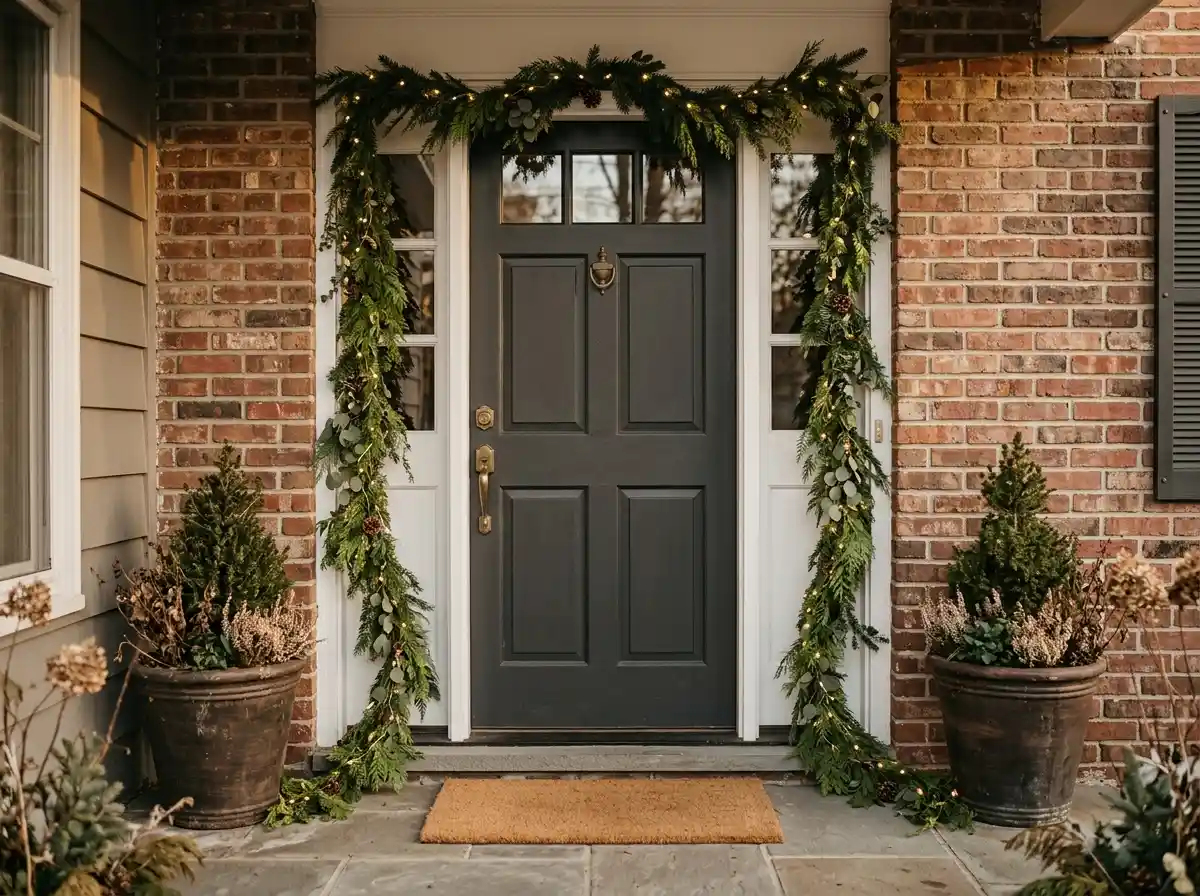
Run one slim garland — real pine or a good faux cedar — up one side of the door frame, across the top, and down the other side. Keep it slim: a single strand frames the door, while a doubled, overstuffed garland swallows it. Fix it with small cup hooks screwed into the trim every 18 inches, or with outdoor adhesive clips on painted surfaces, and keep every branch clear of the door’s swing and the weatherstripping so the door still seals against the cold. Screwed hooks do leave tiny holes in the trim; adhesive clips avoid them but can let go in a hard frost. Leave the garland unlit if your columns carry lights — the frame and the columns should not both glow.
Get the look:
- Main piece: One 9-foot slim cedar garland
- Supporting piece: Cup hooks or outdoor adhesive clips, spaced 18 inches apart
- Texture or material: Soft, drooping faux cedar against painted trim
- Finishing touch: One small bow where the garland meets the top corner
5. Light-Wrapped Columns in One Color Only
Wrap each porch column with one strand of warm white lights, spiraling from bottom to top with even, roughly 6-inch spacing, and plug both into the same timer as the rest of the porch. Even spacing is what separates a styled column from a tangled one — walk back to the street and adjust any bunching before you call it done. If your porch has a single column, wrap the one; a lone column lit cleanly looks intentional, while a half-lit pair looks broken. Keep the wraps snug with the strand’s own tension rather than tape, which fails in the cold. Be warned, this is the slowest idea on the list: two columns, a ladder, and the better part of an hour.
Color note: Buy all your strands in one trip and check each box for the same color temperature — mixing warm white and cool white is the fastest way to make a porch look accidental.
6. A Trio of Small Wreaths on the Windows
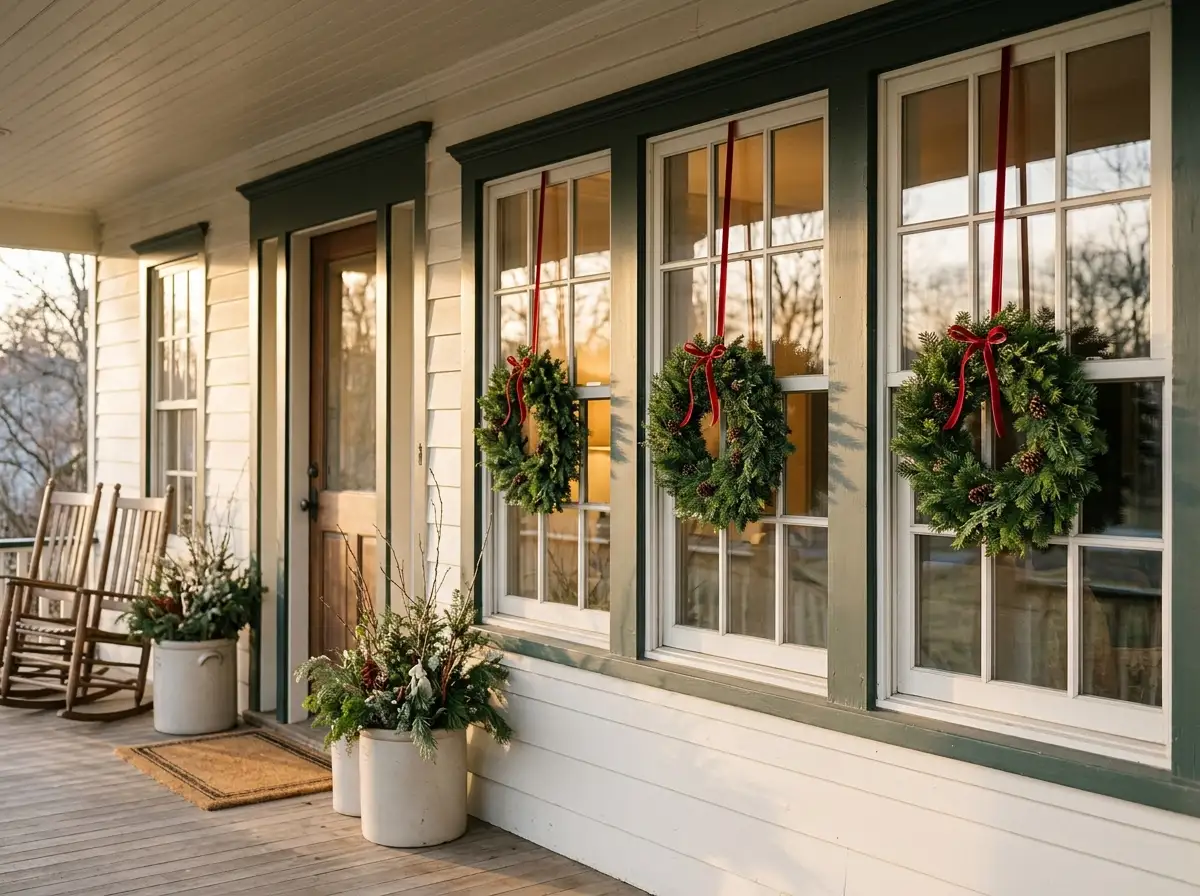
Hang three small wreaths — 10 to 12 inches each — on the porch windows or sidelights, each from a length of cranberry ribbon passed over the top of the frame. A repeated trio gives a plain porch architecture: the eye reads it as one designed gesture rather than three separate decorations. Keep the wreaths plain green, or add one tiny bow each; this is a rhythm piece, not a focal point. Ribbon-hung wreaths do knock softly against the glass on windy nights, and a small felt pad stuck to the back of each one silences it. From inside, the wreaths silhouette against the glass in the evening — a small gift to the people in the room, too.
Seasonal swap: In January, change the cranberry ribbon for plain burlap or cream and the trio becomes winter decor that can stay up until February.
7. Layered Doormats: A Rug Under the Mat
Layer a small outdoor rug — a simple plaid or stripe in red and cream, about 2 by 3 feet — under a plain coir doormat. The rug peeks out on all four sides like a frame, and the combination makes a standard door look wider and more considered. This is the cheapest full idea on the list, and the one guests literally stand on while they wait for the door to open. Choose a low-pile, outdoor-rated rug so the door still clears it, and shake both layers out weekly, because grit trapped under coir grinds porch paint. The one real drawback: layered mats hold moisture after rain and dry slowly in shade, so lift them to dry after a wet week.
Texture note: Rough coir against a smooth woven rug is the contrast that makes the layering read — two smooth mats just look like a mistake.
8. Lanterns on the Steps, Candles on Timers
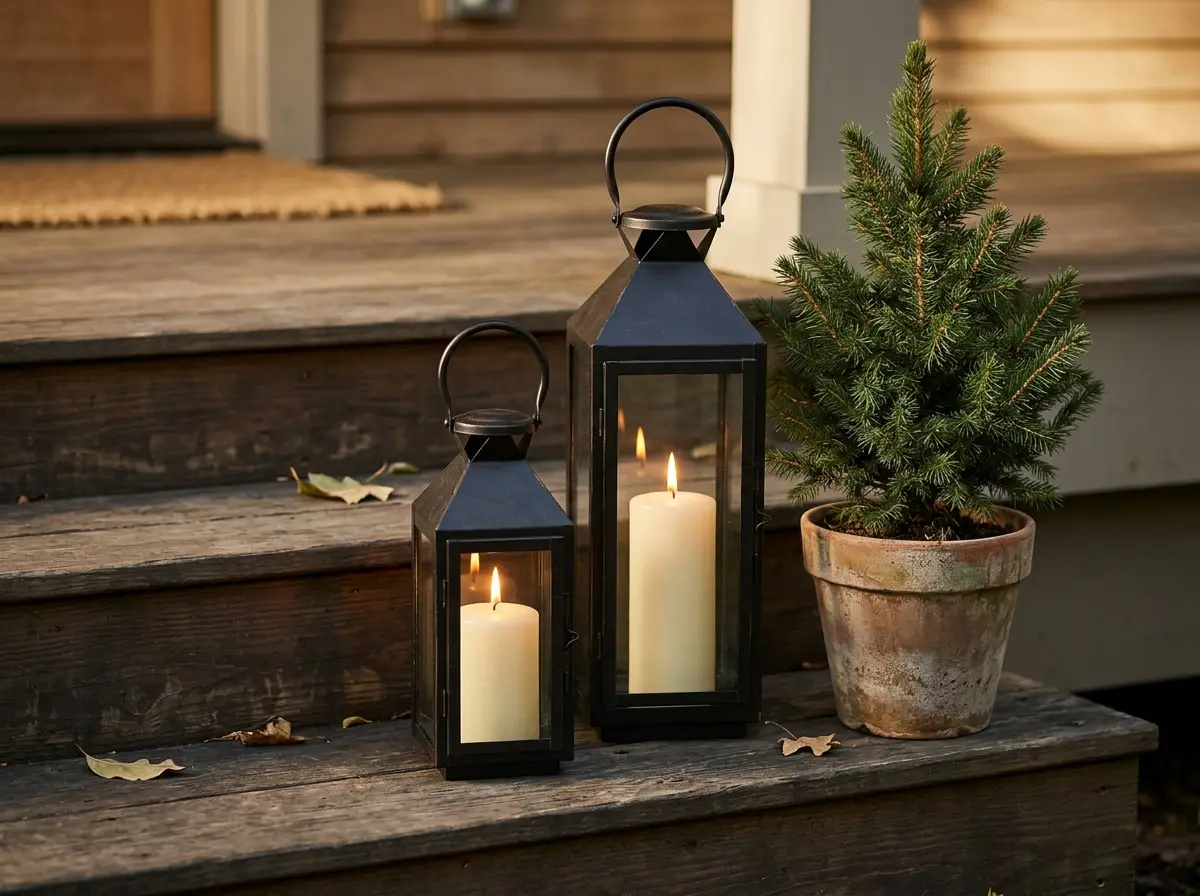
Set two or three black metal lanterns on the porch steps — the largest on the bottom step, smaller ones rising — each holding a battery candle set on a timer. Steps are dead space that every guest’s eyes cross on the way up, and lantern light at ankle height makes a path feel guided rather than merely lit. Battery candles are non-negotiable here: real flames on steps get kicked, rained on, and forgotten. Group the lanterns on one side only, leaving the handrail side clear for hands, packages, and deliveries. Battery flames are steadier and slightly flatter than real wax — from the sidewalk, nobody can tell the difference.
Best for: Porches without an outdoor outlet near the door — timer candles need no power at all and come on at the same dusk hour every night.
| Light source | Best spot | The rule |
|---|---|---|
| Warm white string lights | Door frame or columns, not both | One color temperature across the whole porch |
| Timer candles in lanterns | Steps and side tables | On at dusk, off by 11 p.m. |
| LED luminarias | Along the walkway | Battery only — no open flame near paper or leaves |
| Porch ceiling bulb | Above the door | Swap to warm white so it matches the strands |
9. Window Boxes Filled With Winter Greens
If your porch windows have boxes, strip out the tired fall annuals and refill them with winter greens: fir and cedar laid in thickly, red berries or red twigs standing up through them, and a few pinecones nestled at the ends. The boxes already have the soil and the position; you are only changing the cast. Keep the arrangement loose and slightly wild — window boxes look best a little overgrown, unlike the tidy door area. One caution before you start: full boxes get heavy, so check that aging brackets are sound before you load them with wet soil and branches. Water real greens weekly in a dry winter; faux greens need nothing but a rinse in January.
Easy swap: Everything in the box lifts out in one piece in January, and spring bulbs can go straight into the same soil.
10. A Rocking Chair Corner That Suggests a Room
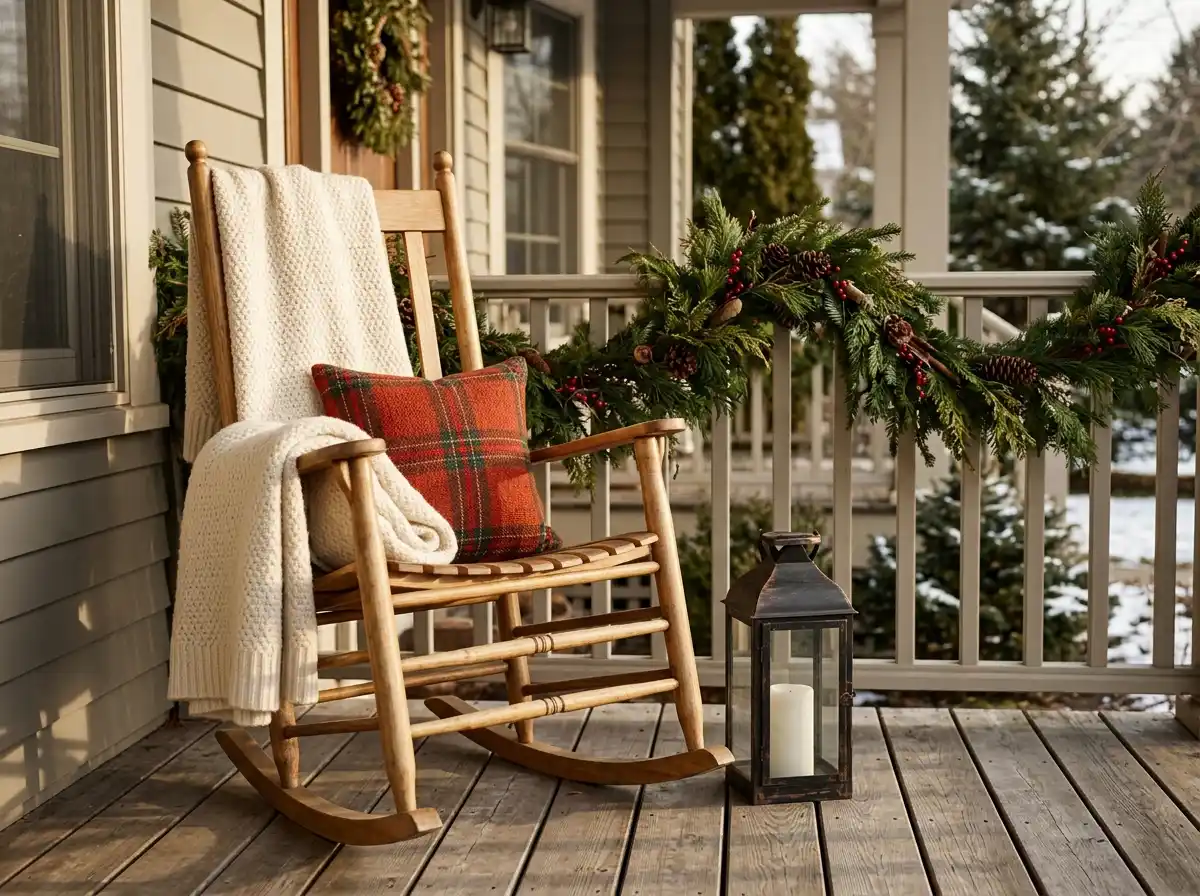
Give the porch chair a winter job. Drape a folded wool or heavy cotton blanket in cream or deep red over the back of a rocking chair or bench, add one plain cushion, and tie a single generous bow on the chair’s top rail — the one place a bow can be big without shouting, as these oversized Christmas bow decor ideas show. Angle the chair slightly toward the door so it greets arrivals. The corner suggests the porch is a room people actually use, even in December, which is what separates a styled porch from a merely decorated one. Textiles do fade and mildew on a rain-exposed porch, though, so this corner belongs under a roof — or the blanket comes in at night.
Get the look:
- Main piece: A rocking chair or bench angled toward the door
- Supporting piece: One folded wool blanket in cream or deep red
- Texture or material: Woven wool against painted wood
- Finishing touch: One large bow tied on the chair’s top rail
11. A Plain Garland on the Stair Rail
Dress the handrail with a plain garland — no lights — fixed with zip ties every 12 inches and trimmed so it never sags into the hand’s path. The rail is a long diagonal line the eye follows up to the door, so greenery there quietly doubles the welcome. Keeping it unlit is deliberate: with the columns or the door frame already glowing, a lit rail pushes the porch toward the billboard end of the scale. Leave a clean break in the greenery at the newel post so hands land on wood, not branches. Zip ties are visible up close in daylight, but green ones against green garland all but disappear.
Space note: Test the rail with a gloved hand before guests arrive — if your grip lands on greenery anywhere, thin that section until it doesn’t.
12. A Firewood Stack That Works as Decor
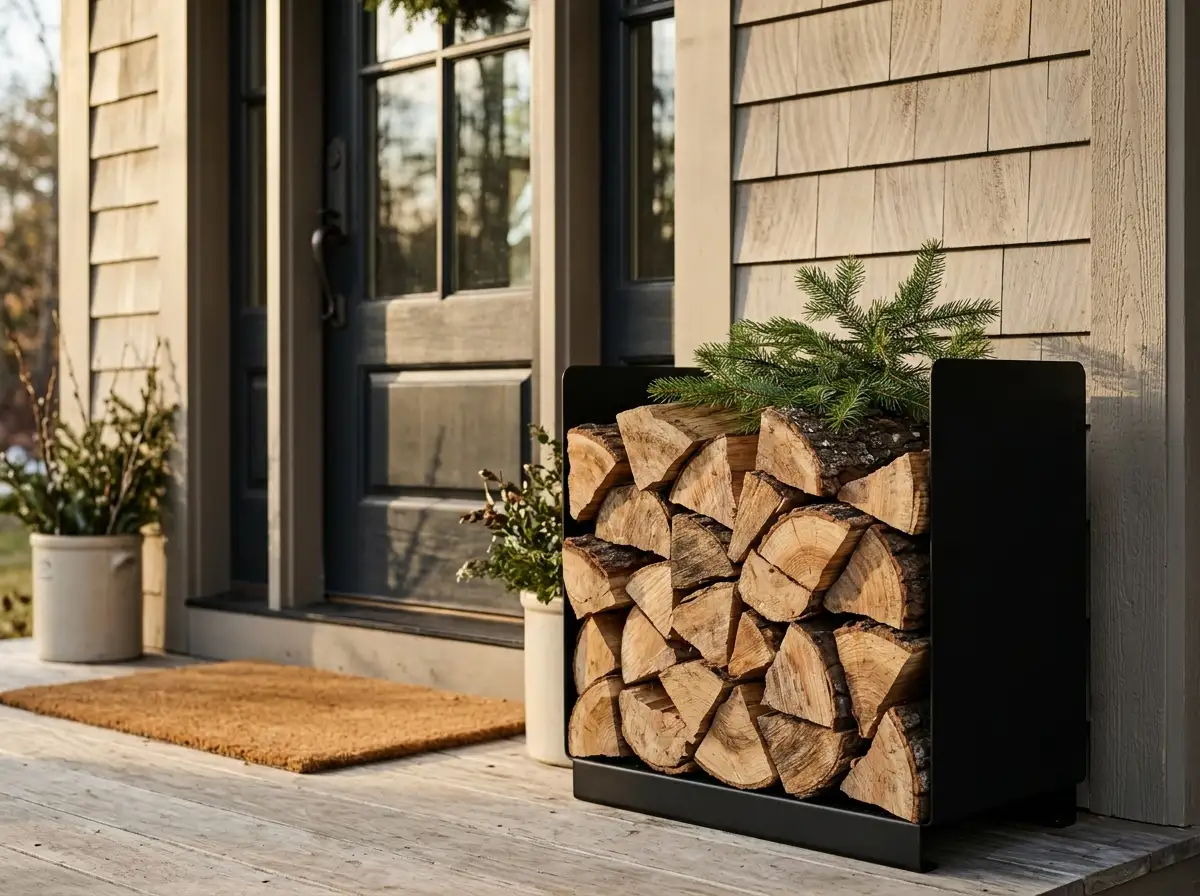
A tidy stack of firewood in a black metal holder beside the door is decoration that also happens to be useful. Stack it bark-side out, ends aligned, no higher than the door handle, and top it with one sprig of cedar if you like. The rough bark and cut ends give the porch the natural texture that smooth, store-bought decor cannot fake, and on the coldest nights the stack quietly promises a fire inside. Even if your fireplace is gas or purely decorative, a small stack reads as winter hospitality from the street. Real wood can harbor insects, so keep the stack a foot from the siding and bring in only what you will burn that week.
Texture note: Wood is the porch’s warmest material — one stack balances all the smooth metal, glass, and painted surfaces around it.
13. Luminarias Along the Walkway
Line the walkway or the porch edge with luminarias: white paper bags folded down at the top, weighted with a scoop of sand, each holding an LED tealight. Six to ten bags, spaced evenly, make a runway of soft light that costs almost nothing and takes about fifteen minutes to set out. They belong to the friendliest family of easy DIY Christmas decorations — no tools, no skill, and children can fold the bags. Use LED lights only, and bring paper bags in when rain threatens; mason jars holding the same tealights are the weatherproof version. Paper luminarias are fair-weather decor, and one wet night ends them — though the replacement cost is pennies.
Budget note: A dozen bags, sand from the garden, and a pack of LED tealights come in under the price of one strand of premium lights.
14. A Pinecone and Greenery Basket by the Door
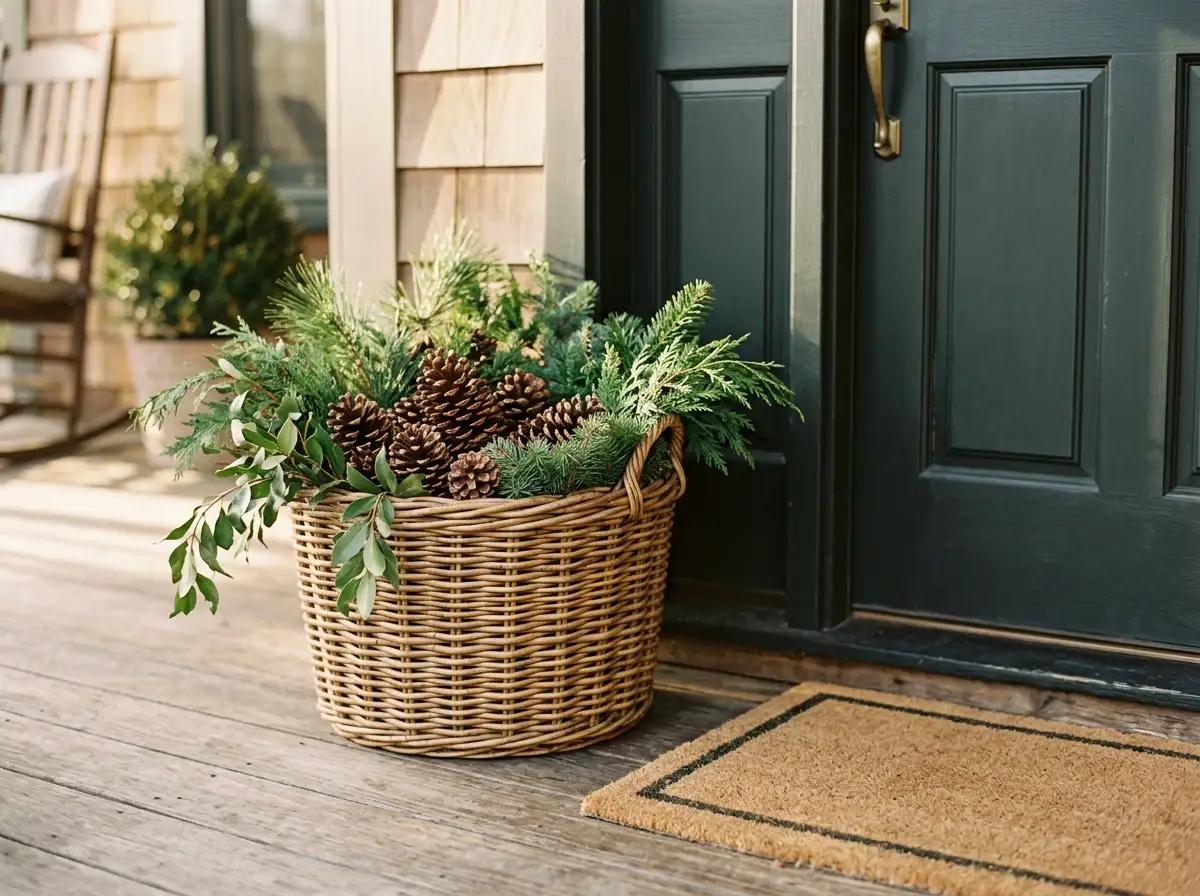
Fill a sturdy basket or a galvanized bucket with pinecones and short evergreen clippings, and set it beside the door or at the foot of the steps. Everything in it can be gathered on a walk — cones from under any pine, clippings from pruning your own shrubs — so the arrangement costs nothing but twenty minutes outdoors. Tuck the clippings in last, standing upright among the cones, and the basket looks composed rather than collected. It also serves as the porch’s repair kit: a spare cone or sprig replaces anything the wind steals from the wreath or urns. Gathered cones sometimes open, close, or drop seeds as temperatures swing, so shake them out outdoors before arranging.
Easy swap: In January, pull the greenery and leave the cones — the basket becomes plain winter texture that works until spring.
15. A Bench With One Cushion and a Potted Tree
If the porch is wide enough for a bench, style one end of it and leave the rest sittable: a small potted spruce or Norfolk pine, 18 to 24 inches tall, in a plain pot with a burlap wrap, plus one cushion in your porch’s red. A living tree beats a plastic one at this size because it smells right and can go into the garden in spring. Set the pot where the bench meets the wall so it never narrows the seat, and water it whenever the soil dries — porch pots freeze and thaw faster than garden beds. The honest catch is commitment: a potted tree needs watering all season and a plan for January, so buy it only if you will actually plant or keep it.
The formula: One green anchor, one red accent, and nothing outside the palette — the little tree and the single cushion follow the same rule as the door.
16. The Timer System That Holds It All Together
Finish the porch the way tidy people finish anything: with a system. Put every strand, lantern, and luminaria on one outdoor timer set from dusk until 11 p.m., route the single extension cord along the wall — never across the steps — and do one 10-minute check each week: re-seat a clip, straighten a wrap, replace a dead candle battery. A porch on a timer looks cared for every single night, including the nights you are out, and it never glows apologetically into January because nobody got around to unplugging it. This small discipline is what keeps all fifteen ideas above on the right side of tasteful.
Why it works:
- One timer means every light agrees on the same on and off hours.
- A weekly check catches small sagging and fading before guests do.
- A fixed end date keeps the display a season, not a habit.
| Piece | Secure it with | Recheck |
|---|---|---|
| Wreath or swag | An over-door hook plus one zip tie | After the first windy night |
| Garland | Cup hooks every 18 inches | Once a week |
| Urns and planters | A paver or sand in the base | After every storm |
| Mats and rugs | An outdoor rug pad or double-sided tape | After rain, before they slip |
| Light strands | Clips, never staples | When you set the timer |
Your one next step: stand at the sidewalk at dusk tonight, take one photo of your porch, and fix or remove the single thing that bothers you most in the picture. One honest fix from the street’s point of view is worth more than three more decorations.