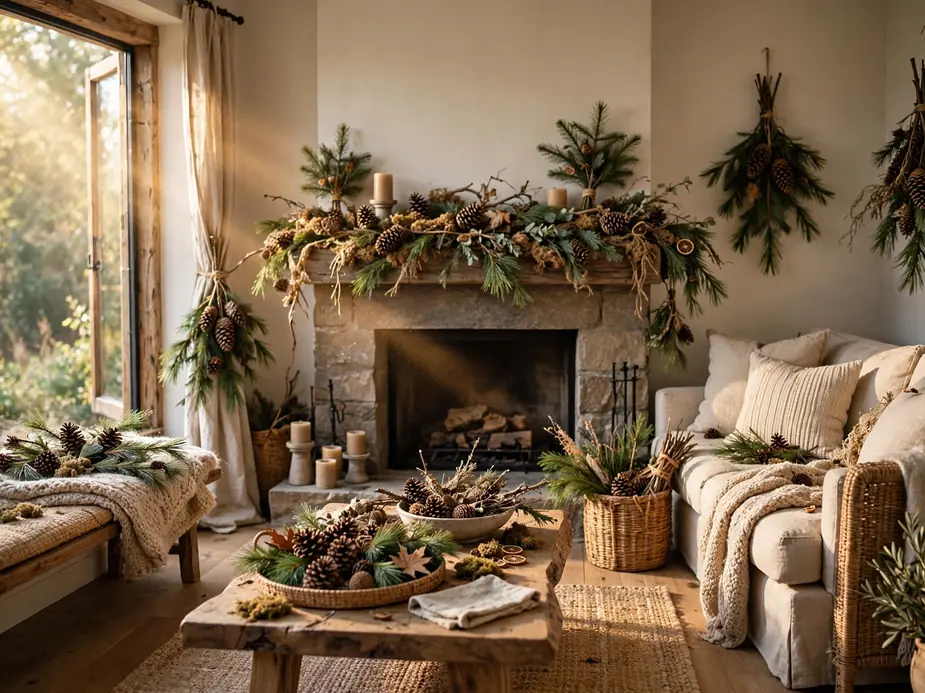
Every December the shops fill with plastic garlands, glittered cones and tinsel that sheds all season, and every January it all has to be boxed, stored and one day thrown away. Meanwhile your own garden, the hedgerow at the end of the street and the woodland floor after a windy night are quietly offering richer material — pinecones, seed heads, scarlet berries, bare sculptural branches — completely free.
Foraged decor works when it is handled with the same care as anything you would buy. Gather legally and lightly, taking fallen material only and a little from many places; then shake, wash and dry everything for a few days so insects and damp stay outside where they belong. Arranged in generous groups and finished with one polished note — a ribbon, a brass holder, candlelight — rough nature reads as real decor.
The 37 ideas below are gathered from gardens, hedgerows, woodland floors and shorelines, and nearly all of them cost nothing but a walk. Take a basket, a pair of pruners and an hour this weekend, and your whole house can be smelling of real green by tonight.
The Foraged Formula That Keeps Natural Looking Polished
- Gather lightly and legally: take fallen material only, a little from many places, nothing from protected land or another’s garden.
- Clean and rest everything: shake, wash and dry finds for a few days so insects and damp stay outside where they belong.
- Arrange in generous groups: single cones look lost; bowls, rows and garlands of them look designed.
- Add one polished note: ribbon, brass or candlelight beside rough nature is what makes foraged read as decor, not debris.
For example: a garland of fifty pinecones on twine across the mantel (generous group), gathered fallen from three different pines and dried a week (light, clean), finished with one brass candle holder at each end (polished note), costs nothing and outlasts every plastic rival.
| # | Idea | Best For | Budget/Effort |
|---|---|---|---|
| 1 | Pinecone Garland Strung on Twine | The mantel, for free | Very low |
| 2 | Pinecone Wreath on a Vine Base | The front door classic | Very low |
| 3 | Acorn Ornaments Tied with Ribbon Loops | Tiny tree treasures | Very low |
| 4 | Bare Branch Centerpiece in a Heavy Vase | Sculpture for the table | Very low |
| 5 | Twig Stars Tied with Jute String | Windows and tree tops | Very low |
| 6 | Fresh Evergreen Clippings as a Mantel Garland | The scent of real green | Very low |
| 7 | Holly and Berry Sprigs in Table Posies | Small, bright arrangements | Very low |
| 8 | Hollowed Log Tealight Row for the Table | Rustic light | Low |
| 9 | Dried Seed Head Stems in Old Bottles | Quiet texture | Very low |
| 10 | Driftwood Tree Built from Graduated Pieces | Coastal homes | Very low |
| 11 | Moss Bowl Centerpiece with Candles | A woodland floor, indoors | Low |
| 12 | Ivy Trails Wound Around the Banister | Green that climbs | Very low |
| 13 | Rose Hip Sprigs Standing in a Cream Jug | Red without berries’ risk | Very low |
| 14 | Magnolia Leaf Wreath, Glossy Side Out | Southern gardens | Very low |
| 15 | Sweet Gum Ball Ornaments Hung on Thread | Nature’s baubles | Very low |
| 16 | Log Slice Ornaments with Burned Designs | Personal and handmade | Low |
| 17 | Twig Reindeer Figures Bound with Twine | Folk-art charm | Very low |
| 18 | Woven Vine Wreath Base Dressed Fresh Weekly | One base, many looks | Very low |
| 19 | Pressed Fern Frames for the Hallway | Green art from the garden | Low |
| 20 | Winterberry Branches in a Tall Floor Vase | A red exclamation mark | Very low |
| 21 | Juniper and Cedar Bundle Swags for Doors | Fragrant welcomes | Very low |
| 22 | Dried Hydrangea Heads in a Mantel Row | Summer, remembered | Very low |
| 23 | Ornamental Grass Plumes in a Corner Crock | Height and softness | Very low |
| 24 | Bark Wrapped Candle Jars Tied with String | Texture around light | Very low |
| 25 | Stone Cairn Stacks on the Porch Steps | Balanced welcomes | Very low |
| 26 | Preserved Leaf Garland in Autumn Tones | The last of fall, honored | Very low |
| 27 | Branch Chandelier Hung with Cones and Baubles | Over the dining table | Low |
| 28 | Feather and Cone Picks Tucked in the Tree | Woodland details | Very low |
| 29 | Crabapple Sprigs in a Table Vase | Jewel fruit on stems | Very low |
| 30 | Acorn and Cone Bowl on the Coffee Table | A bowl of the season | Very low |
| 31 | Log Round Chargers Under Dinner Dishes | The table’s foundation | Low |
| 32 | Willow Whip Hoops Hung as Minimal Wreaths | Bare, beautiful circles | Very low |
| 33 | Scented Pinecone Fire Starters in a Basket | Decor that works | Very low |
| 34 | Dried Lavender and Rosemary Bundles for the Kitchen | Fragrant and useful | Very low |
| 35 | Found Antler Sheds Styled on the Mantel | The lucky find | Very low |
| 36 | Shell and Stone Garland from Beach Walks | Shoreline memories | Very low |
| 37 | Mixed Clippings Wreath from Your Own Trees | Your garden on the door | Very low |
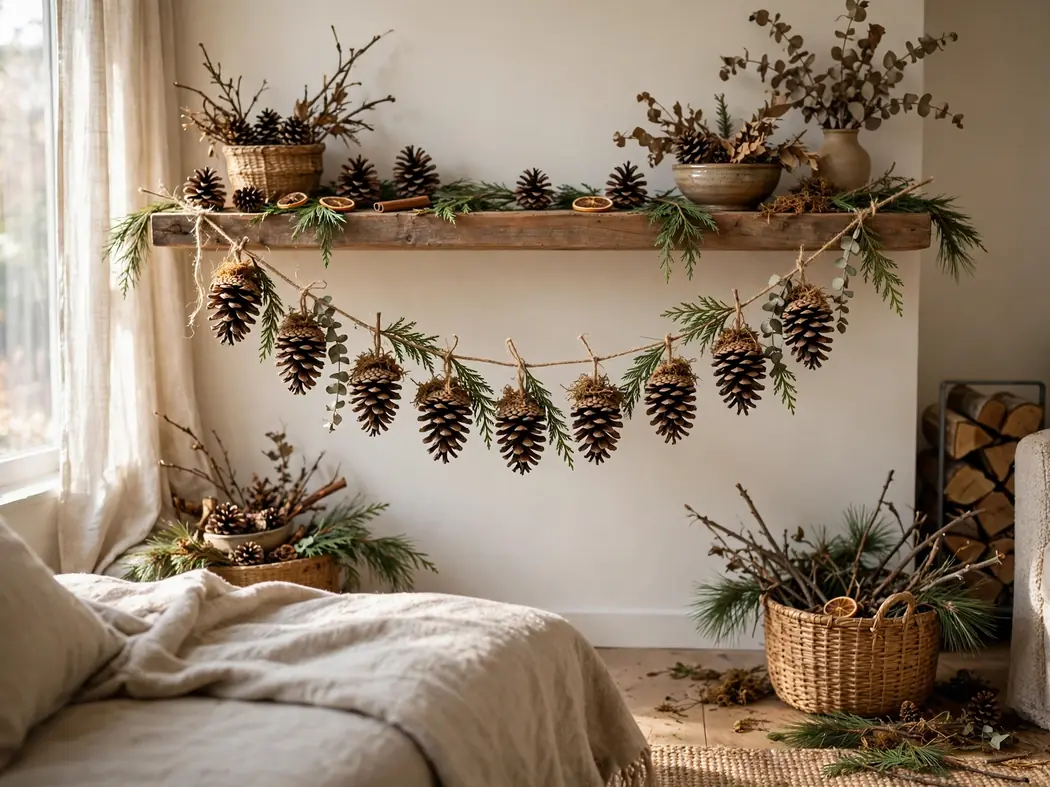
1. Pinecone Garland Strung on Twine
Collect fallen cones after a dry, windy day — thirty to fifty for a six-foot mantel — in mixed sizes, open and sound. Rest them on a tray for a week to dry fully and let any residents move out. Wrap jute twine twice around each cone’s top scales, knot firmly, and string the cones close together so the garland reads as one thick rope of texture. Drape it across the mantel in two soft swags.
Why it works:
- Cones are shaped like ornaments already, so a row needs no decorating.
- The twine disappears, leaving the texture to do all the work.
- Dried cones keep for years, so one walk stocks many Christmases.
2. Pinecone Wreath on a Vine Base
Wind fallen grapevine or willow whips into a 14-inch circle and bind it with twine — your free base. Wire forty to sixty dried cones through their bottom scales with thin garden wire, or set them with a dab of glue where they touch. Work in overlapping rows, biggest cones at the back, smallest at the front edge, until no vine shows. Hang it on a single brass nail and finish with one short length of velvet ribbon at the top.
Budget note: the wreath costs nothing if the wire and ribbon come from the drawer; even bought new, both together run under three dollars.
3. Acorn Ornaments Tied with Ribbon Loops
Gather fifty acorns with their caps still on, from under several oaks rather than stripping one tree bare, and dry them on a sunny sill for a week. Where a cap has loosened, fix it back with the tiniest drop of glue. Cut ribbon — saved scraps of red, cream or forest green, six inches each — and tie a loop through or around each cap, knotting it snug. Hang the acorns in clusters of three at different heights on the tree’s outer branches, where they catch the light like tiny wooden baubles.
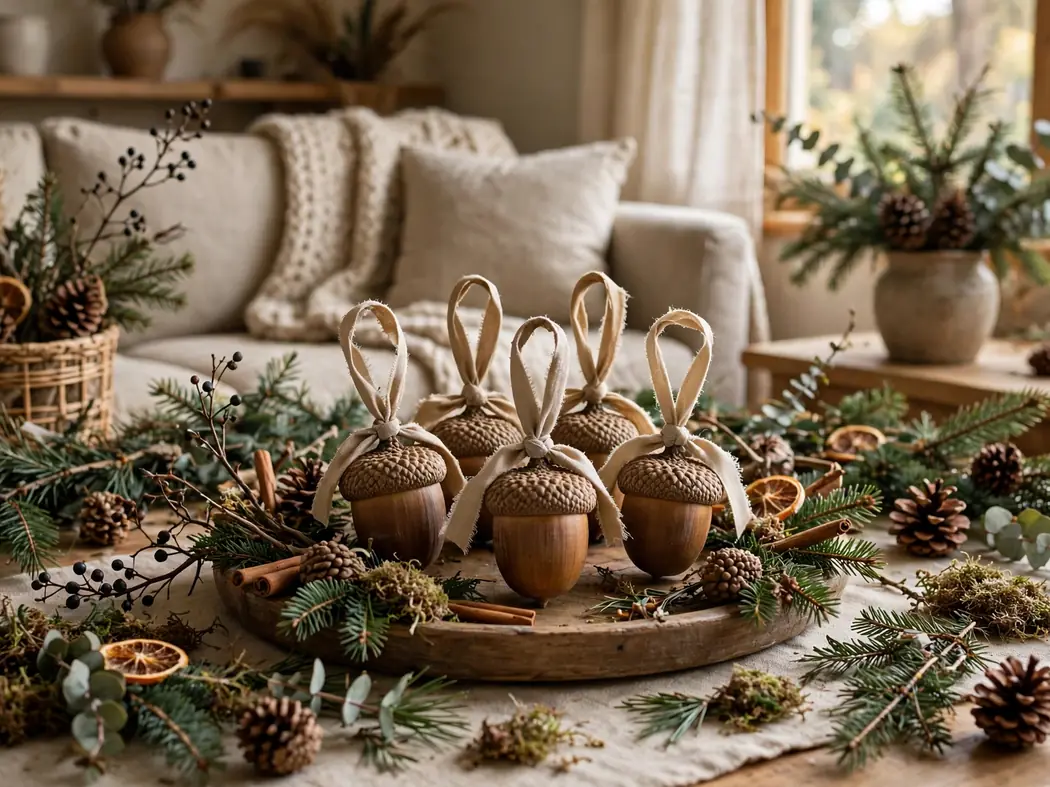
The formula: dried acorn with cap + saved ribbon loop + cluster of three on an outer branch
4. Bare Branch Centerpiece in a Heavy Vase
After a storm, look for one fallen branch with real architecture — curving, forked, about three feet long. Stand it in your heaviest crock, wedged steady with pebbles. Keep it bare, or hang five dried pods and one cone from its thinnest twigs. Set it center-table on a linen runner and let the silhouette do the talking.
Get the look:
- Main piece: one sculptural fallen branch, about three feet, washed and dried
- Supporting piece: a heavy crock or vase weighted with pebbles
- Texture or material: bare bark against a plain linen runner
- Finishing touch: five dried pods and one cone hung on the thinnest twigs
5. Twig Stars Tied with Jute String
Cut fifteen straight twigs — hazel, willow or dogwood prunings — into five-inch lengths, five per star. Lay them into a star, overlapping the ends, and lash every crossing with jute string, four or five tight turns, knotted at the back. Make them in three sizes, from four inches up to a foot across. Hang the small ones on the tree and in windows on long string loops, and rest the big one against the mantel mirror where its shadow doubles it.
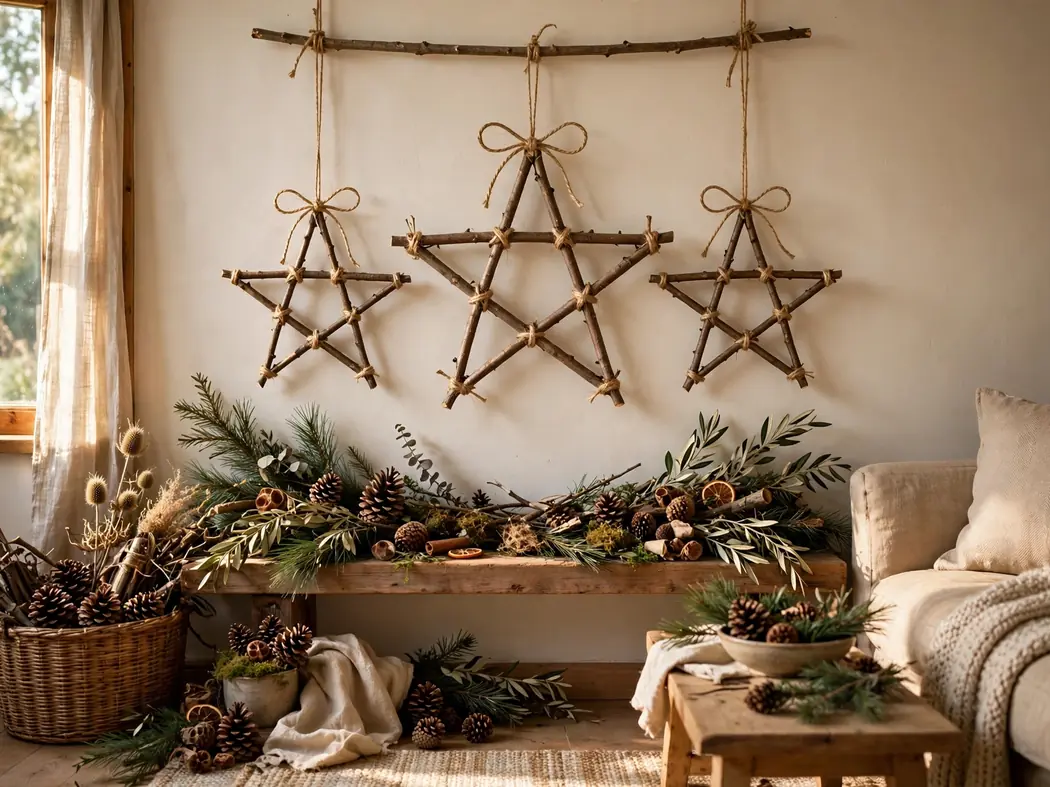
Color note: dogwood prunings bring deep red bark and hazel brings warm tan, so a mixed bundle of stars reads rich without a drop of paint.
6. Fresh Evergreen Clippings as a Mantel Garland
When you prune your own conifers, laurel or holly in early December — or a neighbor offers their offcuts — save armfuls of eight-to-twelve-inch tips. Overlap the stems along the mantel like roof shingles, each new layer hiding the cut ends of the last, and bind the spine loosely with twine every foot. Tuck in six pinecones and stop there. It lasts about two weeks indoors; mist it every few days and keep it clear of flames and radiators.
Texture note: mix two greens with different needles — feathery cedar against stiff spruce, say — and the garland gains depth that a single clipped shrub never gives.
7. Holly and Berry Sprigs in Table Posies
Snip holly sprigs, four to six inches, from several bushes, a few from each so the birds keep their share. Stand three or four sprigs in small glasses or egg cups — one per place setting, or a row of five down the table’s center. The glossy leaves and red berries need nothing else beside them. One honest caution: holly berries are poisonous if eaten, so keep posies at the table’s center, strip any berries within grabbing reach, and skip them entirely where toddlers or pets can pull a glass down.
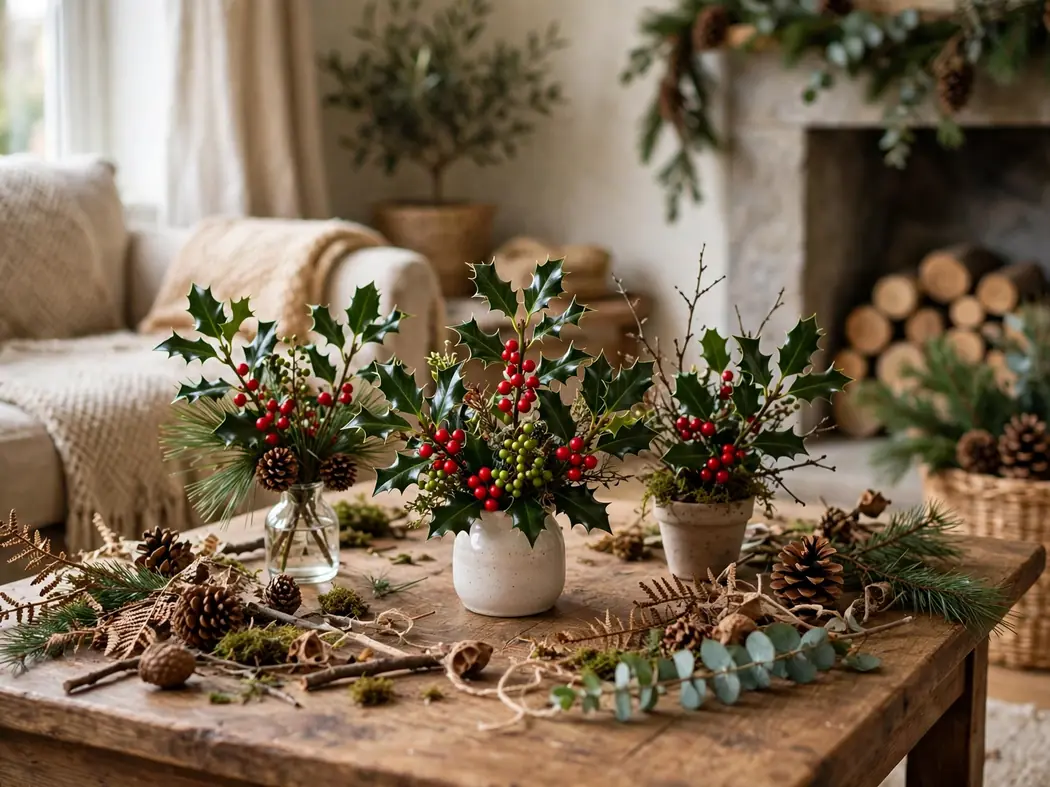
Best for: place settings and narrow tables where a full centerpiece would crowd the plates
8. Hollowed Log Tealight Row for the Table
Choose a straight fallen log, eighteen inches long and five thick — oak or apple if you can. Saw it level along one side so it sits flat, then drill or chisel three or four shallow cups along the top, sized to hold standard tealights in their metal cups. Sand the cut faces smooth and brush off every loose splinter. Set the candles down the middle of the table on a heatproof board, and never leave them burning unattended — the wood is decor, the flame stays supervised.
Space note: one long, low log suits a narrow table better than scattered holders, leaving the ends free for serving dishes.
9. Dried Seed Head Stems in Old Bottles
Before the garden gets its winter tidy, cut the standing seed heads everyone else throws away — poppies with their pepper-pot pods, teasels, honesty with its silver moons, alliums gone to straw. Stand five to seven stems of one kind in a single old bottle, green glass or cloudy white, and group three bottles of different heights on a windowsill or dresser. Leave them completely dry and undyed; the pale parchment tones are the whole point. Kept out of damp, a bottle of poppy heads will still look good at Easter.
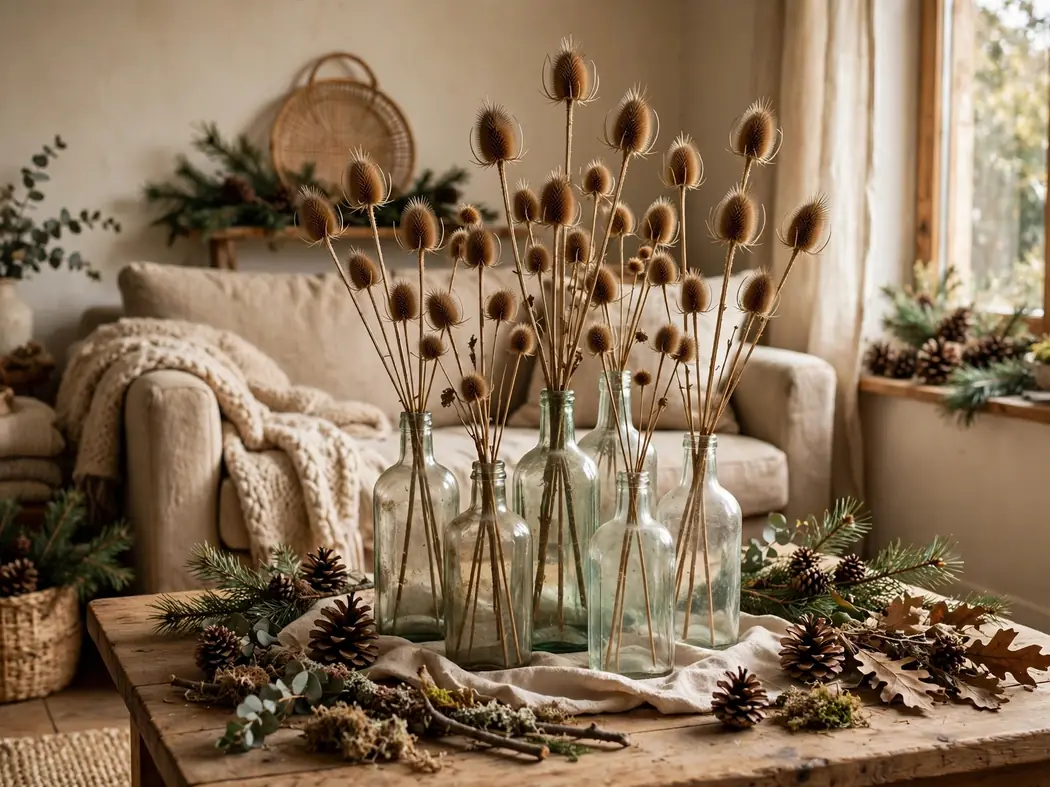
Fit check: tallest stem should stand about twice the bottle’s height; trim at the sink until the proportions sit calmly.
10. Driftwood Tree Built from Graduated Pieces
On shoreline walks, collect only loose driftwood above the high-tide line, and check local rules first. You need nine or ten straight pieces, from about twenty inches down to six. Drill a hole through each center and thread them onto a vertical dowel fixed into a heavy wood block, longest at the bottom, with knots between layers. Drape on acorn ornaments and warm lights. If your coast comes up empty this year, a few stems borrowed from these real touch greenery and garland ideas will fill the gaps invisibly.
Style note: keep surfaces near it plain — driftwood’s silvery grey looks coastal and calm with breathing room.
11. Moss Bowl Centerpiece with Candles
Gather moss in small patches only — a palmful here, a palmful there, from fallen logs and shady banks — never stripping one spot bare, and skip it where rules protect it. Press the pieces, soil side down, into a wide shallow bowl, overlapping like roof tiles, and mist well. Nestle three pillar candles of different heights into the green, each in a small glass jar for safety, and dot six tiny cones around them. The bowl smells faintly of the woodland floor.
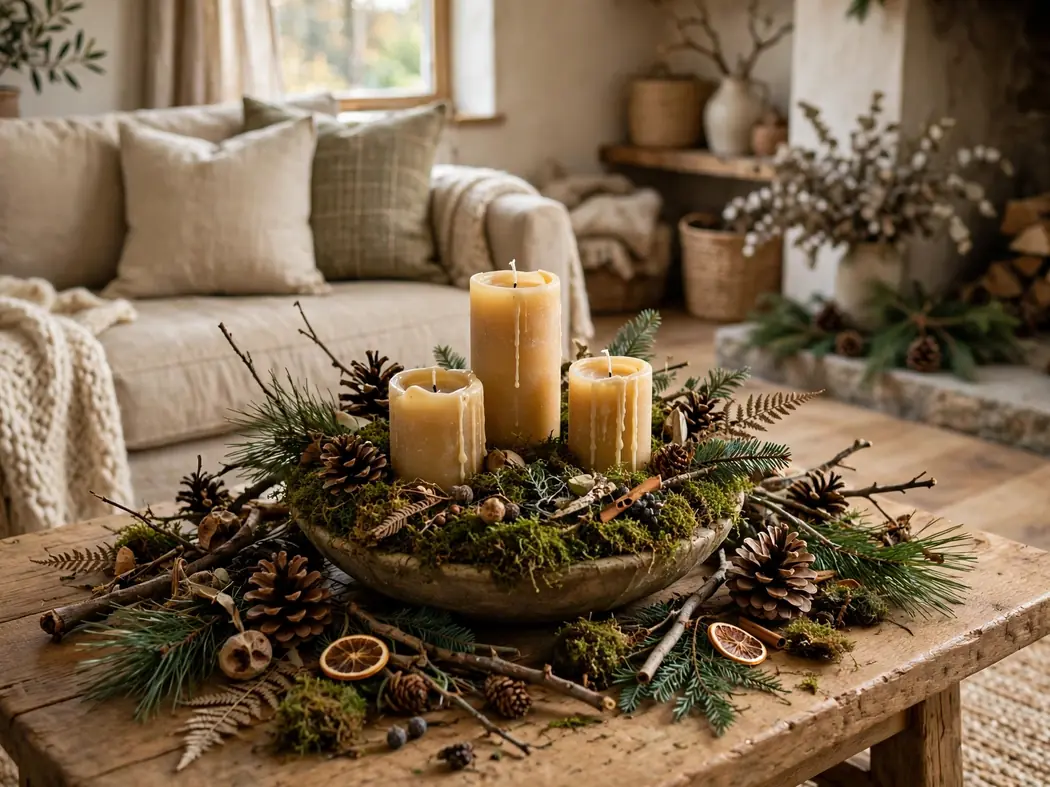
Easy swap: where moss is scarce or protected, line the bowl with fallen evergreen clippings laid flat instead — same green carpet, no gathering worries.
12. Ivy Trails Wound Around the Banister
Cut six to ten ivy trails from a wall or fence where it runs wild anyway, choosing strands four to eight feet long. Wind them loosely around the banister in a slow spiral, ends trailing naturally, securing only start, middle and top with twine ties. Weave two trails in opposite directions for a fuller rope of green. Check daily for dropped leaves on the steps, and keep the trails off any polished treads where they could slip underfoot.
Seasonal swap: come January, swap the ivy for bare twisted willow or vine stems and the staircase keeps its sculpture without the green.
13. Rose Hip Sprigs Standing in a Cream Jug
Wild and garden roses carry their own Christmas color: orange-red hips glowing like lanterns on bare stems. Cut eight to ten sprigs, ten to fourteen inches, from several bushes — hips feed winter birds, so leave most behind — and strip lower leaves. Stand them in a cream jug alone; arching stems arrange themselves. Hips give holly’s red with less worry — still not a snack, so keep the jug from small grazers.
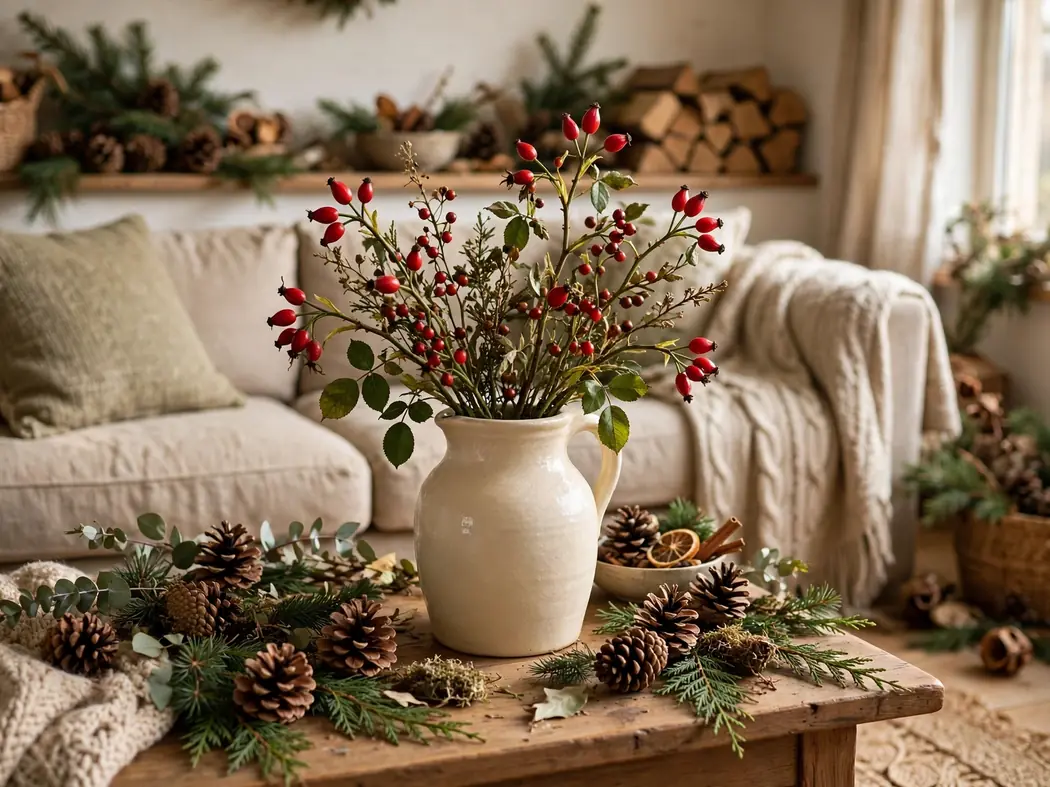
Why it works:
- Hips carry true Christmas red on bare stems, no arranging skill required.
- A plain cream jug throws all attention onto the fruit.
- Hips dry slowly in place, improving rather than fading through the month.
14. Magnolia Leaf Wreath, Glossy Side Out
If a southern magnolia grows in your yard, its prunings are decor gold: big oval leaves, glossy green above, coppery suede beneath. Wire sixty to eighty fresh leaves, overlapping, glossy side out, onto a vine ring sixteen inches across, in bunches of three. It dries holding its shape, turning slightly deeper in tone. New to gathering material like this? Ten minutes reading up on responsible foraging first will keep you legal, light-handed and welcome back next year.
Budget note: the leaves, the vine ring and the wire are all free or drawer-found, so the finished wreath costs less than the nail it hangs on.
15. Sweet Gum Ball Ornaments Hung on Thread
Sweet gum trees drop hundreds of spiky seed balls most people rake onto the compost — nature’s own baubles, perfectly round and full of texture. Collect forty or fifty clean, dry ones and rest them a week indoors. Push a loop of dark thread into each stem hole, knot it, and hang them in generous numbers among your glass ornaments, where their rough burr catches light differently. Left natural they read woodland; one quick coat of saved white paint turns them into snowballs.
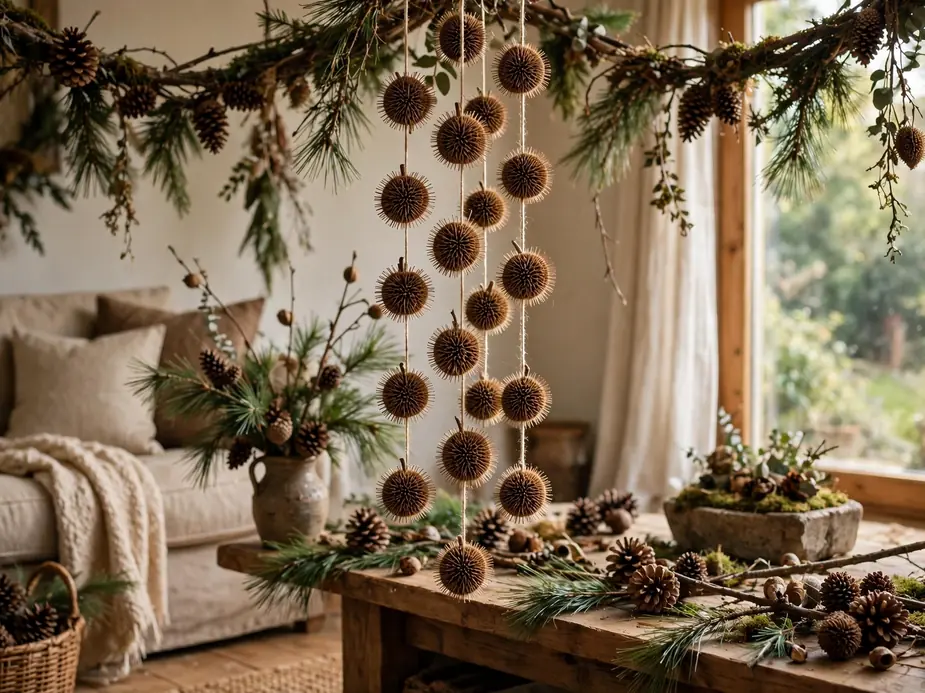
The formula: dried sweet gum ball + dark thread loop + grouped hanging among smoother ornaments
16. Log Slice Ornaments with Burned Designs
Saw a fallen branch three to four inches thick — birch, apple or hazel — into discs a quarter inch thick, and sand both faces smooth. Drill a small hole near each top edge. Pencil on a star, tree or initial, then burn the lines in with a wood-burning tool, working slowly. Thread with twine and hang among the tree’s plainer ornaments; names and dates on the backs make keepsakes.
Get the look:
- Main piece: sanded log slices, quarter inch thick, one drilled hole
- Supporting piece: twine loops knotted through the hole
- Texture or material: pale fresh wood marked with dark burned lines
- Finishing touch: name and year burned on the back
17. Twig Reindeer Figures Bound with Twine
Build each reindeer from the pruning pile: a stout six-inch twig for the body, a shorter angled one for neck and head, four straight sticks for legs, two small forked twigs as antlers. Lash every joint with jute twine in a figure-eight until it stands alone — wobbles are part of the charm. Finish with a scrap of red ribbon or a single tiny cone at the neck. A herd of three graduated sizes looks wonderful ambling across the mantel.
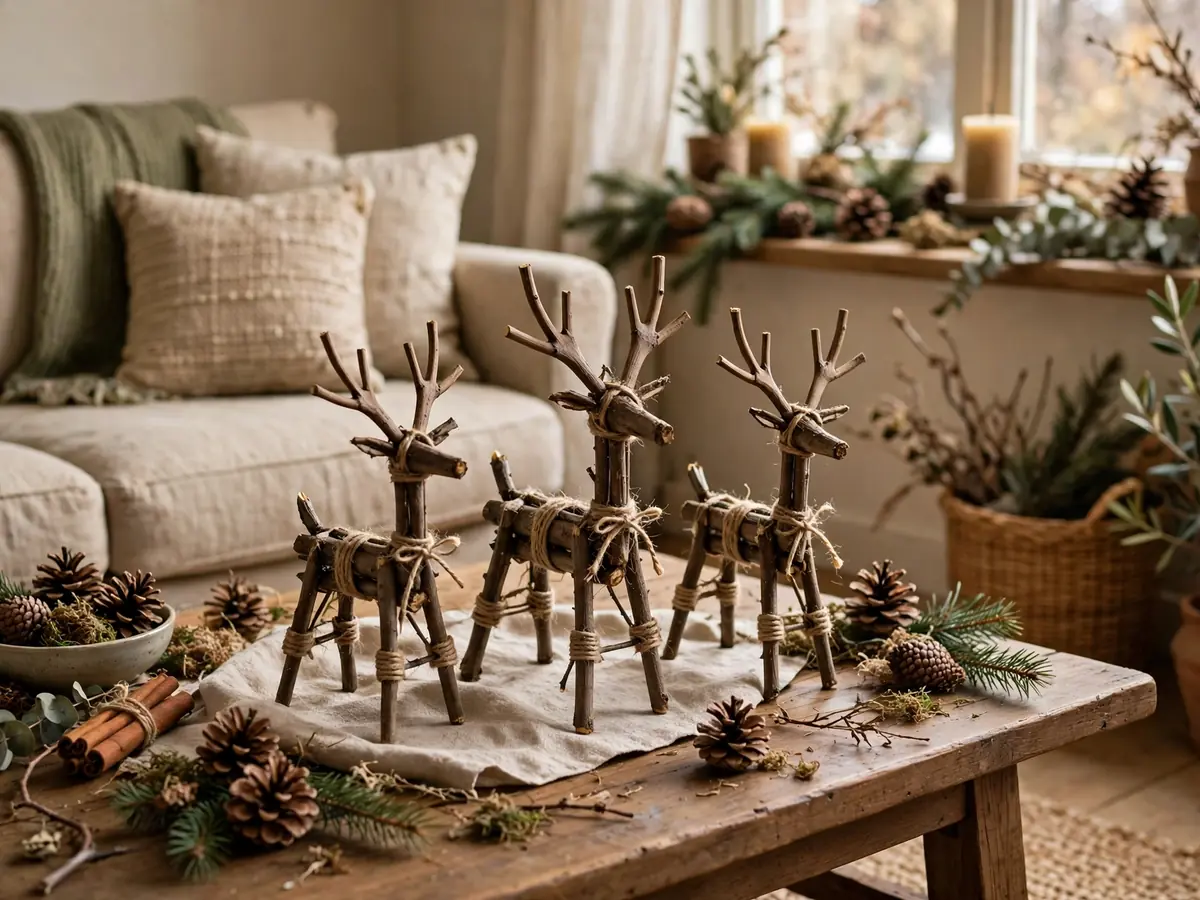
Color note: keep the twigs in their natural greys and browns and use just one red ribbon per herd, so the figures read handmade, not toy-shop.
18. Woven Vine Wreath Base Dressed Fresh Weekly
While vines are bare and pliable, weave one wreath base — grapevine, willow or honeysuckle wound into a ring sixteen to eighteen inches across, thick as your wrist — and let it dry in shape. Hung bare, it is handsome; dress it fresh each week of December. Tuck in whatever the garden offers: holly one week, rose hips the next, cedar and cones after, held by the weave alone. Nothing is glued, so nothing is wasted, and the front door never looks the same twice.
Texture note: the twisted, uneven weave is the decoration — dress only a third of the ring at a time so the vine keeps showing.
19. Pressed Fern Frames for the Hallway
Cut six to ten perfect fern fronds before hard frosts flatten them — from the garden or shady banks — and press them between book pages under heavy books for two weeks. Mount each dried frond on cream card inside a simple frame, thrifted or already owned, and hang three in a row down the hallway at eye level. If you are styling the hall to match the rest of the house, they sit happily alongside the wreaths and garlands in these farmhouse christmas decor ideas without competing for attention.
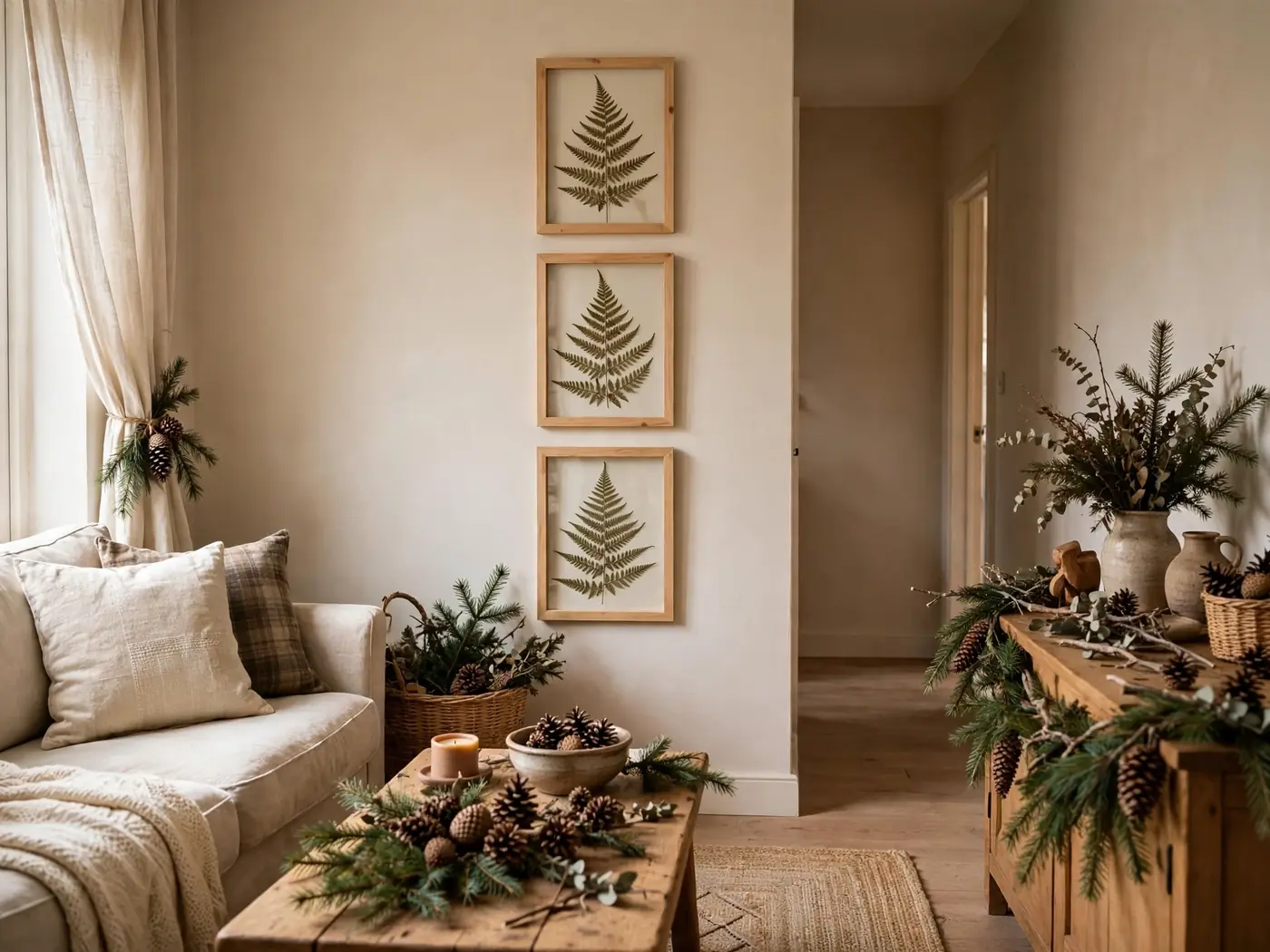
Best for: narrow hallways and gallery walls that need seasonal art without a single purchase
20. Winterberry Branches in a Tall Floor Vase
Winterberry holly drops its leaves in fall and leaves bare stems crowded with scarlet berries — the most dramatic free arrangement of the season. Cut five to seven stems, two to three feet long, a few from several shrubs, and stand them in a tall, heavy floor vase by the fire or door. Two honest cautions: the berries are toxic, so site the vase where children and pets cannot reach or knock it, and strip any low berries near the base; and take modestly, because those berries are the birds’ January pantry.
Space note: a tall vase fills the dead corner beside a hearth or door where nothing else fits.
21. Juniper and Cedar Bundle Swags for Doors
When junipers and cedars get their winter tidy, save the prunings: blue-green juniper, some with dusty blue berries, and flat feathery cedar sprays. Gather six to eight stems, twelve to sixteen inches, into a fan, bind the necks tightly with twine, and cover the binding with a saved ribbon bow. Hang a swag point-down on each interior door, the front door and the gate. The scent is the real gift — every opening door smells like a walk in the woods.
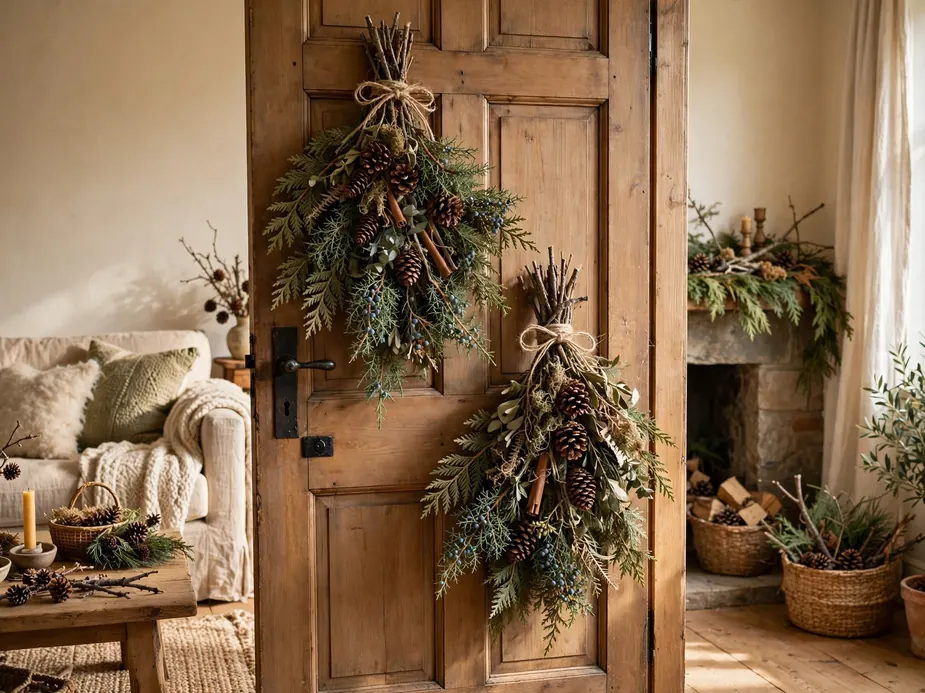
Fit check: a swag should span about two-thirds of the door’s width; much wider and it crowds the handle, narrower and it looks lost.
22. Dried Hydrangea Heads in a Mantel Row
If you left your hydrangea flower heads standing through fall — and gardeners should, they shelter insects — December is their second act. Cut eight to twelve of the dried heads in their faded parchment, sage and dusty rose tones, keeping stems short. Stand them in a row of small jugs, bottles or jam jars along the mantel, one head per vessel, letting the huge lacy blooms touch shoulder to shoulder. They are summer remembered at exactly the moment the garden looks emptiest, and guests always ask where you bought them.
Style note: resist dyeing or spraying them — the muted antique colors are precisely what makes the row look expensive.
23. Ornamental Grass Plumes in a Corner Crock
The feathery plumes of ornamental grasses — pampas, miscanthus, fountain grass — dry standing in the border and cut beautifully all winter. Take fifteen to twenty-five plumes on long stems, from your own clumps only, shaking each well outdoors to shed loose seed. Stand them in a tall stoneware crock or umbrella stand in an empty corner, letting the plumes fountain out above head height. They stir whenever the heating kicks on, keeping a still corner quietly alive.
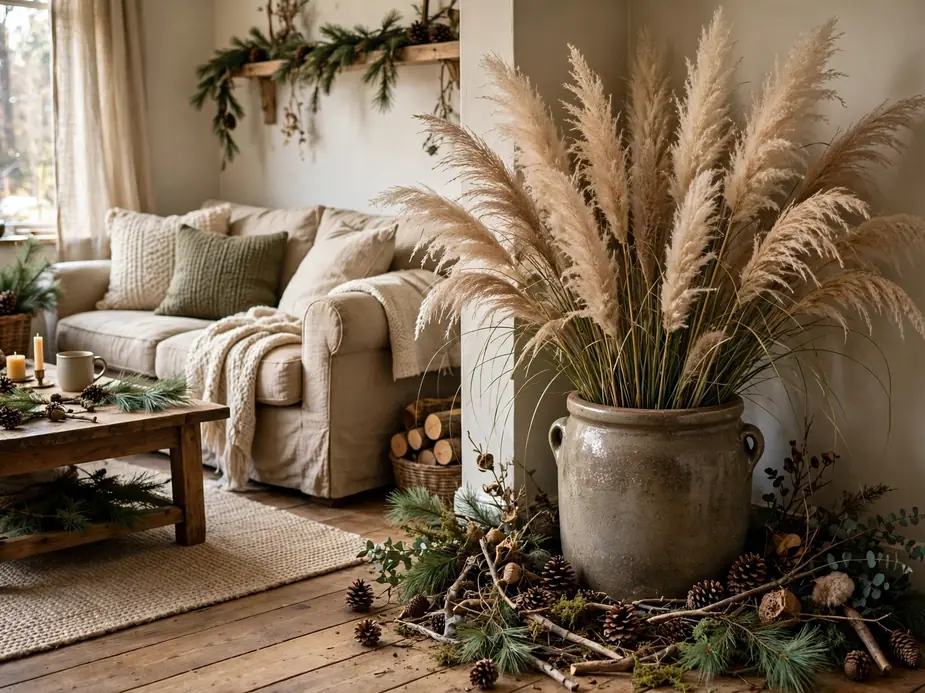
Easy swap: no grasses in the garden? Bare curly willow stems or tall dried teasels from a hedgerow give the same height and softness.
24. Bark Wrapped Candle Jars Tied with String
Bark peels cleanly from fallen birch and cherry logs — take only bark already loose on dead wood, never strip a living tree. Cut pieces tall enough to wrap a jam jar with an inch of overlap, soak stiff ones in warm water until they flex, then wrap and tie twice with kitchen string. Set a tealight or small candle inside each jar and group three on the table or mantel. The flame glows through the glass and silhouettes every ridge and curl of the bark around it.
Seasonal swap: after Twelfth Night, re-tie the same bark jars with plain string and use them for spring bulbs forced indoors.
25. Stone Cairn Stacks on the Porch Steps
Collect smooth, flat stones from your own garden beds — seven to nine per stack, graduated from a wide base up to a pebble — and wash and dry them. Balance three stacks of different heights on the porch steps, largest at the bottom, each layer settled until it stops rocking. A cairn asks nothing all season: no watering, no lights, no January storage. If a storm topples one, restacking is a two-minute pleasure.

Why it works:
- Balanced stones read as intentional sculpture, not a pile of rocks.
- Grey stone against wood and brick needs no color to register.
- They weather every storm outdoors, so the welcome never wilts or fades.
26. Preserved Leaf Garland in Autumn Tones
Make this in October: pick forty to sixty perfect beech, oak or maple leaves in copper, russet and gold, press them a week, then brush with melted beeswax or soak in a glycerin mix if you keep either. Thread twine through each leaf’s stem end, spacing them an inch apart, colors alternating loosely. Strung across a bookshelf or window, it carries fall’s last color honestly into Christmas week, when the bought garlands are already shedding glitter.
Budget note: leaves and twine are free and the preservative is a single pantry item, so a six-foot garland costs pennies.
27. Branch Chandelier Hung with Cones and Baubles
Choose one long, characterful fallen branch — four to five feet, with several forks — wash and dry it a week, and hang it above the dining table from two ceiling hooks on strong twine, clear of standing heads. Hang pinecones on thread, your smallest ornaments and two battery tealights in glass holders along it — real flame stays strictly off. Dinner underneath feels like eating in a forest clearing, and the branch comes down in January to the compost, not the attic.

The formula: long forked branch on two hooks + cones and small ornaments on thread + battery lights only
28. Feather and Cone Picks Tucked in the Tree
Through the year, keep feathers found on walks — pheasant, guinea fowl, hen feathers — washed gently and dried flat. For each pick, wire one feather to a small pinecone, the cone anchoring it upright. Tuck eight to twelve picks into the tree, evenly spaced. Beside a mantel mirror the same picks double — the reflection trick runs through these christmas mirror decor ideas too.
Get the look:
- Main piece: one found feather wired upright to a small pinecone
- Supporting piece: eight to twelve picks spaced through the tree
- Texture or material: soft barred feather against rough cone scales
- Finishing touch: tips angled outward to catch the lights
29. Crabapple Sprigs in a Table Vase
Ornamental crabapple trees hold their tiny fruit long after the leaves fall — clusters of red, orange or gold marbles on twiggy stems. Cut six to eight sprigs, twelve to eighteen inches, a few from different parts of the tree, and leave the birds the rest. Arrange them loosely in a glass vase of water, stems crossed, fruit clusters hanging at different heights. On the table they look like jewels on branches, and they hold for a good two weeks indoors.
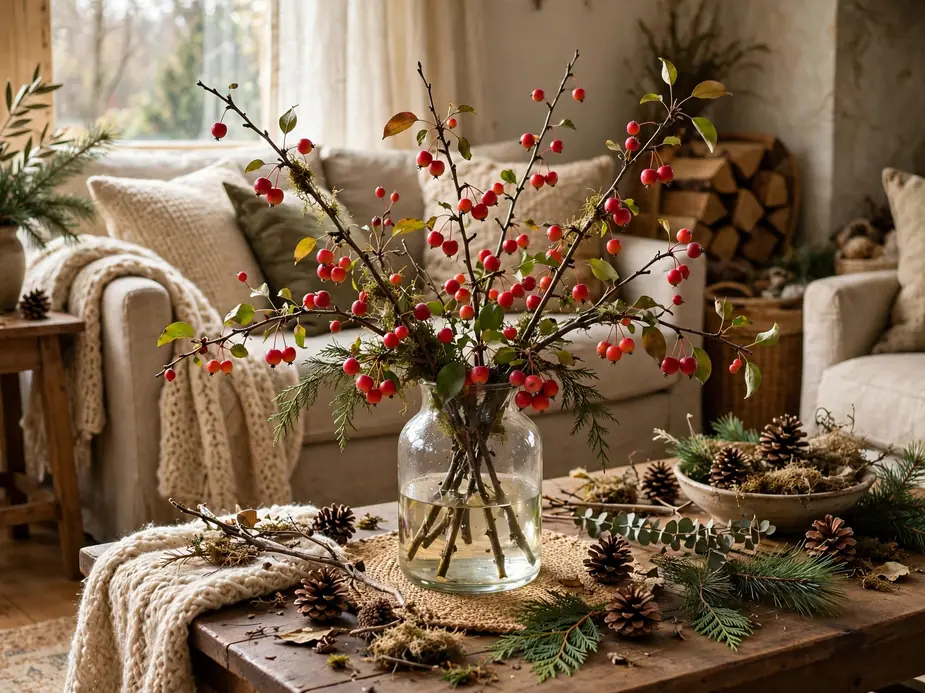
Color note: choose one fruit color per vase — all red reads classic, all gold reads modern — rather than mixing the tree’s whole palette.
30. Acorn and Cone Bowl on the Coffee Table
The five-minute centerpiece: take your widest, shallowest bowl — wood, stoneware or brass — and fill it two-thirds with cleaned, dried stores. Small pinecones first, then acorns with caps on, a handful of spiky sweet gum balls, and three walnuts in their shells on top. Add a short pillar candle in a glass holder at the center, or leave it plain. Guests will pick pieces up and turn them over all evening, which is exactly what a coffee table bowl is for.
Texture note: the bowl works because every surface is different — smooth acorn, ridged cone, spiked gum ball — so the eye keeps moving.
31. Log Round Chargers Under Dinner Dishes
From a fallen log ten to twelve inches across — a storm casualty is ideal — saw rounds three-quarters of an inch thick, one per setting, and sand the tops smooth so plates sit level. Brush off bark dust, check each round for wobble, and set the dinner plate centered on top; the bark edge stays as a rustic rim. Afterward, stacked by the door, they are next year’s chargers — or excellent trivets. Give each guest’s setting that grounded, woodland weight and plain white plates suddenly look like an occasion.
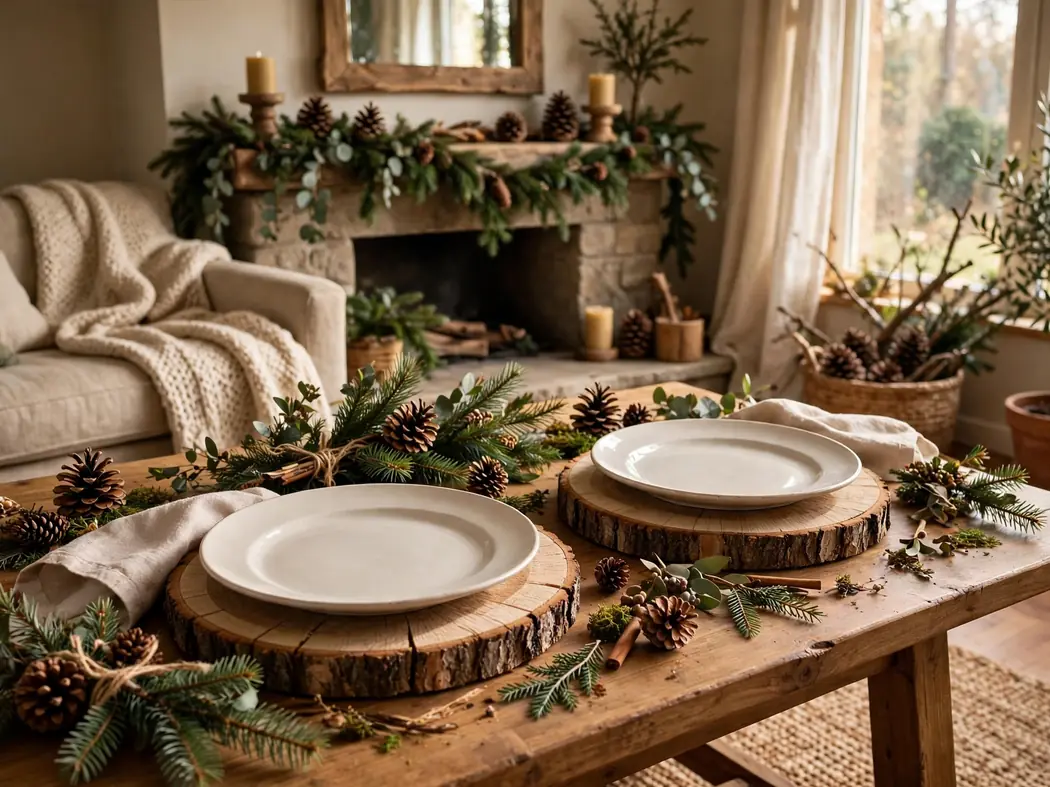
Best for: Christmas dinner and slow Sunday lunches where the table itself should feel like part of the feast
32. Willow Whip Hoops Hung as Minimal Wreaths
Willow whips — the long, straight shoots of a pollarded willow or hedgerow — bend like rope when freshly cut. Bend one whip per hoop into a circle twelve to twenty inches across, ends overlapped four inches and bound with two tight wraps of twine; a second whip makes a sturdier double hoop. Hang the hoops completely bare on interior doors, windows or a plain wall in a group of three sizes. Their whole beauty is the single clean line and the soft shadow it throws.
Space note: hoops hang nearly flat, so they suit doors that must still open fully and walls behind furniture.
33. Scented Pinecone Fire Starters in a Basket
Decor that earns its keep: gather dry, open pinecones and melt saved candle stubs in a tin set in hot water — never over direct flame — then dip each cone once, holding it by the top scale. Set them on old newspaper to harden. Piled in a basket by the hearth with cinnamon sticks and dried orange slices, they scent the room unlit, and two or three under kindling start the Christmas fire.
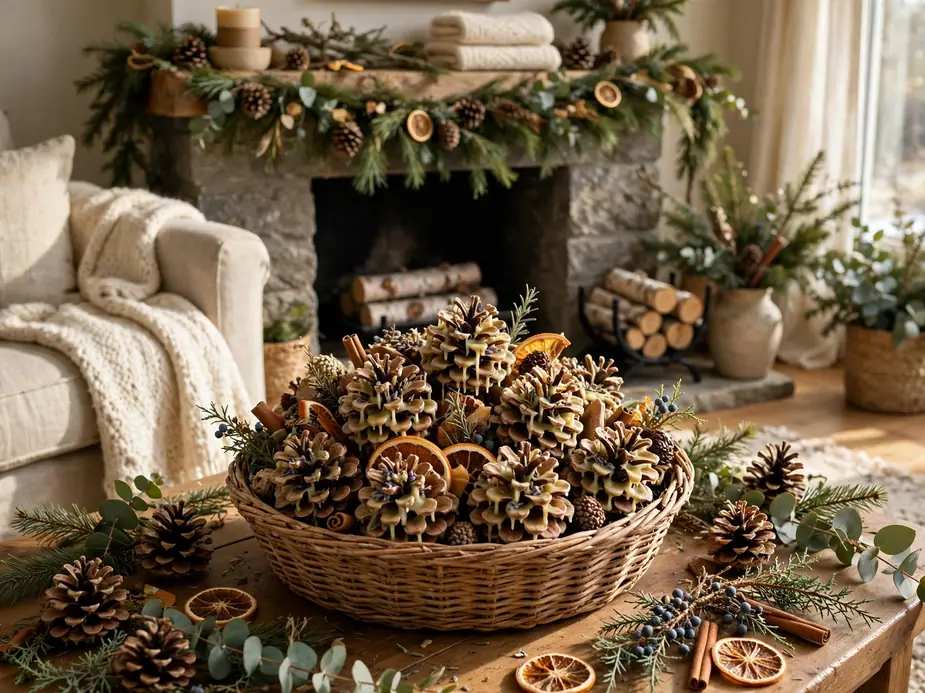
Fit check: use only fully dry, wide-open cones — damp or closed ones smolder instead of catching, which defeats the purpose.
34. Dried Lavender and Rosemary Bundles for the Kitchen
Cut lavender in summer at full purple and rosemary any time the bush needs shaping, and hang both upside down in a dry, dark cupboard for two weeks. Bind twelve to fifteen stems into a bundle with twine and a hanging loop — enough for the kitchen door, the pantry handle and beside the stove, away from naked flame. Every time the bundle is brushed, the kitchen smells like a garden in July. When the scent fades, the rosemary goes straight into the cooking pot.
Style note: hang bundles at staggered heights in odd numbers — three or five — for a kitchen that looks gathered, not arranged.
35. Found Antler Sheds Styled on the Mantel
Now and then a walk gives you treasure: deer shed their antlers every late winter, and a found shed — from your own land, or wherever rules allow — is the finest free mantel piece going. Wash and dry it thoroughly, and check your area’s rules first, since a few places restrict collecting. Lay one along the mantel with cones and evergreen clippings at its base, or stand a pair either side of the clock. Nothing bought has that silhouette, and every visitor will ask where it came from.
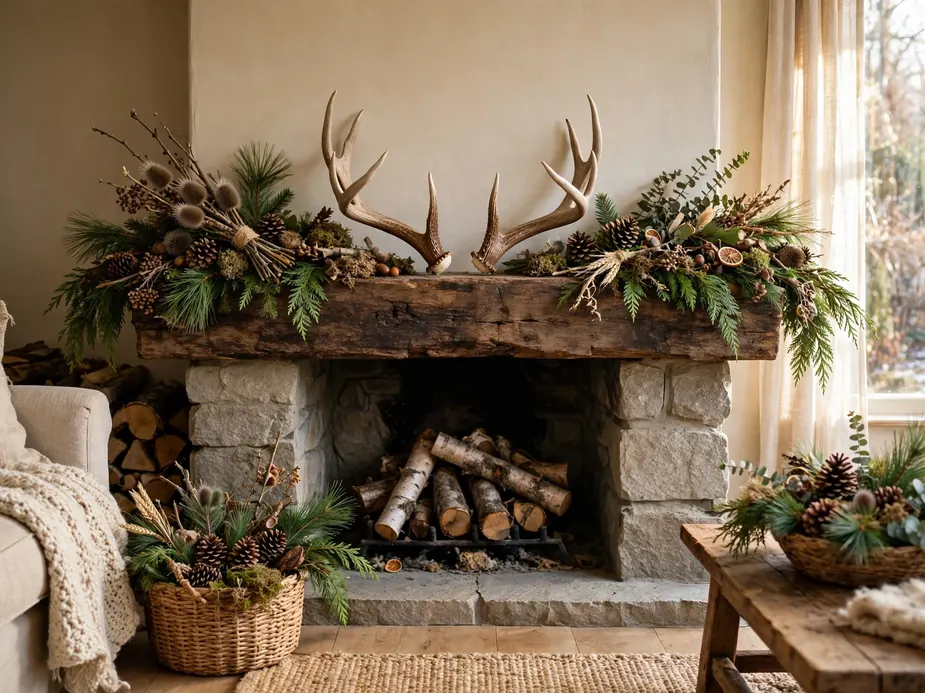
Easy swap: no shed finds this year? A beautifully forked, bark-stripped branch laid the same way borrows the same sculptural effect.
36. Shell and Stone Garland from Beach Walks
All year, pocket the beach’s small gifts: holed shells, tiny worn pebbles, sea glass. By December you need sixty to eighty pieces. Thread them on strong twine, knotting beneath each piece so nothing slides, alternating shell, stone and glass loosely — the randomness is the seaside honesty of it. Check shoreline rules before a big gather, and never take occupied shells. Draped along a mantel or around a window, it is every walk of the year hanging in one line.
Seasonal swap: in summer the same garland moves outdoors to the porch or garden fence, where it weathers happily until next Christmas.
37. Mixed Clippings Wreath from Your Own Trees
The last wreath is the most personal: walk your own garden and take a few clippings from every tree and shrub — cedar, pine, juniper, laurel, holly, magnolia — a little from each, nothing stripped. Wire them in overlapping bunches onto a vine ring, greens blending as they fall. Hang it on the front door with a ribbon you already own. Your whole garden, welcoming people in — and not buyable at any price.
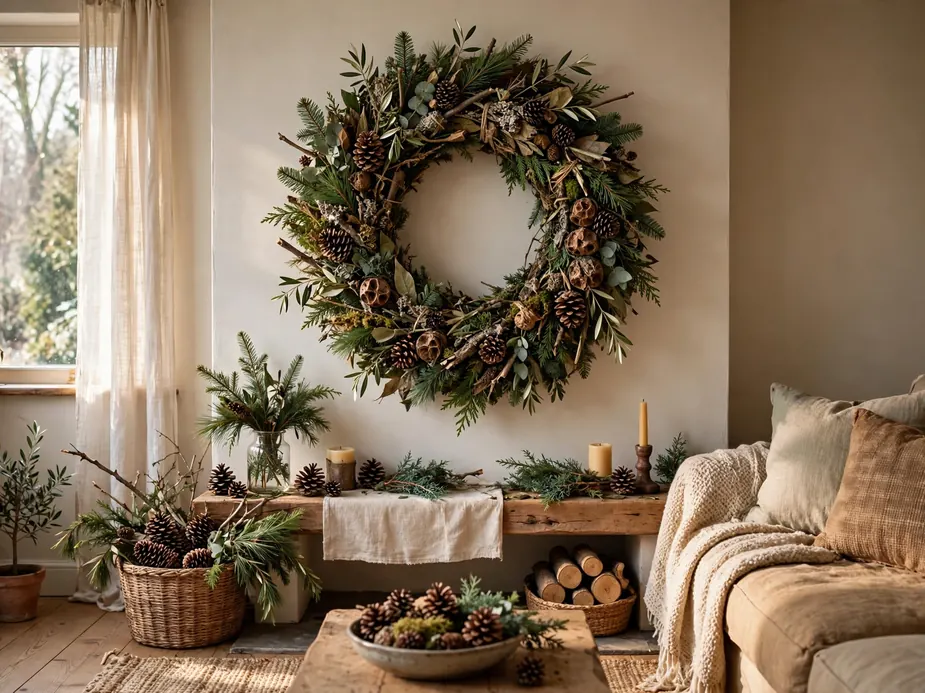
Why it works:
- Greens from one garden share a light and palette, so they harmonize alone.
- A few clippings from many plants costs no tree its shape.
- It tells your own plot’s story better than any bought wreath.