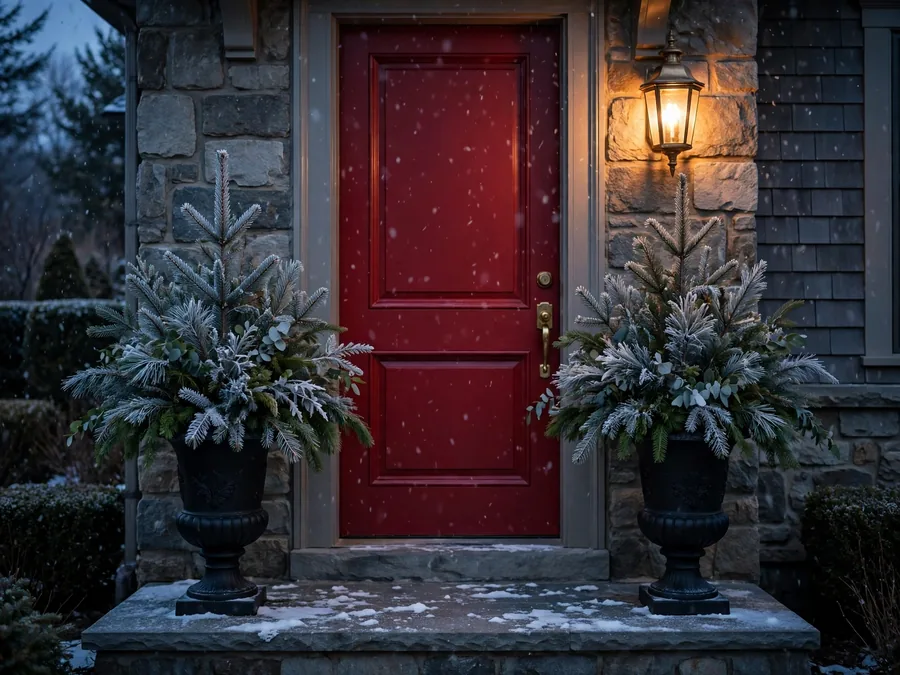
The front door is where Christmas decorating usually tips over. One week it looks bare, the next it is buried under garlands, signs, bells and lights competing for the same few inches of wood — and guests have to edge past the display just to reach the handle. The door itself disappears, and so does the welcome.
The doors that look best follow a quieter rule: decorate the door’s own parts — its colour, hardware, glass and threshold — and let each part carry one small festive note instead of stacking decorations on top of them. For more Christmas door decor ideas built around the whole entry, that principle of one strong note per surface is the thread that runs through every good example.
Below are 18 ideas that work on the door area itself — no wreaths, no swags, just paint, metal, glass, light and a few natural stems. Most use things you already own or can pick up in one trip, and every one of them comes off in minutes when January arrives.
The Front Door Formula That Keeps the Welcome Looking Warm, Not Overdone
- Start with the door itself: treat the door’s colour, hardware and glass as the decoration before adding anything to them.
- Hold the palette to three notes: pick one deep colour, one metal and one natural texture, and let every addition answer to those three.
- Measure the swing and the step first: anything added must clear the door’s swing, the latch and the walking path guests actually use.
- Make every piece removable: choose clings, straps, ties and freestanding pieces that lift away cleanly, so the door returns to normal without a repair job.
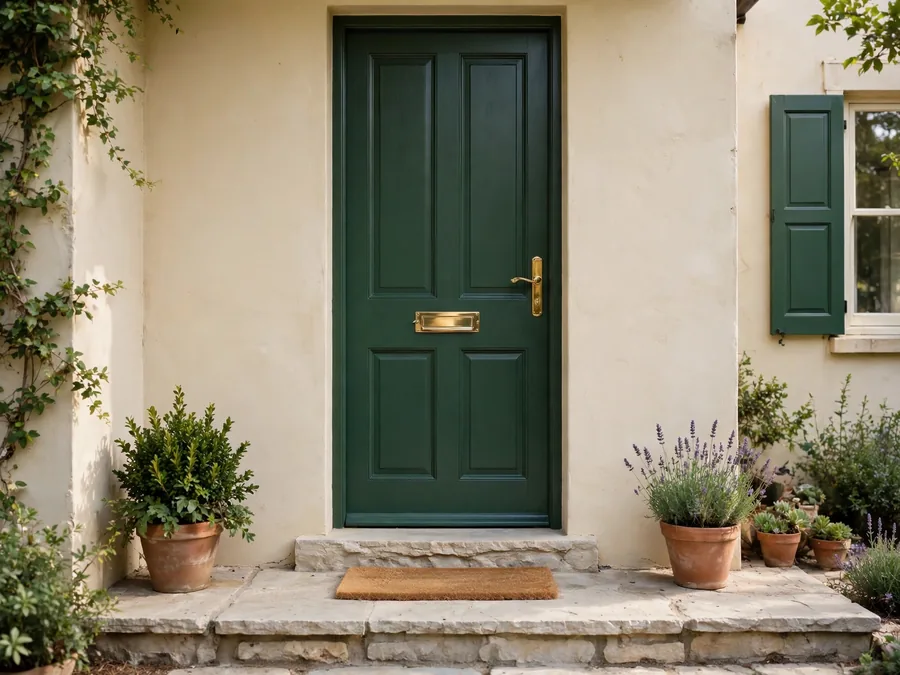
One combination that shows the formula working: a deep-green door with its original brass handle polished bright, a plain coir half-moon mat below, frosted film stars glowing in the sidelights, and two galvanized buckets of birch stems standing either side — four notes, nothing competing, and the door still reads as a door.
| # | Idea | Where It Sits | Effort |
|---|---|---|---|
| 1 | Deep-green door, brass left to shine | Door slab | A weekend |
| 2 | Half-moon coir mat, quiet pattern | Threshold | Minutes |
| 3 | Birch and dogwood stems in buckets | Flanking the door | Under an hour |
| 4 | Polished knocker, one velvet loop | Door centre | Under an hour |
| 5 | Frosted sidelights, one cut-out star | Sidelight glass | Under an hour |
| 6 | Oversized house numbers, one sprig | Beside the door | Under an hour |
| 7 | Flame-effect bulb in the porch light | Porch light | Minutes |
| 8 | One sleigh bell on a leather strap | Door handle | Minutes |
| 9 | Brushed-brass kick plate | Door base | Under an hour |
| 10 | Cream frame trim, dark door | Door frame | A weekend |
| 11 | Frosted pine-branch cling | Door glass | Minutes |
| 12 | Stone-filled boot tray | Beside the door | Minutes |
| 13 | One chair, tartan cushion, rosemary | Door-side corner | Under an hour |
| 14 | Mail slot with a fine gold border | Door centre-low | Under an hour |
| 15 | Paper luminarias on the steps | Front steps | Under an hour |
| 16 | Two-tone panels, deeper moulding | Door panels | A weekend |
| 17 | Bottle-brush trees on the transom | Transom ledge | Minutes |
| 18 | One oversized paper snowflake | Above the door | Minutes |
1. A Deep-Green Door With the Brass Left to Shine
Paint the door itself and let that be the decoration. A deep pine green in a satin finish reads unmistakably festive from the street, yet never has to come down in January. Prime, then roll on two coats, leaving the brass handle, letter plate and hinges unpainted so the metal warms the green. The trade-off is real: a door takes a day of painting plus drying time with the house open, so pick a mild, dry day.
Color note: Deep green against a pale house — cream render, white trim — gives the strongest contrast; on a dark house it nearly disappears, so go one shade brighter.
Done once, it outlasts every seasonal add-on a door can carry.
2. A Half-Moon Coir Mat With a Quiet Holiday Pattern
Swap the everyday mat for one shaped to the door: a half-moon coir mat that follows the swing, flat against the threshold. World Market’s Merry Christmas Vintage Style Shaped Holiday Coir Doormat, $16.99, carries a small holiday pattern — festive at boot level, invisible from the street — and its coir scrapes December mud properly. Honest limit: this mat is rated for sheltered use, so under an open sky it fades faster; a covered porch is its happy home. It earns its place like the best of these front porch ideas.
Budget note: A plain coir half-moon mat costs less and takes a stencilled star in outdoor paint — the shape does the work either way.
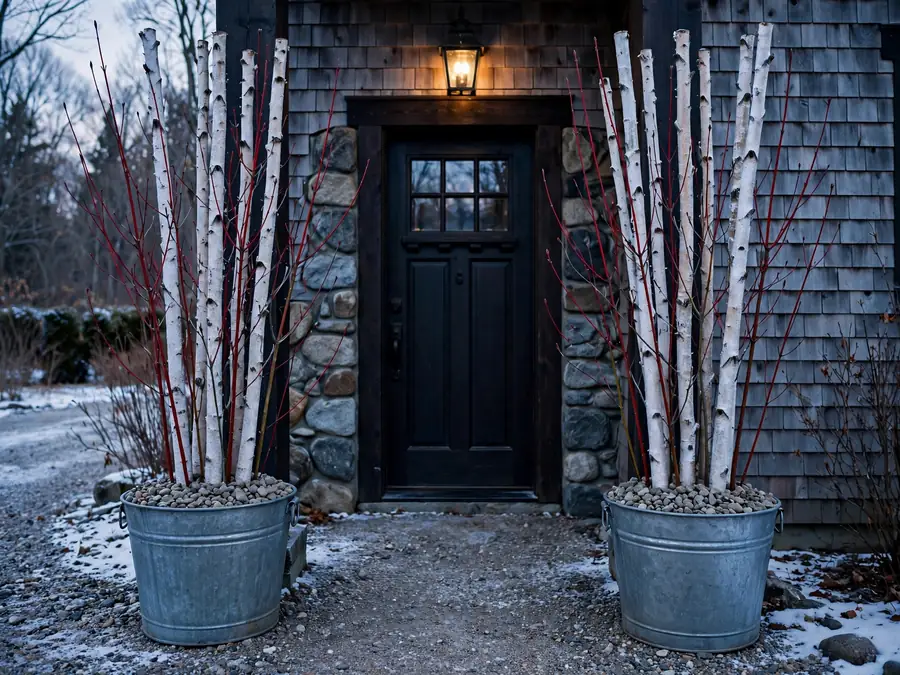
3. Birch and Red Dogwood Stems in Galvanized Buckets
Flank the door with height instead of flowers. Fill two galvanized buckets, about 14 inches tall, with bare birch poles cut to roughly 4 feet and red dogwood stems among them; white bark and red twigs give the colour, with nothing to water or freeze. Weight each bucket with gravel against the wind. The downside: bare stems read stark in flat daylight and come alive mainly in porch light, so this suits doors that get evening light best.
Texture note: Smooth white bark against ribbed galvanized metal and thin red twigs gives three textures in one bucket — that contrast is what the eye catches.
For a door flanked by plain walls, this is height and colour with zero upkeep.
4. A Polished Knocker Tied With One Velvet Loop
Dress the hardware, not the door around it. Polish the brass knocker until it reflects, then loop one narrow crimson velvet ribbon — half an inch wide, tied in a simple knot, tails cut to 2 inches — around its base. That is the whole gesture: shine plus one soft note of red at hand height, where a guest’s eye lands as they knock. Skip it if your knocker is chrome or black; the ribbon needs warm metal against it. Rain spots velvet over a month, so treat the ribbon as a December-only piece.
Style note: Its smallness is what makes it look expensive — a wide bow would shout; a narrow loop reads like tailoring.
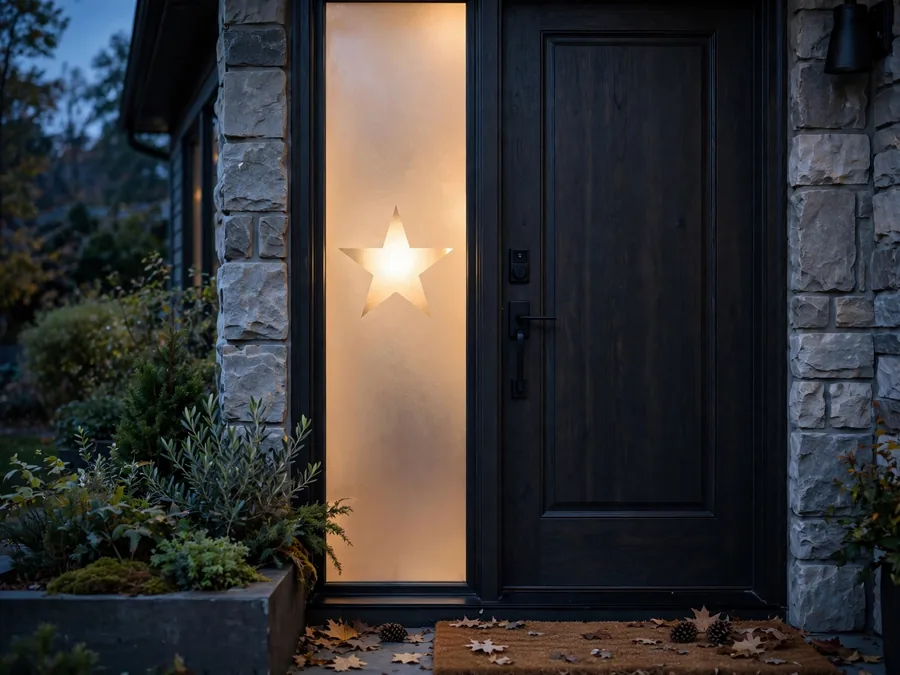
5. Frosted Sidelights With a Single Cut-Out Star
Give the sidelight windows a frost that glows. Cover each pane with frosted window film, but first cut one five-pointed star — about 4 inches across — out of the centre, leaving that shape clear. At night the frosted glass glows from the hall light and the clear star burns brighter inside it, with privacy improved as a bonus. The trade-off: film dulls daytime light slightly, and cheap film bubbles at the edges, so choose static-cling you can lift and re-smooth.
Space note: One star per pane is the discipline — a full pane turns the sidelight into a sticker sheet; one clear star reads as design.
Plain sidelights that usually get ignored gain the fastest glow on the door.
6. Oversized House Numbers With One Sprig Tucked Behind
Let the house numbers carry the greeting. Fit brushed-brass numbers a size up from standard — 6 inches tall instead of 4 — on the wall beside the door where the porch light reaches them. Then tuck a single small sprig of cedar, no longer than the top digit, behind the first number so just its tip shows: a whisper of greenery, not a garland. Masonry needs proper plugs for the drilling, and renters should reuse existing holes or skip on. Numbers this size also help December delivery drivers.
Fit check: Stand at the kerb after dark and read the numbers from car distance; if the sprig shadows a digit, trim it back.
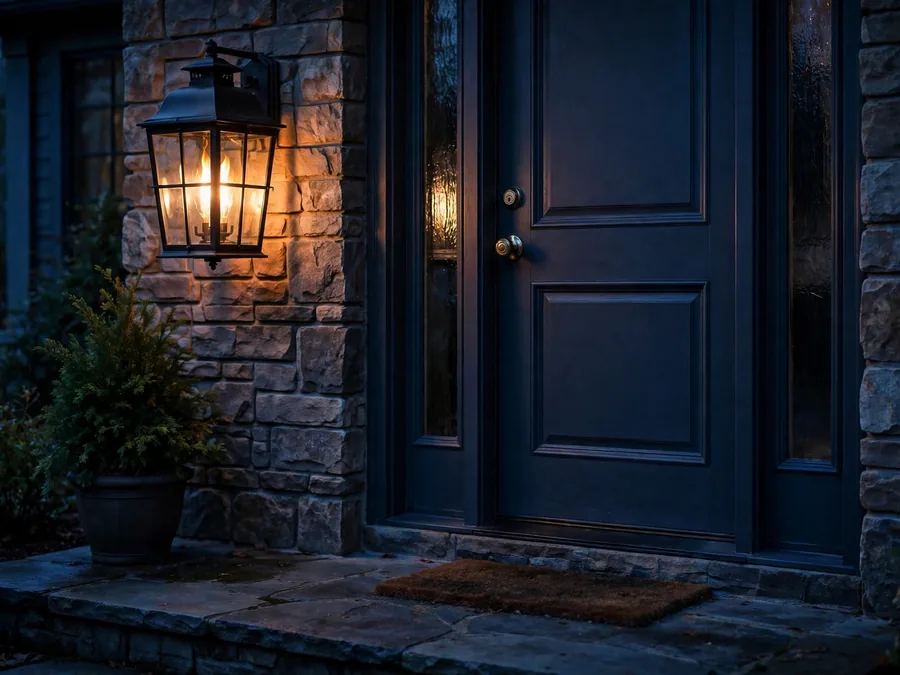
7. A Flame-Effect Bulb in the Porch Light
Change the light, not the fixture. Swap the porch bulb for a flame-effect LED that flickers like a candle inside the existing lantern glass, and the doorway gains candlelight’s warmth with no wiring and no open flame. It sits happily beside the frosted glass in these festive entryway ideas, where warm light does the decorating. One caution: flame bulbs can run dimmer than standard, so on uneven steps keep a brighter bulb in a second socket.
Best for: Glass-panelled porch lanterns on covered porches, where the flicker shows through the glass but the bulb stays dry.
Anyone whose porch light burns every evening gets a new look for one bulb.
8. One Sleigh Bell on a Leather Strap
Sound, in the smallest possible dose. Hang a single brass sleigh bell, about 2 inches across, from the exterior door handle on a short tan leather strap. It rings once, softly, each time the door opens — a greeting guests hear rather than see, and the only decoration on the door itself. One bell is the whole point; a cluster would jangle and cheapen it. Leather darkens with weather, and the bell can mark soft paint, so hang it at the handle’s neck where its swing is short.
Easy swap: In January, hang the bell on an indoor coat hook — the strap then holds a dried-orange slice all winter.
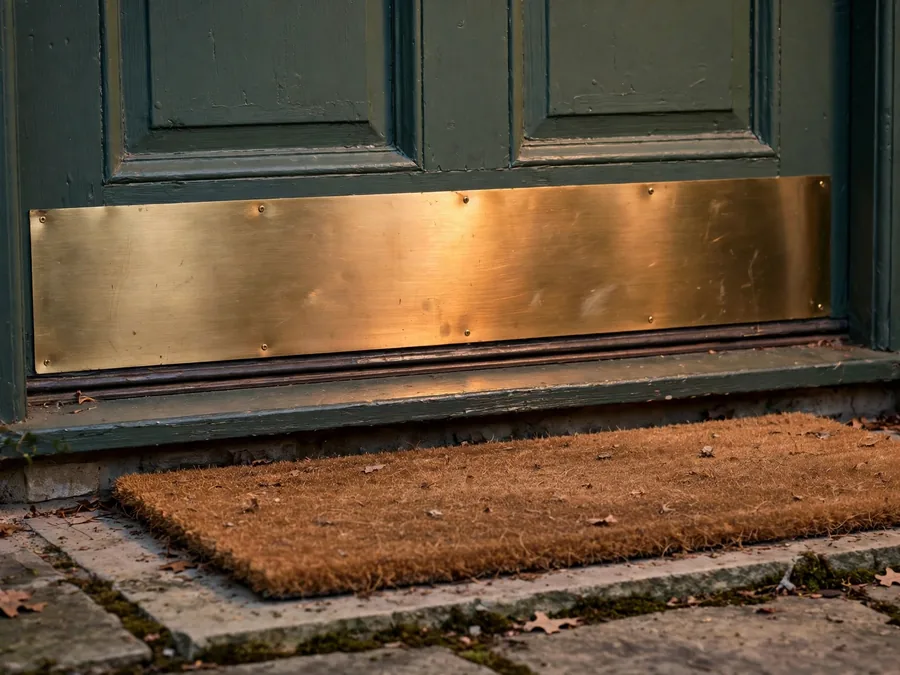
9. A Brushed-Brass Kick Plate and Nothing Else Shiny
Dress the bottom of the door and stop there. Fit a brushed-brass kick plate, 6 inches tall, across the door’s base, kept to a soft sheen, not a mirror shine. It catches porch light in a low band, protects paint from boots and parcels, and gives a plain door a tailored finish. Measure twice: the plate must clear the threshold strip as the door swings, and composite doors need the adhesive-backed kind, not screws. One plate, one metal — that restraint is the look.
The formula: Brushed-brass kick plate + the door’s existing colour left plain + a natural coir mat below it.
Doors that take a beating from boots and deliveries get protection that happens to glow.
| Door Colour | Trim or Frame | Metal to Match | Mat Tone |
|---|---|---|---|
| Deep pine green | Warm cream | Polished brass | Natural coir |
| Classic post-box red | Soft white | Brushed brass | Red-patterned coir |
| Charcoal or black | Pale stone | Antique brass | Plain coir, dark edge |
| Navy | Cream | Brass, lightly aged | Natural coir |
| Natural stained wood | Deep green | Black iron | Woven jute |
10. Cream-Painted Frame Trim Against a Dark Door
If the door’s colour is staying, paint its frame instead. A dark door — black, charcoal, deep red — set inside a freshly painted warm-cream frame looks instantly dressed, because the contrast outlines the doorway like a picture mount. Use exterior satin and mask the door’s edge carefully; the line between frame and door is the whole effect, and a wobbly line ruins it. The cost is a weekend of prep. Renters should pass — but owners of a dark door get a transformation without touching the door.
Color note: Choose a cream with yellow warmth rather than a blue-white; warm cream flatters brass hardware and winter light, while stark white reads as primer.
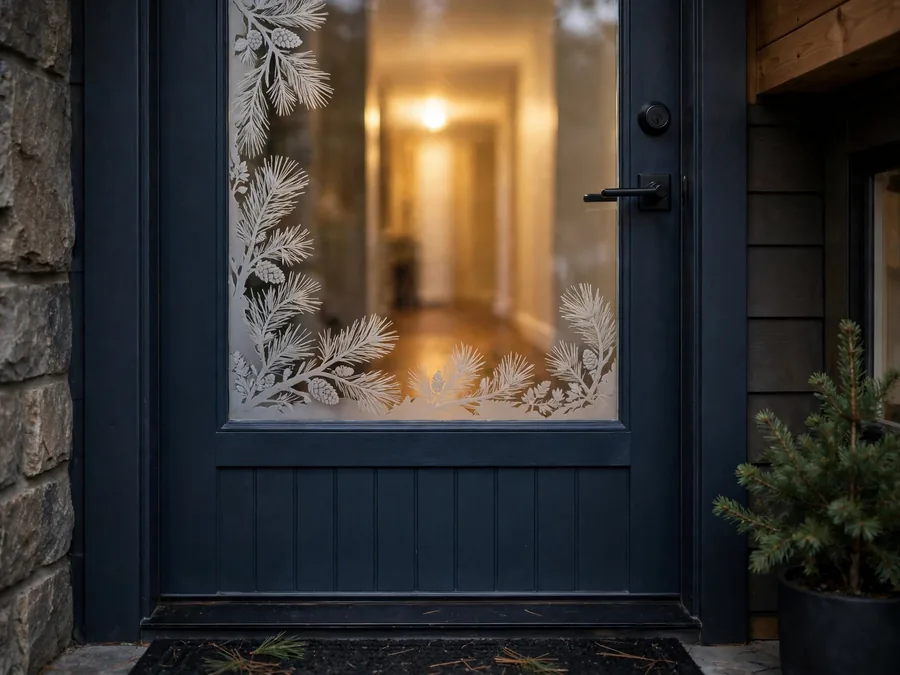
11. A Frosted Pine-Branch Cling on the Door Glass
For doors with a glass lite, dress the glass from inside. Apply a frosted static cling with a pine-branch border — branches along the bottom and one side, centre left clear. It reads as frost, keeps the hallway private, and peels off in January without adhesive. Honest limits: clings dislike steamy glass, so on a condensing door, expect to smooth corners weekly. Check the print from outside at night first — some look grey, not frosty, under porch light.
Seasonal swap: Swap the pine border for a plain frost band in spring, and the door keeps its privacy year-round without the Christmas note.
Glazed doors that leave the hallway on show gain privacy and a festive frame in one sheet.
12. A Stone-Filled Boot Tray Beside the Door
Claim the floor beside the door for the season’s real traffic. Set a galvanized boot tray, roughly 30 by 14 inches, on the porch floor tight against the wall, filled with a layer of smooth river stones. Wet boots drain between the stones instead of puddling, and the tray corrals December’s shoe pile into one tidy, deliberate zone. It is purely practical, which is its charm — but skip it on a narrow stoop where the tray would eat the standing room guests need while the door opens.
Space note: Leave 3 feet of clear floor inside the door’s swing; the tray sits against the wall, never in the door’s arc.
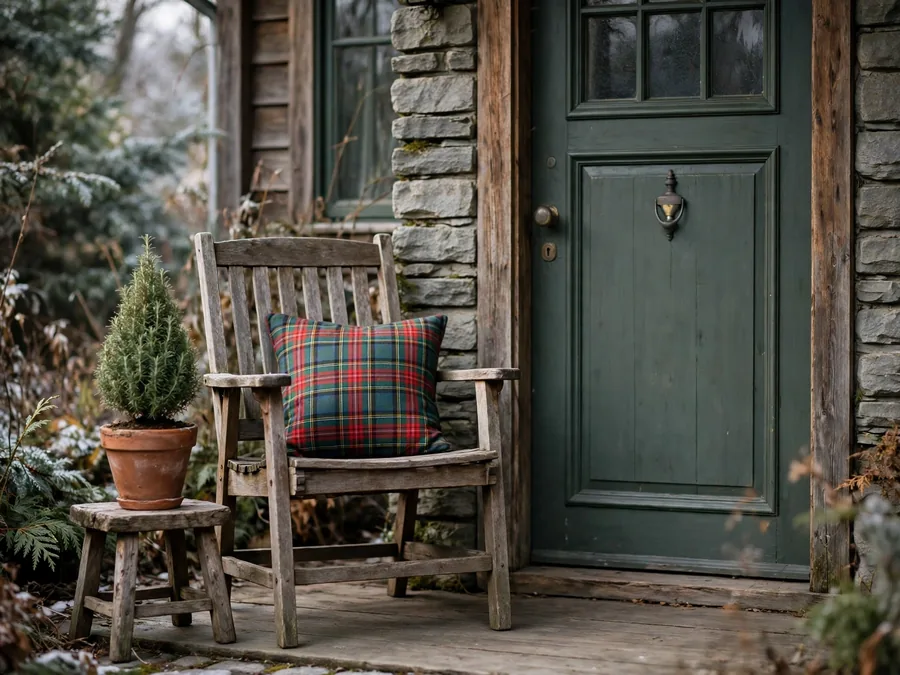
13. One Chair, One Tartan Cushion, One Pot of Rosemary
Give the door a neighbour, not a crowd. Place a single chair beside the door with exactly one cushion in a deep red-and-green tartan, and set a small terracotta pot of rosemary, clipped into a rough cone, on a low stool beside it. Rosemary smells right and survives cold porches well. One dressed chair is a welcome; a whole dressed set feels like a display. Bring the cushion in during heavy rain.
Get the look:
- Main piece: one porch chair, wood or black metal
- Supporting piece: a low wooden stool
- Texture or material: tartan wool-look cushion, rough terracotta
- Finishing touch: a small rosemary cone
Wide porches can hold this corner without feeling staged.
14. A Polished Mail Slot With a Fine Gold Border
The mail slot is the door’s forgotten centrepiece. Polish a brass slot until it shines, then paint one fine gold line — a paint pen and a ruler are all it takes — as a border half an inch out from its edge. The thin line frames the slot the way a mount frames a print, and in porch light the pair glows quietly. Practise the line on card first; a shaky border looks worse than none. On a white door, use a deep red line instead — gold on white nearly vanishes.
Budget note: One metallic paint pen does this border plus gift tags and place cards all season — a small buy with many uses.
15. Paper Luminarias Lining the Front Steps
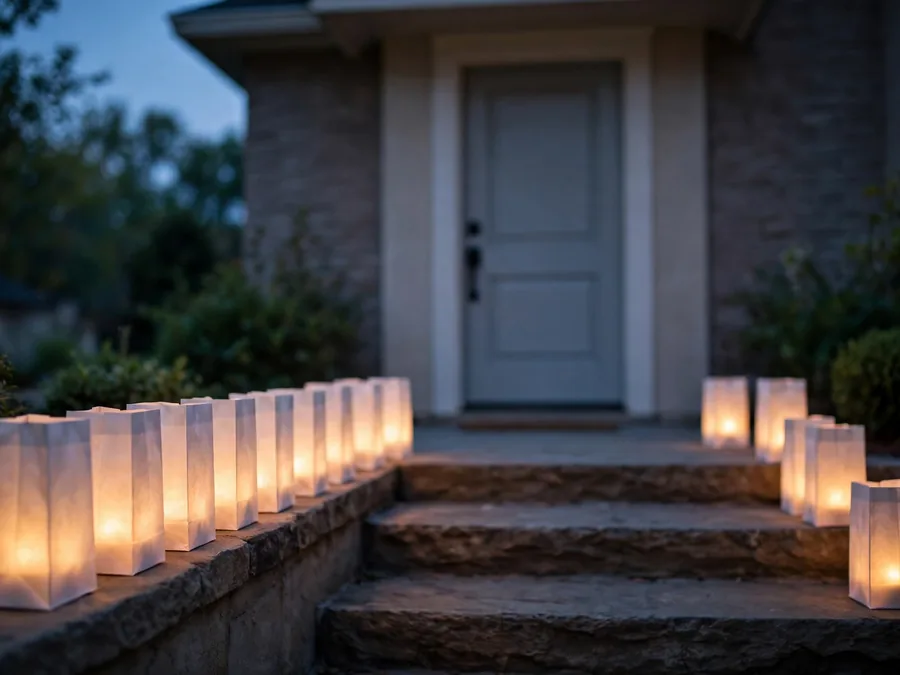
Light the path, not the door. Stand white or kraft paper luminaria bags along the edges of the front steps — one per step, alternating sides — each weighted with sand and lit by a battery tea light. Their low line leads guests in like runway lights and leaves the door plain — the contrast makes both work. Battery lights are non-negotiable near paper, and the bags are fair-weather only: wind and rain retire them.
Fit check: Bags sit on the step’s edge, never its tread — climb them in the dark yourself first, and move any bag your toe finds.
Households expecting evening visitors get the grandest entrance here for the price of paper bags.
| If You Add This | Then Skip This | Why |
|---|---|---|
| A patterned doormat | Any second rug or runner | Two patterns at foot level fight, and layered mats trip guests |
| Tall flanking stems | Anything else tall by the door | One pair of verticals frames the door; a third crowds it |
| A flame-effect bulb | Extra string lights on the door | One warm light source welcomes; two compete and glare |
| A bell on the handle | A hanging door ornament too | The handle can carry one voice, not a choir |
| Painted frame or panels | Hanging decor on the door slab | Fresh paint is the decoration — let it be seen |
16. Two-Tone Panels With Deeper-Painted Moulding
A subtle paint trick for panelled doors: keep the door’s main colour, and paint only the raised moulding around each panel one shade deeper from the same family. A mid-green door gains deep-green panel outlines; a red door gains burgundy ones. The panels suddenly read as crafted joinery rather than flat slab, and visitors sense the richness without spotting why. It is fiddly work with an artist’s brush and masking tape — allow an afternoon. It pairs naturally with these brass Christmas accents, since deep tones make brass look richer.
Style note: Use the same finish in both shades — satin with satin. A gloss moulding on a satin door looks like a repair, not a design.
17. Bottle-Brush Trees on the Transom Ledge
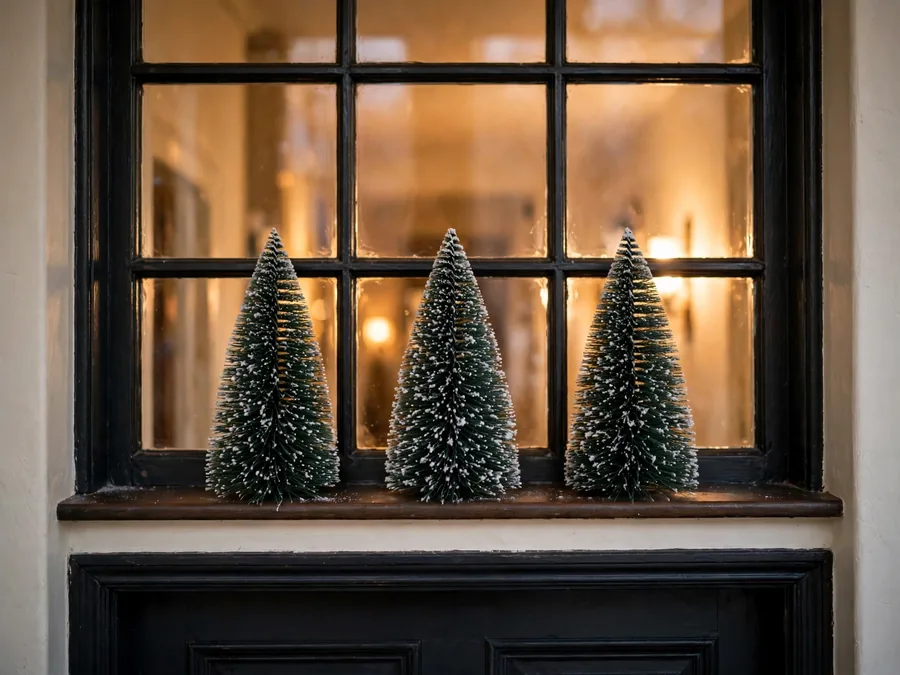
Use the window nobody decorates. If your door has a transom window, line its interior ledge with three bottle-brush trees — 4 to 6 inches tall, deep green with snow-dusted tips — spaced evenly across the glass. Outside, they silhouette against the hall light like a tiny forest. Keep them off the glass so condensation cannot spot them, and skip this with no ledge; trees stuck to glass look like a shop window.
Why it works:
- It dresses the pane every guest sees but nobody thinks to decorate
- They read through glass at night — no wiring, no weatherproofing
- It adds height with nothing hanging on the door
Tall period doorways were made for this row of trees.
18. One Oversized Paper Snowflake Over the Door
Finish with a single point of theatre. Fold and cut one oversized paper snowflake — 18 to 24 inches across, from heavy white or cream paper — and hang it from the porch ceiling on clear fishing line so it floats centred above the door, turning slowly. Alone, it looks like sculpture, not a craft project — scale is what separates the two. Heavy paper matters, because thin paper curls in damp porch air within days. With no porch roof, hang it inside the door glass instead.
Easy swap: Come January, the same line and hook hold a plain paper star in warm cream — the floating point stays, the Christmas note goes.
Let the Door Do the Welcoming
None of these 18 ideas asks the door to carry more than it can hold. Paint, polish, glass and light do the heavy lifting; the festive notes — a sprig, a bell, a row of paper lights — stay small enough to feel like details rather than a display. Choose by what your door already has: glass wants film, brass wants polish, a plain slab wants colour, and a wide porch wants one dressed corner.
Your one next step: stand outside your front door tonight with the porch light on, look only at the door itself, and pick the single surface — slab, glass, hardware or threshold — that looks tiredest. Start there tomorrow with the matching idea from this list, and stop when that one surface shines.